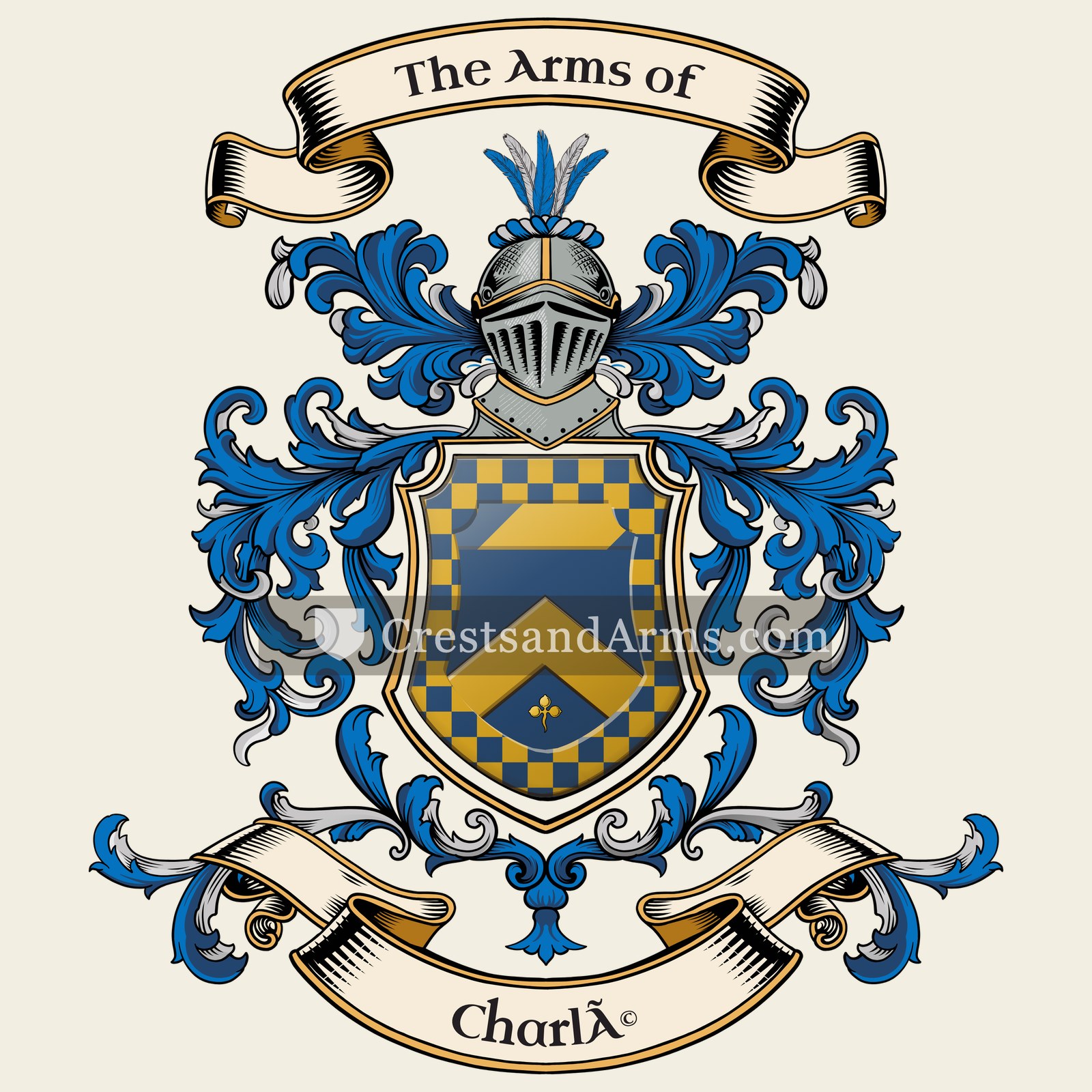
A record of documented arms, meaning and origin, researched for the Charlé family of Belgium.
Reg. 4747 · Belgian, A–C
Coat of Arms & Family Crest Details
Symbols on this shield
chevronProtection, and faithful service completed
chiefAuthority, wisdom and dominion
bendDefence, and the scarf of a commander
trefoilPerpetuity, and the Trinity
Colours
Blue (Azure)Means: Loyalty and truth
Gold (Or)Means: Generosity
Historical info
Source
J. B. Rietstap, Armorial Général, Gouda: G. B. van Goor Zonen, 1884–87
Blazon (the actual original written record)
“D'azur au chev. d'or, acc. en p. d'un trèfle du même; au chef bandé d'or et d'azur de huit pièces. L'écu entouré d'une bord. comp. d'or et d'azur. C.: cinq pl. d'aut., alt. d'azur et d'or.”
HainautHainaut, c. 1848
Digital archive packCoat of arms PNG, gold border print PDF, vector SVG and the certificate of authenticity. Sent to your email in minutes.
Map of Belgium showing where the Charlé arms are recorded
The Charlé arms were recorded in Hainaut, c. 1848.
Hainaut sat on the border between France and the Low Countries and was fought over for centuries. Families there held their land under arms and expected to defend it, so a shield was a working thing.
This is where the arms were entered in the register. Families often moved to other parts of the country, so the same name can turn up in more than one region.
The body that granted and recorded arms in Belgium in this period.
Leopold I of Belgium
Sovereign of the period
Leopold I of Belgium
1831–1865
Reigning in Belgium when the Charlé arms are first recorded.
How Arms Worked in Belgium
In Belgium, a coat of arms is considered personal property that is passed down through the male line to legitimate descendants. Families often use the same shield design across generations to show their shared heritage. If a branch of the family wants to change the design, they must apply for an official update to their specific version of the arms.
Granting authority
The Conseil héraldique is the official body that regulates and approves all coats of arms in Belgium.
How they got arms
Families obtain their coats of arms through formal royal grants or by confirming their historical right to use existing designs.
Where arms were recorded
All approved coats of arms are officially recorded in the public registers of the Conseil héraldique since 1844.
The family's standing
Recorded among the armigerous families of Hainaut.
Origin & History of the Charlé Family in Belgium
The family name Charlé finds its historical roots in the region of Hainaut, a province that straddles the border between modern-day Belgium and France. By the year 1848, records confirm that members of the family were well-established within this area, which was then a bustling center of industrial growth and agricultural change. The name itself likely evolved as a variation of the name Charles, which was a popular given name throughout Western Europe during the Middle Ages. As surnames became more permanent to help officials track tax payments and military service, families often adopted the names of respected ancestors or local figures. Living in Hainaut during the mid-nineteenth century, the Charlé family would have experienced a period of significant social transition as the region became a key player in the early European coal and steel industries. This environment suggests that the family was part of the hardworking population that helped shape the local economy during a time of great political upheaval across the continent.
Charlé Meaning & Related Branches
Root word
Karl
A Germanic word meaning free man or man.
This name
CharléDerived from the Germanic name Charles, signifying a free man or person of status.
also spelled
Charley
Sharlay
Documented Sources
J. B. Rietstap, Armorial Général, Gouda: G. B. van Goor Zonen, 1884–87
Archives de l'État à Mons, État civil de la province de Hainaut
Chantal, D., Histoire du Hainaut, 1985
Duvivier, C., Recherches sur le Hainaut, 1890
Digital archive packCoat of arms PNG, gold border print PDF, vector SVG and the certificate of authenticity. Sent to your email in minutes.


 chevronProtection, and faithful service completed
 chiefAuthority, wisdom and dominion
 bendDefence, and the scarf of a commander
 trefoilPerpetuity, and the Trinity
 chevronProtection, and faithful service completed
 chiefAuthority, wisdom and dominion
 bendDefence, and the scarf of a commander
 trefoilPerpetuity, and the Trinity