A record of documented arms, meaning and origin, researched for the Charles family lines. Documented in 3 countries.
Reg. 5118 · French, A–C
Coat of Arms & Family Crest Details
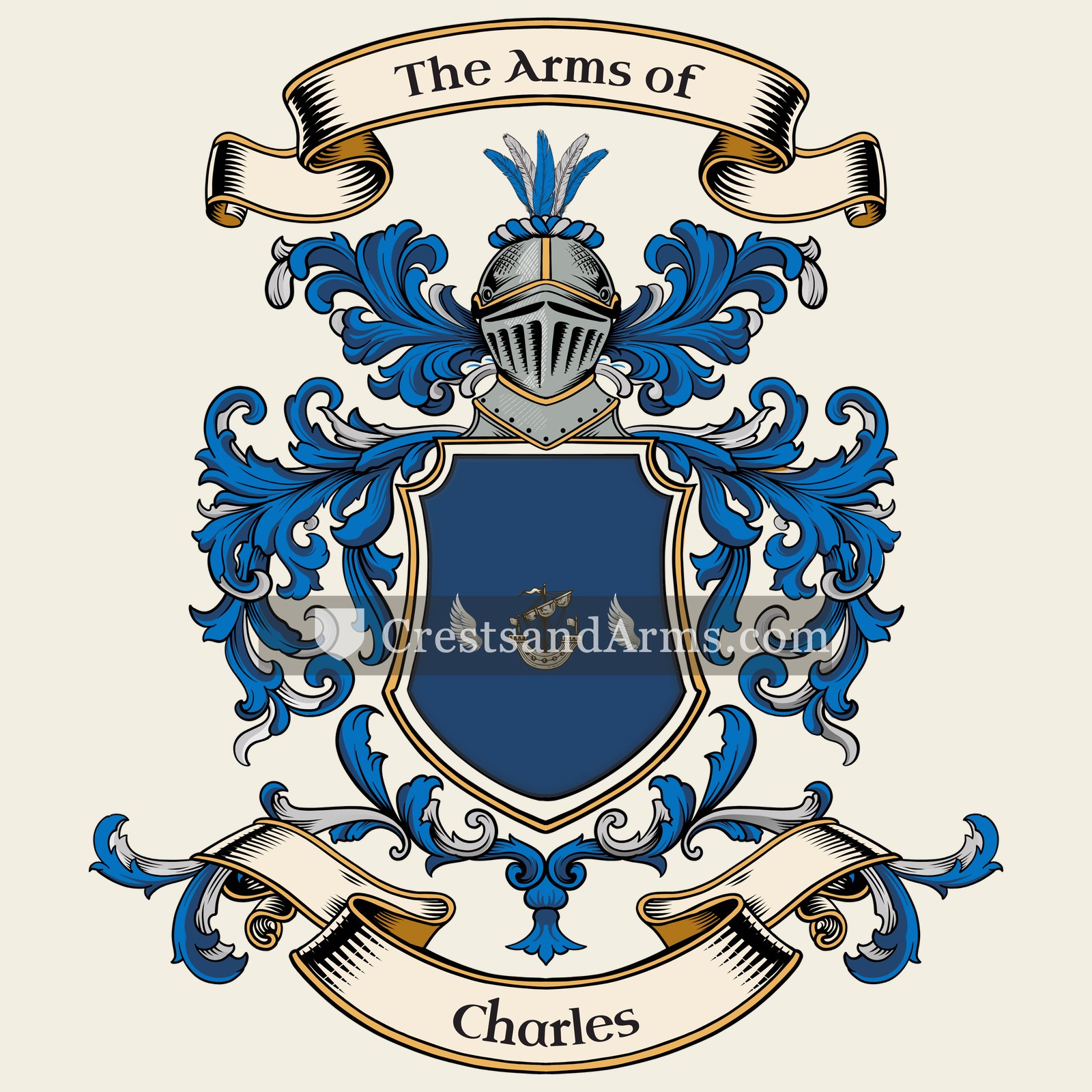
Symbols on this shield
shipEnterprise, and a great voyage undertaken
wingSwiftness, and protection under a raised wing
Colours
Blue (Azure)Means: Loyalty and truth
Silver (Argent)Means: Peace and sincerity
Historical info
Source
J. B. Rietstap, Armorial Général, Gouda: G. B. van Goor Zonen, 1884–87
Blazon (the actual original written record)
“D'azur à un bâteau d'arg., le mât baissé, surm. d'un croiss. d'or entre deux ailes fascées d'arg. et d'azur. C.: le croiss. entre les ailes de l'écu.”
LorraineLorraine, c. 1654
Digital archive packCoat of arms PNG, gold border print PDF, vector SVG and the certificate of authenticity. Sent to your email in minutes.
Map of France showing where the Charles arms are recorded
The Charles arms were recorded in Lorraine, c. 1654.
Lorraine sat on the border between France and the German lands, and border country bred soldiers. Families here held small estates and served in arms, and a fighting man was exactly the sort who carried a shield of his own.
This is where the arms were entered in the register. Families often moved to other parts of the country, so the same name can turn up in more than one region.
The body that granted and recorded arms in France in this period.
Louis XIV of France
Sovereign of the period
Louis XIV of France
1643–1715
Reigning in France when the Charles arms are first recorded.
How Arms Worked in France
In France, a coat of arms was a mark of honor that passed down through the male line to all legitimate descendants. Families often used the same shield without changes to show their shared heritage. If a branch wanted to stand out, they could add a small mark to their shield to show their specific place in the family tree.
Granting authority
The Juge d'armes de France acted as the official authority that regulated and verified coats of arms across the country.
How they got arms
Families typically inherited their arms from ancestors, though they could also receive them through royal grants or by proving their noble status.
Where arms were recorded
Coats of arms were officially recorded in the Armorial Général de France, which began its main collection in the year 1696.
The family's standing
Recorded among the armigerous families of Lorraine.
Origin & History of the Charles Family in France
The name Charles originates from the ancient Germanic word *karl*, which translates to a free man. In France, the name gained immense prestige due to the influence of Charlemagne, the famous medieval emperor who unified much of Western Europe. By the middle of the seventeenth century, the family was well-established in the Lorraine region, a territory known for its complex history at the crossroads of French and German cultures. Records from 1654 confirm that members of the family were living in this area during a time of significant transition as the region became increasingly integrated into the French kingdom. Because Lorraine served as a vital buffer zone between powerful empires, families living there often navigated unique political landscapes that shaped their local identity and social standing. The presence of the family in this specific province highlights their long-standing roots in a region that played a central role in the development of the French state.
Coat of Arms & Family Crest Details
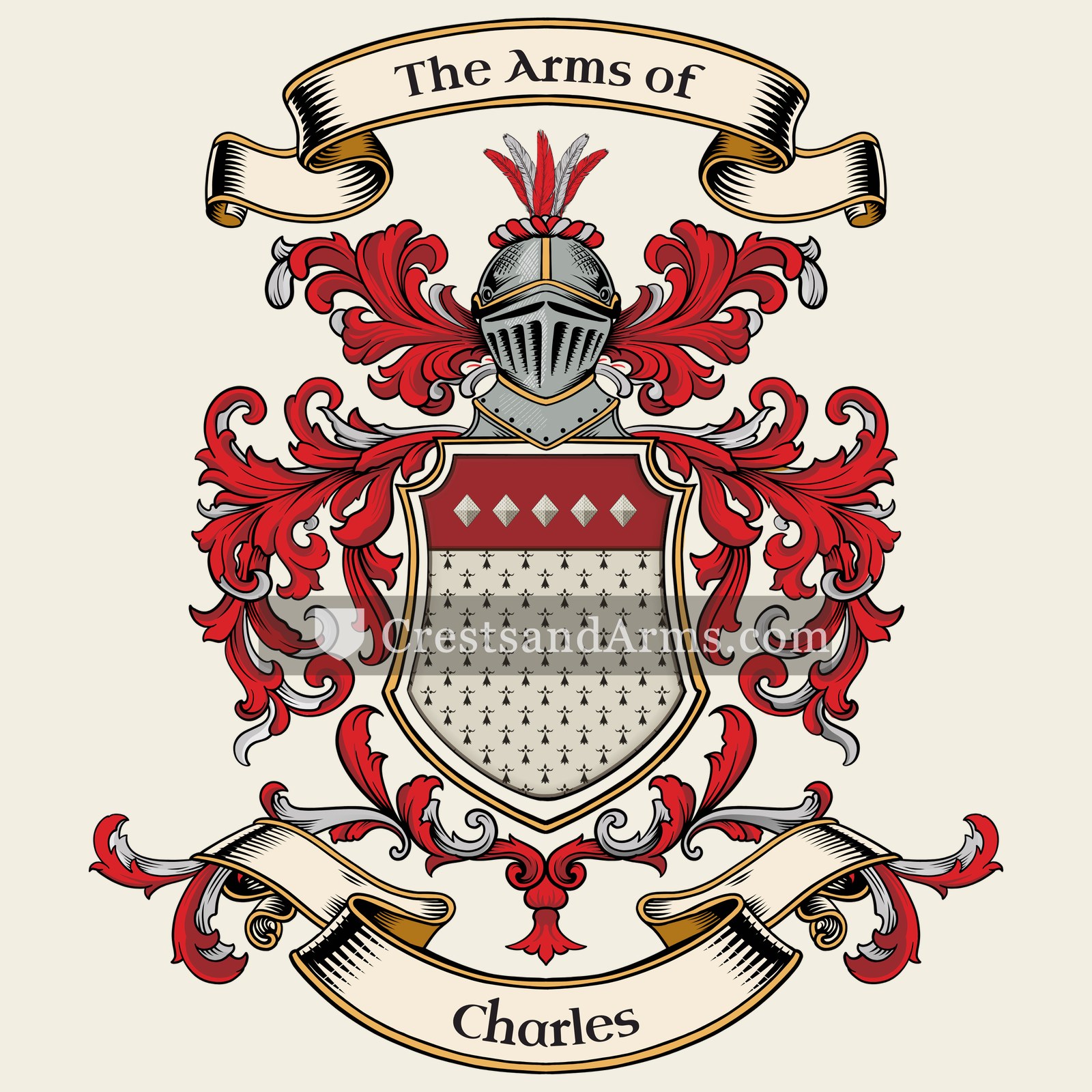
Symbols on this shield
chiefAuthority, wisdom and dominion
lozengeHonour and nobility, and the arms of a woman
Colours
ErmineMeans: Dignity
Red (Gules)Means: Military strength
Historical info
Source
Sir Bernard Burke, The General Armory of England, Scotland, Ireland and Wales, London: Harrison & Sons, 1884
Blazon (the actual original written record)
“Erm. on a chief gu. five lozenges in fesse of the field”
WarwickStratford · Warwick, c. 1620
Digital archive packCoat of arms PNG, gold border print PDF, vector SVG and the certificate of authenticity. Sent to your email in minutes.
Map of England showing where the Charles arms are recorded
The Charles arms were recorded in Warwick, c. 1620.
Warwickshire lay in the middle of England, and its landed families were spread evenly across it rather than gathered in one corner. A great many held a single manor each, and each of those holdings brought its own claim to arms.
This is where the arms were entered in the register. Families often moved to other parts of the country, so the same name can turn up in more than one region.
The body that granted and recorded arms in England in this period.
James VI and I
Sovereign of the period
James VI and I
1603–1625
Reigning in France when the Charles arms are first recorded.
How Arms Worked in England
English heraldry allowed arms to be shared by all legitimate descendants of the original owner. These symbols were treated as personal property that moved through the generations to all children. While the eldest son kept the original design, other family members could use the same shield without needing to change it or register their own unique versions.
Granting authority
The College of Arms in London has regulated the use of coats of arms throughout England and Wales since 1484.
How they got arms
Families typically obtained their coats of arms through a formal grant from the Crown or by proving their ancient right to them.
Where arms were recorded
All official coats of arms are recorded in the registers kept at the College of Arms, which date back to the fifteenth century.
The family's standing
Recorded among the armigerous families of Warwick.
Origin & History of the Charles Family in England
The name Charles originated as a given name derived from the Germanic word *karl*, which translates to a free man. In England, the name gained significant popularity following the Norman Conquest, as it was associated with Charlemagne and the royal traditions of the continent. By the time the family was established in Warwick in 1620, the name had transitioned from a personal identifier to a hereditary surname used to distinguish specific lineages within the local community. During this period, families in Warwickshire were often deeply connected to the agricultural and mercantile life of the English Midlands. The presence of the Charles family in Warwick during the early seventeenth century suggests they were part of a stable, settled population that witnessed the significant social and political shifts occurring just before the English Civil War. As the name became fixed as a surname, it helped define the family's place within the parish records and legal documents that governed life in a growing English market town.
Coat of Arms & Family Crest Details
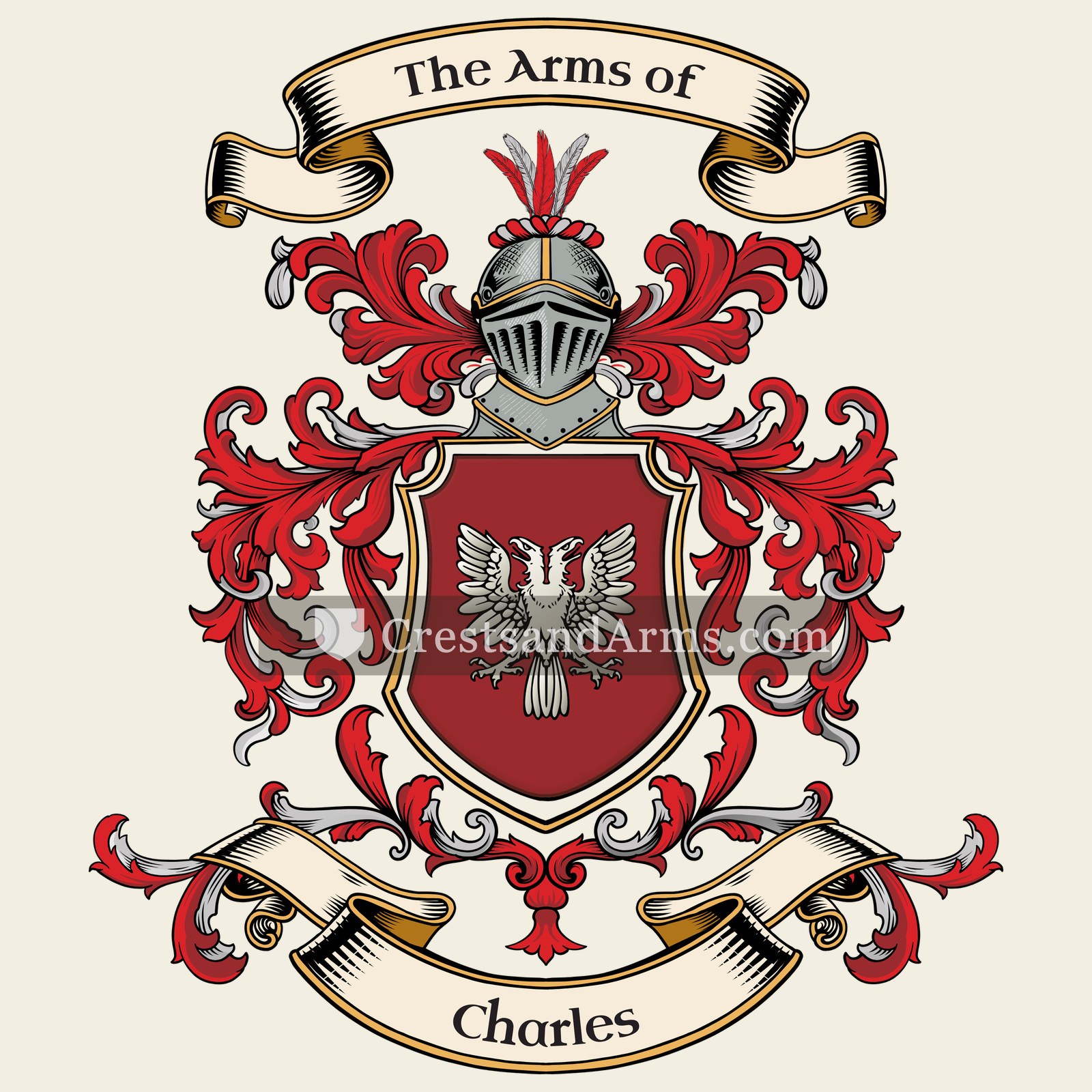
Symbols on this shield
eagleNobility, strength and a keen mind
Colours
Red (Gules)Means: Military strength
ErmineMeans: Dignity
Silver (Argent)Means: Peace and sincerity
Historical info
Source
Sir Bernard Burke, The General Armory of England, Scotland, Ireland and Wales, London: Harrison & Sons, 1884
Blazon (the actual original written record)
“Per fesse wavy gu. and erm. in chief an eagle displ. ar”
Irelandc. 1645
Digital archive packCoat of arms PNG, gold border print PDF, vector SVG and the certificate of authenticity. Sent to your email in minutes.
Map of Ireland showing where the Charles arms are recorded
The Charles arms were recorded in Ireland, c. 1645.
Arms such as these were typically recorded in Dublin.
Dublin was the seat of government in Ireland and the place where grants were sought and recorded. Families with business at the castle or the courts settled nearby, and settling there put their arms on record.
This is where the arms were entered in the register. Families often moved to other parts of the country, so the same name can turn up in more than one region.
The body that granted and recorded arms in Ireland in this period.
Charles I of England
Sovereign of the period
Charles I of England
1625–1649
Reigning in France when the Charles arms are first recorded.
How Arms Worked in Ireland
The Ulster King of Arms granted coats of arms to individuals who proved their social standing and good character. These symbols were typically inherited by all legitimate descendants of the original holder. If a family branch wanted a unique look, they could apply for a specific change to their design through the office to ensure their identity remained distinct.
Granting authority
The Ulster King of Arms acted as the official body that regulated and issued all coats of arms throughout Ireland.
How they got arms
Families obtained their arms through formal grants issued by the office after proving their eligibility and paying the required fees.
Where arms were recorded
All official grants were recorded in the registers held by the Ulster King of Arms starting from the year 1552.
The family's standing
Recorded among the armigerous families of Ireland.
Origin & History of the Charles Family in Ireland
The name Charles has a long history in Ireland, particularly within the urban environment of Dublin. By 1645, records indicate that members of the Charles family were already established residents in the city. During this period, Dublin was a bustling center of trade and political change, and families like the Charles line often integrated into the merchant and professional classes. The name itself originates from the Germanic word *karl*, which means a free man. Over time, it transitioned from a personal name into a hereditary surname as families sought to distinguish themselves in growing colonial and administrative records. While the name was often associated with English or continental influence, its presence in seventeenth-century Dublin shows how it became part of the diverse social fabric of the Irish capital during a time of significant historical upheaval.
Charles Meaning & Related Branches
Root word
Karl
A Germanic word meaning free man or husbandman.
This name
CharlesDerived from the Germanic term for a free man, signifying nobility and strength.
also spelled
Charlles
Charle
Sharl
Charlys
Related arms
Stipplinsimilar arms
Carlesvariant spelling
Charlévariant spelling
Charlezvariant spelling
Documented Sources
J. B. Rietstap, Armorial Général, Gouda: G. B. van Goor Zonen, 1884–87
Dauzat, Albert, Dictionnaire étymologique des noms et prénoms de France, 1951
Lepage, Henri, Les communes de la Meurthe: journal historique des villes, bourgs, villages, hameaux et censes de ce département, 1853
Archives départementales de Meurthe-et-Moselle, Registres paroissiaux et d'état civil de la province de Lorraine
Digital archive packCoat of arms PNG, gold border print PDF, vector SVG and the certificate of authenticity. Sent to your email in minutes.


 shipEnterprise, and a great voyage undertaken
 wingSwiftness, and protection under a raised wing
 shipEnterprise, and a great voyage undertaken
 wingSwiftness, and protection under a raised wing


 chiefAuthority, wisdom and dominion
 lozengeHonour and nobility, and the arms of a woman


 eagleNobility, strength and a keen mind