Map of Belgium showing where the Charlet arms are recorded
The Charlet arms were recorded in Luxemb, c. 1545.
This is where the arms were entered in the register. Families often moved to other parts of the country, so the same name can turn up in more than one region.
The body that granted and recorded arms in Belgium in this period.
Charles V
Sovereign of the period
Charles V
1519–1556
Reigning in Belgium when the Charlet arms are first recorded.
How Arms Worked in Belgium
In Belgium, a coat of arms is considered personal property that is passed down through the male line to legitimate descendants. Families often use the same shield design across generations to show their shared heritage. If a branch of the family wants to change the design, they must apply for an official update to their specific version of the arms.
Granting authority
The Conseil héraldique is the official body that regulates and approves all coats of arms in Belgium.
How they got arms
Families obtain their coats of arms through formal royal grants or by confirming their historical right to use existing designs.
Where arms were recorded
All approved coats of arms are officially recorded in the public registers of the Conseil héraldique since 1844.
The family's standing
Recorded among the armigerous families of Belgium.
Origin & History of the Charlet Family in Belgium
The surname Charlet has deep roots in the historical regions that now form modern Belgium and Luxembourg. The name is a diminutive form of the name Charles, which suggests that early ancestors were likely known as the son or the little version of someone named Charles. By the year 1545, records confirm that members of the Charlet family were established in the Luxembourg area, which was then part of the Seventeen Provinces under the rule of the Habsburg Empire. During this period, the family likely lived as part of the local agrarian or artisan classes, as surnames were becoming more permanent to help tax collectors and church officials keep track of the growing population. As the family moved across the borders of what is now Belgium and Luxembourg, they adapted to the local dialects and administrative systems of the Low Countries. Their presence in these lands during the sixteenth century places them in the middle of a time of great religious and political change, which influenced how families settled and recorded their identities for future generations.
Coat of Arms & Family Crest Details
Symbols on this shield
bendDefence, and the scarf of a commander
knightChivalry and service in arms
Colours
Red (Gules)Means: Military strength
Gold (Or)Means: Generosity
Historical info
Source
J. B. Rietstap, Armorial Général, Gouda: G. B. van Goor Zonen, 1884–87
Blazon (the actual original written record)
“Parti: au 1 de gu. à deux bandes d'or; au 2 de gu. à un sauvage d'or, tenant de sa main dextre une massue sur son épaule et de sa sen. une merle. C.: le sauvage de l'écu.”
Francec. 1608
Digital archive packCoat of arms PNG, gold border print PDF, vector SVG and the certificate of authenticity. Sent to your email in minutes.
Map of France showing where the Charlet arms are recorded
The Charlet arms were recorded in France, c. 1608.
Arms such as these were typically recorded in Bretagne.
More families held coats of arms in Bretagne than anywhere else in France. The land was divided into many small estates rather than a few large ones, so far more households counted as gentry, and each needed a shield of its own to be told apart.
This is where the arms were entered in the register. Families often moved to other parts of the country, so the same name can turn up in more than one region.
The body that granted and recorded arms in France in this period.
Henry IV of France
Sovereign of the period
Henry IV of France
1589–1610
Reigning in Belgium when the Charlet arms are first recorded.
How Arms Worked in France
In France, a coat of arms was a mark of honor that passed down through the male line to all legitimate descendants. Families often used the same shield without changes to show their shared heritage. If a branch wanted to stand out, they could add a small mark to their shield to show their specific place in the family tree.
Granting authority
The Juge d'armes de France acted as the official authority that regulated and verified coats of arms across the country.
How they got arms
Families typically inherited their arms from ancestors, though they could also receive them through royal grants or by proving their noble status.
Where arms were recorded
Coats of arms were officially recorded in the Armorial Général de France, which began its main collection in the year 1696.
The family's standing
Recorded among the armigerous families of France.
Origin & History of the Charlet Family in France
The surname Charlet finds its roots in the medieval French practice of using nicknames derived from personal names. It is a diminutive form of the name Charles, which was highly popular in France due to the legacy of Charlemagne. By the time the name appears in the historical record of Bretagne in 1608, it had already established itself as a common way to identify individuals within a community. Families bearing this name were often part of the rural or merchant classes who lived through the transition from the Renaissance to the early modern period. In the context of Bretagne, the name reflects the regional naming customs of the era, where local parish registers began to solidify family identities. These early ancestors were likely farmers or tradespeople who contributed to the local economy and social structure of their parishes long before the name spread across other parts of France.
Coat of Arms & Family Crest Details
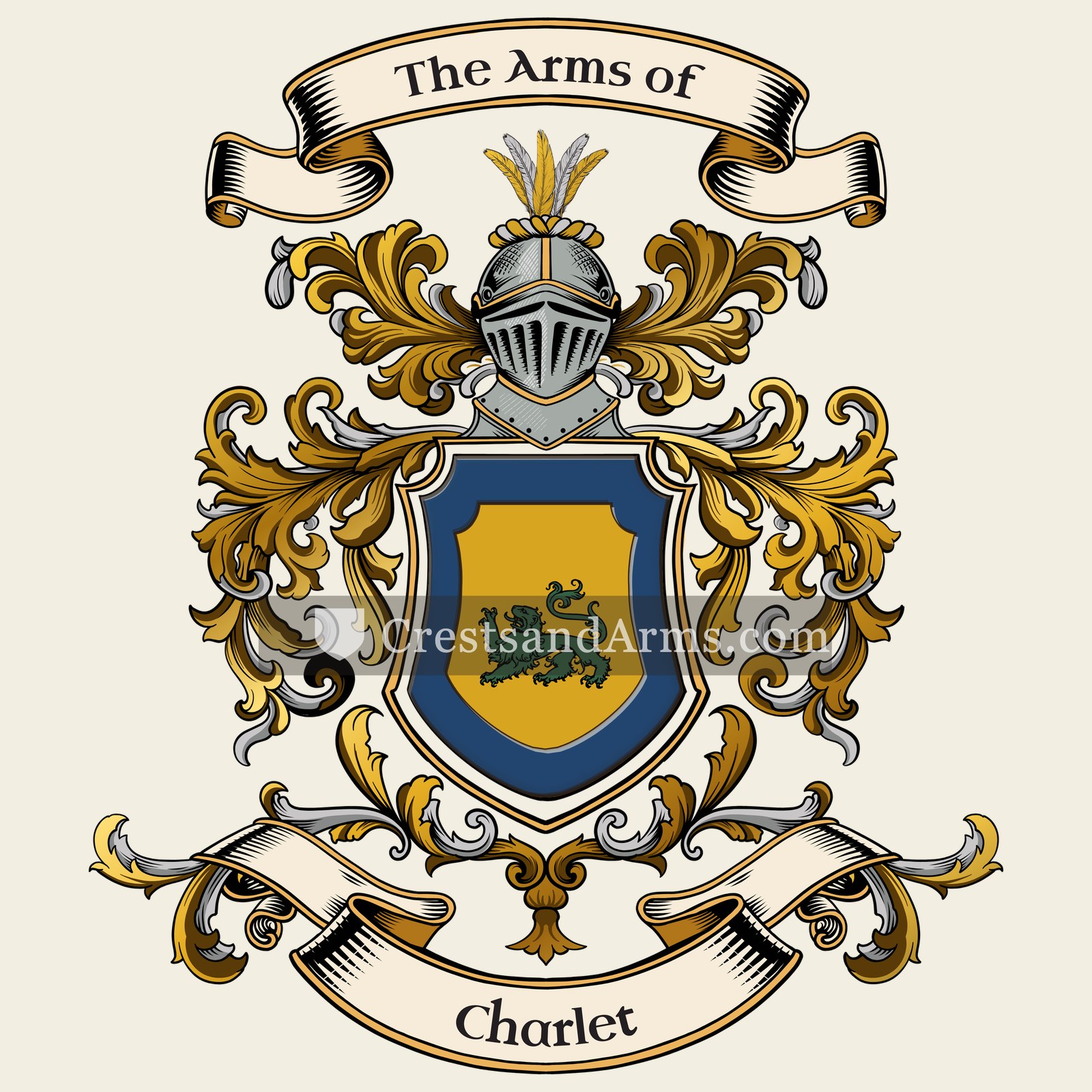
Symbols on this shield
bordureA difference between branches of one family
lionCourage, strength and royalty
Colours
Gold (Or)Means: Generosity
Blue (Azure)Means: Loyalty and truth
Green (Vert)Means: Hope
Historical info
Source
Sir Bernard Burke, The General Armory of England, Scotland, Ireland and Wales, London: Harrison & Sons, 1884
Blazon (the actual original written record)
“Or, a lion ramp. vert within a bordure engr. az”
WorcesterHill · Worcester, c. 1620
Digital archive packCoat of arms PNG, gold border print PDF, vector SVG and the certificate of authenticity. Sent to your email in minutes.
Map of England showing where the Charlet arms are recorded
The Charlet arms were recorded in Worcester, c. 1620.
Worcestershire was orchard and farming country with a scattering of old manors. Its gentry were middling rather than great, but a manor was a manor, and holding one was what brought arms.
This is where the arms were entered in the register. Families often moved to other parts of the country, so the same name can turn up in more than one region.
The body that granted and recorded arms in England in this period.
James VI and I
Sovereign of the period
James VI and I
1603–1625
Reigning in Belgium when the Charlet arms are first recorded.
How Arms Worked in England
English heraldry allowed arms to be shared by all legitimate descendants of the original owner. These symbols were treated as personal property that moved through the generations to all children. While the eldest son kept the original design, other family members could use the same shield without needing to change it or register their own unique versions.
Granting authority
The College of Arms in London has regulated the use of coats of arms throughout England and Wales since 1484.
How they got arms
Families typically obtained their coats of arms through a formal grant from the Crown or by proving their ancient right to them.
Where arms were recorded
All official coats of arms are recorded in the registers kept at the College of Arms, which date back to the fifteenth century.
The family's standing
Recorded among the armigerous families of Worcester.
Origin & History of the Charlet Family in England
The family name Charlet has roots that reach back into the social fabric of seventeenth-century England, with documented evidence placing members of the family in the city of Worcester by 1620. During this period, Worcester was a bustling center of trade and religious activity, and families like the Charlets were often integrated into the local professional or merchant classes. The name itself is likely a diminutive form of Charles, reflecting a common naming tradition where a suffix was added to a given name to create a distinct surname. As the family established their presence in the West Midlands, they became part of the local community records that tracked births, marriages, and property ownership. By settling in a significant cathedral city, the early Charlets were positioned within a network of regional commerce and civic life that defined the era. Their presence in the historical record of Worcester provides a clear glimpse into how a family name evolved and took root in the English landscape during the early modern period.
Charlet Meaning & Related Branches
Root word
Charles
Derived from the Germanic word karl meaning free man.
This name
CharletA diminutive form referring to a descendant or follower of a free man.
also spelled
Charlett
Sharlay
Charlety
Related arms
Lowerecorded with Charlet, same area
Palmerrecorded with Charlet, same area
Documented Sources
J. B. Rietstap, Armorial Général, Gouda: G. B. van Goor Zonen, 1884–87
Fruin, Robert, Geschiedenis der staatsinstellingen in Nederland tot den val der republiek, 1901
State Archives in Belgium, Parish Registers of the Southern Netherlands, 1500–1795
Luxembourg National Archives, État civil et registres paroissiaux, 1545–1800
Digital archive packCoat of arms PNG, gold border print PDF, vector SVG and the certificate of authenticity. Sent to your email in minutes.


 chiefAuthority, wisdom and dominion
 starThe celestial goddess, and nobility
 eagleNobility, strength and a keen mind
 chiefAuthority, wisdom and dominion
 starThe celestial goddess, and nobility
 eagleNobility, strength and a keen mind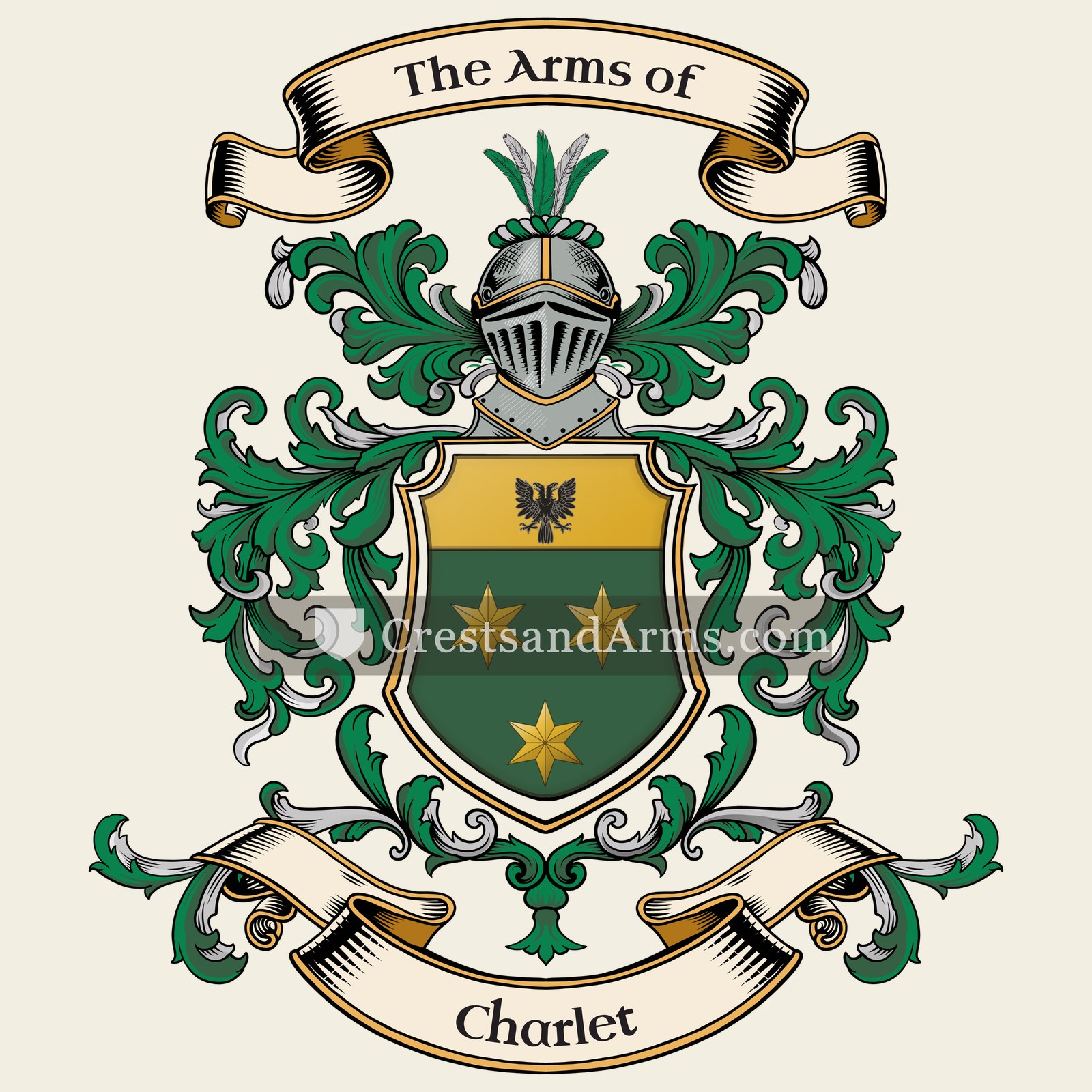


 bendDefence, and the scarf of a commander
 knightChivalry and service in arms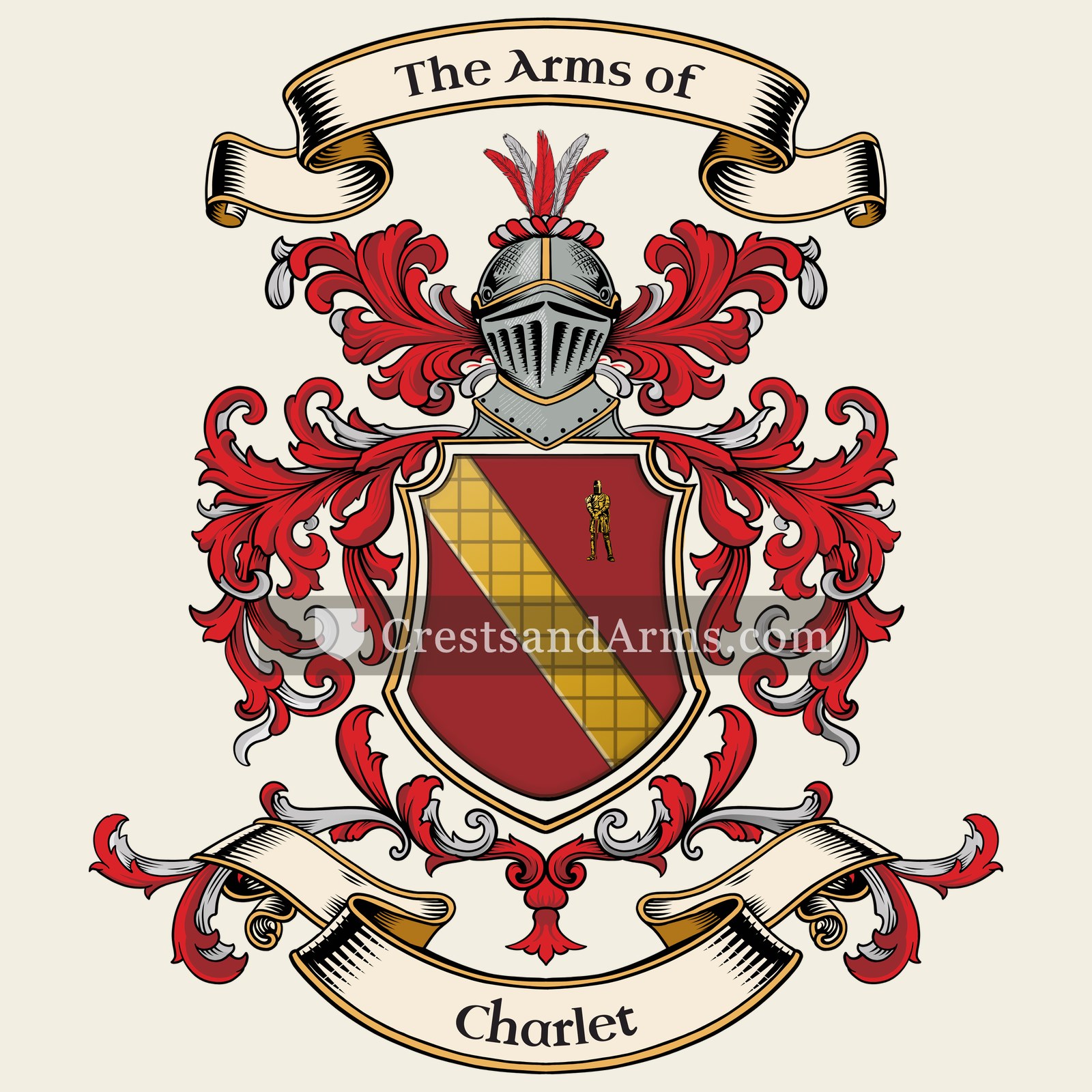


 bordureA difference between branches of one family
 lionCourage, strength and royalty