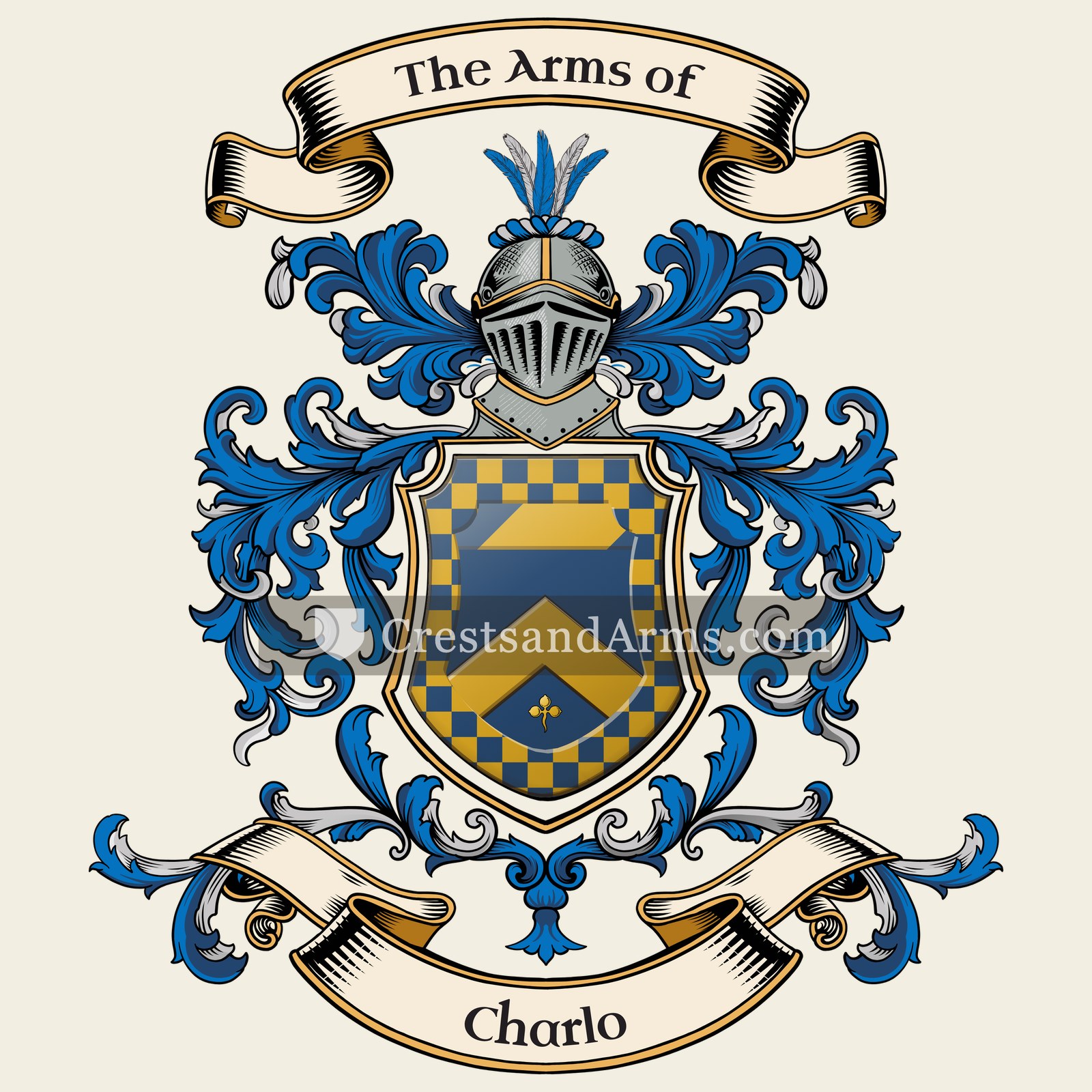
A record of documented arms, meaning and origin, researched for the Charlo family of Belgium.
Reg. 4676 · Belgian, A–C
Coat of Arms & Family Crest Details
Symbols on this shield
chevronProtection, and faithful service completed
chiefAuthority, wisdom and dominion
bendDefence, and the scarf of a commander
trefoilPerpetuity, and the Trinity
Colours
Blue (Azure)Means: Loyalty and truth
Gold (Or)Means: Generosity
Historical info
Source
J. B. Rietstap, Armorial Général, Gouda: G. B. van Goor Zonen, 1884–87
Blazon (the actual original written record)
“D'azur au chev. d'or, acc. en p. d'un trèfle du même; au chef bandé d'or et d'azur de huit pièces. L'écu entouré d'une bord. comp. d'or et d'azur. C.: cinq pl. d'aut., alt. d'azur et d'or.”
HainautHainaut, c. 1848
Digital archive packCoat of arms PNG, gold border print PDF, vector SVG and the certificate of authenticity. Sent to your email in minutes.
Map of Belgium showing where the Charlo arms are recorded
The Charlo arms were recorded in Hainaut, c. 1848.
Hainaut sat on the border between France and the Low Countries and was fought over for centuries. Families there held their land under arms and expected to defend it, so a shield was a working thing.
This is where the arms were entered in the register. Families often moved to other parts of the country, so the same name can turn up in more than one region.
The body that granted and recorded arms in Belgium in this period.
Leopold I of Belgium
Sovereign of the period
Leopold I of Belgium
1831–1865
Reigning in Belgium when the Charlo arms are first recorded.
How Arms Worked in Belgium
In Belgium, a coat of arms is considered personal property that is passed down through the male line to legitimate descendants. Families often use the same shield design across generations to show their shared heritage. If a branch of the family wants to change the design, they must apply for an official update to their specific version of the arms.
Granting authority
The Conseil héraldique is the official body that regulates and approves all coats of arms in Belgium.
How they got arms
Families obtain their coats of arms through formal royal grants or by confirming their historical right to use existing designs.
Where arms were recorded
All approved coats of arms are officially recorded in the public registers of the Conseil héraldique since 1844.
The family's standing
Recorded among the armigerous families of Hainaut.
Origin & History of the Charlo Family in Belgium
The family name Charlo has deep roots in the region of Hainaut, a historic area that spans parts of modern-day Belgium and France. By the mid-nineteenth century, families bearing this name were well-established within the local social fabric of this province. During the year 1848, which was a time of significant political upheaval and social change across Europe, the Charlo family was already integrated into the agricultural and industrial life of the region. The name likely evolved as a variation of the common medieval name Charles, which was popular throughout the Frankish territories. As the family grew, they became part of the local population that helped shape the identity of Hainaut during its transition into the modern industrial era. Their presence in official records from this period suggests a stable lineage that was deeply connected to the local customs and the evolving landscape of Western Europe.
Related Branches & Arms
Root word
Karl
A Germanic word meaning free man.
This name
CharloA diminutive form representing a free man or a person of noble character.
also spelled
Charley
Sharlay
Documented Sources
J. B. Rietstap, Armorial Général, Gouda: G. B. van Goor Zonen, 1884–87
Archives de l'État à Mons, État civil de la province de Hainaut (1796-1900)
Dauzat, Albert, Dictionnaire étymologique des noms de famille et prénoms de France, 1951
Piérard, Christiane, Histoire de la province de Hainaut, 1970
Digital archive packCoat of arms PNG, gold border print PDF, vector SVG and the certificate of authenticity. Sent to your email in minutes.


 chevronProtection, and faithful service completed
 chiefAuthority, wisdom and dominion
 bendDefence, and the scarf of a commander
 trefoilPerpetuity, and the Trinity
 chevronProtection, and faithful service completed
 chiefAuthority, wisdom and dominion
 bendDefence, and the scarf of a commander
 trefoilPerpetuity, and the Trinity