Map of France showing where the Charon arms are recorded
The Charon arms were recorded in Limousin, c. 1663.
Limousin was upland farming country in central France, poor in money but full of old families. Estates were small and held for a very long time, and long tenure counted for more than wealth when arms were recorded.
This is where the arms were entered in the register. Families often moved to other parts of the country, so the same name can turn up in more than one region.
The body that granted and recorded arms in France in this period.
Louis XIV of France
Sovereign of the period
Louis XIV of France
1643–1715
Reigning in France when the Charon arms are first recorded.
How Arms Worked in France
In France, a coat of arms was a mark of honor that passed down through the male line to all legitimate descendants. Families often used the same shield without changes to show their shared heritage. If a branch wanted to stand out, they could add a small mark to their shield to show their specific place in the family tree.
Granting authority
The Juge d'armes de France acted as the official authority that regulated and verified coats of arms across the country.
How they got arms
Families typically inherited their arms from ancestors, though they could also receive them through royal grants or by proving their noble status.
Where arms were recorded
Coats of arms were officially recorded in the Armorial Général de France, which began its main collection in the year 1696.
The family's standing
Recorded among the armigerous families of Limousin.
Origin & History of the Charon Family in France
The surname Charon finds its roots in the medieval occupational traditions of France, where it served as a descriptive name for a wheelwright or a maker of carts. By the seventeenth century, the name was firmly established across various French provinces, reflecting the essential role these craftsmen played in an agrarian society. Records confirm that members of the Charon family were settled in the Limousin region by 1663, a period when the area was characterized by its rugged landscape and strong local traditions. Families like the Charons often lived in small rural communities where they maintained their trade for generations, contributing to the local economy by building the wooden transport necessary for farming and trade. This connection to the land and the skilled labor of the time helped the family name persist through the centuries as a marker of their practical heritage in the heart of France.
Coat of Arms & Family Crest Details
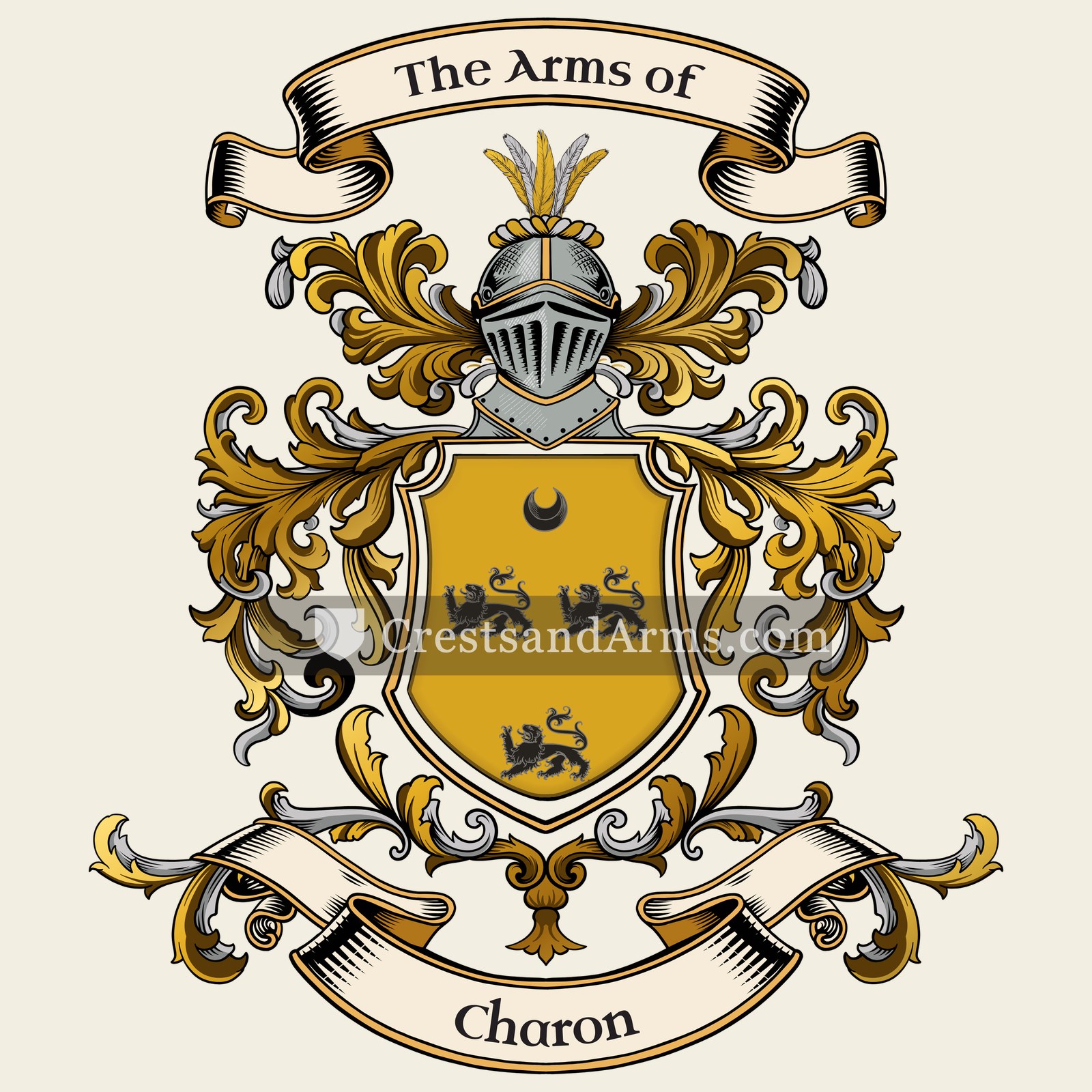
Symbols on this shield
lionCourage, strength and royalty
crescentHonour by the sovereign, and the second son
Colours
Gold (Or)Means: Generosity
Black (Sable)Means: Constancy
Historical info
Source
Sir Bernard Burke, The General Armory of England, Scotland, Ireland and Wales, London: Harrison & Sons, 1884
Blazon (the actual original written record)
“Or, three lions pass. in pale sa. a crescent for diff”
Irelandc. 1617
Digital archive packCoat of arms PNG, gold border print PDF, vector SVG and the certificate of authenticity. Sent to your email in minutes.
Map of Ireland showing where the Charon arms are recorded
The Charon arms were recorded in Ireland, c. 1617.
Arms such as these were typically recorded in Dublin.
Dublin was the seat of government in Ireland and the place where grants were sought and recorded. Families with business at the castle or the courts settled nearby, and settling there put their arms on record.
This is where the arms were entered in the register. Families often moved to other parts of the country, so the same name can turn up in more than one region.
The body that granted and recorded arms in Ireland in this period.
James VI and I
Sovereign of the period
James VI and I
1603–1625
Reigning in France when the Charon arms are first recorded.
How Arms Worked in Ireland
The Ulster King of Arms granted coats of arms to individuals who proved their social standing and good character. These symbols were typically inherited by all legitimate descendants of the original holder. If a family branch wanted a unique look, they could apply for a specific change to their design through the office to ensure their identity remained distinct.
Granting authority
The Ulster King of Arms acted as the official body that regulated and issued all coats of arms throughout Ireland.
How they got arms
Families obtained their arms through formal grants issued by the office after proving their eligibility and paying the required fees.
Where arms were recorded
All official grants were recorded in the registers held by the Ulster King of Arms starting from the year 1552.
The family's standing
Recorded among the armigerous families of Ireland.
Origin & History of the Charon Family in Ireland
The history of the Charon family in Ireland begins with documented evidence of their presence in Dublin as early as 1617. While the name itself has roots in continental Europe, these early arrivals likely integrated into the bustling trade networks of the city during the seventeenth century. Dublin was a major hub for merchants and skilled tradespeople at this time, and families like the Charons often found opportunities in the growing urban economy. By settling in the capital, they became part of a diverse population that included both local residents and newcomers from across the sea. Over the following decades, the family name became established within the social and economic fabric of the region, marking the start of a long lineage that persisted through the changing political landscape of Ireland.
Charon Meaning & Related Branches
Root word
Charon
Derived from the Greek mythological ferryman of the underworld.
This name
CharonA surname originally used as a nickname for a ferryman or boatman.
also spelled
Charron
Charond
Charont
Sharon
Charun
Related arms
Charronvariant spelling
Documented Sources
J. B. Rietstap, Armorial Général, Gouda: G. B. van Goor Zonen, 1884–87
Dauzat, Albert. Dictionnaire étymologique des noms et prénoms de France. 1951
Archives départementales de la Haute-Vienne. Registres paroissiaux et d'état civil du Limousin. 1663
Digital archive packCoat of arms PNG, gold border print PDF, vector SVG and the certificate of authenticity. Sent to your email in minutes.


 chevronProtection, and faithful service completed
 starThe celestial goddess, and nobility
 lionCourage, strength and royalty
 chevronProtection, and faithful service completed
 starThe celestial goddess, and nobility
 lionCourage, strength and royalty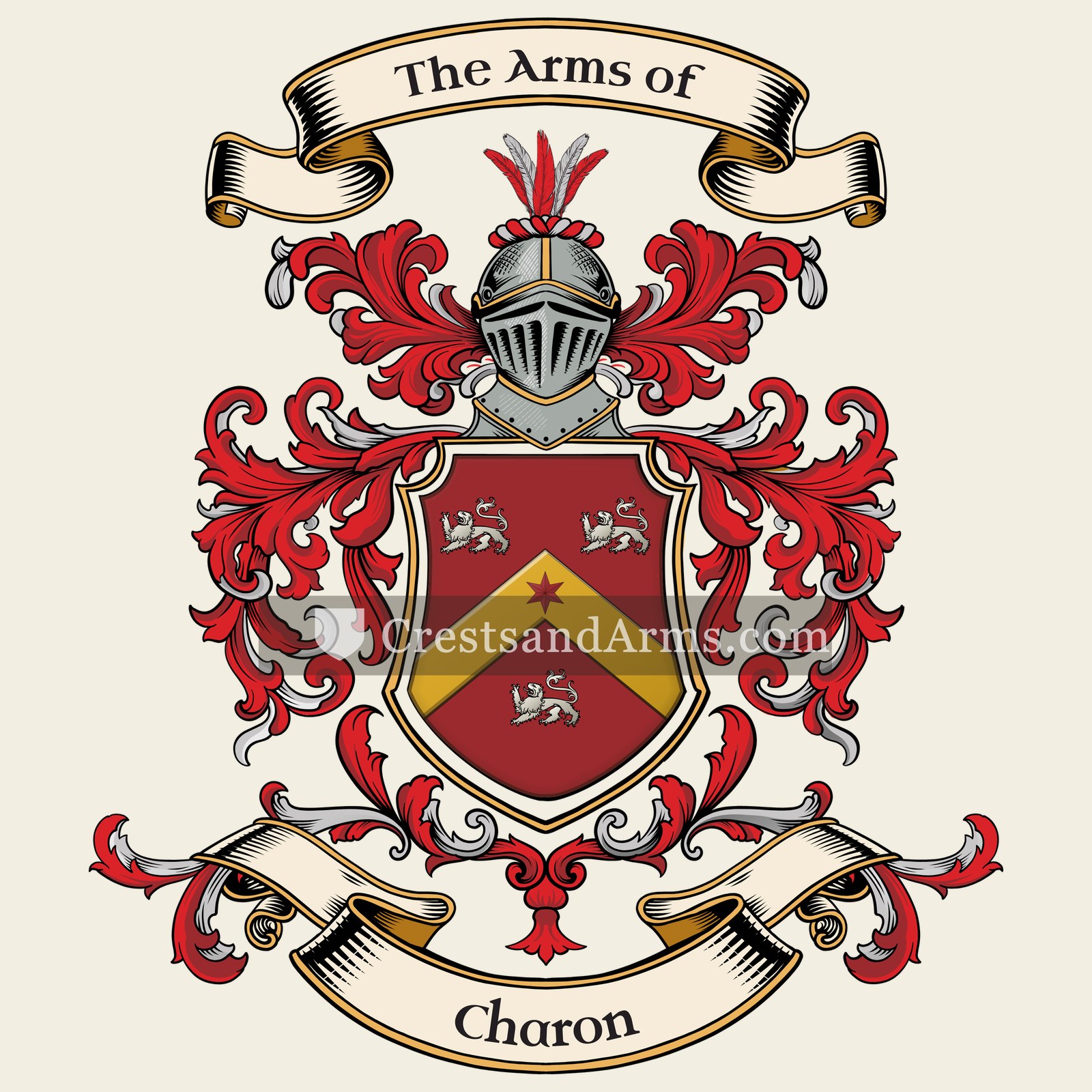


 crescentHonour by the sovereign, and the second son