Map of France showing where the Châteauneuf arms are recorded
The Châteauneuf arms were recorded in Maine, c. 1663.
Maine was quiet farming country in western France, held in small manors by families who stayed for generations. Nothing about it was grand, but steady landholding is exactly what puts a name in the registers.
This is where the arms were entered in the register. Families often moved to other parts of the country, so the same name can turn up in more than one region.
The body that granted and recorded arms in France in this period.
Louis XIV of France
Sovereign of the period
Louis XIV of France
1643–1715
Reigning in France when the Châteauneuf arms are first recorded.
How Arms Worked in France
In France, a coat of arms was a mark of honor that passed down through the male line to all legitimate descendants. Families often used the same shield without changes to show their shared heritage. If a branch wanted to stand out, they could add a small mark to their shield to show their specific place in the family tree.
Granting authority
The Juge d'armes de France acted as the official authority that regulated and verified coats of arms across the country.
How they got arms
Families typically inherited their arms from ancestors, though they could also receive them through royal grants or by proving their noble status.
Where arms were recorded
Coats of arms were officially recorded in the Armorial Général de France, which began its main collection in the year 1696.
The family's standing
Recorded among the armigerous families of Maine.
Origin & History of the Châteauneuf Family in France
The name Châteauneuf is a classic example of a locative surname, which means it originated from a specific place rather than a trade or a nickname. In French, the name translates literally to "new castle," and it was historically granted to families who lived near or held authority over a newly constructed fortress. During the Middle Ages, many different families across various French provinces adopted this name independently because new fortifications were being built constantly throughout the kingdom. By the time the name appeared in the historical records of Maine in 1663, it had already been established for centuries as a mark of local prominence. Families bearing this name were often part of the minor nobility or landholding class, serving as guardians of these strategic sites during times of regional conflict. As these individuals moved from their ancestral estates to new territories, they carried the name with them, effectively turning a description of a building into a lasting family legacy.
Coat of Arms & Family Crest Details
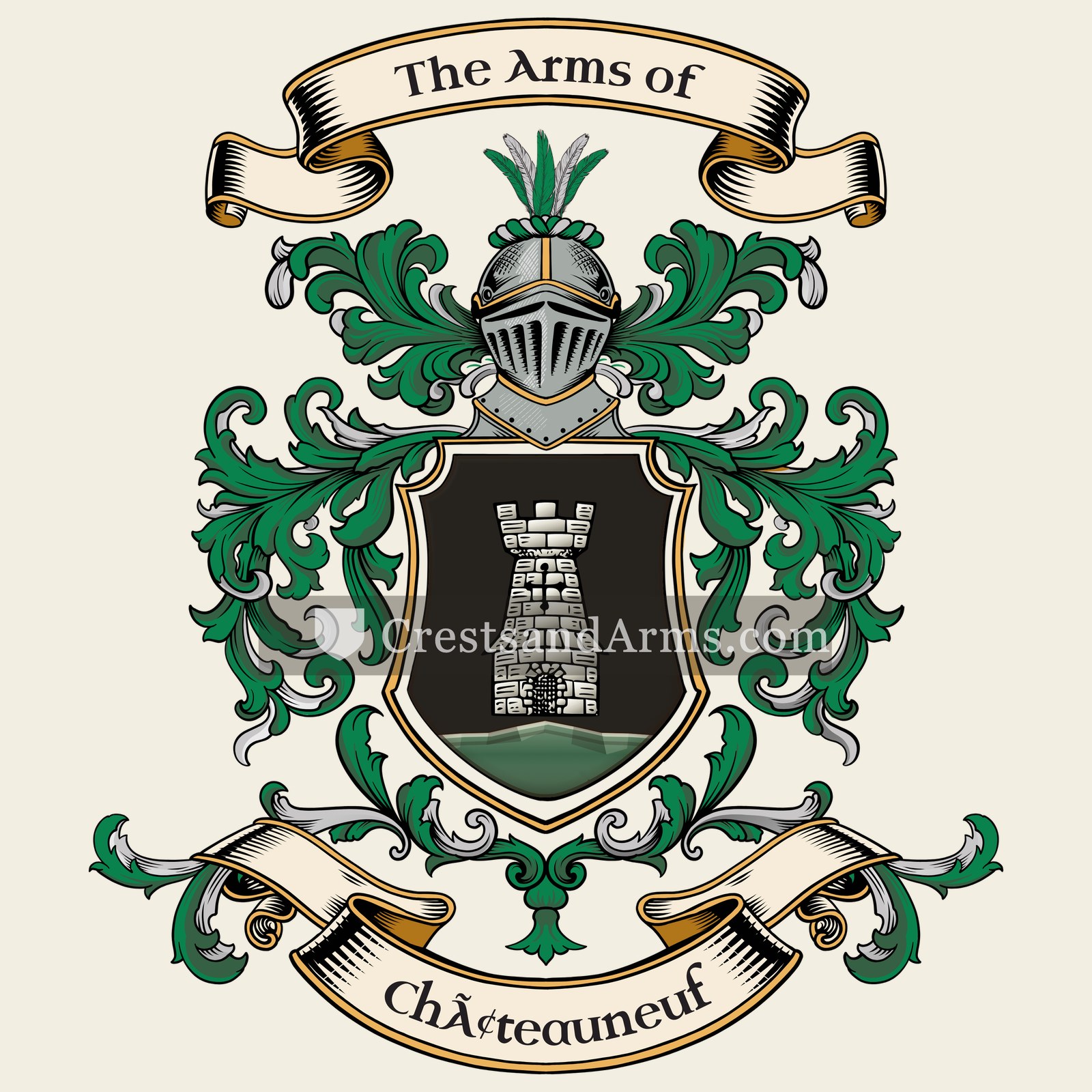
Symbols on this shield
mountThe ground held, and steadfastness upon it
towerGrandeur and solidity, and a stronghold defended
Colours
Black (Sable)Means: Constancy
Green (Vert)Means: Hope
Silver (Argent)Means: Peace and sincerity
Historical info
Source
J. B. Rietstap, Armorial Général, Gouda: G. B. van Goor Zonen, 1884–87
Blazon (the actual original written record)
“De sa. à un château sommé de trois tours, celle du milieu plus élevée, le tout d'arg., maçonné de sa., posé sur une terrasse de sin.”
SwitzerlandGenève, c. 1745
Digital archive packCoat of arms PNG, gold border print PDF, vector SVG and the certificate of authenticity. Sent to your email in minutes.
Map of Switzerland showing where the Châteauneuf arms are recorded
The Châteauneuf arms were recorded in Genève, c. 1745.
This is where the arms were entered in the register. Families often moved to other parts of the country, so the same name can turn up in more than one region.
The body that granted and recorded arms in Switzerland in this period.
How Arms Worked in Switzerland
In Switzerland, coats of arms were not restricted to the nobility and were often adopted by common citizens and families. These symbols were passed down through generations to show family identity. When branches of a family grew, they often changed small details of the design to distinguish their own line from the original group.
Granting authority
Cantonal and civic authorities managed the use of coats of arms within their specific regions and local jurisdictions.
How they got arms
Families typically assumed their own coats of arms based on local custom rather than receiving them from a central monarch.
Where arms were recorded
Arms were recorded in various cantonal and civic registers starting from the fourteenth century throughout the Swiss region.
The family's standing
Recorded among the armigerous families of Switzerland.
Origin & History of the Châteauneuf Family in Switzerland
The family name Châteauneuf carries a rich history that reflects the movement of people across the borders of France and Switzerland. While the name originates from the French term for a new castle, its presence in the city of Genève by 1745 suggests that the family was part of a broader migration of individuals seeking new opportunities in the Swiss Confederation. During the eighteenth century, Genève served as a major intellectual and commercial hub, attracting families who often integrated into the local professional and civic life. The Châteauneuf family likely established themselves within the city’s social fabric during this period of growth and stability. By settling in this region, they became part of the long tradition of families who helped shape the unique cultural identity of the Swiss territories. Their history serves as a window into how surnames traveled alongside families as they moved across Europe to build new lives in changing political landscapes.
Châteauneuf Meaning & Related Branches
Root word
Castellum Novum
Latin for new castle or new fortified place.
This name
ChâteauneufRefers to a person who lived in or originated from a newly constructed castle.
also spelled
Chastelneuf
Shatonuf
Documented Sources
J. B. Rietstap, Armorial Général, Gouda: G. B. van Goor Zonen, 1884–87
Dauzat, Albert, Les noms de famille de France, 1988
Morlet, Marie-Thérèse, Dictionnaire étymologique des noms de famille, 1991
Archives nationales d'outre-mer, Registres paroissiaux et d'état civil, 1663
Digital archive packCoat of arms PNG, gold border print PDF, vector SVG and the certificate of authenticity. Sent to your email in minutes.


 starThe celestial goddess, and nobility
 starThe celestial goddess, and nobility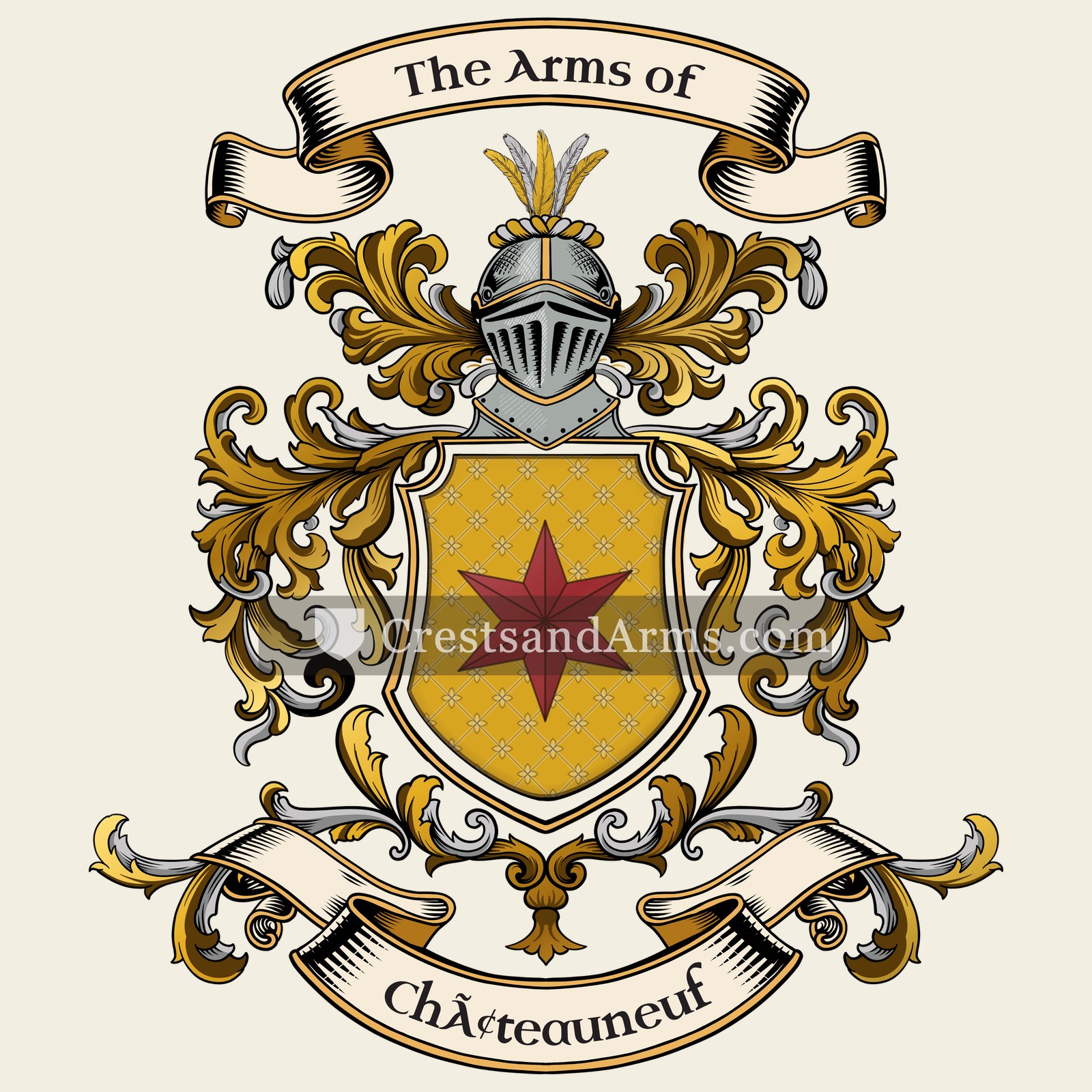


 mountThe ground held, and steadfastness upon it
 towerGrandeur and solidity, and a stronghold defended