Map of France showing where the Chawla arms are recorded
The Chawla arms were recorded in Forez, c. 1663.
Forez was a small upland county in central France, thick with minor gentry holding modest estates. Its families were more numerous than wealthy, and even a small holding was enough for a shield of one's own.
This is where the arms were entered in the register. Families often moved to other parts of the country, so the same name can turn up in more than one region.
The body that granted and recorded arms in France in this period.
Louis XIV of France
Sovereign of the period
Louis XIV of France
1643–1715
Reigning in France when the Chawla arms are first recorded.
How Arms Worked in France
In France, a coat of arms was a mark of honor that passed down through the male line to all legitimate descendants. Families often used the same shield without changes to show their shared heritage. If a branch wanted to stand out, they could add a small mark to their shield to show their specific place in the family tree.
Granting authority
The Juge d'armes de France acted as the official authority that regulated and verified coats of arms across the country.
How they got arms
Families typically inherited their arms from ancestors, though they could also receive them through royal grants or by proving their noble status.
Where arms were recorded
Coats of arms were officially recorded in the Armorial Général de France, which began its main collection in the year 1696.
The family's standing
Recorded among the armigerous families of Forez.
Origin & History of the Chawla Family in France
The history of the Chawla name in the Forez region of France begins with documented records dating back to 1663. During the seventeenth century, the Forez area was a distinct province known for its rural traditions and local trade networks. Families like the Chawlas often lived in small agricultural communities where their surname was likely tied to a specific geographic location or a local nickname used by neighbors. Because the region was somewhat isolated from major urban centers, families tended to stay in the same villages for generations. This allowed the name to become firmly established in the local parish registers and land records of the time. By studying these early mentions, we can see how the family integrated into the social and economic life of the French countryside during the reign of King Louis XIV.
Related Branches & Arms
Root word
Chaule
Old French term referring to a person with a bald head.
This name
ChawlaA surname of French origin derived from a nickname for a bald individual.
also spelled
Chall
Challe
Chahl
Shal
Documented Sources
J. B. Rietstap, Armorial Général, Gouda: G. B. van Goor Zonen, 1884–87
Archives départementales de la Loire, Registres paroissiaux et d'état civil de la commune de Forez, 1663
Fournier, Gabriel, Les villages et la vie rurale en France au XVIIe siècle, 1972
Gonon, Marguerite, La vie quotidienne en Forez au XVIIe siècle, 1960
Digital archive packCoat of arms PNG, gold border print PDF, vector SVG and the certificate of authenticity. Sent to your email in minutes.


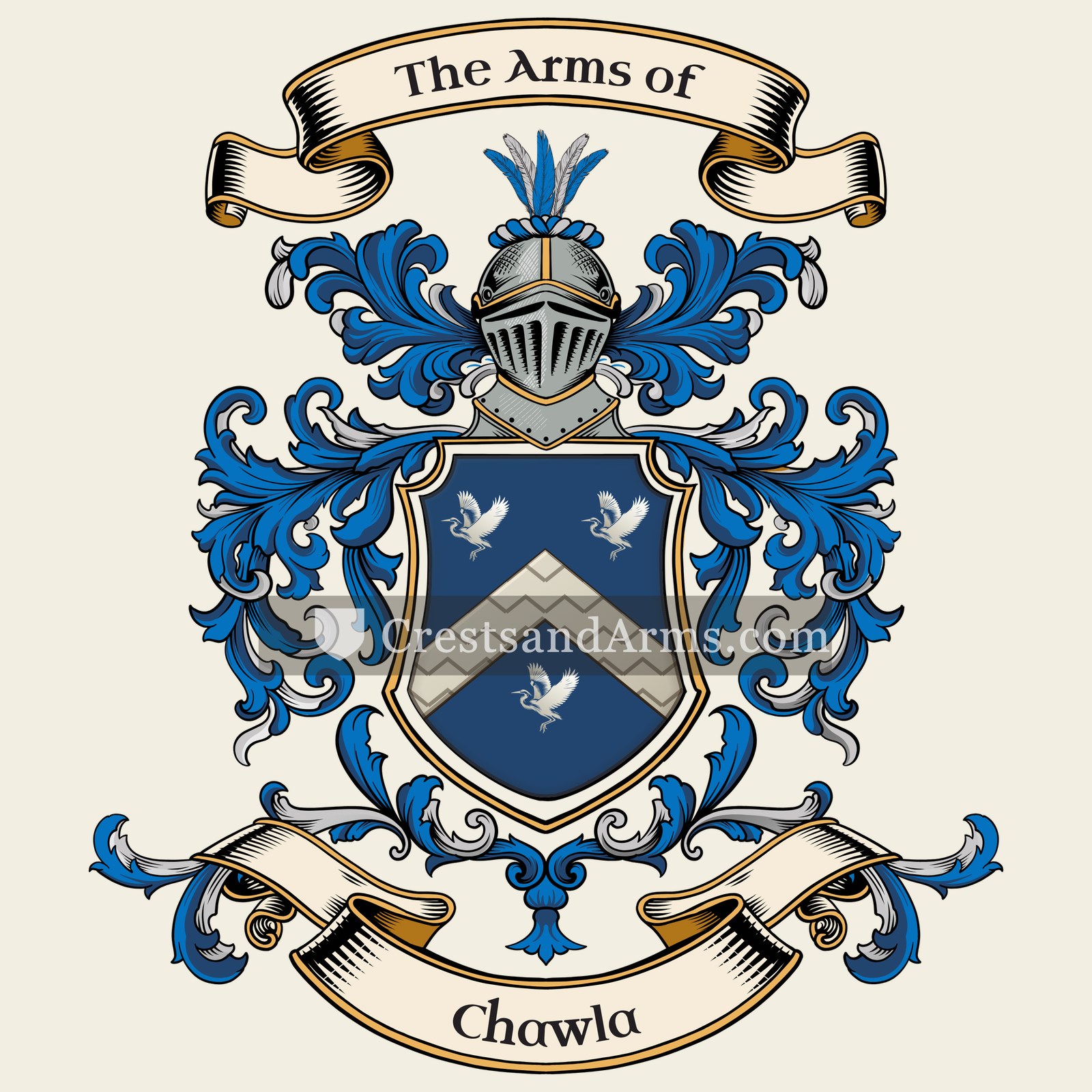
 chevronProtection, and faithful service completed
 heronPatience and quiet watchfulness
 chevronProtection, and faithful service completed
 heronPatience and quiet watchfulness