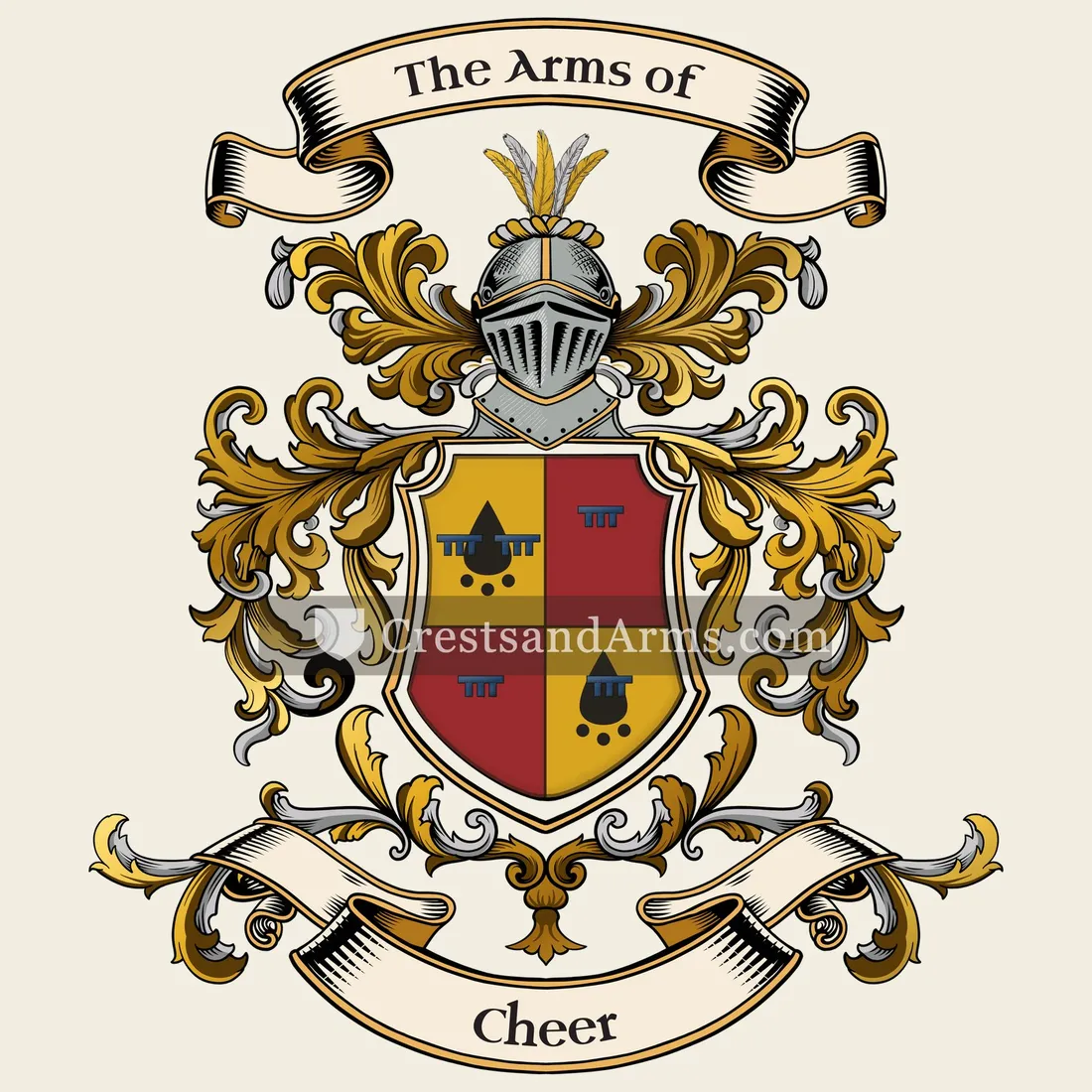
A record of documented arms, meaning and origin, researched for the Cheer family of Britain.
Reg. 9121 · Britain, A–C
Meaning of the Cheer family crest colors & symbols
Symbols on this shield
labelThe eldest son, during his father's life
ermineDignity and rank
Colours
Gold (Or)Means: Generosity
Red (Gules)Means: Military strength
Blue (Azure)Means: Loyalty and truth
Black (Sable)Means: Constancy
Historical info
Source
J. B. Rietstap, Armorial Général, Gouda: G. B. van Goor Zonen, 1884–87
Blazon (the actual original written record)
“Ec., d'or et de gu., l'or semé de mouch. d'herm. de sa.; au lambel de cinq pendants d'azur, br. en chef sur les deux premiers quartiers. C.: un dogue pass. d'azur, coll. et bouclé d'or. D.: PRÆMIUM VIRTUTIS HONOR.”
BritainLondres, c. 1700
Digital archive packCoat of arms PNG, gold border print PDF, vector SVG and the certificate of authenticity. Sent to your email in minutes.
Map of Britain showing where the Cheer arms are recorded
The Cheer arms were recorded in Londres, c. 1700.
Arms such as these were typically recorded in Kent.
Kent sits between London and the short crossing to Europe, and the trade passing through made it wealthy. Merchant families bought land with that money, and it was landowners who took coats of arms.
This is where the arms were entered in the register. Families often moved to other parts of the country, so the same name can turn up in more than one region.
The body that granted and recorded arms in Britain in this period.
William III of England
Sovereign of the period
William III of England
1694–1702
Reigning in Britain when the Cheer arms are first recorded.
How Arms Worked in Britain
English heraldry allowed arms to be shared by all legitimate descendants of the original owner. These symbols were treated as personal property that moved through the generations to all children. While the eldest son kept the original design, other family members could use the same shield without needing to change it or register their own unique versions.
Granting authority
The College of Arms in London has regulated the use of coats of arms throughout England and Wales since 1484.
How they got arms
Families typically obtained their coats of arms through a formal grant from the Crown or by proving their ancient right to them.
Where arms were recorded
All official coats of arms are recorded in the registers kept at the College of Arms, which date back to the fifteenth century.
The family's standing
Recorded among the armigerous families of Britain.
Origin & History of the Cheer Family in Britain
The surname Cheer is primarily rooted in the historical landscape of Kent, England, where records confirm the family’s presence by the early 1700s. Linguistically, the name likely originated as a descriptive nickname, derived from the Old French word "chiere," which referred to a person’s facial expression or general demeanor. In medieval times, such names were often given to individuals who were known for having a pleasant or cheerful disposition. As the family established itself in the rural parishes of Kent, they were likely involved in the local agricultural economy that defined the region during the eighteenth century. Over time, the name evolved from a simple descriptor into a stable hereditary surname, marking the transition of the family from local residents into a recognized part of the community’s social fabric.
Cheer Meaning & Related Branches
Root word
chere
Old French word meaning face, countenance, or expression.
This name
CheerA nickname for a person with a cheerful or pleasant facial expression.
also spelled
Cheer
Documented Sources
J. B. Rietstap, Armorial Général, Gouda: G. B. van Goor Zonen, 1884–87
Reaney, P.H. and Wilson, R.M., A Dictionary of English Surnames, 1991
Kent Archives, Parish Registers of Kent, Series P/201
Cottle, Basil, The Penguin Dictionary of Surnames, 1967
Digital archive packCoat of arms PNG, gold border print PDF, vector SVG and the certificate of authenticity. Sent to your email in minutes.


 labelThe eldest son, during his father's life
 ermineDignity and rank
 labelThe eldest son, during his father's life
 ermineDignity and rank