Map of France showing where the Chenault arms are recorded
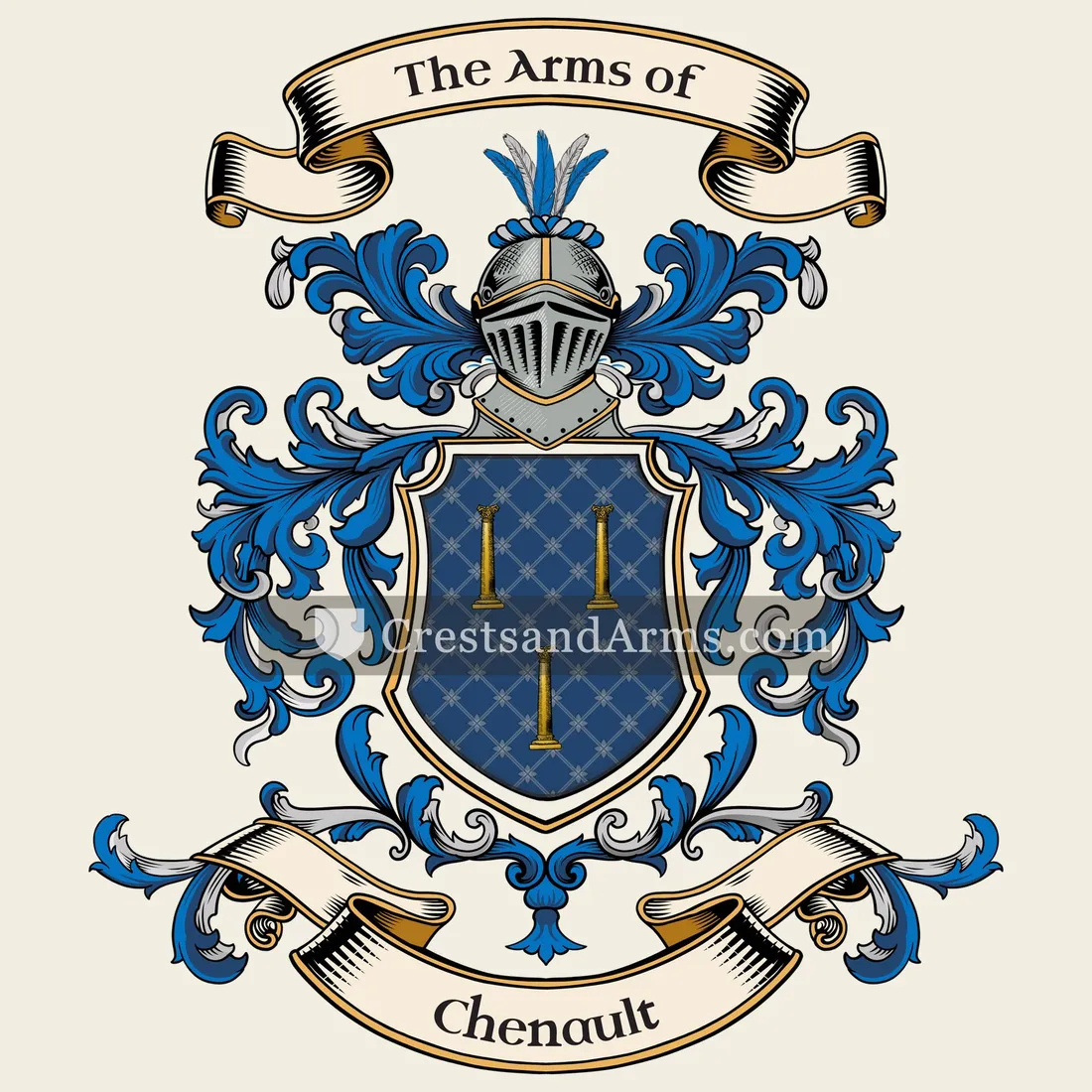
The Chenault arms were recorded in France, c. 1725.
Arms such as these were typically recorded in Bretagne.
More families held coats of arms in Bretagne than anywhere else in France. The land was divided into many small estates rather than a few large ones, so far more households counted as gentry, and each needed a shield of its own to be told apart.
This is where the arms were entered in the register. Families often moved to other parts of the country, so the same name can turn up in more than one region.
The body that granted and recorded arms in France in this period.
Louis XV of France
Sovereign of the period
Louis XV of France
1715–1774
Reigning in France when the Chenault arms are first recorded.
How Arms Worked in France
In France, a coat of arms was a mark of honor that passed down through the male line to all legitimate descendants. Families often used the same shield without changes to show their shared heritage. If a branch wanted to stand out, they could add a small mark to their shield to show their specific place in the family tree.
Granting authority
The Juge d'armes de France acted as the official authority that regulated and verified coats of arms across the country.
How they got arms
Families typically inherited their arms from ancestors, though they could also receive them through royal grants or by proving their noble status.
Where arms were recorded
Coats of arms were officially recorded in the Armorial Général de France, which began its main collection in the year 1696.
The family's standing
Recorded among the armigerous families of France.
Origin & History of the Chenault Family in France
The family name Chenault finds its deep roots in the historical region of Bretagne in northwestern France. By the early 18th century, records confirm that members of the family were well established within this coastal territory. The name itself is thought to be a variation of older French terms related to oak trees, which suggests that the earliest ancestors may have lived near prominent forests or worked in trades involving timber. During the 1720s, life in Bretagne was defined by a strong connection to both the land and the sea, and families like the Chenaults were often part of the local agricultural or artisanal communities that supported the regional economy. As the family grew, they remained tied to the unique cultural traditions of the Breton people, which helped shape their identity long before many members eventually migrated to other parts of the world.
Chenault Meaning & Related Branches
Root word
chene
Old French term for an oak tree.
This name
ChenaultA topographic name for someone who lived near a prominent oak tree or forest.
also spelled
Colin
Chenault
Colin de Sheno
Documented Sources
J. B. Rietstap, Armorial Général, Gouda: G. B. van Goor Zonen, 1884–87
Archives départementales d’Ille-et-Vilaine, Série B (Fonds de la juridiction de Rennes)
Dauzat, Albert, Dictionnaire étymologique des noms de famille et prénoms de France, 1951
Morvan, Françoise, Bretagne est l'univers, 2008
Digital archive packCoat of arms PNG, gold border print PDF, vector SVG and the certificate of authenticity. Sent to your email in minutes.


 columnFortitude and constancy
 columnFortitude and constancy