Map of Germany showing where the Chilo arms are recorded
The Chilo arms were recorded in Silesia, c. 1765.
Silesia was farming country in the east of the German lands, held in large estates by families who stayed put for generations. Owning land was what entitled a family to arms, so the region fills a good deal of the register.
This is where the arms were entered in the register. Families often moved to other parts of the country, so the same name can turn up in more than one region.
The body that granted and recorded arms in Germany in this period.
Francis I, Holy Roman Emperor
Sovereign of the period
Francis I, Holy Roman Emperor
1745–1765
Reigning in Germany when the Chilo arms are first recorded.
How Arms Worked in Germany
In the Holy Roman Empire, coats of arms were often granted to individuals by the Emperor or his representatives. These arms were then passed down through the generations to all legitimate descendants of the original holder. Younger branches of a family usually kept the same shield design without needing to change it, as the arms belonged to the entire lineage.
Granting authority
The Holy Roman Emperor held the sole power to grant new coats of arms throughout his vast imperial territories.
How they got arms
Families typically obtained their coats of arms through a formal imperial grant or by proving their noble status to the authorities.
Where arms were recorded
These grants were officially recorded in the Imperial Chancery registers, which began keeping formal records of such honors during the Middle Ages.
The family's standing
Recorded among the armigerous families of Silesia.
Origin & History of the Chilo Family in Germany
The family name Chilo has deep roots in the historical region of Silesia, where records confirm members of the family were established by 1765. During the eighteenth century, Silesia was a vibrant crossroads of Central European culture, shifting between the influence of the Austrian Habsburgs and the rising power of the Kingdom of Prussia. Families living in this area during that time often worked in agriculture, local trade, or skilled crafts, which were the primary ways to build a stable life in the rural villages and growing towns of the region. Because Silesia was a melting pot of languages and traditions, the name likely evolved alongside the changing borders and social structures of the era. By settling in this region, the early Chilo family became part of a resilient population that navigated the complex political and economic changes of eighteenth-century Europe.
Chilo Meaning & Related Branches
Root word
Kilian
Derived from the Gaelic name Cillín meaning little church or cell.
This name
ChiloA German variant of the name Kilian, historically associated with Saint Kilian.
also spelled
Chilae
Chilah
Chil
Keela
Documented Sources
J. B. Rietstap, Armorial Général, Gouda: G. B. van Goor Zonen, 1884–87
Knie, Johann Georg, Alphabetisch-statistisch-topographische Uebersicht der Dörfer, Flecken, Städte und anderen Orte der Königl. Preuß. Provinz Schlesien, 1845
State Archive in Wrocław (Archiwum Państwowe we Wrocławiu), Akta stanu cywilnego (Civil Registry Records), 1765
Digital archive packCoat of arms PNG, gold border print PDF, vector SVG and the certificate of authenticity. Sent to your email in minutes.


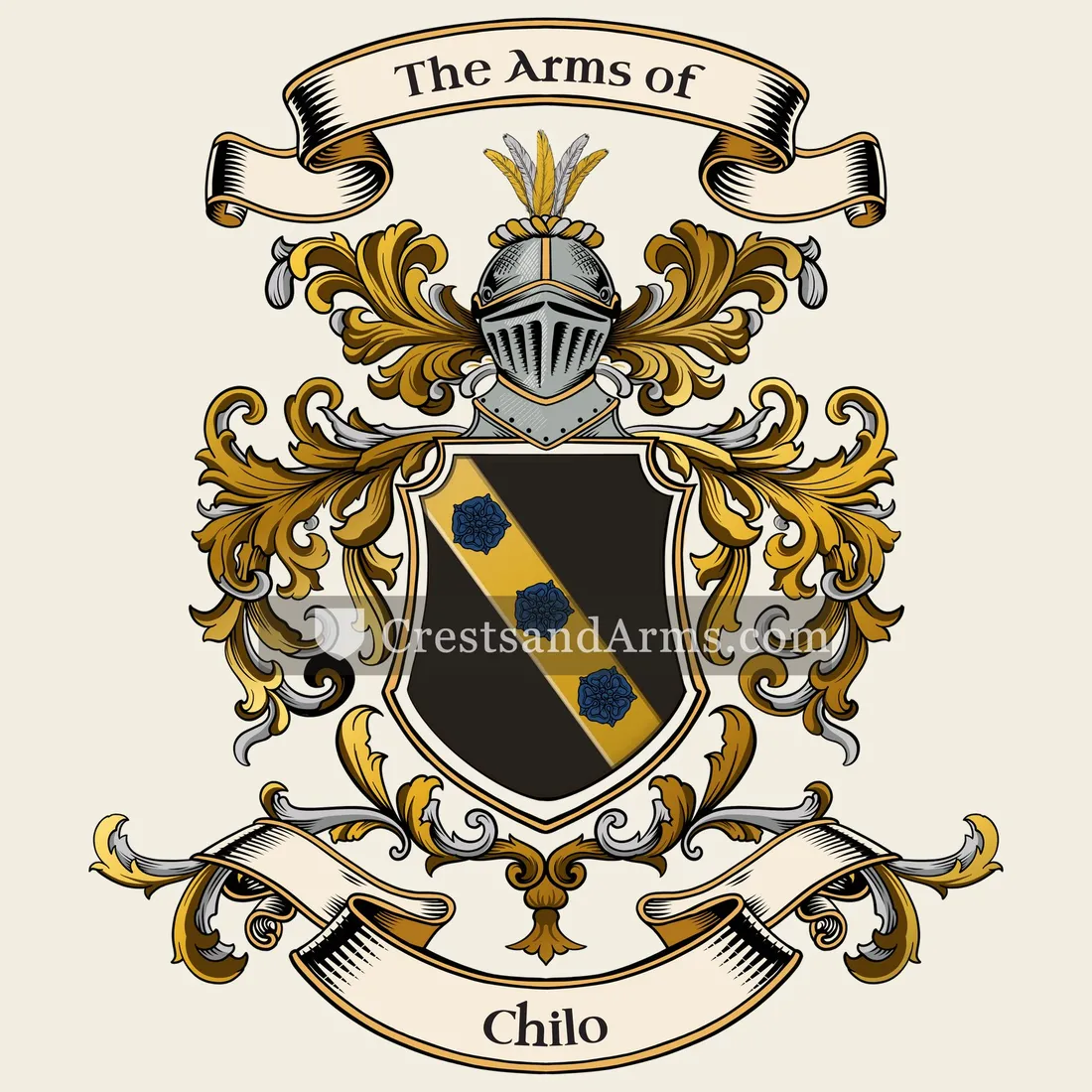
 bendDefence, and the scarf of a commander
 roseThe seventh son, and beauty with grace
 bendDefence, and the scarf of a commander
 roseThe seventh son, and beauty with grace