Map of Ireland showing where the Chinnery arms are recorded
The Chinnery arms were recorded in Cork, c. 1799.
Cork was the largest county in Ireland, with a great harbour and a wide farming hinterland. Both English settlers and older Irish families held land there, and holding land is what brought a family into the records.
This is where the arms were entered in the register. Families often moved to other parts of the country, so the same name can turn up in more than one region.
The body that granted and recorded arms in Ireland in this period.
George III of Great Britain
Sovereign of the period
George III of Great Britain
1760–1801
Reigning in Ireland when the Chinnery arms are first recorded.
How Arms Worked in Ireland
The Ulster King of Arms granted coats of arms to individuals who proved their social standing and good character. These symbols were typically inherited by all legitimate descendants of the original holder. If a family branch wanted a unique look, they could apply for a specific change to their design through the office to ensure their identity remained distinct.
Granting authority
The Ulster King of Arms acted as the official body that regulated and issued all coats of arms throughout Ireland.
How they got arms
Families obtained their arms through formal grants issued by the office after proving their eligibility and paying the required fees.
Where arms were recorded
All official grants were recorded in the registers held by the Ulster King of Arms starting from the year 1552.
The family's standing
Recorded among the armigerous families of Cork.
Origin & History of the Chinnery Family in Ireland
The surname Chinnery is believed to have roots in England before members of the family established a significant presence in Ireland. By the late 18th century, the family was well-integrated into the social and professional fabric of County Cork. Records confirm that members of the Chinnery family were active in the region by 1799, often participating in the local administration and the merchant classes that defined the city’s economy during that era. Over time, the family became closely tied to the development of Cork, with various members serving in civic roles and contributing to the local community. Their history reflects the broader movement of families who relocated across the Irish Sea to build new lives and businesses in the bustling ports of southern Ireland.
Chinnery Meaning & Related Branches
Root word
Chiner
An occupational term derived from the Old French word for a designer.
This name
ChinneryA surname of Anglo-Norman origin denoting a person who worked as a designer or embroiderer.
also spelled
Chinnary
Chinnirie
Documented Sources
Sir Bernard Burke, The General Armory of England, Scotland, Ireland and Wales, London: Harrison & Sons, 1884
Burke, Bernard. A Genealogical and Heraldic History of the Landed Gentry of Ireland. 1912
Digital archive packCoat of arms PNG, gold border print PDF, vector SVG and the certificate of authenticity. Sent to your email in minutes.


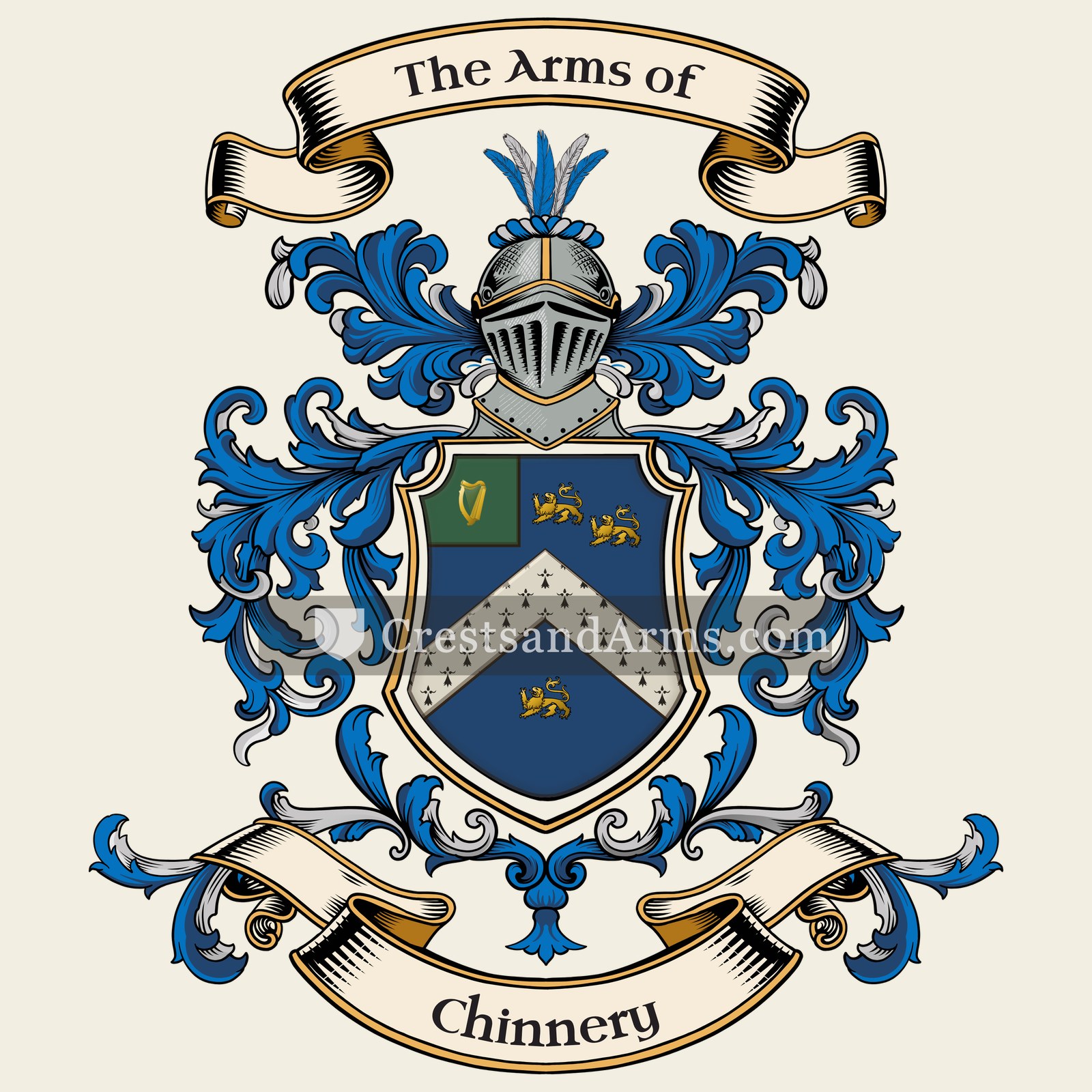
 chevronProtection, and faithful service completed
 cantonA mark of honour granted by the sovereign
 lionCourage, strength and royalty
 harpWell-tuned governance and love of music
 chevronProtection, and faithful service completed
 cantonA mark of honour granted by the sovereign
 lionCourage, strength and royalty
 harpWell-tuned governance and love of music