Map of Spain showing where the Choban arms are recorded
The Choban arms were recorded in Asturies, c. 1722.
This is where the arms were entered in the register. Families often moved to other parts of the country, so the same name can turn up in more than one region.
The body that granted and recorded arms in Spain in this period.
Philip V of Spain
Sovereign of the period
Philip V of Spain
1714–1724
Reigning in Spain when the Choban arms are first recorded.
How Arms Worked in Spain
In Spain, a coat of arms was considered a form of property that belonged to the entire family line. These arms were passed down from a father to all his children equally. Younger branches of the family usually kept the original design without needing to add any special marks to distinguish their specific line.
Granting authority
The Cronista Rey de Armas was the official body that regulated and granted coats of arms throughout Spain.
How they got arms
Families often obtained their arms through royal grants or by proving their noble status to the official heraldic authority.
Where arms were recorded
Coats of arms were officially recorded in the registers of the Cronista Rey de Armas starting in 1496.
The family's standing
Recorded among the armigerous families of Spain.
Origin & History of the Choban Family in Spain
The family name Choban finds its roots in the linguistic traditions of the Balkan and Anatolian regions, where the word historically identified a shepherd or a guardian of livestock. While the name is often associated with Eastern Europe and Turkey, the presence of the family in the Asturias region of northern Spain by 1722 suggests a fascinating history of migration and adaptation. During the eighteenth century, Asturias was a rugged area defined by its mountain ranges and coastal trade routes, making it a common destination for travelers moving across the continent. Families carrying this name likely integrated into the local agrarian society, shifting from their traditional pastoral roots to the unique cultural landscape of northern Spain. This transition highlights how surnames often traveled alongside families as they sought new opportunities in different parts of the world, gradually becoming a permanent part of the local community.
Related Branches & Arms
Root word
choban
A person who tends or guards a flock of sheep.
This name
ChobanAn occupational surname for a shepherd or a herdsman.
also spelled
Kobian
Cobiane
Documented Sources
J. B. Rietstap, Armorial Général, Gouda: G. B. van Goor Zonen, 1884–87
Archivo Histórico Diocesano de Oviedo, Libros Sacramentales de la Parroquia de San Juan de Amandi, 1722
García Arias, Xosé Lluis, Toponimia asturiana: el porqué de los nombres de nuestros pueblos, 2005
Moll, Francesc de Borja, Els llinatges catalans, 1959
Digital archive packCoat of arms PNG, gold border print PDF, vector SVG and the certificate of authenticity. Sent to your email in minutes.


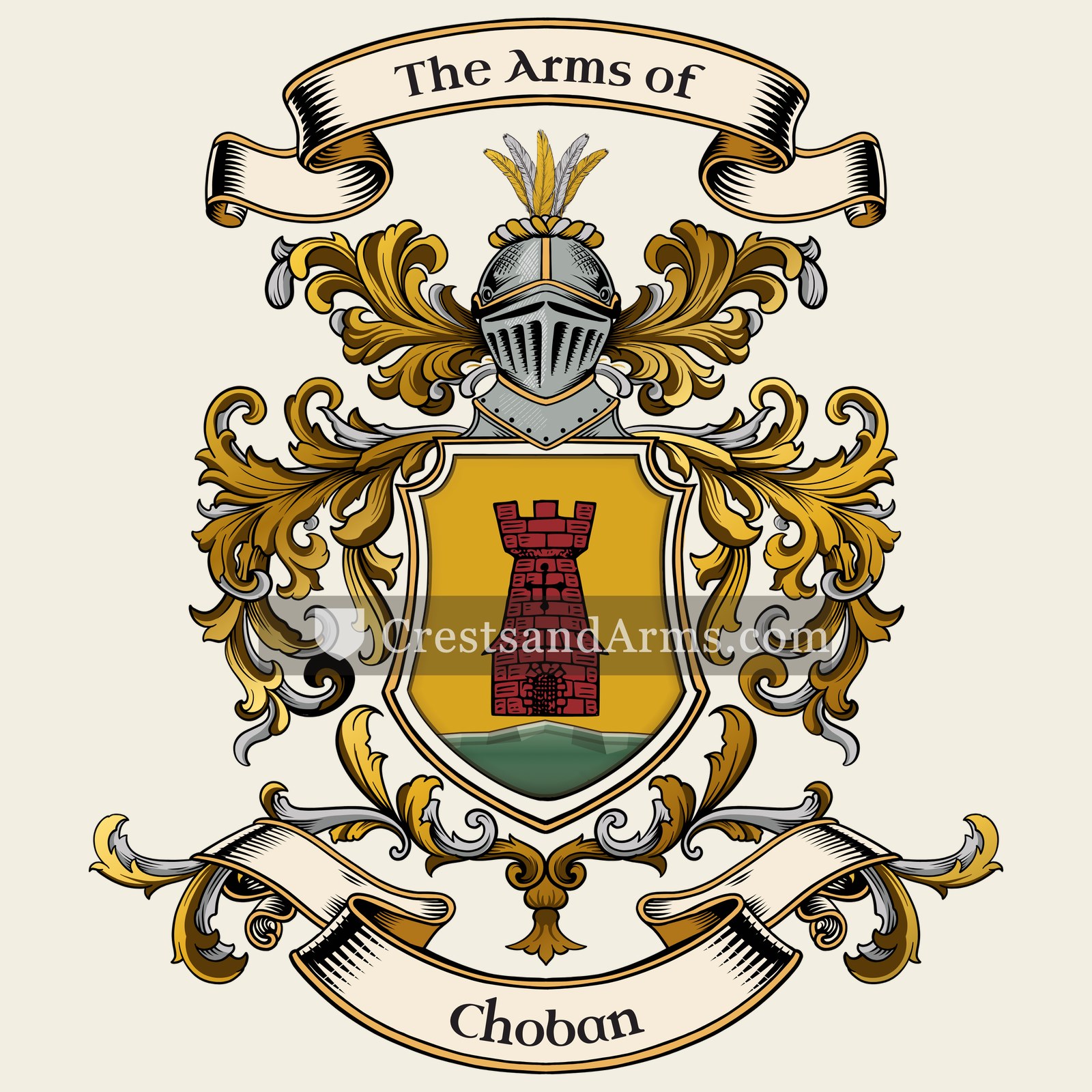
 mountThe ground held, and steadfastness upon it
 towerGrandeur and solidity, and a stronghold defended
 mountThe ground held, and steadfastness upon it
 towerGrandeur and solidity, and a stronghold defended