A record of documented arms, meaning and origin, researched for the Christmann family lines. Documented in 2 countries.
Reg. 5532 · Swiss, A–C
Coat of Arms & Family Crest Details
Symbols on this shield
swanGrace, light and the poet's art
mulletThe third son, and a divine quality from above
Colours
Blue (Azure)Means: Loyalty and truth
Gold (Or)Means: Generosity
Silver (Argent)Means: Peace and sincerity
Historical info
Source
J. B. Rietstap, Armorial Général, Gouda: G. B. van Goor Zonen, 1884–87
Blazon (the actual original written record)
“D'azur au cygne d'arg., bq. et m. d'or, le vol levé, surm. d'une étoile d'or; à la bord. du même. C.: un agneau pascal pass. d'arg. avec sa banderole. L.: à dextre d'or et d'azur, à sen. d'arg. et d'azur.”
SwitzerlandBâle, c. 1745
Digital archive packCoat of arms PNG, gold border print PDF, vector SVG and the certificate of authenticity. Sent to your email in minutes.
Map of Switzerland showing where the Christmann arms are recorded
The Christmann arms were recorded in Bâle, c. 1745.
This is where the arms were entered in the register. Families often moved to other parts of the country, so the same name can turn up in more than one region.
The body that granted and recorded arms in Switzerland in this period.
How Arms Worked in Switzerland
In Switzerland, coats of arms were not restricted to the nobility and were often adopted by common citizens and families. These symbols were passed down through generations to show family identity. When branches of a family grew, they often changed small details of the design to distinguish their own line from the original group.
Granting authority
Cantonal and civic authorities managed the use of coats of arms within their specific regions and local jurisdictions.
How they got arms
Families typically assumed their own coats of arms based on local custom rather than receiving them from a central monarch.
Where arms were recorded
Arms were recorded in various cantonal and civic registers starting from the fourteenth century throughout the Swiss region.
The family's standing
Recorded among the armigerous families of Switzerland.
Origin & History of the Christmann Family in Switzerland
The surname Christmann has deep roots in the German-speaking regions of Europe, functioning as a descriptive name that historically identified a devout individual or a person who played the role of Christ in local religious mystery plays. By the time the family established a documented presence in Basel in 1745, Switzerland was a hub of trade and craftsmanship that attracted many families seeking stability. During this era, the Christmann family likely integrated into the urban fabric of Basel as skilled artisans or merchants, contributing to the city's reputation as a center for printing and silk manufacturing. Because Basel served as a crossroads between Switzerland, France, and Germany, the family name reflects the fluid movement of people across borders during the eighteenth century. Their presence in the city records suggests they were part of a growing middle class that helped shape the social and economic character of the region during a time of significant transition.
Coat of Arms & Family Crest Details
Symbols on this shield
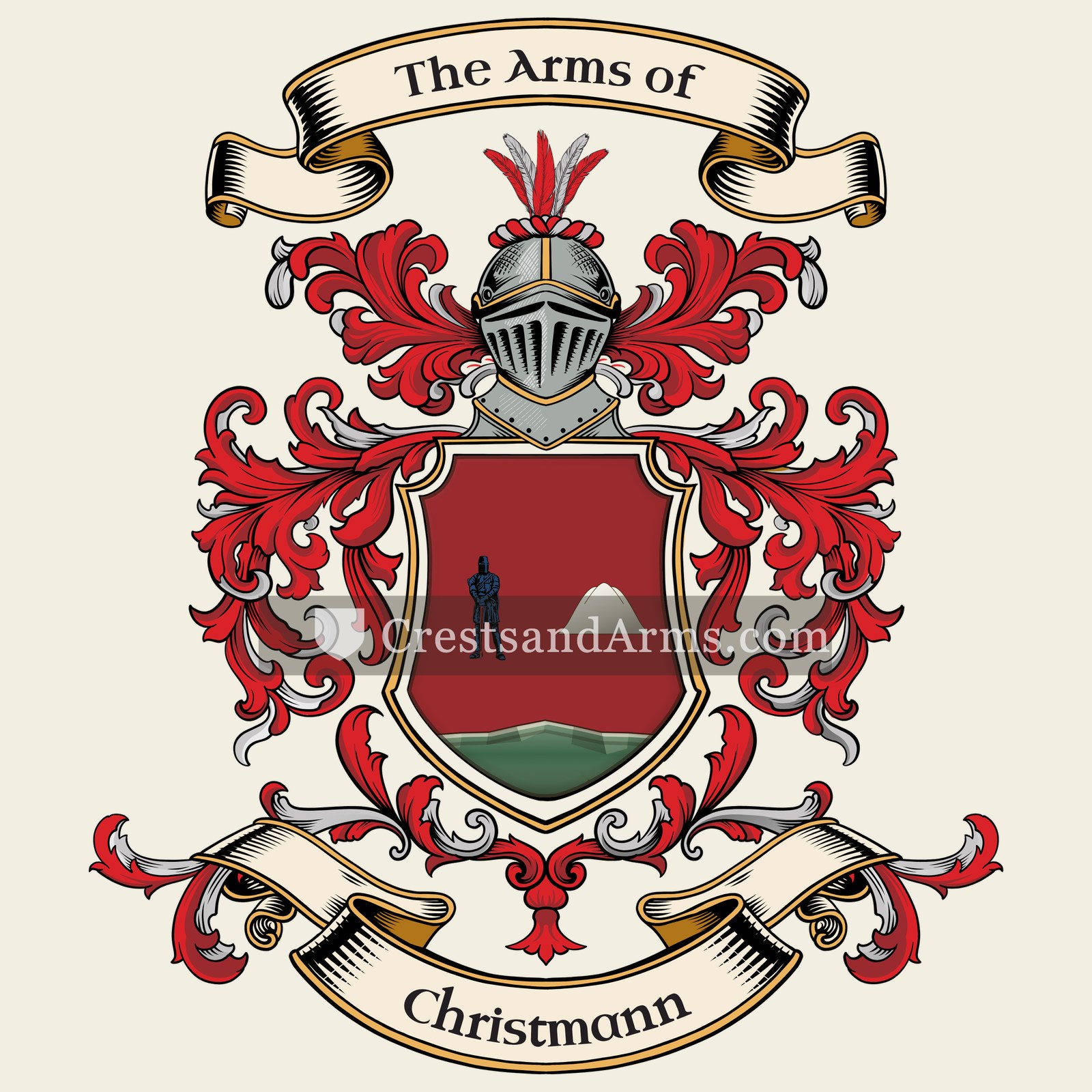
mountThe ground held, and steadfastness upon it
knightChivalry and service in arms
Colours
Red (Gules)Means: Military strength
Green (Vert)Means: Hope
Blue (Azure)Means: Loyalty and truth
Silver (Argent)Means: Peace and sincerity
Historical info
Source
J. B. Rietstap, Armorial Général, Gouda: G. B. van Goor Zonen, 1884–87
Blazon (the actual original written record)
“De gu. à un chevalier, arm. de toutes pièces d'azur, posé sur un tertre d'arg., la visière levée, tenant de sa main dextre une épée et de sa sen. un bouclier d'arg. ch. d'une croix du champ. Cq. cour. C.: le chevalier, iss.”
AustriaKitzbühl Tirol, c. 1772
Digital archive packCoat of arms PNG, gold border print PDF, vector SVG and the certificate of authenticity. Sent to your email in minutes.
Map of Austria showing where the Christmann arms are recorded
The Christmann arms were recorded in Kitzbühl Tirol, c. 1772.
This is where the arms were entered in the register. Families often moved to other parts of the country, so the same name can turn up in more than one region.
Region
Kitzbühl
Town
Kitzbühl Tirol
First recorded
1772
Granting Authority for the Christmann Arms
Imperial and Royal chancery
Sodacan · CC BY-SA 3.0
The body that granted and recorded arms in Austria in this period.
Joseph II, Holy Roman Emperor
Sovereign of the period
Joseph II, Holy Roman Emperor
1765–1790
Reigning in Switzerland when the Christmann arms are first recorded.
How Arms Worked in Austria
Austrian coats of arms were often linked directly to noble titles granted by the Emperor. These symbols belonged to the entire family line rather than just one individual. When a family grew, new branches kept the original design without needing to change it. This system allowed all members of a noble house to share the same identity across many generations.
Granting authority
The Imperial and Royal chancery managed all heraldic matters and controlled the official granting of arms throughout the Austrian lands.
How they got arms
Families typically received their arms through a formal imperial decree that often accompanied the elevation of a person to noble status.
Where arms were recorded
Official records of these grants were kept in the Imperial Register of Nobility which began its formal documentation process in 1453.
The family's standing
Recorded among the armigerous families of Austria.
Origin & History of the Christmann Family in Austria
The surname Christmann is rooted in the deep cultural and religious traditions of the German-speaking world, functioning originally as a descriptive name for a devout follower of the Christian faith. In the mountainous region of Tyrol, the family established a notable presence by the late eighteenth century, with documented records confirming their residence in the town of Kitzbühel by 1772. During this period, Kitzbühel was a thriving center for mining and trade, attracting families who sought stability in the shadow of the Alps. The Christmanns likely integrated into the local community as skilled laborers or tradespeople, contributing to the steady development of this historic market town. As the family grew, they became part of the social fabric of the region, reflecting the broader patterns of migration and settlement that defined life in the Austrian provinces during the late Enlightenment era.
Christmann Meaning & Related Branches
Root word
Christus
The anointed one or the Messiah in ancient Greek.
This name
ChristmannA person who serves or follows Christ, often denoting a devout Christian.
also spelled
Christman
Kristmann
Kristman
Related arms
Breitenbergerrecorded with Christmann, same area
Fichterrecorded with Christmann, same area
Hackrecorded with Christmann, same area
Hoysonrecorded with Christmann, same area
Documented Sources
J. B. Rietstap, Armorial Général, Gouda: G. B. van Goor Zonen, 1884–87
Historisches Lexikon der Schweiz, Christmann, 2005
Staatsarchiv Basel-Stadt, Bürgerverzeichnisse und Einwohnerregister der Stadt Basel, 1745
Brechenmacher, Josef Karlmann, Etymologisches Wörterbuch der deutschen Familiennamen, 1957
Digital archive packCoat of arms PNG, gold border print PDF, vector SVG and the certificate of authenticity. Sent to your email in minutes.


 swanGrace, light and the poet's art
 mulletThe third son, and a divine quality from above
 swanGrace, light and the poet's art
 mulletThe third son, and a divine quality from above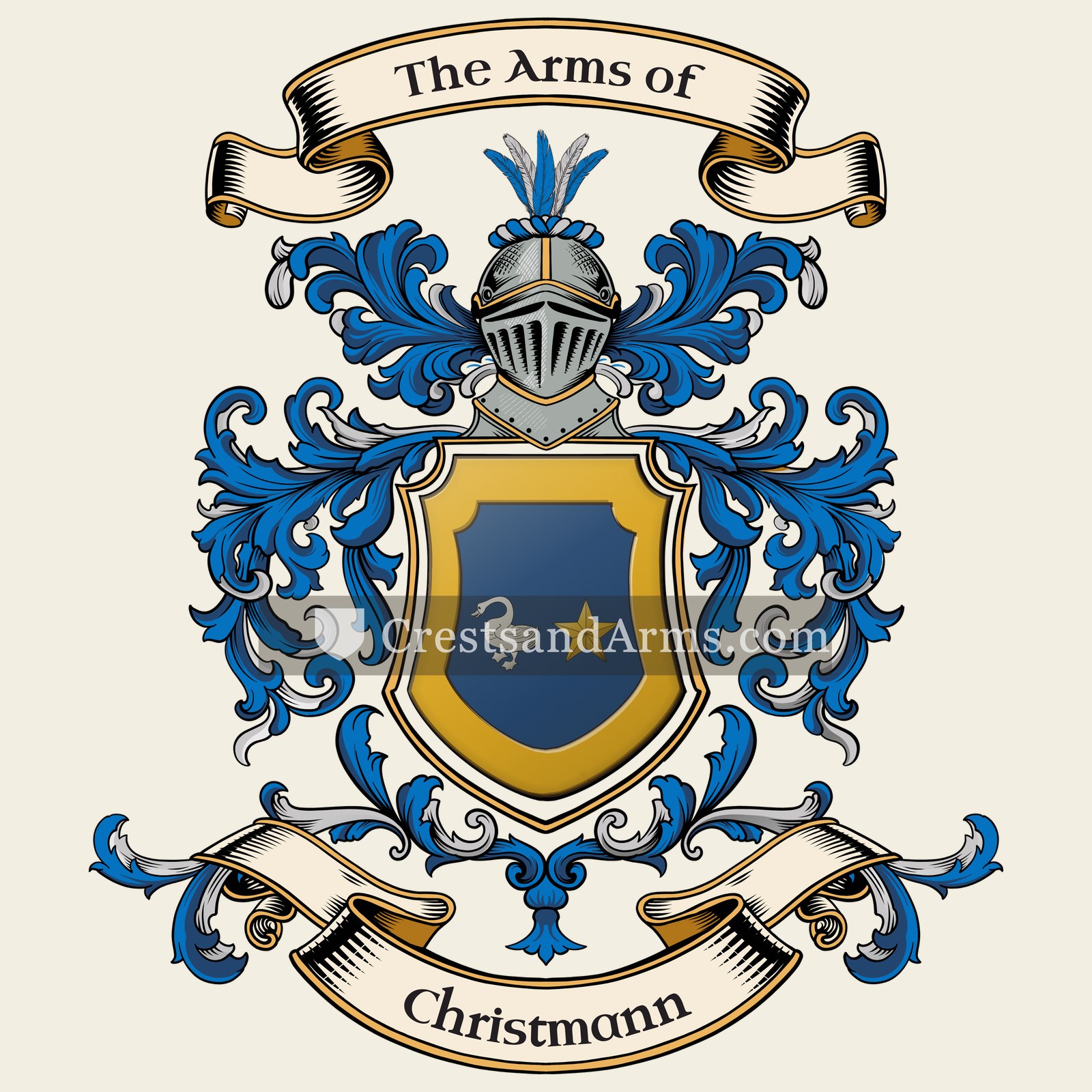

 mountThe ground held, and steadfastness upon it
 knightChivalry and service in arms