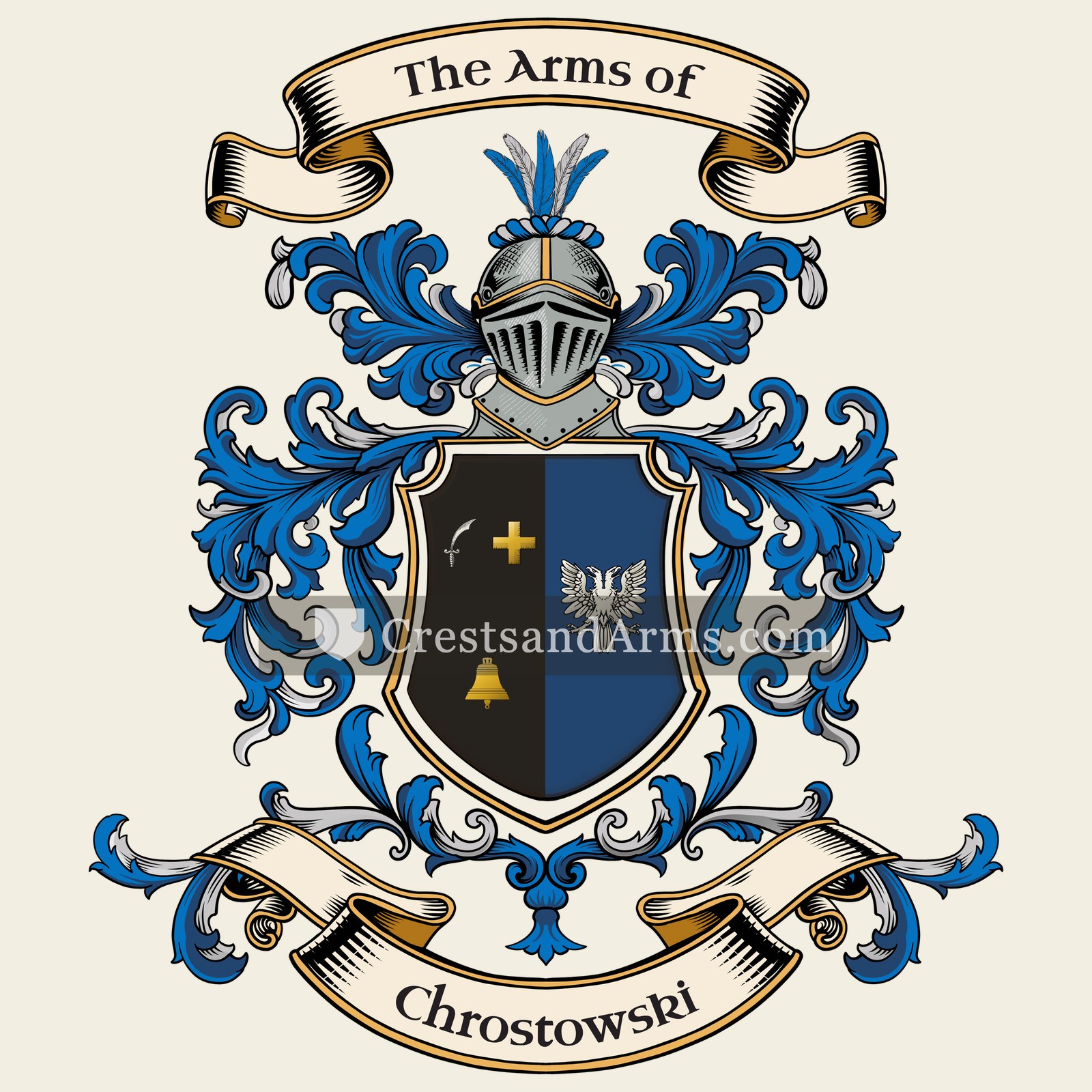
A record of documented arms, meaning and origin, researched for the Chrostowski family of Russia.
Reg. 2830 · Russian, A–C
Coat of Arms & Family Crest Details
Symbols on this shield
cross symbolChristian faith and service
chequyConstancy, and the counting-board
swordJustice, and military honour
bellA call to prayer, and a warning given
eagleNobility, strength and a keen mind
Colours
Black (Sable)Means: Constancy
Blue (Azure)Means: Loyalty and truth
Silver (Argent)Means: Peace and sincerity
Gold (Or)Means: Generosity
Historical info
Source
J. B. Rietstap, Armorial Général, Gouda: G. B. van Goor Zonen, 1884–87
Blazon (the actual original written record)
“Parti: au 1 de sa. à un sabre d'arg., garni d'or, posé en barre, la pointe en bas, acc. en chef à dextre d'une croix pattée d'or et en p. à sen. d'une cloche du même; au 2 coupé: a. d'azur à la demi-aigle au nat., sommée d'une couronne royale d'or, mouv. du parti; b. échiq. d'arg. et d'azur. C.: trois pl. d'aut.”
Russiac. 1784
Digital archive packCoat of arms PNG, gold border print PDF, vector SVG and the certificate of authenticity. Sent to your email in minutes.
Map of Russia showing where the Chrostowski arms are recorded
The Chrostowski arms were recorded in Russia, c. 1784.
Arms such as these were typically recorded in Moscow.
Moscow held the Russian court, and rank there came from service rather than land. Families who served the Tsar were entered in the registers of nobility, and that entry is where their arms are recorded.
This is where the arms were entered in the register. Families often moved to other parts of the country, so the same name can turn up in more than one region.
The body that granted and recorded arms in Russia in this period.
Catherine II of Russia
Sovereign of the period
Catherine II of Russia
1762–1796
Reigning in Russia when the Chrostowski arms are first recorded.
How Arms Worked in Russia
Russian heraldry was strictly tied to the nobility and the state service system. Families proved their ancient status or earned new rank to receive an official grant from the Tsar. These symbols were then inherited by all legitimate children of the noble line. If a family lacked proof of their status, they were often excluded from the official records entirely.
Granting authority
The Herald Master's Office acted as the central state body that strictly regulated and verified all noble heraldic symbols.
How they got arms
Families typically received their arms through a formal state grant or by proving their noble status to the government authorities.
Where arms were recorded
All approved coats of arms were officially recorded in the General Armorial of the Noble Families of the Russian Empire starting in 1797.
The family's standing
Recorded among the armigerous families of Russia.
Origin & History of the Chrostowski Family in Russia
The surname Chrostowski is rooted in the linguistic traditions of the Slavic regions, specifically deriving from the Polish word "chrost," which refers to brushwood or a thicket. Historically, this suggests that the earliest ancestors likely lived near a dense forest or a shrub-covered area, leading neighbors to identify them by their surroundings. By the late 18th century, members of the family had established a presence in Moscow, as evidenced by records from 1784. During this period, Moscow served as a major crossroads for people moving between the Polish-Lithuanian Commonwealth and the expanding Russian Empire. The family likely migrated due to the shifting political borders and economic opportunities found in the imperial capital. As they settled into this new urban environment, they maintained their distinct surname, which served as a link to their ancestral origins while they integrated into the diverse social fabric of 18th-century Russia.
Related Branches & Arms
Root word
chrost
Old Polish term referring to brushwood, thickets, or thorny undergrowth.
This name
ChrostowskiA topographic surname denoting someone who lived near or worked in a dense thicket or brushwood area.
also spelled
Christowsky
Kristowski
Kristowsky
Documented Sources
J. B. Rietstap, Armorial Général, Gouda: G. B. van Goor Zonen, 1884–87
Krzysztof Górski, Nazwiska Polaków: Słownik historyczno-etymologiczny, 1990
Russian State Archive of Ancient Acts (RGADA), Fond 350: Land Census Records of the Moscow Governorate, 1784
Kazimierz Rymut, Nazwiska Polaków: Słownik historyczno-etymologiczny, 1999
Digital archive packCoat of arms PNG, gold border print PDF, vector SVG and the certificate of authenticity. Sent to your email in minutes.


 cross symbolChristian faith and service
 chequyConstancy, and the counting-board
 swordJustice, and military honour
 bellA call to prayer, and a warning given
 eagleNobility, strength and a keen mind
 cross symbolChristian faith and service
 chequyConstancy, and the counting-board
 swordJustice, and military honour
 bellA call to prayer, and a warning given
 eagleNobility, strength and a keen mind