Map of England showing where the Church arms are recorded
The Church arms were recorded in Essex, c. 1620.
Essex lay close enough to London for City money to buy land there. Merchants who prospered moved out to estates within a day's ride, and a new landowner almost always wanted arms to go with the ground.
This is where the arms were entered in the register. Families often moved to other parts of the country, so the same name can turn up in more than one region.
The body that granted and recorded arms in England in this period.
James VI and I
Sovereign of the period
James VI and I
1603–1625
Reigning in England when the Church arms are first recorded.
How Arms Worked in England
English heraldry allowed arms to be shared by all legitimate descendants of the original owner. These symbols were treated as personal property that moved through the generations to all children. While the eldest son kept the original design, other family members could use the same shield without needing to change it or register their own unique versions.
Granting authority
The College of Arms in London has regulated the use of coats of arms throughout England and Wales since 1484.
How they got arms
Families typically obtained their coats of arms through a formal grant from the Crown or by proving their ancient right to them.
Where arms were recorded
All official coats of arms are recorded in the registers kept at the College of Arms, which date back to the fifteenth century.
The family's standing
Recorded among the armigerous families of Essex.
Origin & History of the Church Family in England
The surname Church is a locative name, meaning it was originally used to identify people who lived near a prominent local church or served as officials within the parish. In medieval England, surnames often emerged from a person's surroundings, and those living in the shadow of a village steeple were frequently referred to by this title. By the early 17th century, the name was well-established across several English counties, including Essex. Records from 1620 confirm that families bearing the name were active members of the Essex community during this period of significant social change. These early ancestors were likely farmers or tradespeople who played a vital role in the daily life of their parishes. As the name spread through local records, it became a permanent marker of families who were deeply rooted in the English landscape long before many of them eventually crossed the Atlantic to seek new opportunities in the American colonies.
Coat of Arms & Family Crest Details
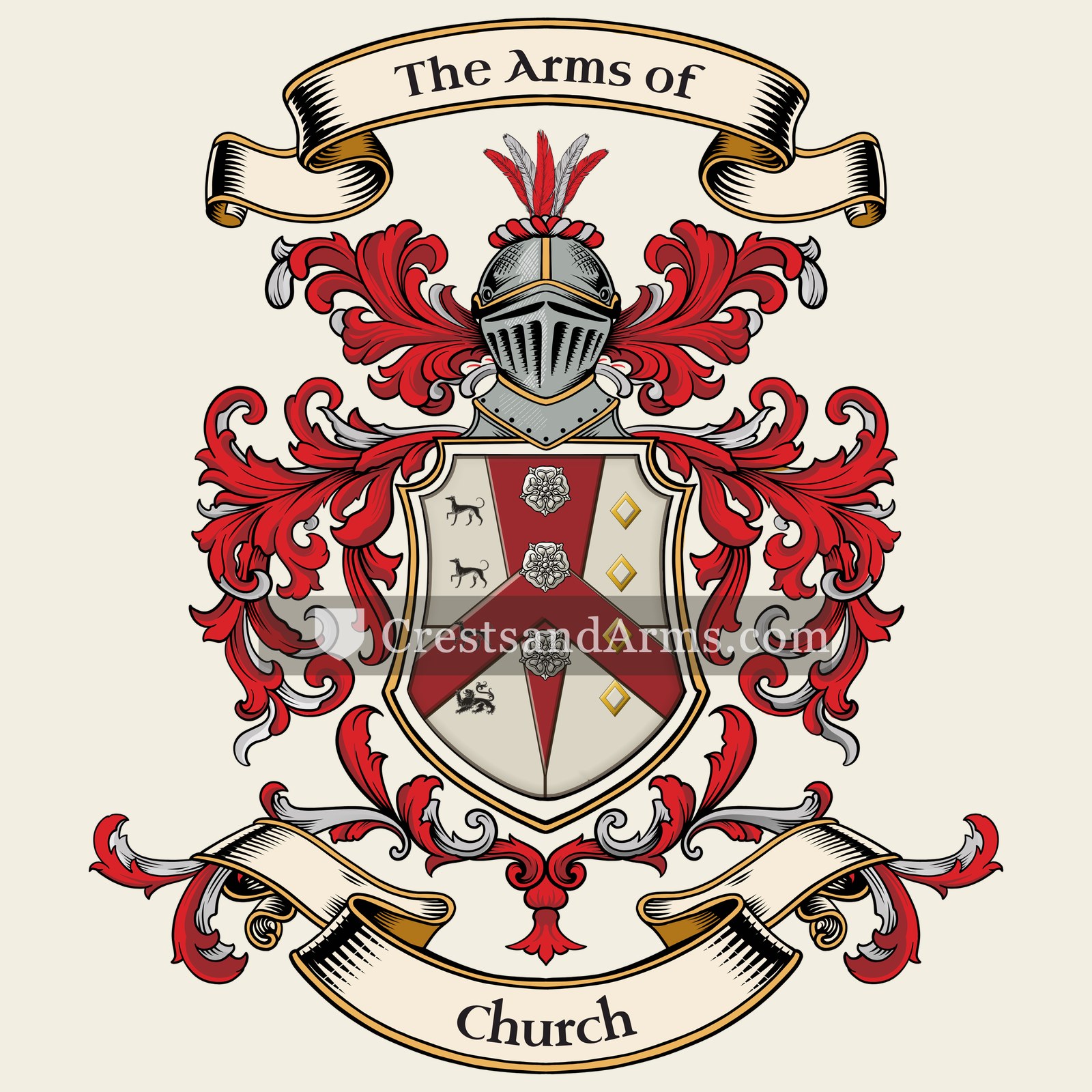
Symbols on this shield
pileWell-doing, and a mark of distinction
chevronProtection, and faithful service completed
roseThe seventh son, and beauty with grace
greyhoundCourage, vigilance and loyalty
lionCourage, strength and royalty
masclePersuasion and the mail of a knight's coat
Colours
Silver (Argent)Means: Peace and sincerity
Red (Gules)Means: Military strength
Black (Sable)Means: Constancy
Gold (Or)Means: Generosity
Historical info
Source
Sir Bernard Burke, The General Armory of England, Scotland, Ireland and Wales, London: Harrison & Sons, 1884
Blazon (the actual original written record)
“Quarterly, 1st and 4th, ar. on a pile gu. a chev. of the field charged with three roses of the second barbed and seeded ppr. betw. as many greyhounds' heads erased of the first, for CHURCH; 2nd and 3rd, sa. a lion ramp. betw. four mascles saltirewise or, for PHILLIPS”
BreconFfrwdgrech · Brecon, c. 1869
Digital archive packCoat of arms PNG, gold border print PDF, vector SVG and the certificate of authenticity. Sent to your email in minutes.
Map of Wales showing where the Church arms are recorded
The Church arms were recorded in Brecon, c. 1869.
Brecon was mid-Welsh hill country, held in small estates by families who stayed for generations. Land was worth less than in the lowlands, but holding it still brought arms.
This is where the arms were entered in the register. Families often moved to other parts of the country, so the same name can turn up in more than one region.
The body that granted and recorded arms in Wales in this period.
Victoria
Sovereign of the period
Victoria
1837–1901
Reigning in England when the Church arms are first recorded.
How Arms Worked in Wales
English heraldry allowed arms to be shared by all legitimate descendants of the original owner. These symbols were treated as personal property that moved through the generations to all children. While the eldest son kept the original design, other family members could use the same shield without needing to change it or register their own unique versions.
Granting authority
The College of Arms in London has regulated the use of coats of arms throughout England and Wales since 1484.
How they got arms
Families typically obtained their coats of arms through a formal grant from the Crown or by proving their ancient right to them.
Where arms were recorded
All official coats of arms are recorded in the registers kept at the College of Arms, which date back to the fifteenth century.
The family's standing
Recorded among the armigerous families of Brecon.
Origin & History of the Church Family in Wales
The surname Church is a topographical name, which means it was originally given to people who lived near a prominent local church or a religious building. While the name is common throughout England, its presence in Wales often reflects the movement of families across the border or the anglicization of local Welsh names during the nineteenth century. By 1869, records confirm that members of the Church family were well-established in the market town of Brecon. This town served as a vital hub for trade and administration in the region, suggesting that these early ancestors were likely involved in the local economy or the growing industrial sectors of South Wales. Their presence in Brecon highlights how families during this era often settled in growing towns to take advantage of new opportunities in commerce and community life. As the family integrated into the Welsh landscape, they became part of the unique social fabric of the Breconshire area, contributing to the history of a region known for its deep connection to both its rural roots and its evolving urban centers.
Church Meaning & Related Branches
Root word
kyriakon
Ancient Greek term meaning belonging to the Lord.
This name
ChurchA topographic name for someone who lived near a church or was employed by one.
also spelled
Chirch
Related arms
Fulthorprecorded with Church, same area
Spaneyrecorded with Church, same area
Tongrecorded with Church, same area
Documented Sources
Sir Bernard Burke, The General Armory of England, Scotland, Ireland and Wales, London: Harrison & Sons, 1884
Bardsley, Charles Wareing, A Dictionary of English and Welsh Surnames, 1901
Reaney, P.H., A Dictionary of British Surnames, 1958
Essex Record Office, Archdeaconry of Essex Records, 1620
Digital archive packCoat of arms PNG, gold border print PDF, vector SVG and the certificate of authenticity. Sent to your email in minutes.


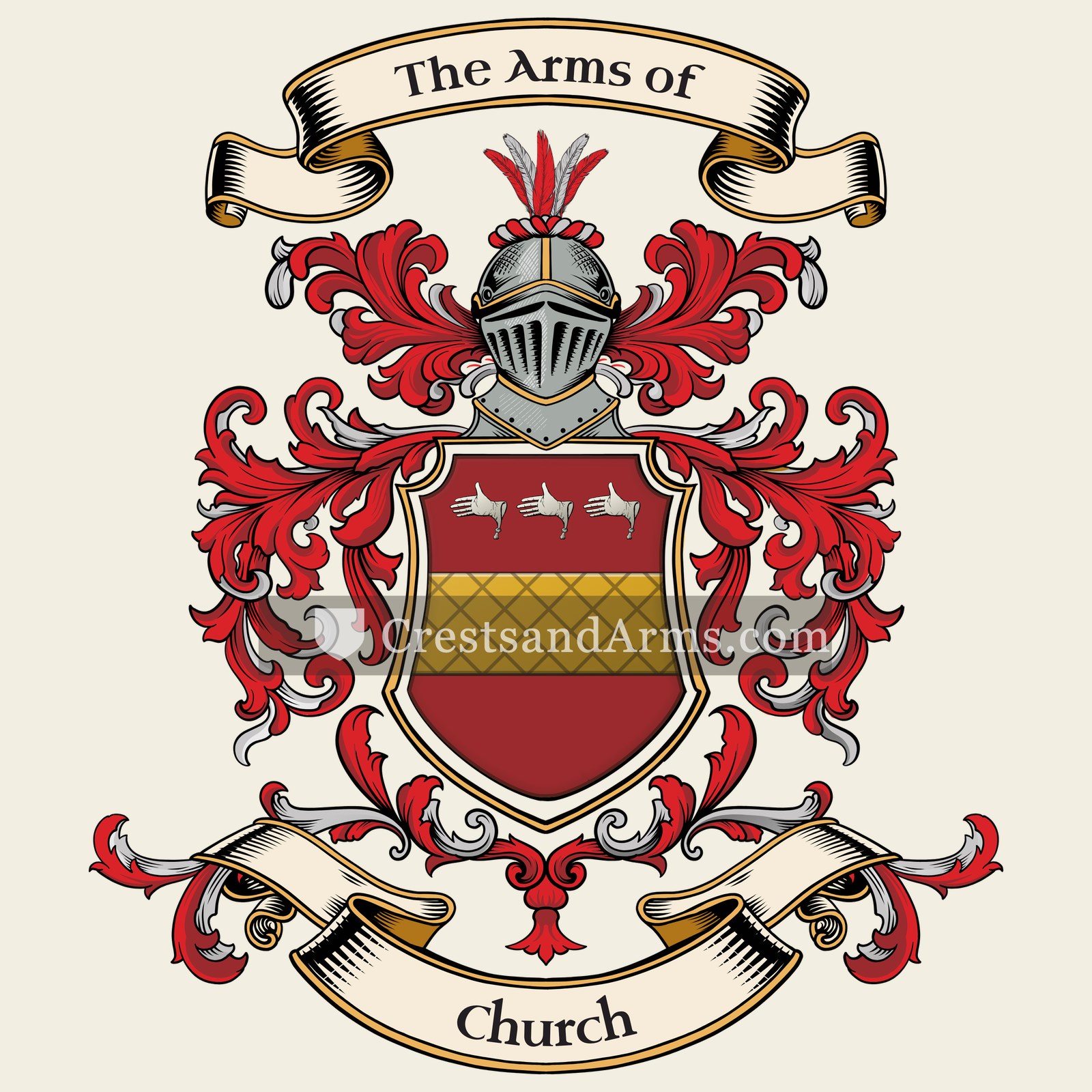
 fessThe military belt, and readiness to serve
 gauntletA challenge given and the readiness to meet it
 fessThe military belt, and readiness to serve
 gauntletA challenge given and the readiness to meet it


 pileWell-doing, and a mark of distinction
 chevronProtection, and faithful service completed
 roseThe seventh son, and beauty with grace
 greyhoundCourage, vigilance and loyalty
 lionCourage, strength and royalty
 masclePersuasion and the mail of a knight's coat