Map of England showing where the Ciarletta arms are recorded
The Ciarletta arms were recorded in Worcester, c. 1620.
Worcestershire was orchard and farming country with a scattering of old manors. Its gentry were middling rather than great, but a manor was a manor, and holding one was what brought arms.
This is where the arms were entered in the register. Families often moved to other parts of the country, so the same name can turn up in more than one region.
The body that granted and recorded arms in England in this period.
James VI and I
Sovereign of the period
James VI and I
1603–1625
Reigning in England when the Ciarletta arms are first recorded.
How Arms Worked in England
English heraldry allowed arms to be shared by all legitimate descendants of the original owner. These symbols were treated as personal property that moved through the generations to all children. While the eldest son kept the original design, other family members could use the same shield without needing to change it or register their own unique versions.
Granting authority
The College of Arms in London has regulated the use of coats of arms throughout England and Wales since 1484.
How they got arms
Families typically obtained their coats of arms through a formal grant from the Crown or by proving their ancient right to them.
Where arms were recorded
All official coats of arms are recorded in the registers kept at the College of Arms, which date back to the fifteenth century.
The family's standing
Recorded among the armigerous families of Worcester.
Origin & History of the Ciarletta Family in England
The surname Ciarletta finds its roots in the linguistic traditions of southern Italy, where it evolved as a diminutive form of the given name Ciaro. This naming convention typically served to identify a younger member of a family or a person with a specific physical trait. While the name is deeply tied to Italian heritage, the presence of the family in Worcester by 1620 suggests a remarkably early migration pattern for the era. During the seventeenth century, individuals moving from the Mediterranean to English-speaking regions often faced significant challenges in documenting their origins, yet these early settlers managed to establish a foothold in the local community. By integrating into the social and economic fabric of Worcester, the Ciarletta family transitioned from their Mediterranean beginnings to become part of the historical landscape of early colonial society.
Related Branches & Arms
Root word
Chiaro
An Italian adjective meaning clear, bright, or light-colored.
This name
CiarlettaA diminutive form indicating a person with light hair or a bright complexion.
also spelled
Charlety
Documented Sources
Sir Bernard Burke, The General Armory of England, Scotland, Ireland and Wales, London: Harrison & Sons, 1884
De Felice, Emidio. Dizionario dei cognomi italiani. 1978
Fucilla, Joseph G. Our Italian Surnames. 1949
Worcestershire Archive and Archaeology Service. Parish Registers of Worcester, 1600–1650
Digital archive packCoat of arms PNG, gold border print PDF, vector SVG and the certificate of authenticity. Sent to your email in minutes.


 bordureA difference between branches of one family
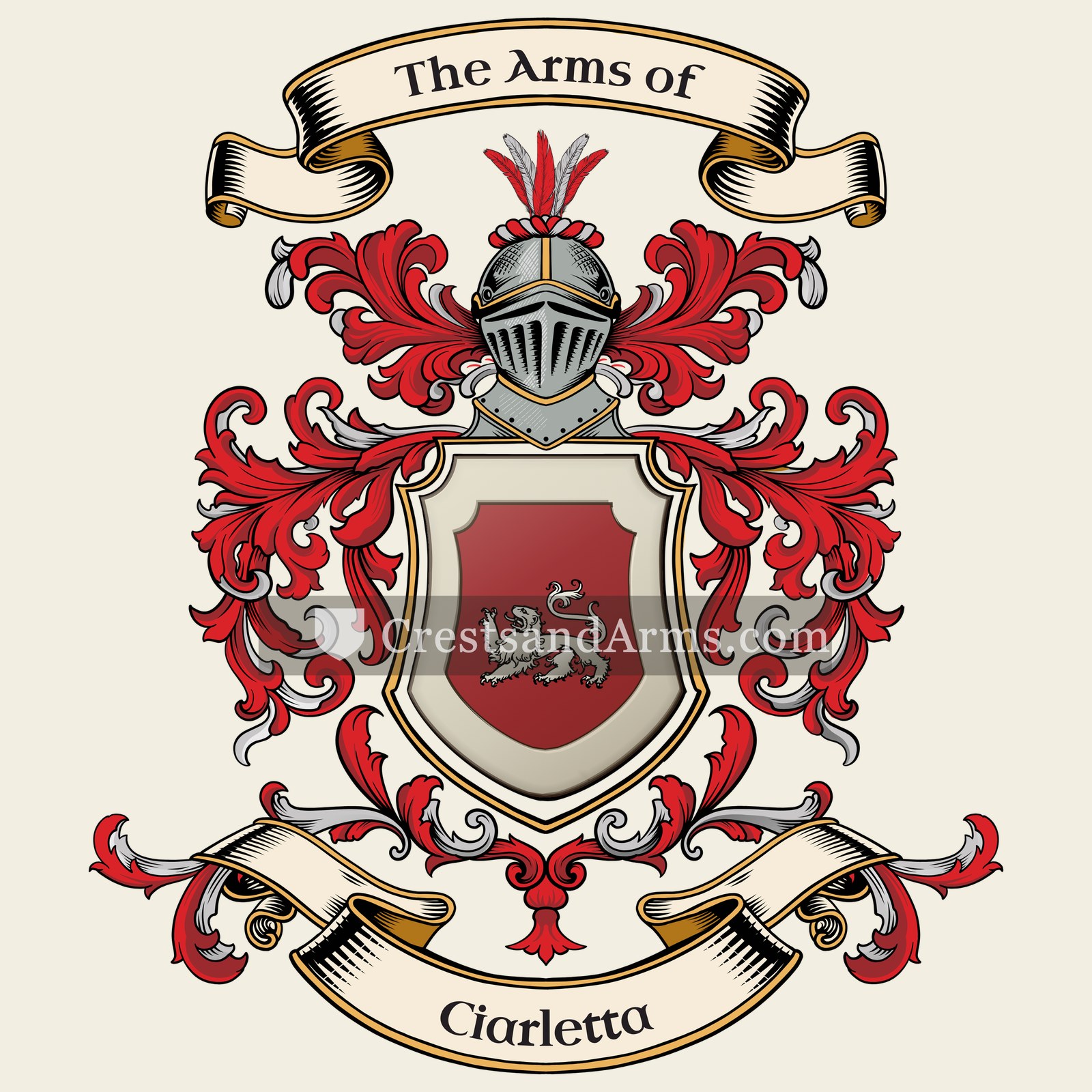
 lionCourage, strength and royalty
 bordureA difference between branches of one family
 lionCourage, strength and royalty