Map of Italy showing where the Cicle arms are recorded
The Cicle arms were recorded in Dalmatia, c. 1775.
Dalmatia was a string of walled towns along the Adriatic coast, each with its own leading families. Sea trade made them wealthy, and the towns kept lists of the houses entitled to arms.
This is where the arms were entered in the register. Families often moved to other parts of the country, so the same name can turn up in more than one region.
The body that granted and recorded arms in Italy in this period.
Alvise Giovanni Mocenigo
Sovereign of the period
Alvise Giovanni Mocenigo
1763–1778
Reigning in Italy when the Cicle arms are first recorded.
How Arms Worked in Italy
In the Italian states, coats of arms were often used by noble families to show their status and history. These symbols were passed down through the generations to all legitimate male descendants. Younger branches of a family usually kept the original design but sometimes added small changes to distinguish their specific line from the main branch.
Granting authority
Various local rulers and city governments controlled the use of coats of arms across the different Italian states.
How they got arms
Families often assumed their own arms or received them as official grants from local lords, popes, or city councils.
Where arms were recorded
Arms were recorded in local city archives or private family books rather than in one single national register.
The family's standing
Recorded among the armigerous families of Dalmatia.
Origin & History of the Cicle Family in Italy
The history of the Cicle family name is deeply rooted in the coastal region of Dalmatia, where records confirm the presence of family members by the year 1775. During this period, Dalmatia was a vibrant crossroads of culture under the influence of the Venetian Republic and the Austro-Hungarian Empire. Families living in this area were often involved in maritime trade, agriculture, or local administration due to the strategic importance of the Adriatic coastline. The name likely evolved as a localized variation of regional surnames common to the Slavic and Italian populations living side by side in Dalmatian port cities. As the family moved through these changing political landscapes, they maintained their identity while adapting to the linguistic shifts of the Balkan Peninsula. This early presence in Dalmatia suggests that the ancestors of the Cicle line were part of the resilient communities that helped shape the social and economic fabric of the eastern Adriatic shore during the late eighteenth century.
Cicle Meaning & Related Branches
Root word
Cicero
Derived from the Latin word for chickpea or a facial growth.
This name
CicleAn occupational or descriptive surname likely referring to a grower or seller of chickpeas.
also spelled
Cikel
Sikl
Documented Sources
J. B. Rietstap, Armorial Général, Gouda: G. B. van Goor Zonen, 1884–87
Kovačić, Slavko. Pregled povijesti župa Splitske nadbiskupije, 1990
State Archives in Split (Državni arhiv u Splitu), Matice krštenih i vjenčanih za područje Dalmacije, 1775
Digital archive packCoat of arms PNG, gold border print PDF, vector SVG and the certificate of authenticity. Sent to your email in minutes.


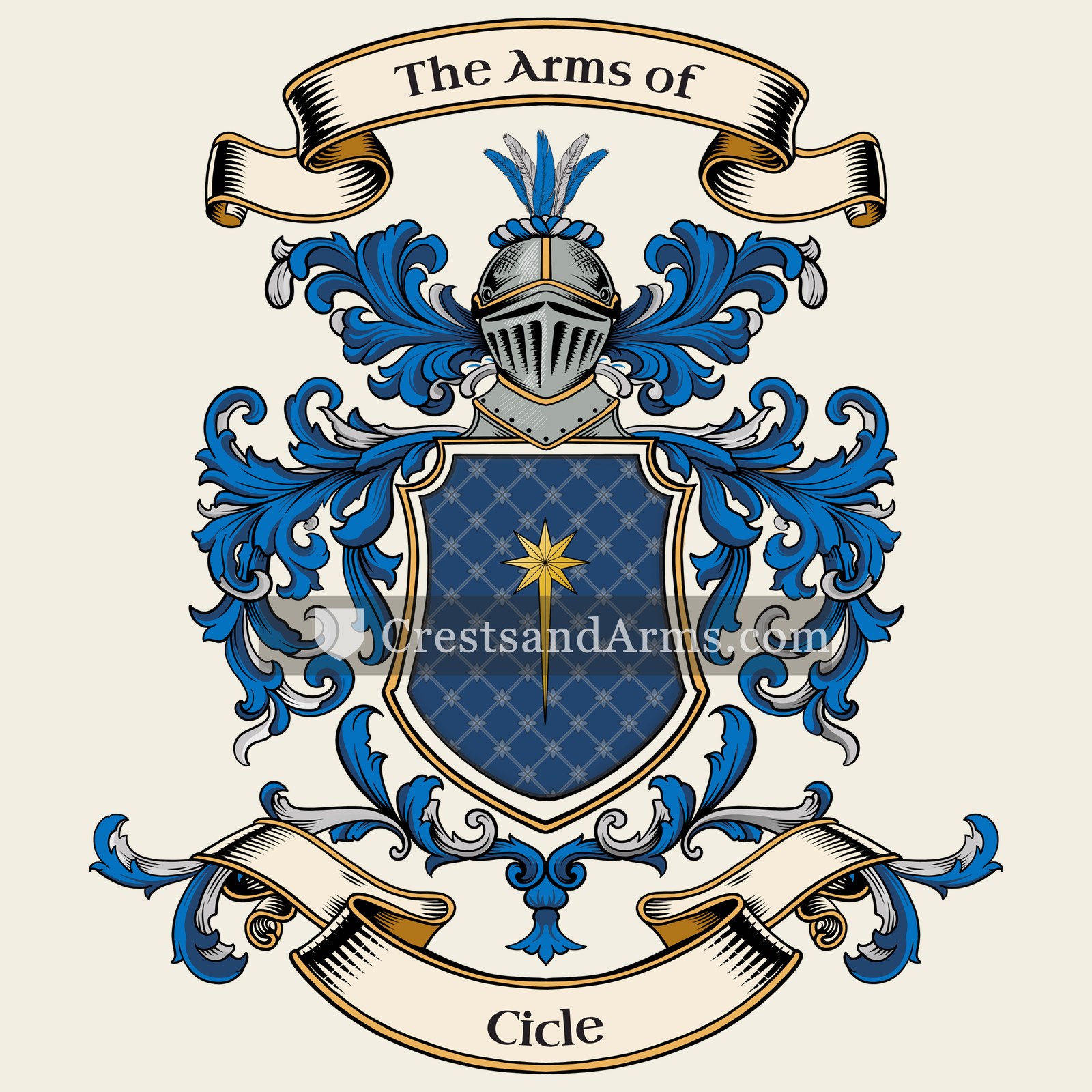
 cometA great event foretold, and swift renown
 cometA great event foretold, and swift renown