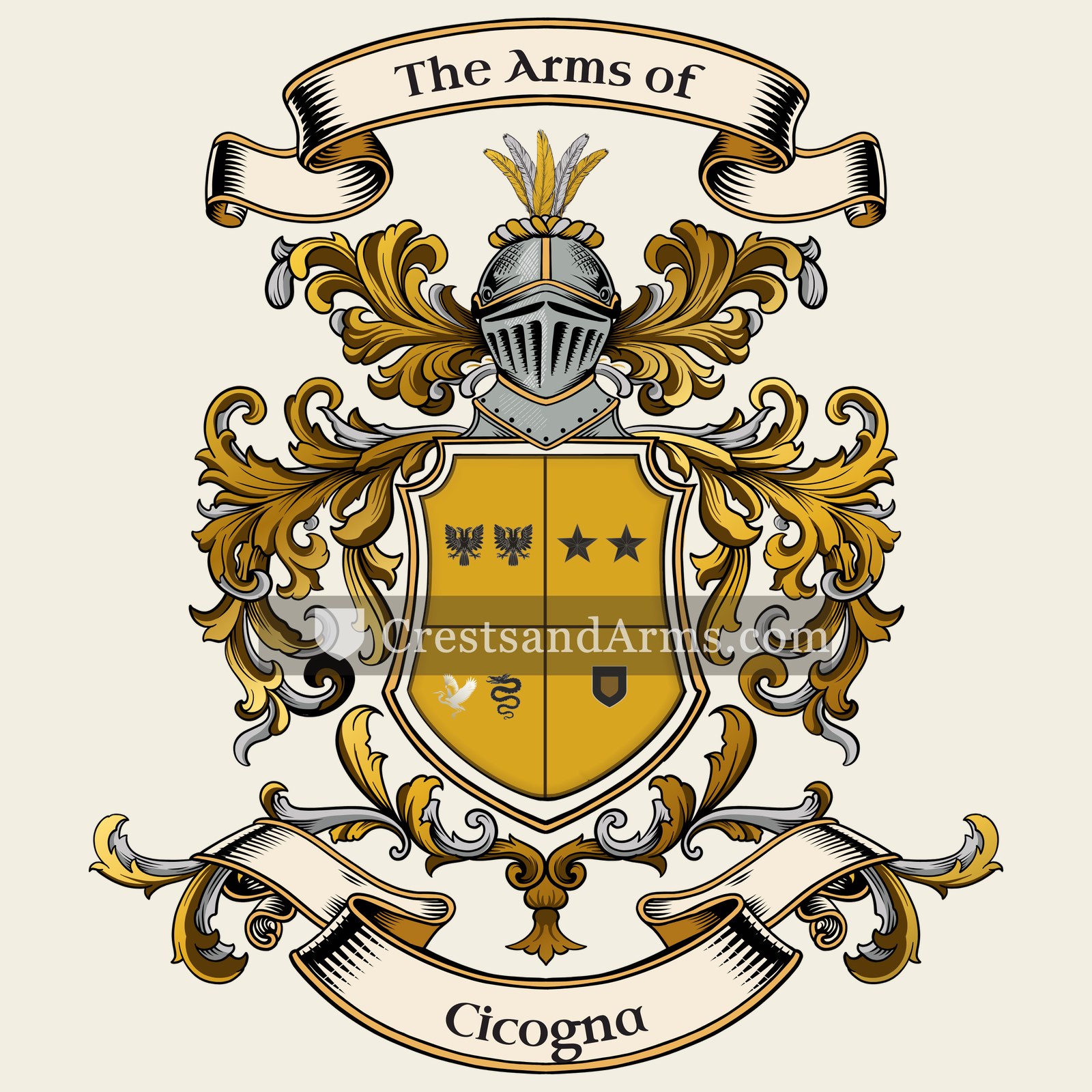
A record of documented arms, meaning and origin, researched for the Cicogna family of Italy.
Reg. 6863 · Italian, A–C
Coat of Arms & Family Crest Details
Symbols on this shield
eagleNobility, strength and a keen mind
mulletThe third son, and a divine quality from above
heronPatience and quiet watchfulness
serpentWisdom, healing and prudence
escutcheonA shield within a shield, and a claim inherited
Colours
Gold (Or)Means: Generosity
Black (Sable)Means: Constancy
Silver (Argent)Means: Peace and sincerity
Historical info
Source
J. B. Rietstap, Armorial Général, Gouda: G. B. van Goor Zonen, 1884–87
Blazon (the actual original written record)
“Ec.: aux 1 et 4 d'or à l'aigle de sa.; aux 2 et 3 de gu. à une étoile d'or, surm. d'un listel d'arg., ch. du mot VICTORIA. Sur le tout d'azur à une cigogne d'arg., bq. et m. de gu., tenant en son bec une anguille au nat. Deux cq. cour. C.: 1° la cigogne; 2° l'aigle, iss.”
ItalyVérone, c. 1775
Digital archive packCoat of arms PNG, gold border print PDF, vector SVG and the certificate of authenticity. Sent to your email in minutes.
Map of Italy showing where the Cicogna arms are recorded
The Cicogna arms were recorded in Vérone, c. 1775.
This is where the arms were entered in the register. Families often moved to other parts of the country, so the same name can turn up in more than one region.
The body that granted and recorded arms in Italy in this period.
Alvise Giovanni Mocenigo
Sovereign of the period
Alvise Giovanni Mocenigo
1763–1778
Reigning in Italy when the Cicogna arms are first recorded.
How Arms Worked in Italy
In the Italian states, coats of arms were often used by noble families to show their status and history. These symbols were passed down through the generations to all legitimate male descendants. Younger branches of a family usually kept the original design but sometimes added small changes to distinguish their specific line from the main branch.
Granting authority
Various local rulers and city governments controlled the use of coats of arms across the different Italian states.
How they got arms
Families often assumed their own arms or received them as official grants from local lords, popes, or city councils.
Where arms were recorded
Arms were recorded in local city archives or private family books rather than in one single national register.
The family's standing
Recorded among the armigerous families of Italy.
Origin & History of the Cicogna Family in Italy
The surname Cicogna originates from the Italian word for stork, a bird that has long served as a symbol of good fortune and migration throughout European history. By the late eighteenth century, the family was well established in the city of Verona, which was then a significant cultural and administrative hub within the Republic of Venice. During this period, families in the region often gained social standing through involvement in local governance, trade, or the management of agricultural estates in the surrounding Venetian countryside. The presence of the Cicogna name in Verona by 1775 suggests that the family was part of the stable middle or upper classes who helped maintain the city's infrastructure and traditions during the final years of the Venetian Republic. As the family grew, they became deeply integrated into the local community, contributing to the distinct social fabric of Northern Italy before the major political shifts of the nineteenth century.
Cicogna Meaning & Related Branches
Root word
ciconia
A Latin term referring to the long-legged wading bird, the stork.
This name
CicognaDerived from a nickname for someone who resembled a stork or lived near a nesting site.
also spelled
Cicognae
Cicognah
Cicogn
Chikonya
Documented Sources
J. B. Rietstap, Armorial Général, Gouda: G. B. van Goor Zonen, 1884–87
Crollalanza, Giovan Battista di, Dizionario storico-blasonico delle famiglie nobili e notabili italiane estinte e fiorenti, 1886
Archivio di Stato di Verona, Anagrafe storica della città di Verona, 1775
Digital archive packCoat of arms PNG, gold border print PDF, vector SVG and the certificate of authenticity. Sent to your email in minutes.


 eagleNobility, strength and a keen mind
 mulletThe third son, and a divine quality from above
 heronPatience and quiet watchfulness
 serpentWisdom, healing and prudence
 escutcheonA shield within a shield, and a claim inherited
 eagleNobility, strength and a keen mind
 mulletThe third son, and a divine quality from above
 heronPatience and quiet watchfulness
 serpentWisdom, healing and prudence
 escutcheonA shield within a shield, and a claim inherited