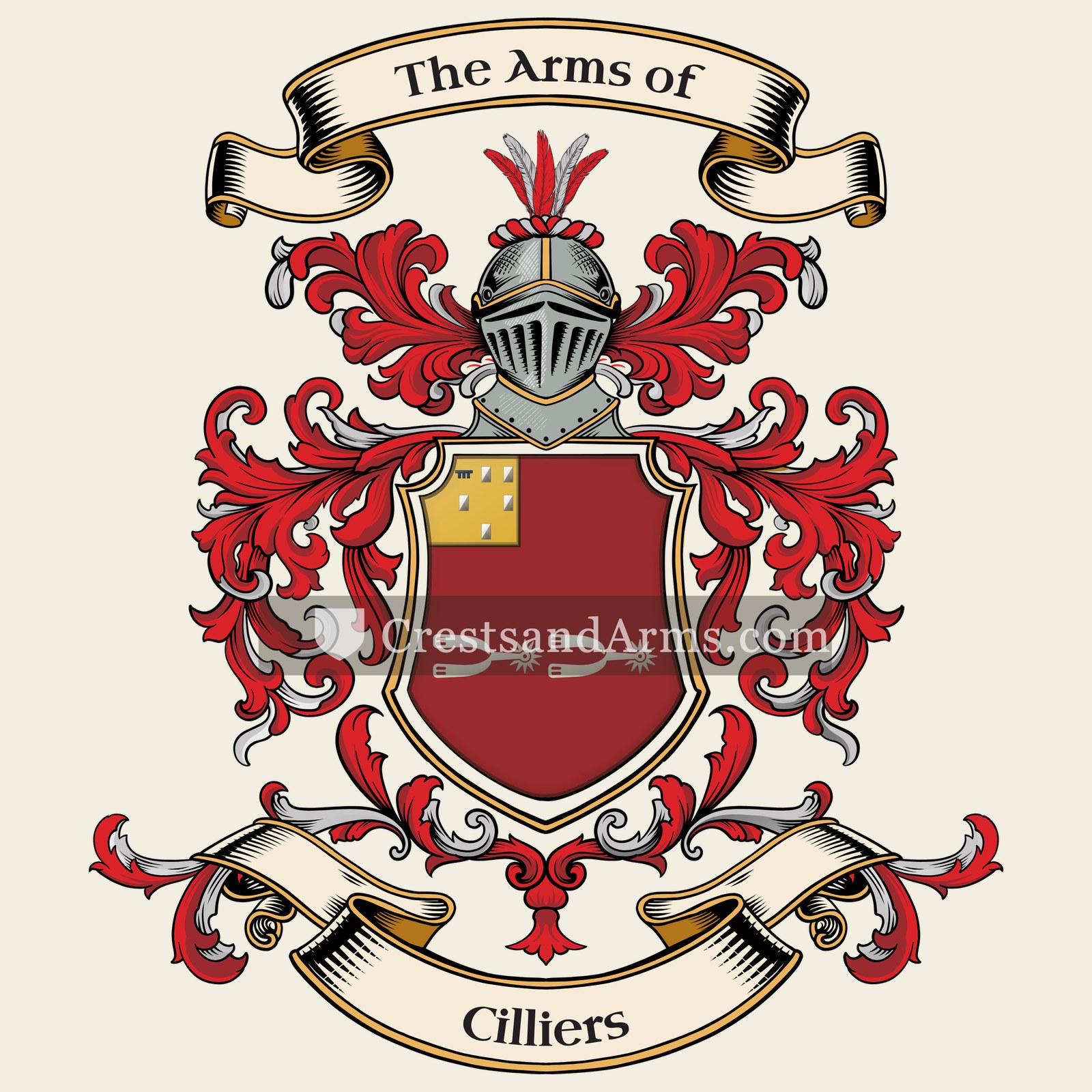
A record of documented arms, meaning and origin, researched for the Cilliers family of Belgium.
Reg. 9735 · Belgian, A–C
Coat of Arms & Family Crest Details
Symbols on this shield
labelThe eldest son, during his father's life
spurKnighthood, and readiness to spur on
billetThe sealed letter, and a message delivered
Colours
Red (Gules)Means: Military strength
Gold (Or)Means: Generosity
Silver (Argent)Means: Peace and sincerity
Blue (Azure)Means: Loyalty and truth
Historical info
Source
J. B. Rietstap, Armorial Général, Gouda: G. B. van Goor Zonen, 1884–87
Blazon (the actual original written record)
“De gu. à deux étriers d'arg., 1 en chef à sen. et 1 en p.; au fr.-q. d'or, ch. d'un lambel d'azur, acc. de cinq bill. couchées de gu., 3 en chef et 2 en p.”
Belgiumc. 1737
Digital archive packCoat of arms PNG, gold border print PDF, vector SVG and the certificate of authenticity. Sent to your email in minutes.
Map of Belgium showing where the Cilliers arms are recorded
The Cilliers arms were recorded in Belgium, c. 1737.
Arms such as these were typically recorded in Brabant.
Brabant lay at the heart of the Low Countries, where the trade routes met. Its towns were wealthy and its landowners many, and both kinds of family kept arms, which is why the region is so heavily represented.
This is where the arms were entered in the register. Families often moved to other parts of the country, so the same name can turn up in more than one region.
The body that granted and recorded arms in Belgium in this period.
Charles VI, Holy Roman Emperor
Sovereign of the period
Charles VI, Holy Roman Emperor
1711–1740
Reigning in Belgium when the Cilliers arms are first recorded.
How Arms Worked in Belgium
In Belgium, a coat of arms is considered personal property that is passed down through the male line to legitimate descendants. Families often use the same shield design across generations to show their shared heritage. If a branch of the family wants to change the design, they must apply for an official update to their specific version of the arms.
Granting authority
The Conseil héraldique is the official body that regulates and approves all coats of arms in Belgium.
How they got arms
Families obtain their coats of arms through formal royal grants or by confirming their historical right to use existing designs.
Where arms were recorded
All approved coats of arms are officially recorded in the public registers of the Conseil héraldique since 1844.
The family's standing
Recorded among the armigerous families of Belgium.
Origin & History of the Cilliers Family in Belgium
The Cilliers family name has its roots in the historical region of Brabant, which spans parts of modern-day Belgium and the Netherlands. By 1737, records indicate that members of the family were established in this area, living as part of a society deeply influenced by trade and local agriculture. The name itself is thought to be a variation of the French word *cellier*, which refers to a person who worked in a storeroom or a wine cellar. This suggests that the earliest ancestors likely held occupations related to the storage and management of goods. As the family grew, their presence in the region became tied to the social and economic shifts of the eighteenth century. Many individuals bearing the name eventually migrated across Europe and beyond, carrying this occupational history with them as they settled in new lands.
Related Branches & Arms
Root word
Cillier
Derived from the French word for a cellar or storeroom.
This name
CilliersAn occupational surname for someone who worked in or managed a cellar.
also spelled
Cellyers
Sellyay
Documented Sources
J. B. Rietstap, Armorial Général, Gouda: G. B. van Goor Zonen, 1884–87
De Villiers, C.C., Geslacht-register der oude Kaapsche familien, 1893
Heese, J.A. and Lombard, R.T.J., South African Genealogies, 1986
National Archives of South Africa, Cape Town Archives Repository (KAB), Church Registers, 1737
Digital archive packCoat of arms PNG, gold border print PDF, vector SVG and the certificate of authenticity. Sent to your email in minutes.


 labelThe eldest son, during his father's life
 spurKnighthood, and readiness to spur on
 billetThe sealed letter, and a message delivered
 labelThe eldest son, during his father's life
 spurKnighthood, and readiness to spur on
 billetThe sealed letter, and a message delivered