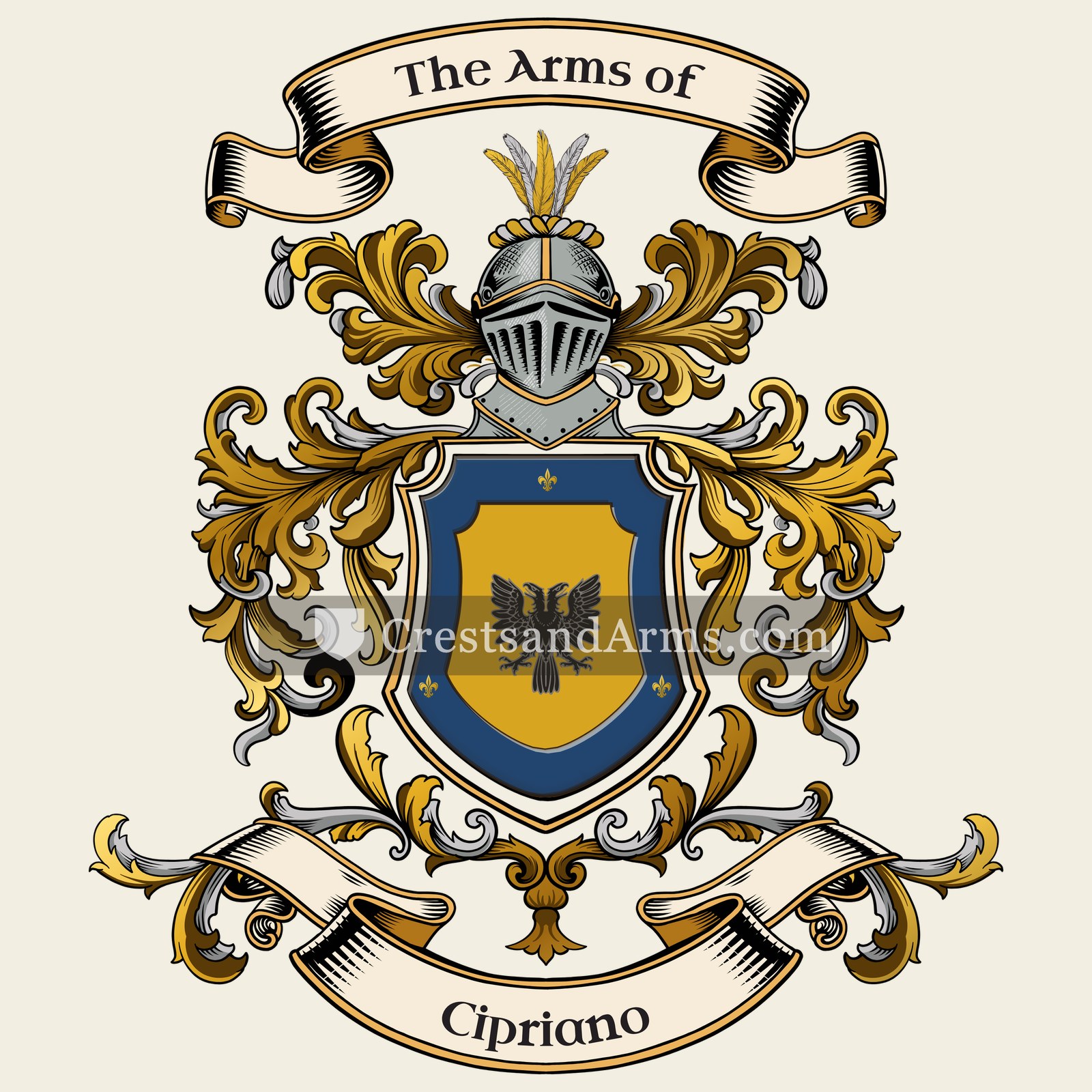
A record of documented arms, meaning and origin, researched for the Cipriano family lines. Documented in 3 countries.
Reg. 7598 · French, A–C
Coat of Arms & Family Crest Details
Symbols on this shield
roundelA coin, and one who has been to the crusades
Colours
Gold (Or)Means: Generosity
Historical info
Source
J. B. Rietstap, Armorial Général, Gouda: G. B. van Goor Zonen, 1884–87
Blazon (the actual original written record)
“D'or à six boules d'azur. C.: une couleuvre cour., engloutissant une couleuvre plus petite. - Armes mod.: Coupé: au 1 parti: d'or à six boules d'azur, et d'azur à trois chev. d'or; et au chef d'arg., br. sur ce parti et ch. d'une croix de Jérusalem d'or; au 2”
FranceCorse, c. 1663
Digital archive packCoat of arms PNG, gold border print PDF, vector SVG and the certificate of authenticity. Sent to your email in minutes.
Map of France showing where the Cipriano arms are recorded
The Cipriano arms were recorded in Corse, c. 1663.
This is where the arms were entered in the register. Families often moved to other parts of the country, so the same name can turn up in more than one region.
The body that granted and recorded arms in France in this period.
Louis XIV of France
Sovereign of the period
Louis XIV of France
1643–1715
Reigning in France when the Cipriano arms are first recorded.
How Arms Worked in France
In France, a coat of arms was a mark of honor that passed down through the male line to all legitimate descendants. Families often used the same shield without changes to show their shared heritage. If a branch wanted to stand out, they could add a small mark to their shield to show their specific place in the family tree.
Granting authority
The Juge d'armes de France acted as the official authority that regulated and verified coats of arms across the country.
How they got arms
Families typically inherited their arms from ancestors, though they could also receive them through royal grants or by proving their noble status.
Where arms were recorded
Coats of arms were officially recorded in the Armorial Général de France, which began its main collection in the year 1696.
The family's standing
Recorded among the armigerous families of France.
Origin & History of the Cipriano Family in France
The family name Cipriano traces its roots to the island of Corsica, which has been a part of France since the late eighteenth century but maintained a distinct cultural identity for much longer. The name itself is derived from the Latin name Cyprianus, meaning someone who comes from Cyprus. By 1663, records show that members of the Cipriano family were well-established residents of Corsica. During this period, the island was under the control of the Republic of Genoa, which heavily influenced the naming conventions and social structures of the local population. Families like the Ciprianos often lived in small, tight-knit mountain villages where they were deeply involved in local agriculture and community leadership. As the island transitioned into French rule, the family name persisted as a mark of their long-standing heritage in the Mediterranean region. Their history reflects the broader story of Corsican families who navigated centuries of shifting political borders while maintaining their unique ancestral identity.
Coat of Arms & Family Crest Details
Symbols on this shield
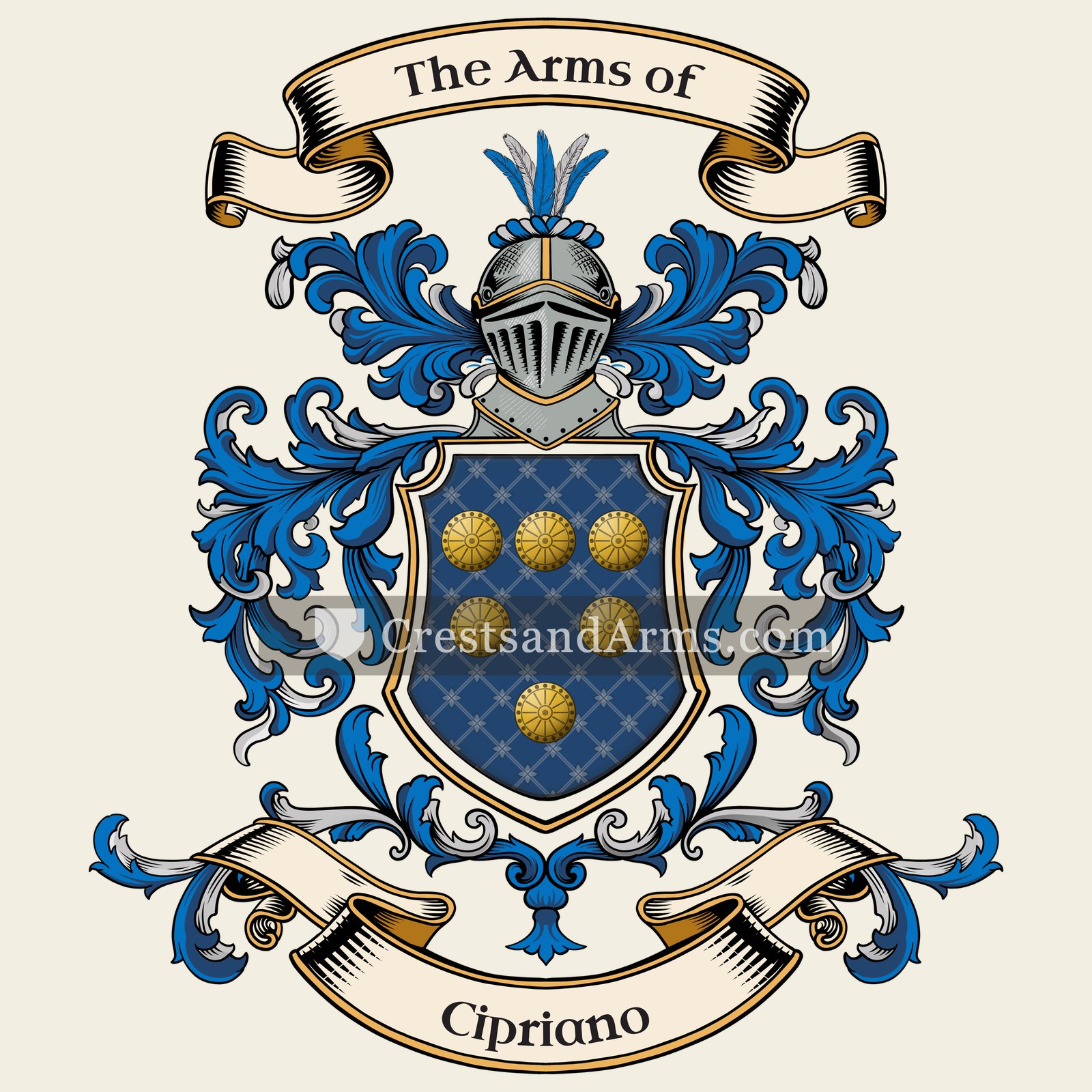
roundelA coin, and one who has been to the crusades
Colours
Blue (Azure)Means: Loyalty and truth
Gold (Or)Means: Generosity
Historical info
Source
J. B. Rietstap, Armorial Général, Gouda: G. B. van Goor Zonen, 1884–87
Blazon (the actual original written record)
“D'azur à six boules d'or.”
ItalyVérone, c. 1775
Digital archive packCoat of arms PNG, gold border print PDF, vector SVG and the certificate of authenticity. Sent to your email in minutes.
Map of Italy showing where the Cipriano arms are recorded
The Cipriano arms were recorded in Vérone, c. 1775.
This is where the arms were entered in the register. Families often moved to other parts of the country, so the same name can turn up in more than one region.
The body that granted and recorded arms in Italy in this period.
Alvise Giovanni Mocenigo
Sovereign of the period
Alvise Giovanni Mocenigo
1763–1778
Reigning in France when the Cipriano arms are first recorded.
How Arms Worked in Italy
In the Italian states, coats of arms were often used by noble families to show their status and history. These symbols were passed down through the generations to all legitimate male descendants. Younger branches of a family usually kept the original design but sometimes added small changes to distinguish their specific line from the main branch.
Granting authority
Various local rulers and city governments controlled the use of coats of arms across the different Italian states.
How they got arms
Families often assumed their own arms or received them as official grants from local lords, popes, or city councils.
Where arms were recorded
Arms were recorded in local city archives or private family books rather than in one single national register.
The family's standing
Recorded among the armigerous families of Italy.
Origin & History of the Cipriano Family in Italy
The family name Cipriano finds its roots in the Latin name Cyprianus, which signifies a person originating from the island of Cyprus. In the context of Italian history, this name was often adopted by families to honor Saint Cyprian, a prominent early Christian figure. By the late 18th century, the family established a notable presence in the city of Verona. During this era, Verona served as a vital cultural and commercial hub within the Venetian Republic. Families living in this region were often involved in the city's active trade networks or local administrative roles. The presence of the Cipriano name in Verona by 1775 suggests that the family was well-integrated into the social fabric of northern Italy during a time of significant political transition. As the family grew, they contributed to the local history of the Veneto region through their daily work and community participation.
Coat of Arms & Family Crest Details
Symbols on this shield
bordureA difference between branches of one family
eagleNobility, strength and a keen mind
fleur de lisPurity, light, and the sixth son
Colours
Gold (Or)Means: Generosity
Historical info
Source
Sir Bernard Burke, The General Armory of England, Scotland, Ireland and Wales, London: Harrison & Sons, 1884
Blazon (the actual original written record)
“Or, an eagle displ. sa. crowned gu. within a bordure az. charged with three fleurs-de-lis in chief of the first”
EnglandLondon, c. 1620
Digital archive packCoat of arms PNG, gold border print PDF, vector SVG and the certificate of authenticity. Sent to your email in minutes.
Map of England showing where the Cipriano arms are recorded
The Cipriano arms were recorded in London, c. 1620.
This is where the arms were entered in the register. Families often moved to other parts of the country, so the same name can turn up in more than one region.
The body that granted and recorded arms in England in this period.
James VI and I
Sovereign of the period
James VI and I
1603–1625
Reigning in France when the Cipriano arms are first recorded.
How Arms Worked in England
English heraldry allowed arms to be shared by all legitimate descendants of the original owner. These symbols were treated as personal property that moved through the generations to all children. While the eldest son kept the original design, other family members could use the same shield without needing to change it or register their own unique versions.
Granting authority
The College of Arms in London has regulated the use of coats of arms throughout England and Wales since 1484.
How they got arms
Families typically obtained their coats of arms through a formal grant from the Crown or by proving their ancient right to them.
Where arms were recorded
All official coats of arms are recorded in the registers kept at the College of Arms, which date back to the fifteenth century.
The family's standing
Recorded among the armigerous families of England.
Origin & History of the Cipriano Family in England
The Cipriano name first appeared in the historical record of London during the early seventeenth century, marking a period when the city served as a bustling hub for international trade and migration. By 1620, individuals bearing this surname were documented within the city, likely arriving as part of the growing network of merchants and artisans who traveled between the Mediterranean region and England. Because the name is derived from the Latin *Cyprianus*, meaning "from Cyprus," it suggests that the family’s roots were tied to the movement of people across European maritime routes. These early settlers in London lived during a time of significant social change, often integrating into the diverse neighborhoods of the capital while maintaining their unique cultural identity. Their presence in the city records provides a glimpse into the quiet but steady influence of continental families who helped shape the cosmopolitan character of London during the Stuart era.
Related Branches & Arms
Root word
Cyprianus
Derived from the Latin word for someone from the island Cyprus.
This name
CiprianoA surname indicating ancestral origin from the Mediterranean island of Cyprus.
also spelled
Cipriany
Cipriane
Seepreeanee
Ciprianny
Documented Sources
J. B. Rietstap, Armorial Général, Gouda: G. B. van Goor Zonen, 1884–87
Arrighi, Jean-Marie, Histoire de la Corse, 2008
Graziani, Antoine-Marie, Histoire de Gênes, 2017
Archives départementales de la Corse-du-Sud, Registres paroissiaux et d'état civil, 1663
Digital archive packCoat of arms PNG, gold border print PDF, vector SVG and the certificate of authenticity. Sent to your email in minutes.


 roundelA coin, and one who has been to the crusades
 roundelA coin, and one who has been to the crusades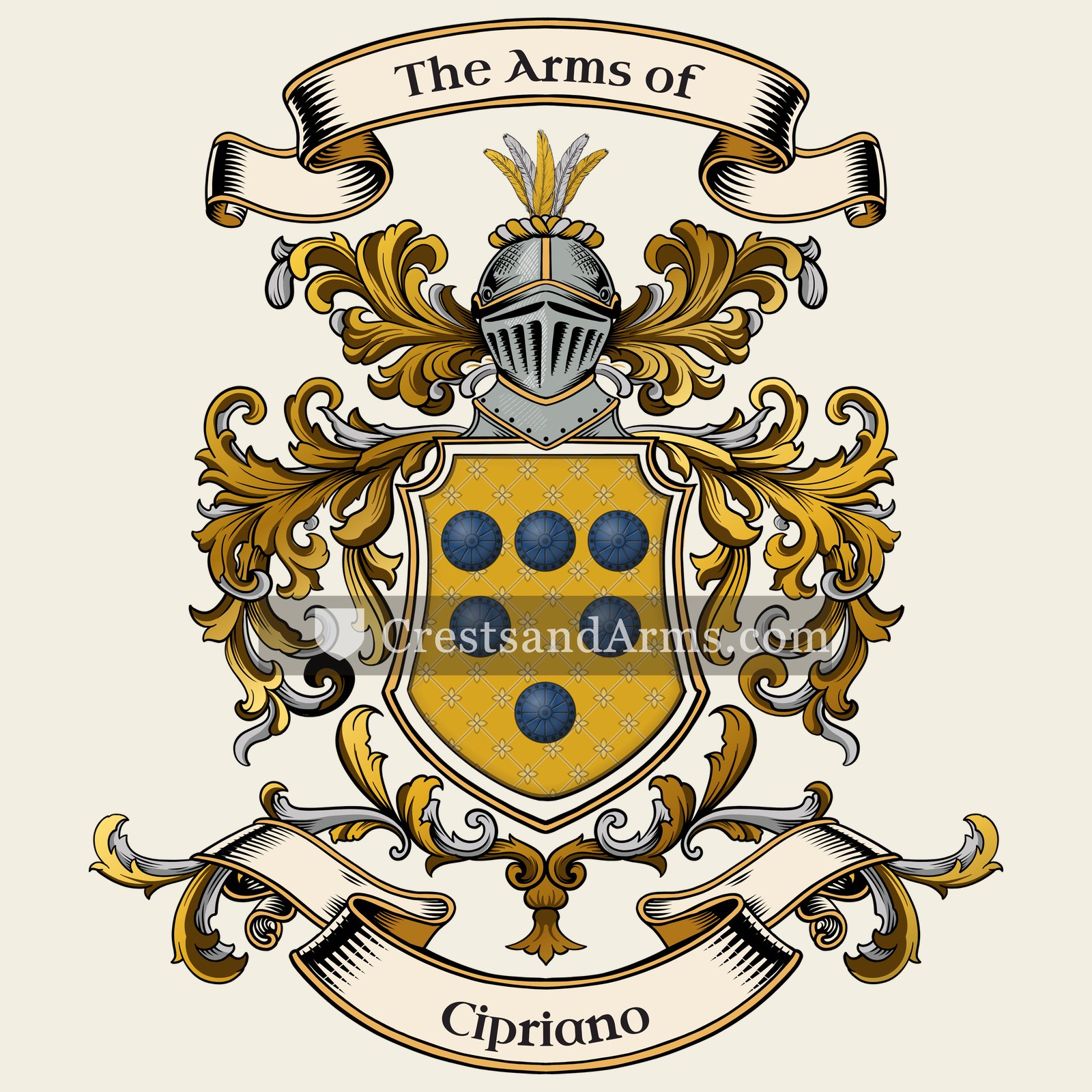




 bordureA difference between branches of one family
 eagleNobility, strength and a keen mind
 fleur de lisPurity, light, and the sixth son