Map of France showing where the Claeys arms are recorded
The Claeys arms were recorded in Flandre, c. 1663.
Flandre grew rich on cloth, and its towns were among the busiest in Europe. Merchant families bought land with their profits and took arms to go with it, so trade put as many names in the registers here as land did.
This is where the arms were entered in the register. Families often moved to other parts of the country, so the same name can turn up in more than one region.
The body that granted and recorded arms in France in this period.
Louis XIV of France
Sovereign of the period
Louis XIV of France
1643–1715
Reigning in France when the Claeys arms are first recorded.
How Arms Worked in France
In France, a coat of arms was a mark of honor that passed down through the male line to all legitimate descendants. Families often used the same shield without changes to show their shared heritage. If a branch wanted to stand out, they could add a small mark to their shield to show their specific place in the family tree.
Granting authority
The Juge d'armes de France acted as the official authority that regulated and verified coats of arms across the country.
How they got arms
Families typically inherited their arms from ancestors, though they could also receive them through royal grants or by proving their noble status.
Where arms were recorded
Coats of arms were officially recorded in the Armorial Général de France, which began its main collection in the year 1696.
The family's standing
Recorded among the armigerous families of Flandre.
Origin & History of the Claeys Family in France
The surname Claeys is a patronymic name that originated in the historical region of Flanders. It serves as a shortened version of the name Nicolaas, which was a very popular choice in the Low Countries during the Middle Ages. Families carrying this name were well-established in the Flemish landscape by the mid-seventeenth century, with documented records confirming their presence in the region by 1663. Because Flanders was a major center for trade and agriculture, many people with this name worked as skilled craftsmen or farmers who helped shape the local economy. Over time, the name became deeply rooted in the cultural identity of the area, reflecting the linguistic traditions of the Dutch-speaking population. As the family grew, they remained closely tied to the history of the Flemish provinces, contributing to the development of the towns and rural communities where they resided.
Claeys Meaning & Related Branches
Root word
Nicolaus
Victory of the people derived from Greek words for victory and people.
This name
ClaeysA Flemish and French patronymic form referring to a descendant of Nicholas.
also spelled
Claeyss
Klas
Documented Sources
J. B. Rietstap, Armorial Général, Gouda: G. B. van Goor Zonen, 1884–87
Debrabandere, Frans. Woordenboek van de familienamen in België en Noord-Frankrijk. 2003
State Archives in Belgium (Rijksarchief), Parochieregisters van de provincie West-Vlaanderen
Digital archive packCoat of arms PNG, gold border print PDF, vector SVG and the certificate of authenticity. Sent to your email in minutes.


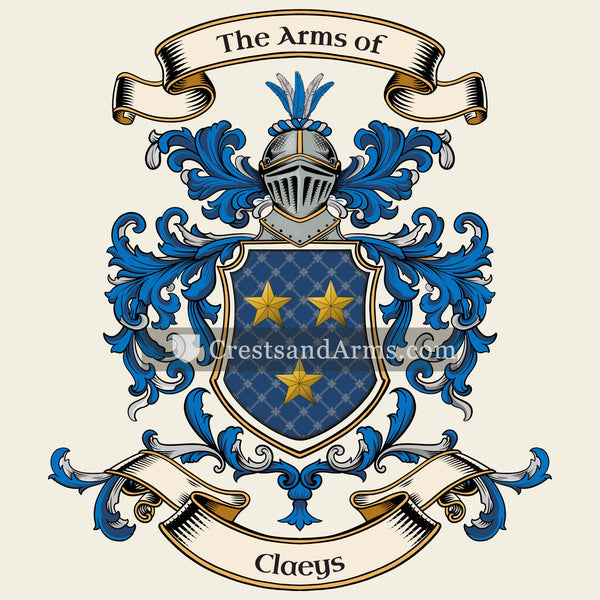
 mulletThe third son, and a divine quality from above
 mulletThe third son, and a divine quality from above