Map of France showing where the Clare arms are recorded
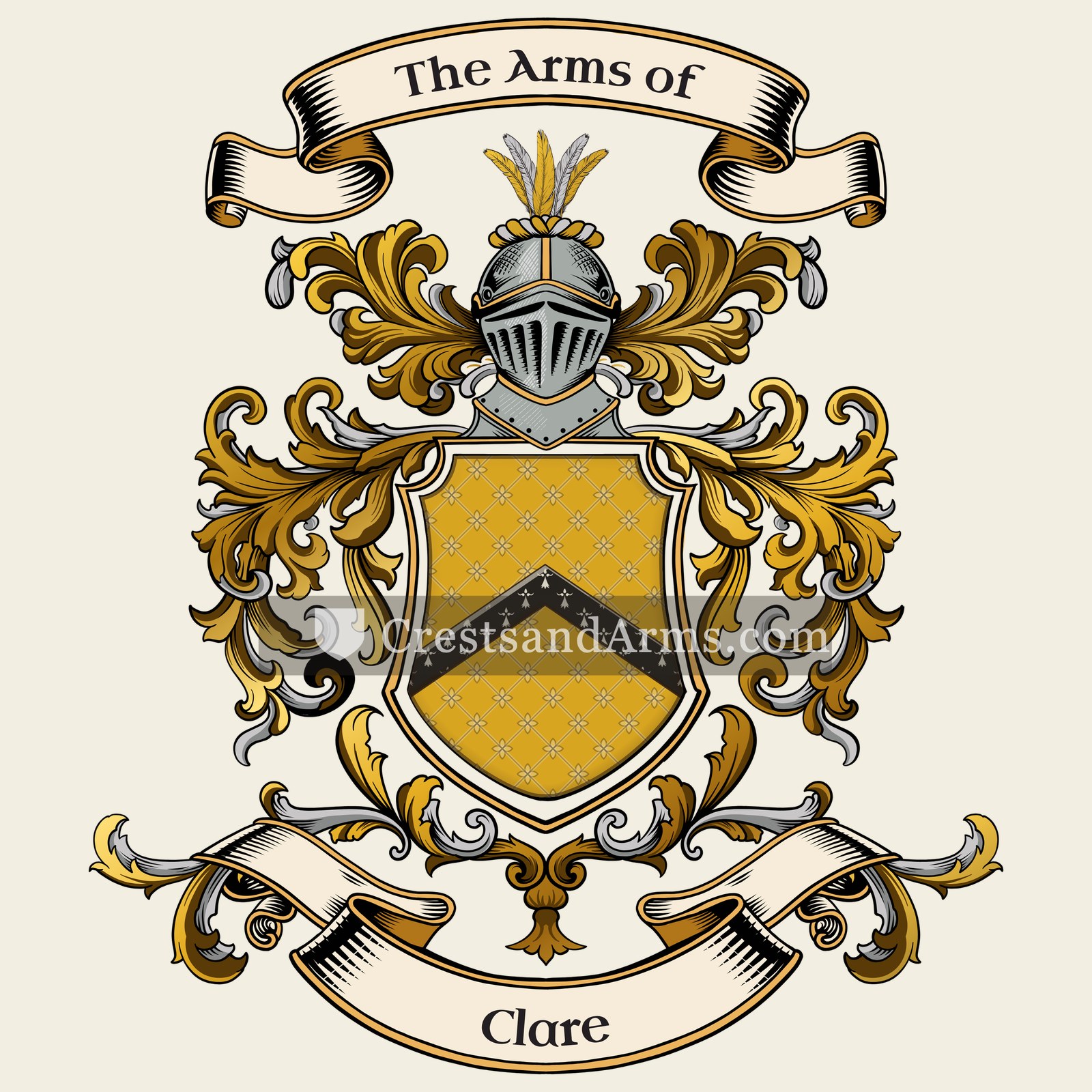
The Clare arms were recorded in France, c. 1313.
Arms such as these were typically recorded in Bretagne.
More families held coats of arms in Bretagne than anywhere else in France. The land was divided into many small estates rather than a few large ones, so far more households counted as gentry, and each needed a shield of its own to be told apart.
This is where the arms were entered in the register. Families often moved to other parts of the country, so the same name can turn up in more than one region.
The body that granted and recorded arms in France in this period.
Philip IV of France
Sovereign of the period
Philip IV of France
1285–1314
Reigning in France when the Clare arms are first recorded.
How Arms Worked in France
In France, a coat of arms was a mark of honor that passed down through the male line to all legitimate descendants. Families often used the same shield without changes to show their shared heritage. If a branch wanted to stand out, they could add a small mark to their shield to show their specific place in the family tree.
Granting authority
The Juge d'armes de France acted as the official authority that regulated and verified coats of arms across the country.
How they got arms
Families typically inherited their arms from ancestors, though they could also receive them through royal grants or by proving their noble status.
Where arms were recorded
Coats of arms were officially recorded in the Armorial Général de France, which began its main collection in the year 1696.
The family's standing
Recorded among the armigerous families of France.
Origin & History of the Clare Family in France
The history of the Clare family name in France is deeply connected to the region of Brittany, where members of the family were documented as early as 1313. During this period, the name was closely associated with the social and political landscape of the Breton nobility. Families in this region often derived their surnames from specific locations or ancestral estates, which helped them maintain their status within the local feudal system. By the early 14th century, the Clare name was already established enough to appear in official administrative records, suggesting that the family held land or served in roles that required them to be accounted for by the local authorities. These early records provide a glimpse into a time when the family was integrating into the complex social hierarchy of medieval France, long before the name spread to other parts of Europe.
Coat of Arms & Family Crest Details
Symbols on this shield
chevronProtection, and faithful service completed
Colours
Gold (Or)Means: Generosity
Red (Gules)Means: Military strength
Historical info
Source
Sir Bernard Burke, The General Armory of England, Scotland, Ireland and Wales, London: Harrison & Sons, 1884
Blazon (the actual original written record)
“Or, three chevs. gu”
HerefordEarls · Hereford, c. 1313
Digital archive packCoat of arms PNG, gold border print PDF, vector SVG and the certificate of authenticity. Sent to your email in minutes.
Map of England showing where the Clare arms are recorded
The Clare arms were recorded in Hereford, c. 1313.
Herefordshire lay on the Welsh border, where land was held in return for military service. Families there were expected to arm and to fight, and a fighting household needed a shield it could be known by.
This is where the arms were entered in the register. Families often moved to other parts of the country, so the same name can turn up in more than one region.
The body that granted and recorded arms in England in this period.
Edward II of England
Sovereign of the period
Edward II of England
1307–1327
Reigning in France when the Clare arms are first recorded.
How Arms Worked in England
English heraldry allowed arms to be shared by all legitimate descendants of the original owner. These symbols were treated as personal property that moved through the generations to all children. While the eldest son kept the original design, other family members could use the same shield without needing to change it or register their own unique versions.
Granting authority
The College of Arms in London has regulated the use of coats of arms throughout England and Wales since 1484.
How they got arms
Families typically obtained their coats of arms through a formal grant from the Crown or by proving their ancient right to them.
Where arms were recorded
All official coats of arms are recorded in the registers kept at the College of Arms, which date back to the fifteenth century.
The family's standing
Recorded among the armigerous families of Hereford.
Origin & History of the Clare Family in England
The surname Clare has deep roots in the landscape of medieval England, emerging as a locative name derived from the town of Clare in Suffolk. While the family gained significant prominence through high-ranking nobles in the centuries following the Norman Conquest, the name also spread to other regions as individuals moved for work or land. By 1313, records confirm that members of the Clare family were established in the county of Hereford. During this period, the name was often used to identify people based on their place of origin, helping to distinguish families in a society where surnames were still becoming standardized. These early residents of Hereford likely participated in the local agricultural and social systems of the time, contributing to the steady growth of the name across the English countryside.
Coat of Arms & Family Crest Details
Symbols on this shield
ermineDignity and rank
Colours
Gold (Or)Means: Generosity
Counter-ermine (Ermines)Means: Dignity
Historical info
Source
Sir Bernard Burke, The General Armory of England, Scotland, Ireland and Wales, London: Harrison & Sons, 1884
Blazon (the actual original written record)
“Or, three chevronels ermines”
Irelandc. 1639
Digital archive packCoat of arms PNG, gold border print PDF, vector SVG and the certificate of authenticity. Sent to your email in minutes.
Map of Ireland showing where the Clare arms are recorded
The Clare arms were recorded in Ireland, c. 1639.
Arms such as these were typically recorded in Dublin.
Dublin was the seat of government in Ireland and the place where grants were sought and recorded. Families with business at the castle or the courts settled nearby, and settling there put their arms on record.
This is where the arms were entered in the register. Families often moved to other parts of the country, so the same name can turn up in more than one region.
The body that granted and recorded arms in Ireland in this period.
Charles I of England
Sovereign of the period
Charles I of England
1625–1649
Reigning in France when the Clare arms are first recorded.
How Arms Worked in Ireland
The Ulster King of Arms granted coats of arms to individuals who proved their social standing and good character. These symbols were typically inherited by all legitimate descendants of the original holder. If a family branch wanted a unique look, they could apply for a specific change to their design through the office to ensure their identity remained distinct.
Granting authority
The Ulster King of Arms acted as the official body that regulated and issued all coats of arms throughout Ireland.
How they got arms
Families obtained their arms through formal grants issued by the office after proving their eligibility and paying the required fees.
Where arms were recorded
All official grants were recorded in the registers held by the Ulster King of Arms starting from the year 1552.
The family's standing
Recorded among the armigerous families of Ireland.
Origin & History of the Clare Family in Ireland
The history of the Clare family in Ireland is deeply connected to the shifting political landscape of the seventeenth century. By 1639, records confirm that members of the family were established in Dublin, a city that served as the primary center for administration and commerce at the time. During this period, families like the Clares often moved between England and Ireland due to the plantation policies and the expansion of government influence under the British Crown. Living in Dublin placed the family at the heart of Irish social life, where they likely participated in the growing urban economy of the capital. While the name itself has roots in older European traditions, its presence in Dublin during the 1630s marks a significant chapter of the family becoming part of the Irish historical narrative. This era was defined by rapid change, and the family’s ability to settle in such a prominent location suggests they were part of the professional or merchant classes who helped shape the city during the early modern period.
Clare Meaning & Related Branches
Root word
Clarus
Latin adjective meaning clear, bright, or famous.
This name
ClareDerived from a place name or saint, signifying someone bright, illustrious, or clear-headed.
also spelled
Claree
Clair
Clere
Cleere
Related arms
Clerevariant spelling
Belasyserecorded with Clare, same area
Bellomontrecorded with Clare, same area
Bohunrecorded with Clare, same area
Documented Sources
J. B. Rietstap, Armorial Général, Gouda: G. B. van Goor Zonen, 1884–87
Archives départementales d'Ille-et-Vilaine, Fonds de la famille de Clare
Poterie, Hyacinthe, Histoire généalogique de la Bretagne, 1898
Ogée, Jean, Dictionnaire historique et géographique de la province de Bretagne, 1778
Digital archive packCoat of arms PNG, gold border print PDF, vector SVG and the certificate of authenticity. Sent to your email in minutes.


 chevronProtection, and faithful service completed
 chevronProtection, and faithful service completed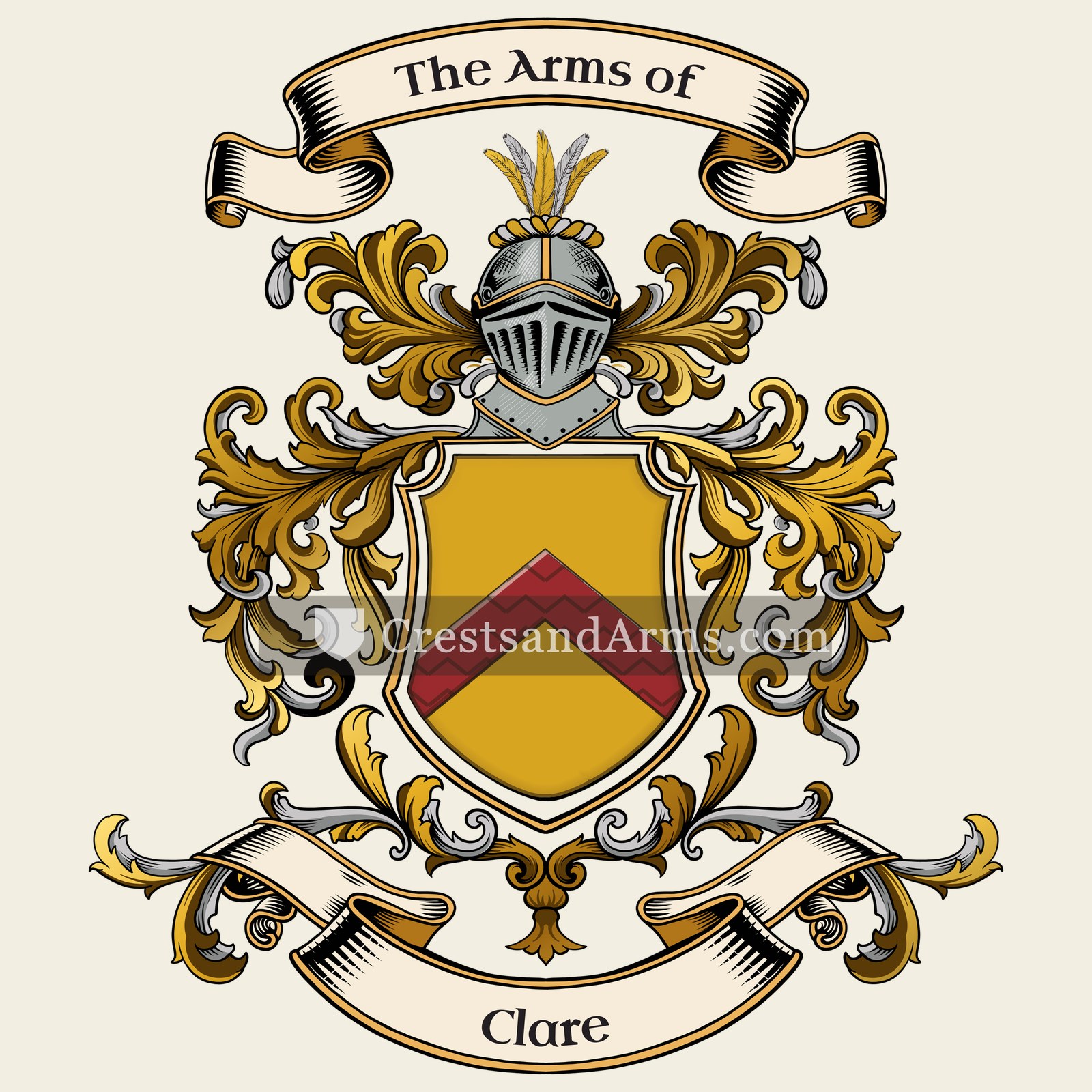


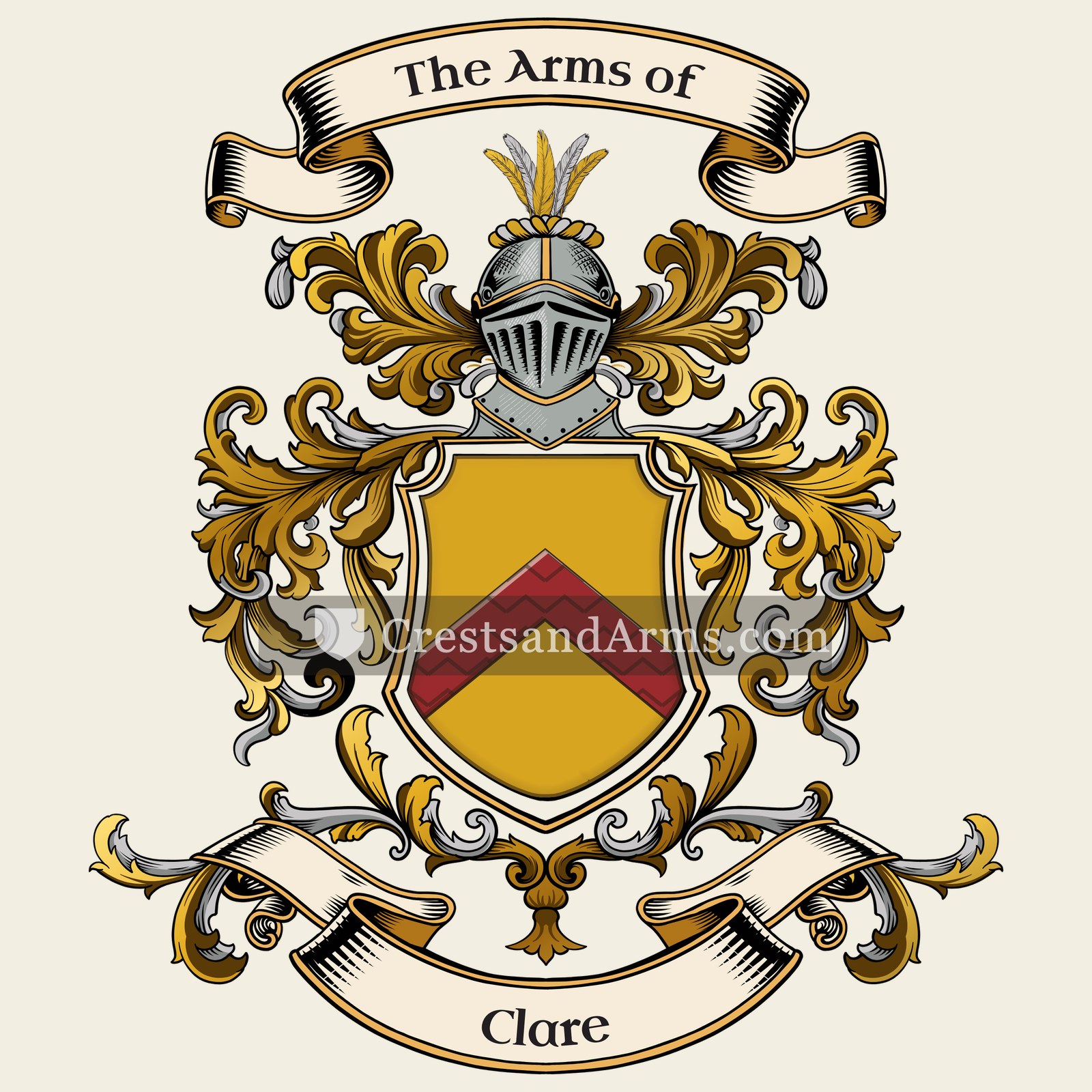


 ermineDignity and rank