Map of France showing where the Claret arms are recorded
The Claret arms were recorded in Comtat-Venaissin, c. 1663.
This is where the arms were entered in the register. Families often moved to other parts of the country, so the same name can turn up in more than one region.
The body that granted and recorded arms in France in this period.
Louis XIV of France
Sovereign of the period
Louis XIV of France
1643–1715
Reigning in France when the Claret arms are first recorded.
How Arms Worked in France
In France, a coat of arms was a mark of honor that passed down through the male line to all legitimate descendants. Families often used the same shield without changes to show their shared heritage. If a branch wanted to stand out, they could add a small mark to their shield to show their specific place in the family tree.
Granting authority
The Juge d'armes de France acted as the official authority that regulated and verified coats of arms across the country.
How they got arms
Families typically inherited their arms from ancestors, though they could also receive them through royal grants or by proving their noble status.
Where arms were recorded
Coats of arms were officially recorded in the Armorial Général de France, which began its main collection in the year 1696.
The family's standing
Recorded among the armigerous families of France.
Origin & History of the Claret Family in France
The family name Claret finds its roots in the sun-drenched landscapes of southern France, particularly within the historical region of the Comtat-Venaissin. By the mid-seventeenth century, records confirm that members of the Claret family were firmly established in this territory, which was then under the direct administration of the Papal States. The name itself is thought to be derived from the Old Occitan word for clear or bright, which likely served as a descriptive nickname for an ancestor with a cheerful personality or a fair complexion. Living in the Comtat-Venaissin placed the family at a unique cultural crossroads where French influence met Italian administrative traditions. Over generations, the family integrated into the local social fabric, likely working as landowners or tradespeople who contributed to the agricultural prosperity of the Rhône valley. This early presence in such a distinct, historically autonomous region helped shape the identity of the family long before the modern borders of France were fully solidified.
Coat of Arms & Family Crest Details
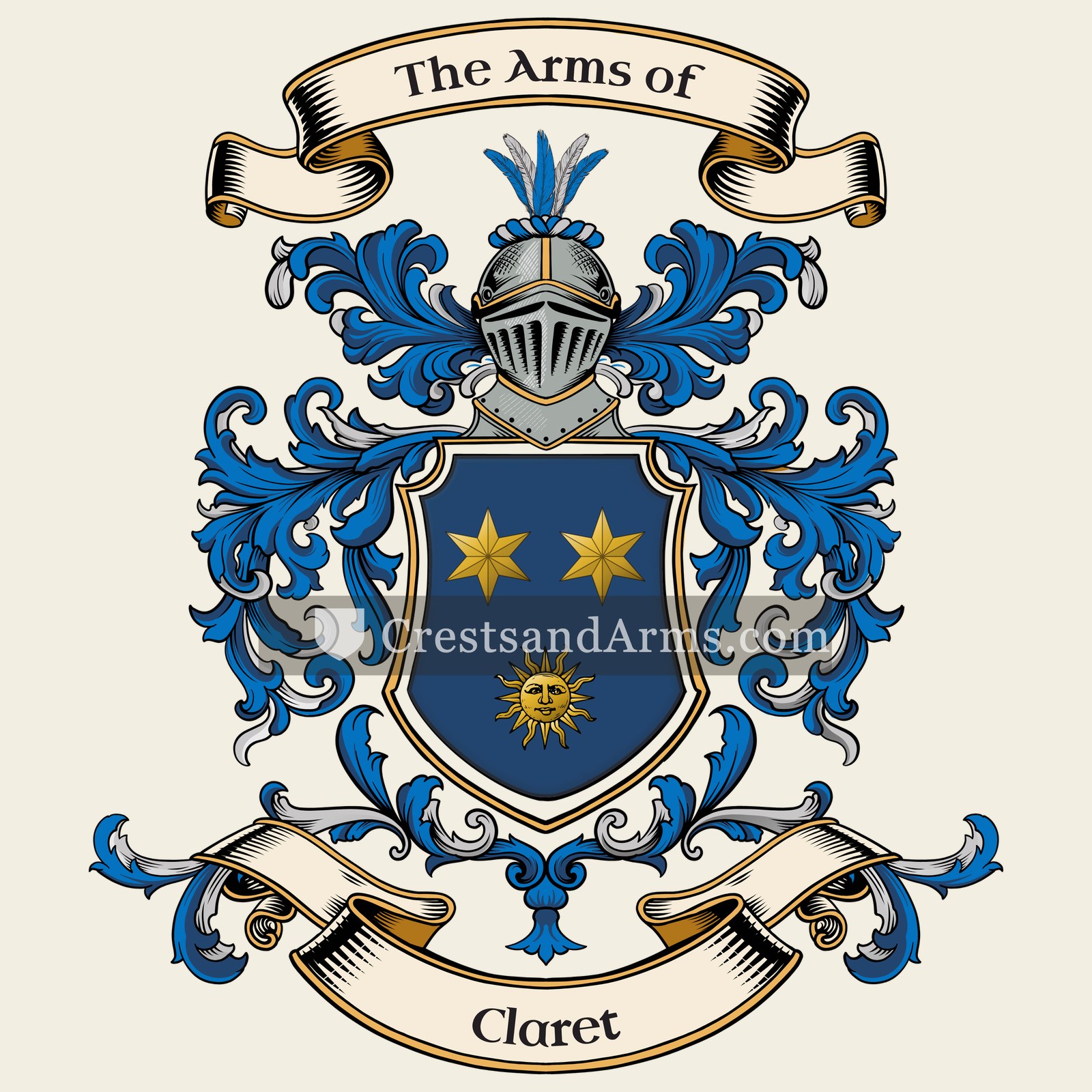
Symbols on this shield
chiefAuthority, wisdom and dominion
keyGuardianship, and the office of a steward
martletA younger son, who must win his own land
Colours
Red (Gules)Means: Military strength
Gold (Or)Means: Generosity
Silver (Argent)Means: Peace and sincerity
Black (Sable)Means: Constancy
Historical info
Source
J. B. Rietstap, Armorial Général, Gouda: G. B. van Goor Zonen, 1884–87
Blazon (the actual original written record)
“De gu. à deux clés d'arg., posées en pals et adossées; au chef d'or, ch. de trois oiseaux de sa.”
Switzerlandc. 1745
Digital archive packCoat of arms PNG, gold border print PDF, vector SVG and the certificate of authenticity. Sent to your email in minutes.
Map of Switzerland showing where the Claret arms are recorded
The Claret arms were recorded in Switzerland, c. 1745.
Arms such as these were typically recorded in Bern.
Bern was the largest of the Swiss cantons and ran itself, with its own council and its own courts. Its governing families held office for generations, and office of that kind carried a shield with it.
This is where the arms were entered in the register. Families often moved to other parts of the country, so the same name can turn up in more than one region.
The body that granted and recorded arms in Switzerland in this period.
How Arms Worked in Switzerland
In Switzerland, coats of arms were not restricted to the nobility and were often adopted by common citizens and families. These symbols were passed down through generations to show family identity. When branches of a family grew, they often changed small details of the design to distinguish their own line from the original group.
Granting authority
Cantonal and civic authorities managed the use of coats of arms within their specific regions and local jurisdictions.
How they got arms
Families typically assumed their own coats of arms based on local custom rather than receiving them from a central monarch.
Where arms were recorded
Arms were recorded in various cantonal and civic registers starting from the fourteenth century throughout the Swiss region.
The family's standing
Recorded among the armigerous families of Switzerland.
Origin & History of the Claret Family in Switzerland
The Claret family name has deep roots in the historical landscape of Switzerland, particularly within the canton of Bern. By the year 1745, members of the family were already established residents in this region, participating in the social and economic life of the city. The name itself likely originated from the French-speaking areas of Europe, suggesting that the family may have migrated across linguistic borders to settle in the Swiss capital. During the eighteenth century, families like the Clarets often integrated into the local guild systems or agricultural networks that defined Bernese society. Their presence in official records from this period indicates that they were recognized members of the community who contributed to the stability and growth of the region. Over time, the family name became a part of the local identity, reflecting the broader patterns of movement and settlement that shaped the diverse cultural heritage of Switzerland.
Coat of Arms & Family Crest Details
Symbols on this shield
starThe celestial goddess, and nobility
sunGlory, splendour and the source of life
Colours
Blue (Azure)Means: Loyalty and truth
Gold (Or)Means: Generosity
Historical info
Source
Sir Bernard Burke, The General Armory of England, Scotland, Ireland and Wales, London: Harrison & Sons, 1884
Blazon (the actual original written record)
“Az. a rainbow in fesse ppr. betw. two estoiles in chief, and the sun in base, or”
Englandc. 1620
Digital archive packCoat of arms PNG, gold border print PDF, vector SVG and the certificate of authenticity. Sent to your email in minutes.
Map of England showing where the Claret arms are recorded
The Claret arms were recorded in England, c. 1620.
Arms such as these were typically recorded in York.
Yorkshire is the largest of the English counties, and it held more gentry families than any other. Land there was split among a great many households rather than a few, so a great many of them carried arms.
This is where the arms were entered in the register. Families often moved to other parts of the country, so the same name can turn up in more than one region.
The body that granted and recorded arms in England in this period.
James VI and I
Sovereign of the period
James VI and I
1603–1625
Reigning in France when the Claret arms are first recorded.
How Arms Worked in England
English heraldry allowed arms to be shared by all legitimate descendants of the original owner. These symbols were treated as personal property that moved through the generations to all children. While the eldest son kept the original design, other family members could use the same shield without needing to change it or register their own unique versions.
Granting authority
The College of Arms in London has regulated the use of coats of arms throughout England and Wales since 1484.
How they got arms
Families typically obtained their coats of arms through a formal grant from the Crown or by proving their ancient right to them.
Where arms were recorded
All official coats of arms are recorded in the registers kept at the College of Arms, which date back to the fifteenth century.
The family's standing
Recorded among the armigerous families of England.
Origin & History of the Claret Family in England
The surname Claret first appears in English historical records during the early seventeenth century, with documented evidence placing members of the family in the city of York by 1620. The name likely originated as a descriptive term or a nickname, potentially linked to the Old French word for a clear or bright appearance, or perhaps associated with the light red wine known as claret that was popular in trade at the time. During this period, York served as a vital northern hub for commerce and religious administration, which likely drew families seeking new opportunities in trade or craftsmanship. As the family established themselves in the region, they became part of the local social fabric of Northern England. Their presence in York suggests they were integrated into the urban life of the city, living among the merchants and tradespeople who defined the economy of the seventeenth century.
Claret Meaning & Related Branches
Root word
clarus
Latin term meaning clear, bright, or famous.
This name
ClaretA topographic name for someone living near a clear stream or a descriptive term for light-colored wine.
also spelled
Clarette
Clarett
Claray
Documented Sources
J. B. Rietstap, Armorial Général, Gouda: G. B. van Goor Zonen, 1884–87
Archives Départementales de Vaucluse, État civil et registres paroissiaux du Comtat-Venaissin, Series E
Benoît, Fernand, Histoire du Comtat Venaissin, 1968
Pégorier, André, Les noms de lieux en France : glossaire de termes dialectaux, 1963
Digital archive packCoat of arms PNG, gold border print PDF, vector SVG and the certificate of authenticity. Sent to your email in minutes.


 mulletThe third son, and a divine quality from above
 sunGlory, splendour and the source of life
 mulletThe third son, and a divine quality from above
 sunGlory, splendour and the source of life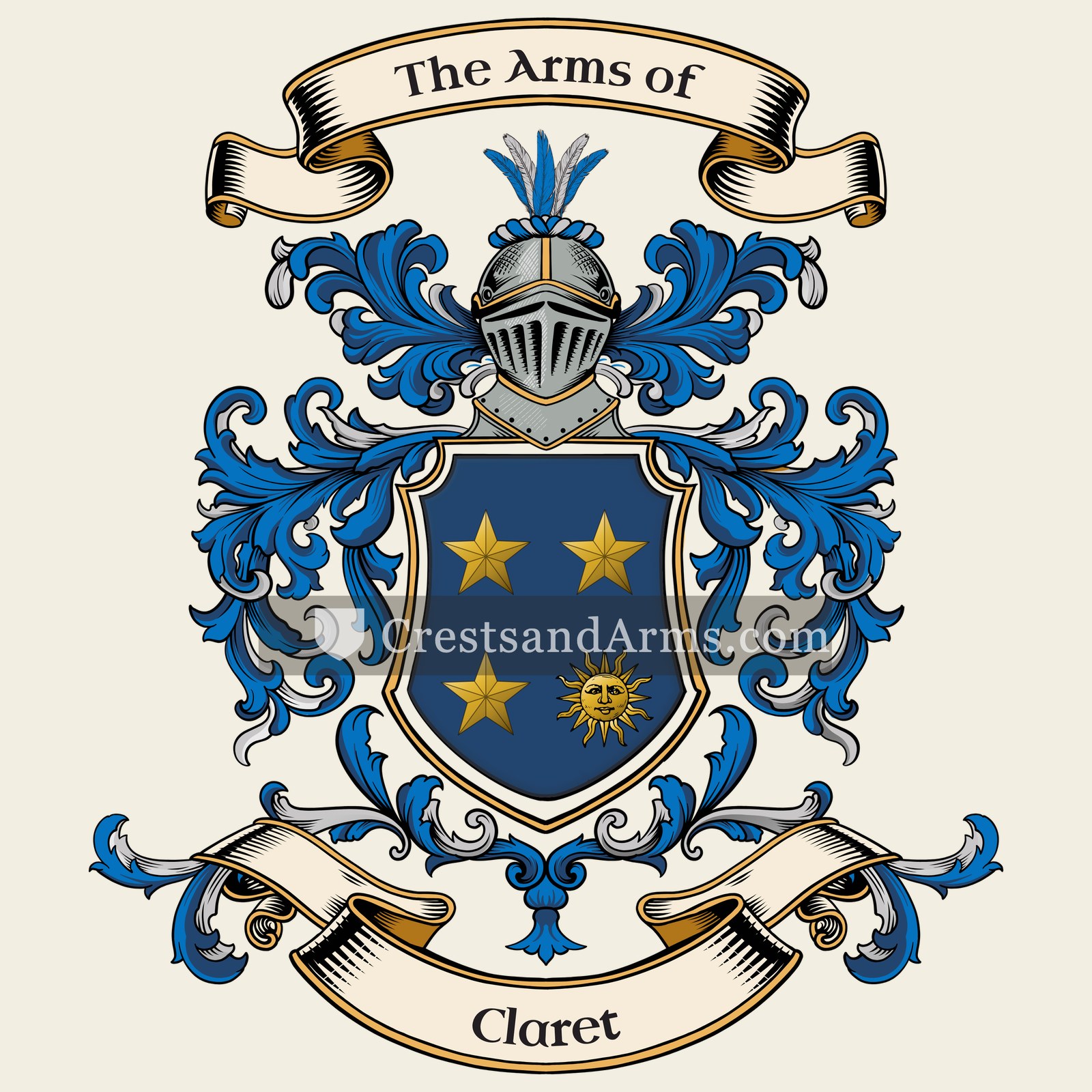


 chiefAuthority, wisdom and dominion
 keyGuardianship, and the office of a steward
 martletA younger son, who must win his own land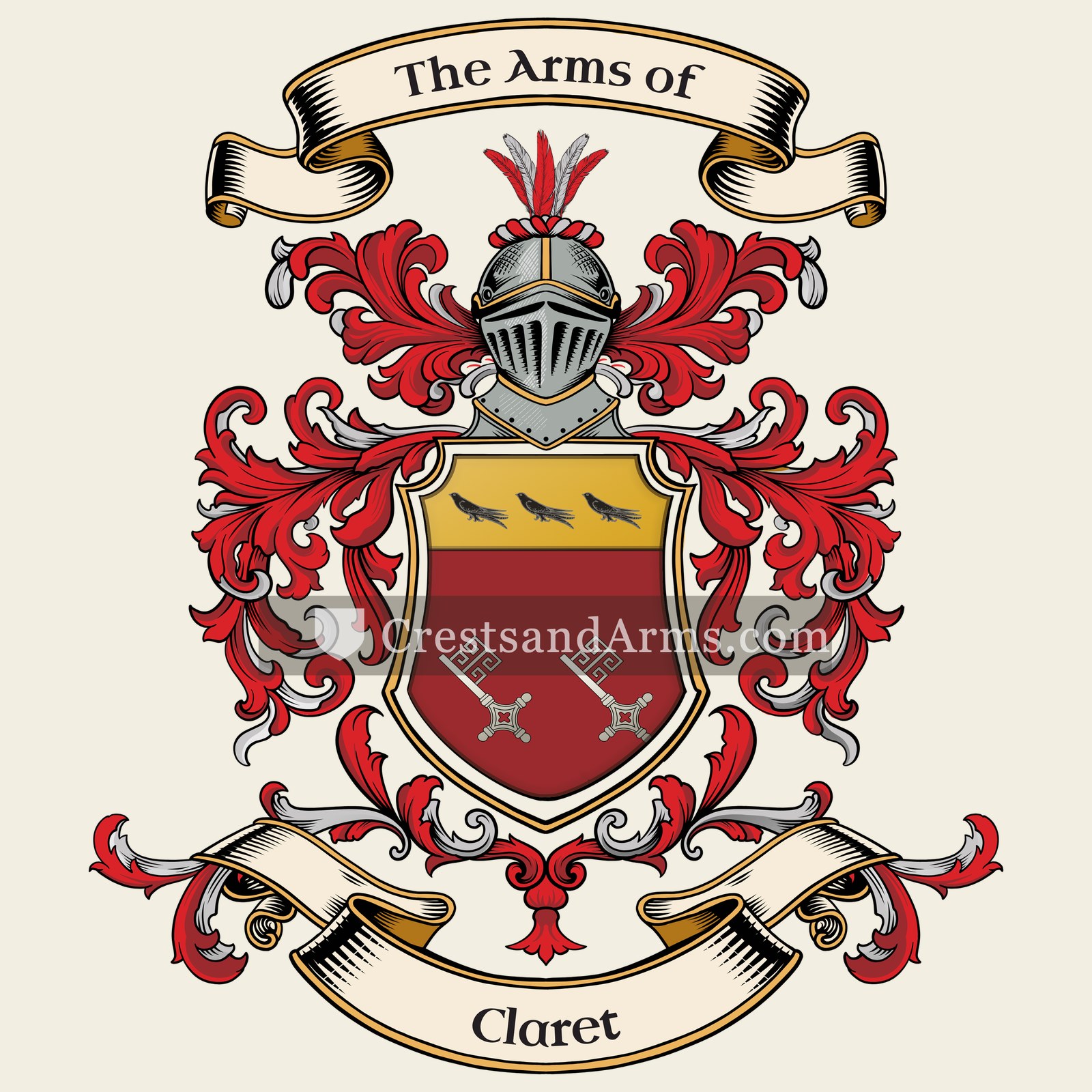

 starThe celestial goddess, and nobility