Map of France showing where the Clarke arms are recorded
The Clarke arms were recorded in Bretagne, c. 1663.
More families held coats of arms in Bretagne than anywhere else in France. The land was divided into many small estates rather than a few large ones, so far more households counted as gentry, and each needed a shield of its own to be told apart.
This is where the arms were entered in the register. Families often moved to other parts of the country, so the same name can turn up in more than one region.
The body that granted and recorded arms in France in this period.
Louis XIV of France
Sovereign of the period
Louis XIV of France
1643–1715
Reigning in France when the Clarke arms are first recorded.
How Arms Worked in France
In France, a coat of arms was a mark of honor that passed down through the male line to all legitimate descendants. Families often used the same shield without changes to show their shared heritage. If a branch wanted to stand out, they could add a small mark to their shield to show their specific place in the family tree.
Granting authority
The Juge d'armes de France acted as the official authority that regulated and verified coats of arms across the country.
How they got arms
Families typically inherited their arms from ancestors, though they could also receive them through royal grants or by proving their noble status.
Where arms were recorded
Coats of arms were officially recorded in the Armorial Général de France, which began its main collection in the year 1696.
The family's standing
Recorded among the armigerous families of Bretagne.
Origin & History of the Clarke Family in France
The family name Clarke has deep roots that stretch across the English Channel into the historic region of Brittany. While the name is often associated with English origins, records confirm that members of the family were established in the French province of Bretagne by 1663. During this period, the name likely functioned as an occupational title, as the word itself stems from the Latin term for a scholar or a member of the clergy. In the social structure of seventeenth-century France, individuals carrying this name were often literate figures who served in administrative or religious roles. Their presence in Brittany suggests that the family integrated into the local community through these professional capacities, bridging the cultural gap between the British Isles and the coastal settlements of northwestern France. This migration pattern highlights how names tied to education and trade moved fluidly across borders during the early modern era.
Coat of Arms & Family Crest Details
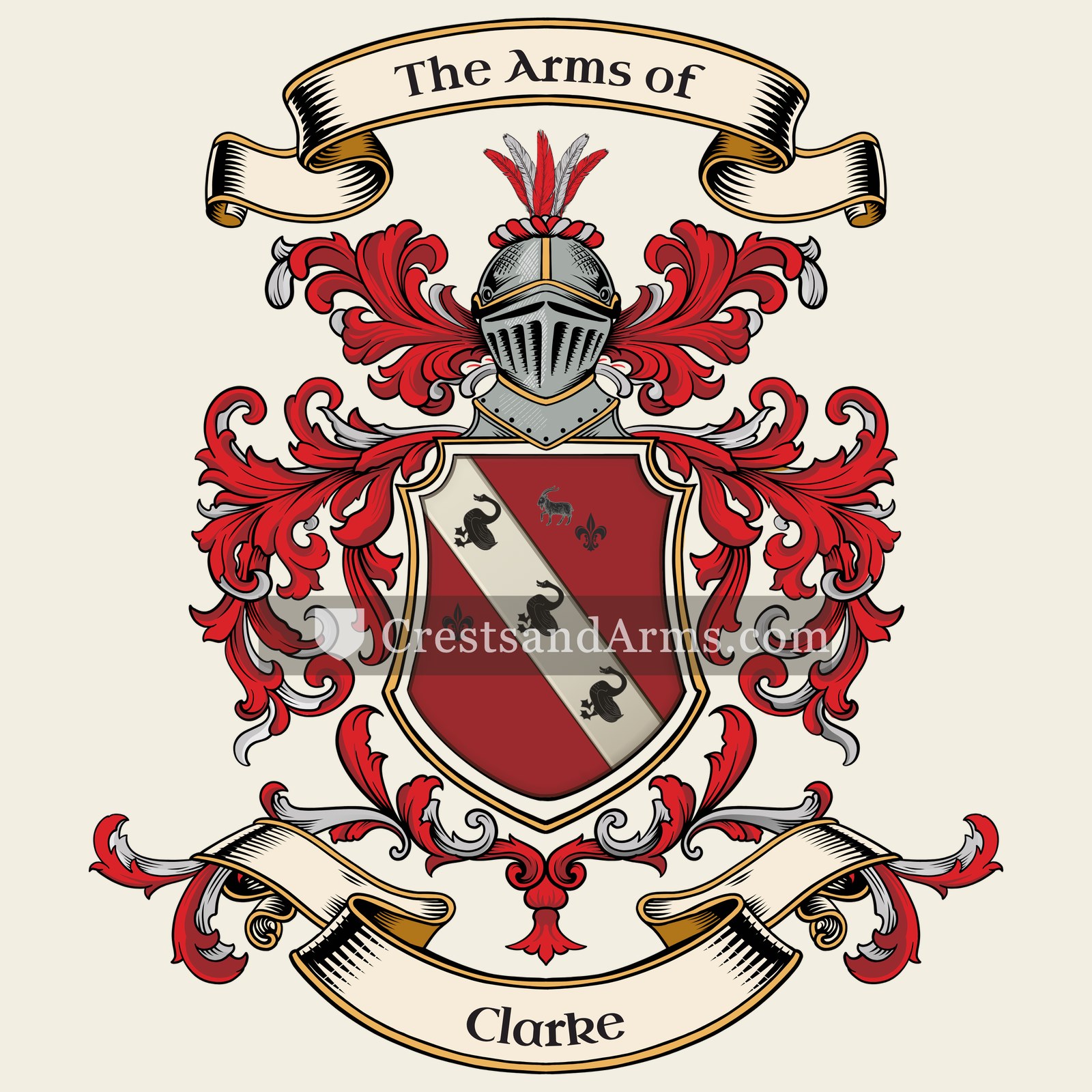
Symbols on this shield
bendDefence, and the scarf of a commander
cantonA mark of honour granted by the sovereign
ramLeadership and authority
roundelA coin, and one who has been to the crusades
swanGrace, light and the poet's art
fleur de lisPurity, light, and the sixth son
Colours
Silver (Argent)Means: Peace and sincerity
Red (Gules)Means: Military strength
Blue (Azure)Means: Loyalty and truth
Black (Sable)Means: Constancy
Gold (Or)Means: Generosity
Historical info
Source
Sir Bernard Burke, The General Armory of England, Scotland, Ireland and Wales, London: Harrison & Sons, 1884
Blazon (the actual original written record)
“Ar. on a bend gu. betw. three pellets as many swans ppr. for augmentation a canton sinister az. thereon a demi ram mounting of the first, armed or, betw. two fleurs-de-lis of the last, over all a dexter baton of the second”
OxfordshireOxfordshire, c. 1513
Digital archive packCoat of arms PNG, gold border print PDF, vector SVG and the certificate of authenticity. Sent to your email in minutes.
Map of England showing where the Clarke arms are recorded
The Clarke arms were recorded in Oxfordshire, c. 1513.
This is where the arms were entered in the register. Families often moved to other parts of the country, so the same name can turn up in more than one region.
The body that granted and recorded arms in England in this period.
Henry VIII of England
Sovereign of the period
Henry VIII of England
1509–1547
Reigning in France when the Clarke arms are first recorded.
How Arms Worked in England
English heraldry allowed arms to be shared by all legitimate descendants of the original owner. These symbols were treated as personal property that moved through the generations to all children. While the eldest son kept the original design, other family members could use the same shield without needing to change it or register their own unique versions.
Granting authority
The College of Arms in London has regulated the use of coats of arms throughout England and Wales since 1484.
How they got arms
Families typically obtained their coats of arms through a formal grant from the Crown or by proving their ancient right to them.
Where arms were recorded
All official coats of arms are recorded in the registers kept at the College of Arms, which date back to the fifteenth century.
The family's standing
Recorded among the armigerous families of Oxfordshire.
Origin & History of the Clarke Family in England
The surname Clarke is an occupational name that originated from the Latin word *clericus*, which referred to a member of the clergy or a learned person who could read and write. In medieval England, literacy was a rare and valuable skill, so those who served as secretaries, scribes, or administrators often adopted this title as their own. By the time the family was firmly established in Oxfordshire in 1513, the name had evolved from a professional description into a hereditary surname passed down through generations. During this period, the Clarkes of Oxfordshire were part of a growing class of educated individuals who managed legal documents and local records for landowners and the church. Their presence in the region reflects the broader social shift where professional roles began to define family identity, cementing the name as a permanent fixture in English history.
Coat of Arms & Family Crest Details
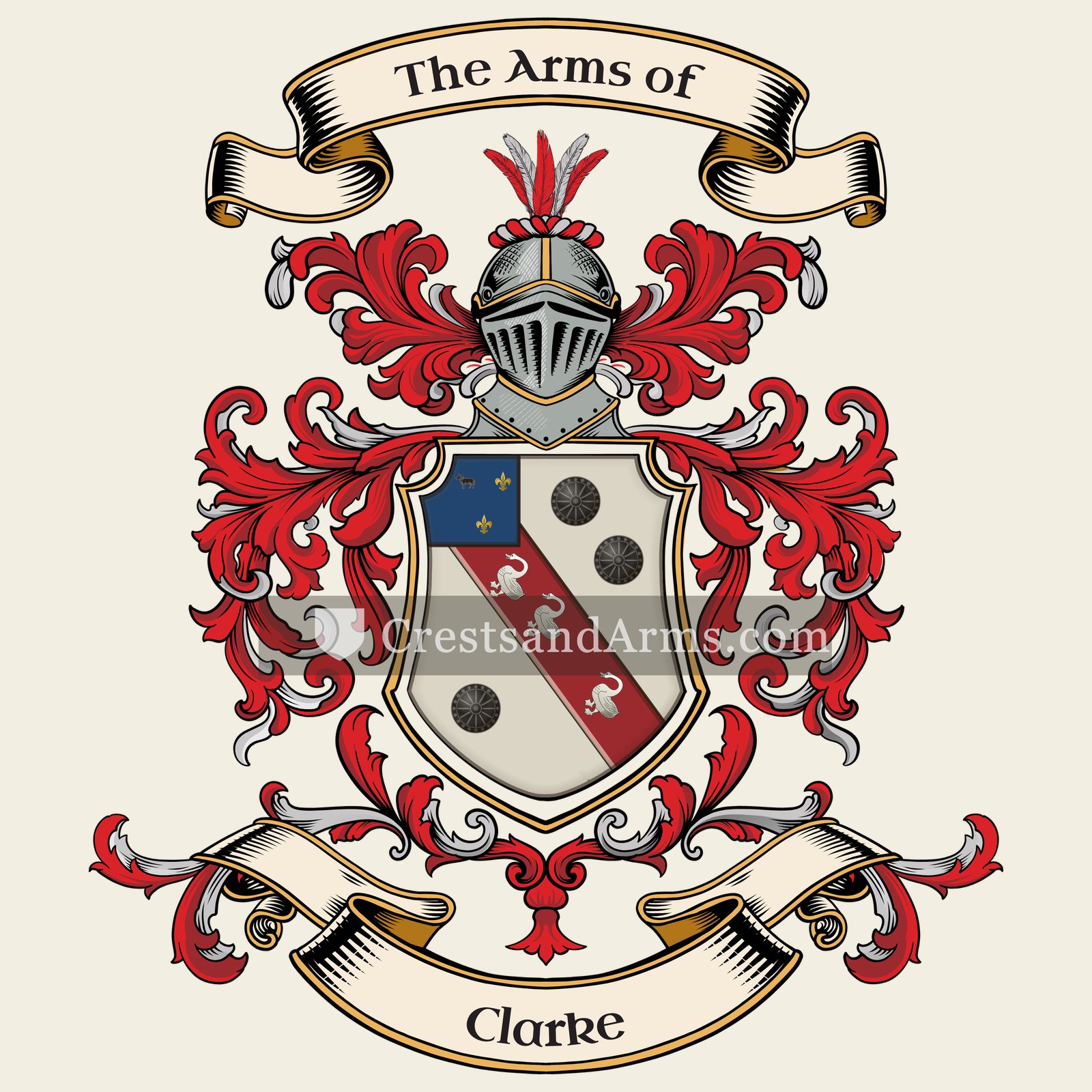
Symbols on this shield
bendDefence, and the scarf of a commander
goatOne who wins by diplomacy rather than force
swanGrace, light and the poet's art
fleur de lisPurity, light, and the sixth son
Colours
Red (Gules)Means: Military strength
Gold (Or)Means: Generosity
Silver (Argent)Means: Peace and sincerity
Black (Sable)Means: Constancy
Historical info
Source
Sir Bernard Burke, The General Armory of England, Scotland, Ireland and Wales, London: Harrison & Sons, 1884
Blazon (the actual original written record)
“Gu. on a bend ar. three swans sa. on a sinister canton per bend or and az. a demi goat ramp. betw. two fleurs-de-lis all counterchanged”
Irelandc. 1594
Digital archive packCoat of arms PNG, gold border print PDF, vector SVG and the certificate of authenticity. Sent to your email in minutes.
Map of Ireland showing where the Clarke arms are recorded
The Clarke arms were recorded in Ireland, c. 1594.
Arms such as these were typically recorded in Dublin.
Dublin was the seat of government in Ireland and the place where grants were sought and recorded. Families with business at the castle or the courts settled nearby, and settling there put their arms on record.
This is where the arms were entered in the register. Families often moved to other parts of the country, so the same name can turn up in more than one region.
The body that granted and recorded arms in Ireland in this period.
Elizabeth I of England
Sovereign of the period
Elizabeth I of England
1558–1603
Reigning in France when the Clarke arms are first recorded.
How Arms Worked in Ireland
The Ulster King of Arms granted coats of arms to individuals who proved their social standing and good character. These symbols were typically inherited by all legitimate descendants of the original holder. If a family branch wanted a unique look, they could apply for a specific change to their design through the office to ensure their identity remained distinct.
Granting authority
The Ulster King of Arms acted as the official body that regulated and issued all coats of arms throughout Ireland.
How they got arms
Families obtained their arms through formal grants issued by the office after proving their eligibility and paying the required fees.
Where arms were recorded
All official grants were recorded in the registers held by the Ulster King of Arms starting from the year 1552.
The family's standing
Recorded among the armigerous families of Ireland.
Origin & History of the Clarke Family in Ireland
The family name Clarke has deep roots in Ireland that stretch back several centuries. While the name originally comes from the Latin word for a scholar or a member of the clergy, it became well established in Ireland during the late medieval and early modern periods. By 1594, records confirm that members of the Clarke family were already living and working in Dublin. During this era, the city served as a major hub for trade and administration, which attracted families seeking new opportunities. As the name spread from urban centers like Dublin into the surrounding countryside, it became associated with both professional roles and land ownership. Over time, the family integrated into the local culture, becoming a common and respected name across many different Irish counties.
Clarke Meaning & Related Branches
Root word
Clericus
A person ordained for religious duties or a member of the clergy.
This name
ClarkeAn occupational surname for a scribe, scholar, or someone employed in a clerical capacity.
also spelled
Clarc
Klerke
Clark
Clerke
Clerk
Related arms
Becketsame arms
Beckettsame arms
Clarksame arms
Clerkvariant spelling
Documented Sources
J. B. Rietstap, Armorial Général, Gouda: G. B. van Goor Zonen, 1884–87
Archives départementales d’Ille-et-Vilaine, Série B: Cours et juridictions
Jones, Michael, The Creation of Brittany: A Late Medieval State, 1988
Le Moyne de La Borderie, Arthur, Histoire de Bretagne, 1896
Digital archive packCoat of arms PNG, gold border print PDF, vector SVG and the certificate of authenticity. Sent to your email in minutes.


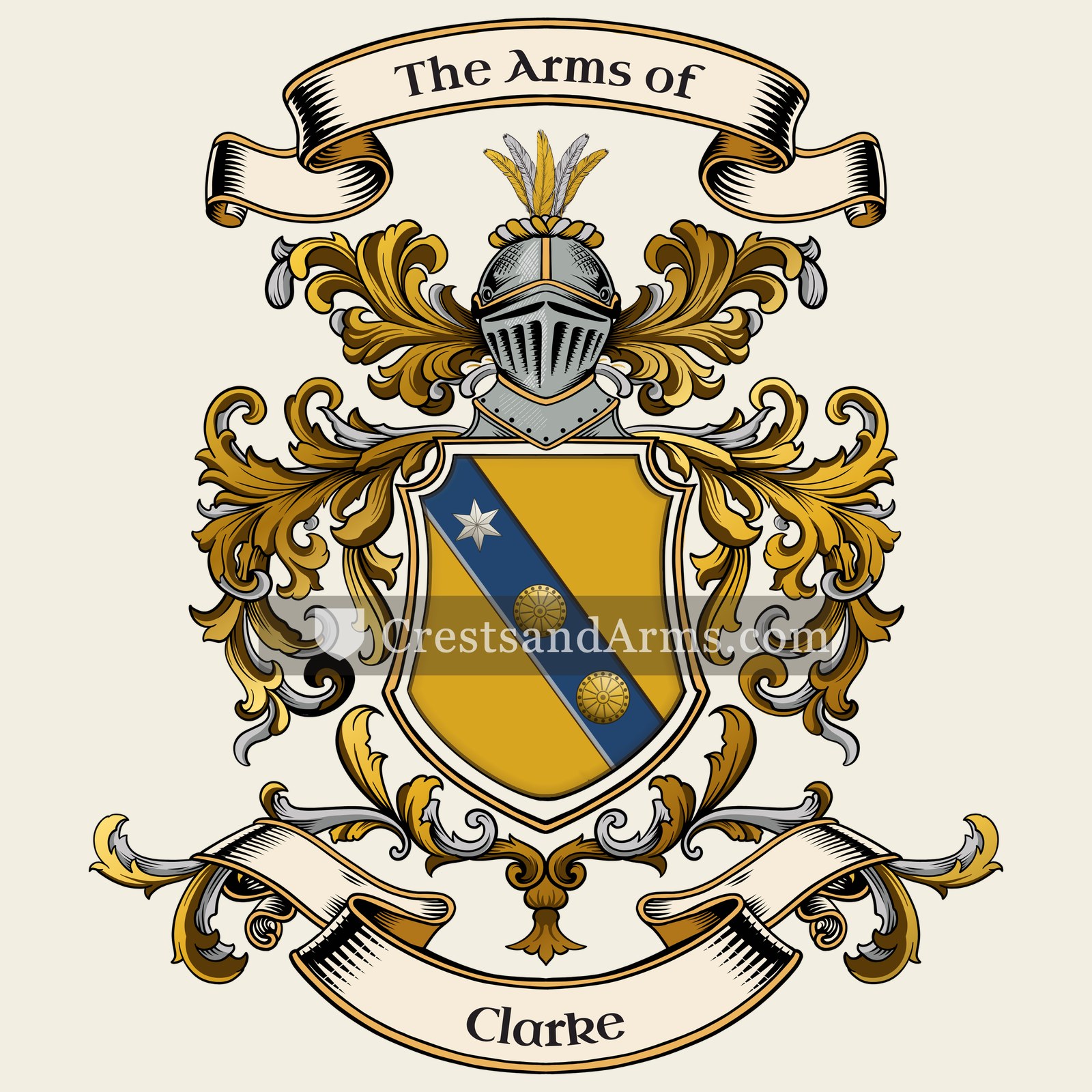
 bendDefence, and the scarf of a commander
 starThe celestial goddess, and nobility
 roundelA coin, and one who has been to the crusades
 bendDefence, and the scarf of a commander
 starThe celestial goddess, and nobility
 roundelA coin, and one who has been to the crusades


 cantonA mark of honour granted by the sovereign
 ramLeadership and authority
 swanGrace, light and the poet's art
 fleur de lisPurity, light, and the sixth son


 goatOne who wins by diplomacy rather than force