Map of Denmark showing where the Clausen arms are recorded
The Clausen arms were recorded in Denmark, c. 1722.
Arms such as these were typically recorded in Sjaælland.
Zealand held the Danish court, the crown's offices and Copenhagen itself. Families who served the king kept estates within reach of it, and royal service was the ordinary route to a coat of arms.
This is where the arms were entered in the register. Families often moved to other parts of the country, so the same name can turn up in more than one region.
The body that granted and recorded arms in Denmark in this period.
Frederik IV of Denmark
Sovereign of the period
Frederik IV of Denmark
1699–1730
Reigning in Denmark when the Clausen arms are first recorded.
How Arms Worked in Denmark
Danish heraldry during this period was closely tied to noble status and royal favor rather than being open to all citizens. Arms were typically granted by the monarch to individuals, and these symbols were then shared by all members of the noble house. If a family line died out, the right to use those specific arms ended with them.
Granting authority
The Danish royal chancery held the power to issue and regulate official coats of arms for the kingdom.
How they got arms
Families usually received their arms through a formal royal grant that confirmed their noble status and rights.
Where arms were recorded
These grants were officially recorded in the Danish Royal Chancery records starting in the sixteenth century.
The family's standing
Recorded among the armigerous families of Denmark.
Origin & History of the Clausen Family in Denmark
The surname Clausen is a patronymic name, which means it was originally created to identify a person as the son of someone named Claus. In Denmark, this naming tradition was very common for centuries before permanent family surnames became mandatory. By the year 1722, records confirm that families bearing this name were well-established on the island of Sjaælland. During this period, most people in rural Denmark lived as tenant farmers on large estates. Life for the Clausen family at this time was deeply tied to the rhythms of the agricultural seasons and the strict social structure of the Danish countryside. As the family moved through the eighteenth century, they likely transitioned from being identified simply by their father's first name to using Clausen as a fixed family identifier. This evolution reflects the broader shift in Danish society as the government began to standardize record-keeping for taxes and military conscription.
Coat of Arms & Family Crest Details
Symbols on this shield
lionCourage, strength and royalty
Colours
Black (Sable)Means: Constancy
Gold (Or)Means: Generosity
Historical info
Source
J. B. Rietstap, Armorial Général, Gouda: G. B. van Goor Zonen, 1884–87
Blazon (the actual original written record)
“De sa. à deux lions affr. d'or, tenant chacun une clé du même, qui se croisent en saut. C.: un lion assis d'or, cour. à l'antique du même; entre un vol coupé ait. de sa. et d'or.”
GermanyNördlingen Bav, c. 1765
Digital archive packCoat of arms PNG, gold border print PDF, vector SVG and the certificate of authenticity. Sent to your email in minutes.
Map of Germany showing where the Clausen arms are recorded
The Clausen arms were recorded in Nördlingen Bav, c. 1765.
This is where the arms were entered in the register. Families often moved to other parts of the country, so the same name can turn up in more than one region.
The body that granted and recorded arms in Germany in this period.
Francis I, Holy Roman Emperor
Sovereign of the period
Francis I, Holy Roman Emperor
1745–1765
Reigning in Denmark when the Clausen arms are first recorded.
How Arms Worked in Germany
In the Holy Roman Empire, coats of arms were often granted to individuals by the Emperor or his representatives. These arms were then passed down through the generations to all legitimate descendants of the original holder. Younger branches of a family usually kept the same shield design without needing to change it, as the arms belonged to the entire lineage.
Granting authority
The Holy Roman Emperor held the sole power to grant new coats of arms throughout his vast imperial territories.
How they got arms
Families typically obtained their coats of arms through a formal imperial grant or by proving their noble status to the authorities.
Where arms were recorded
These grants were officially recorded in the Imperial Chancery registers, which began keeping formal records of such honors during the Middle Ages.
The family's standing
Recorded among the armigerous families of Germany.
Origin & History of the Clausen Family in Germany
The surname Clausen is a patronymic name, which means it was originally created to identify a person as the son of someone named Claus. The name Claus itself is a shortened, Germanic version of the name Nicholas, which became very popular across Northern Europe during the Middle Ages. By the time the family was established in the Bavarian town of Nördlingen in 1765, the name had been in use for several centuries across various German-speaking regions. Families with this name often lived in bustling trade centers like Nördlingen, where they participated in the local economy as craftsmen, merchants, or farmers. Because Nördlingen was a Free Imperial City during the eighteenth century, residents like the Clausen family were part of a unique political system that allowed for significant social and economic activity. This environment helped the family name persist through generations as they integrated into the civic life of the region.
Coat of Arms & Family Crest Details
Symbols on this shield
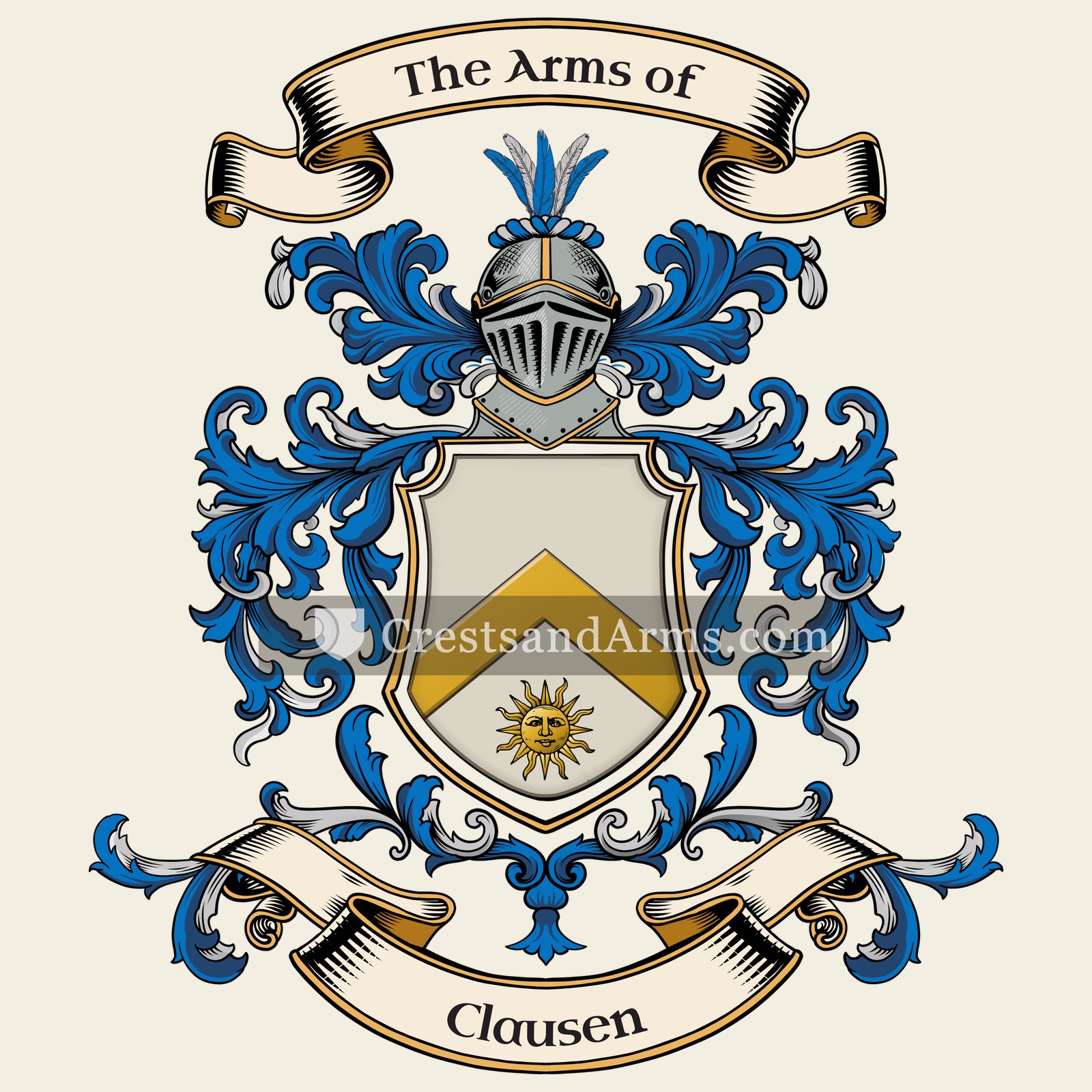
sunGlory, splendour and the source of life
Colours
Silver (Argent)Means: Peace and sincerity
Blue (Azure)Means: Loyalty and truth
Gold (Or)Means: Generosity
Historical info
Source
J. B. Rietstap, Armorial Général, Gouda: G. B. van Goor Zonen, 1884–87
Blazon (the actual original written record)
“Tranché: au 1 d'arg. plein; au 2 d'azur à un demi-soleil d'or, mouv. du tranché, acc. en p. d'un V d'or.”
SwitzerlandValais, c. 1745
Digital archive packCoat of arms PNG, gold border print PDF, vector SVG and the certificate of authenticity. Sent to your email in minutes.
Map of Switzerland showing where the Clausen arms are recorded
The Clausen arms were recorded in Valais, c. 1745.
This is where the arms were entered in the register. Families often moved to other parts of the country, so the same name can turn up in more than one region.
The body that granted and recorded arms in Switzerland in this period.
How Arms Worked in Switzerland
In Switzerland, coats of arms were not restricted to the nobility and were often adopted by common citizens and families. These symbols were passed down through generations to show family identity. When branches of a family grew, they often changed small details of the design to distinguish their own line from the original group.
Granting authority
Cantonal and civic authorities managed the use of coats of arms within their specific regions and local jurisdictions.
How they got arms
Families typically assumed their own coats of arms based on local custom rather than receiving them from a central monarch.
Where arms were recorded
Arms were recorded in various cantonal and civic registers starting from the fourteenth century throughout the Swiss region.
The family's standing
Recorded among the armigerous families of Switzerland.
Origin & History of the Clausen Family in Switzerland
The family name Clausen has deep roots in the mountainous landscape of the Valais region in Switzerland. The name is a patronymic, which means it originated as a shortened form of the name Nicholas. In the high alpine valleys of the 18th century, families often lived in small, isolated communities where they relied on agriculture and livestock to survive. By 1745, records confirm that members of the Clausen family were well-established residents in this area. These early ancestors were likely part of the local social structure that managed communal land and mountain pastures. Their lives were shaped by the challenging terrain and the strict traditions of the Swiss cantons. Over time, the family became a recognized part of the local population, contributing to the cultural and economic development of the Valais region through their work and community involvement.
Clausen Meaning & Related Branches
Root word
Nicolaus
Derived from Greek meaning victory of the people.
This name
ClausenA patronymic surname meaning son of Claus, a shortened form of Nicholas.
also spelled
Clauson
Klausen
Related arms
Claussenvariant spelling
Documented Sources
J. B. Rietstap, Armorial Général, Gouda: G. B. van Goor Zonen, 1884–87
Hofman, Tyge. Danske Adelsmænds Breve. 1750
Kroman, Erik. Danske middelalderlige retsudtryk. 1934
Rigsarkivet (Danish National Archives), Kirkebøger (Parish Registers for Sjaælland, 1722)
Rigsarkivet (Danish National Archives), Danske Kancelli (Danish Chancery records)
Digital archive packCoat of arms PNG, gold border print PDF, vector SVG and the certificate of authenticity. Sent to your email in minutes.


 bendDefence, and the scarf of a commander
 bendDefence, and the scarf of a commander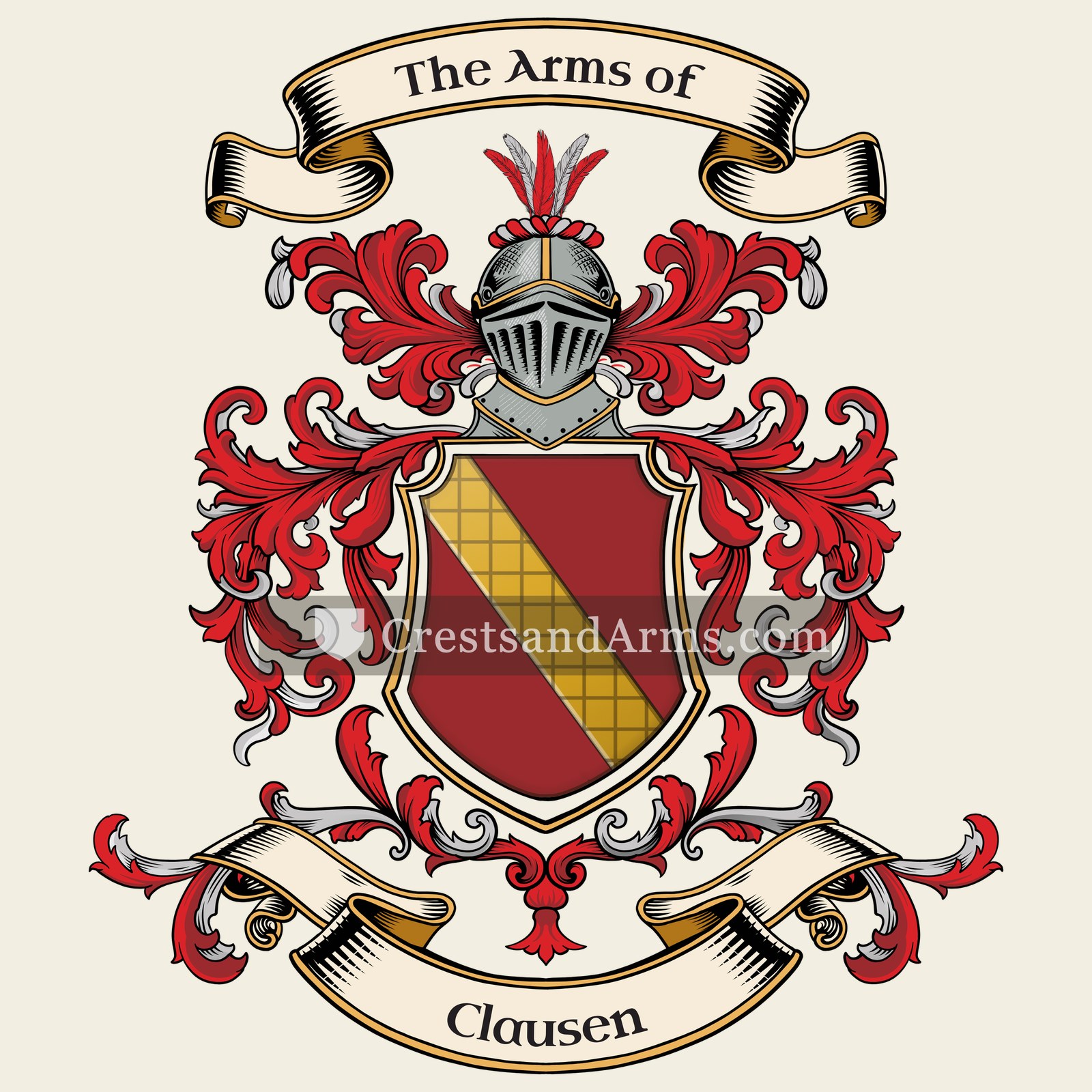


 lionCourage, strength and royalty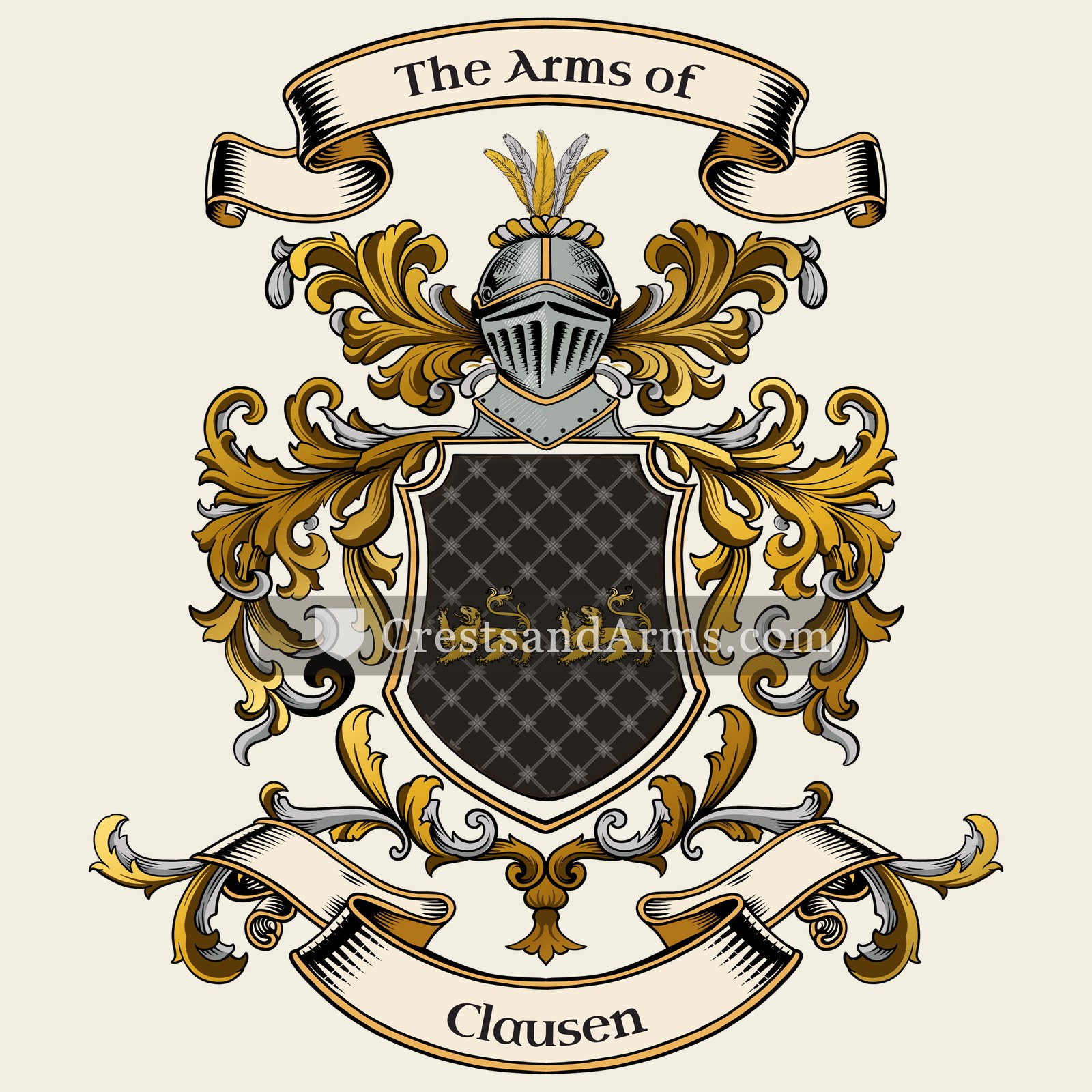


 sunGlory, splendour and the source of life