Map of France showing where the Clavel arms are recorded
The Clavel arms were recorded in Dauphine, c. 1663.
Dauphine lay in the mountains of south-eastern France, a country of small estates and scattered valleys. Its gentry were many and mostly modest, and even a small landholding was enough to justify arms.
This is where the arms were entered in the register. Families often moved to other parts of the country, so the same name can turn up in more than one region.
The body that granted and recorded arms in France in this period.
Louis XIV of France
Sovereign of the period
Louis XIV of France
1643–1715
Reigning in France when the Clavel arms are first recorded.
How Arms Worked in France
In France, a coat of arms was a mark of honor that passed down through the male line to all legitimate descendants. Families often used the same shield without changes to show their shared heritage. If a branch wanted to stand out, they could add a small mark to their shield to show their specific place in the family tree.
Granting authority
The Juge d'armes de France acted as the official authority that regulated and verified coats of arms across the country.
How they got arms
Families typically inherited their arms from ancestors, though they could also receive them through royal grants or by proving their noble status.
Where arms were recorded
Coats of arms were officially recorded in the Armorial Général de France, which began its main collection in the year 1696.
The family's standing
Recorded among the armigerous families of Dauphine.
Origin & History of the Clavel Family in France
The surname Clavel has deep roots in the historical province of Dauphiné, a rugged region in southeastern France nestled against the Alps. By the mid-seventeenth century, the family was already well-established in this area, as evidenced by records confirming their presence there in 1663. The name itself is derived from the Old French word *clavel*, which referred to a nail or a small peg. This suggests that the earliest ancestors to carry the name likely worked as blacksmiths, carpenters, or tradespeople who specialized in metalwork or construction. Living in the mountainous landscape of Dauphiné, these early family members were part of a resilient community that navigated the complex social and religious shifts of the era. Over time, the name became a permanent fixture in local parish registers, marking the family as a stable and enduring part of the region’s long history.
Coat of Arms & Family Crest Details
Colours
Blue (Azure)Means: Loyalty and truth
Historical info
Source
J. B. Rietstap, Armorial Général, Gouda: G. B. van Goor Zonen, 1884–87
Blazon (the actual original written record)
“D'azur à trois clous d'or.”
AustriaVienne Dauphiné, c. 1772
Digital archive packCoat of arms PNG, gold border print PDF, vector SVG and the certificate of authenticity. Sent to your email in minutes.
Map of Austria showing where the Clavel arms are recorded
The Clavel arms were recorded in Vienne Dauphiné, c. 1772.
This is where the arms were entered in the register. Families often moved to other parts of the country, so the same name can turn up in more than one region.
Region
Vienne Dauphiné
Town
Vienne Dauphiné
First recorded
1772
Granting Authority for the Clavel Arms
Imperial and Royal chancery
Sodacan · CC BY-SA 3.0
The body that granted and recorded arms in Austria in this period.
Joseph II, Holy Roman Emperor
Sovereign of the period
Joseph II, Holy Roman Emperor
1765–1790
Reigning in France when the Clavel arms are first recorded.
How Arms Worked in Austria
Austrian coats of arms were often linked directly to noble titles granted by the Emperor. These symbols belonged to the entire family line rather than just one individual. When a family grew, new branches kept the original design without needing to change it. This system allowed all members of a noble house to share the same identity across many generations.
Granting authority
The Imperial and Royal chancery managed all heraldic matters and controlled the official granting of arms throughout the Austrian lands.
How they got arms
Families typically received their arms through a formal imperial decree that often accompanied the elevation of a person to noble status.
Where arms were recorded
Official records of these grants were kept in the Imperial Register of Nobility which began its formal documentation process in 1453.
The family's standing
Recorded among the armigerous families of Austria.
Origin & History of the Clavel Family in Austria
The name Clavel has deep roots in the historical region of the Dauphiné in southeastern France, where records confirm the family was well-established by 1772. While the name is primarily French in origin, the movement of people across European borders during the eighteenth and nineteenth centuries brought families with this surname into the lands of the Austrian Empire. In the context of Austria, the name often appeared among families involved in trade, administration, or military service as the borders of the Habsburg Monarchy expanded. Because the name is derived from the Old French word for a nail or a clove, it likely began as a descriptive nickname for a craftsman or a merchant dealing in spices. As these individuals migrated eastward into Austrian territories, they integrated into local communities while maintaining their ancestral identity. This transition reflects the broader patterns of migration that shaped the diverse population of the Austrian Empire, where families from across the continent settled to pursue new opportunities in an evolving political landscape.
Coat of Arms & Family Crest Details
Symbols on this shield
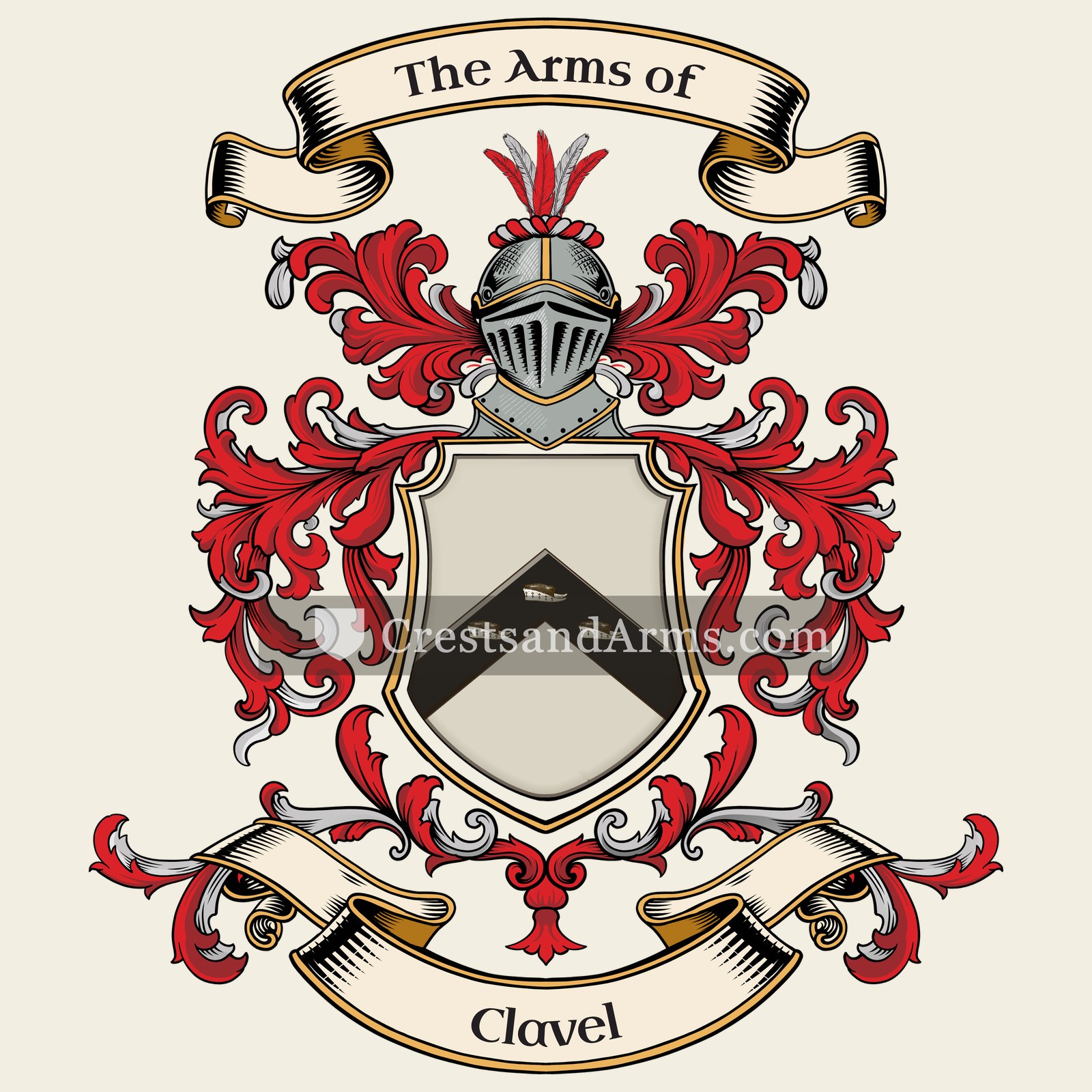
chevronProtection, and faithful service completed
hat or capDignity, and the honour of office
Colours
Silver (Argent)Means: Peace and sincerity
Black (Sable)Means: Constancy
Historical info
Source
Sir Bernard Burke, The General Armory of England, Scotland, Ireland and Wales, London: Harrison & Sons, 1884
Blazon (the actual original written record)
“Ar. on a chev. sa. three caps of maintenance ar”
DorsetDorset, c. 1623
Digital archive packCoat of arms PNG, gold border print PDF, vector SVG and the certificate of authenticity. Sent to your email in minutes.
Map of England showing where the Clavel arms are recorded
The Clavel arms were recorded in Dorset, c. 1623.
Dorset was quiet farming and grazing country along the south coast. Its gentry were middling rather than grand, but they held their manors for a very long time, and long holding is what puts a name in the records.
This is where the arms were entered in the register. Families often moved to other parts of the country, so the same name can turn up in more than one region.
The body that granted and recorded arms in England in this period.
James VI and I
Sovereign of the period
James VI and I
1603–1625
Reigning in France when the Clavel arms are first recorded.
How Arms Worked in England
English heraldry allowed arms to be shared by all legitimate descendants of the original owner. These symbols were treated as personal property that moved through the generations to all children. While the eldest son kept the original design, other family members could use the same shield without needing to change it or register their own unique versions.
Granting authority
The College of Arms in London has regulated the use of coats of arms throughout England and Wales since 1484.
How they got arms
Families typically obtained their coats of arms through a formal grant from the Crown or by proving their ancient right to them.
Where arms were recorded
All official coats of arms are recorded in the registers kept at the College of Arms, which date back to the fifteenth century.
The family's standing
Recorded among the armigerous families of Dorset.
Origin & History of the Clavel Family in England
The surname Clavel has deep roots in the English landscape, with early records confirming the family was well-established in the county of Dorset by 1623. The name is derived from the Old French word "clavel," which translates to a small nail or a stud, and it was likely used as a descriptive nickname for a person who worked with metal or possessed a sharp, pointed personality. By the early 17th century, members of the Clavel family were prominent landowners and active participants in the local governance of Dorset. Their presence in the region during this period suggests they were part of the landed gentry who played a significant role in the agricultural and social development of the English countryside. As the family grew, they became deeply integrated into the local parish systems, leaving behind a legacy of documented births, marriages, and property transactions that reflect the steady expansion of their influence across southern England.
Clavel Meaning & Related Branches
Root word
Clavus
A Latin term referring to a nail, spike, or stud.
This name
ClavelA topographic name for someone living near a clove-shaped piece of land or a nail-maker.
also spelled
Clavell
Clavelle
Clavelly
Clavellee
Claville
Related arms
Courbon de St.-Genest et de Monriolsimilar arms
Drionsimilar arms
Gooldsimilar arms
Clavillevariant spelling
Documented Sources
J. B. Rietstap, Armorial Général, Gouda: G. B. van Goor Zonen, 1884–87
Archives départementales de l'Isère, Collection des registres paroissiaux et d'état civil
Albert Dauzat, Dictionnaire étymologique des noms et prénoms de France, 1951
Marie-Thérèse Morlet, Dictionnaire étymologique des noms de famille, 1991
Digital archive packCoat of arms PNG, gold border print PDF, vector SVG and the certificate of authenticity. Sent to your email in minutes.


 chevronProtection, and faithful service completed
 ermineDignity and rank
 chevronProtection, and faithful service completed
 ermineDignity and rank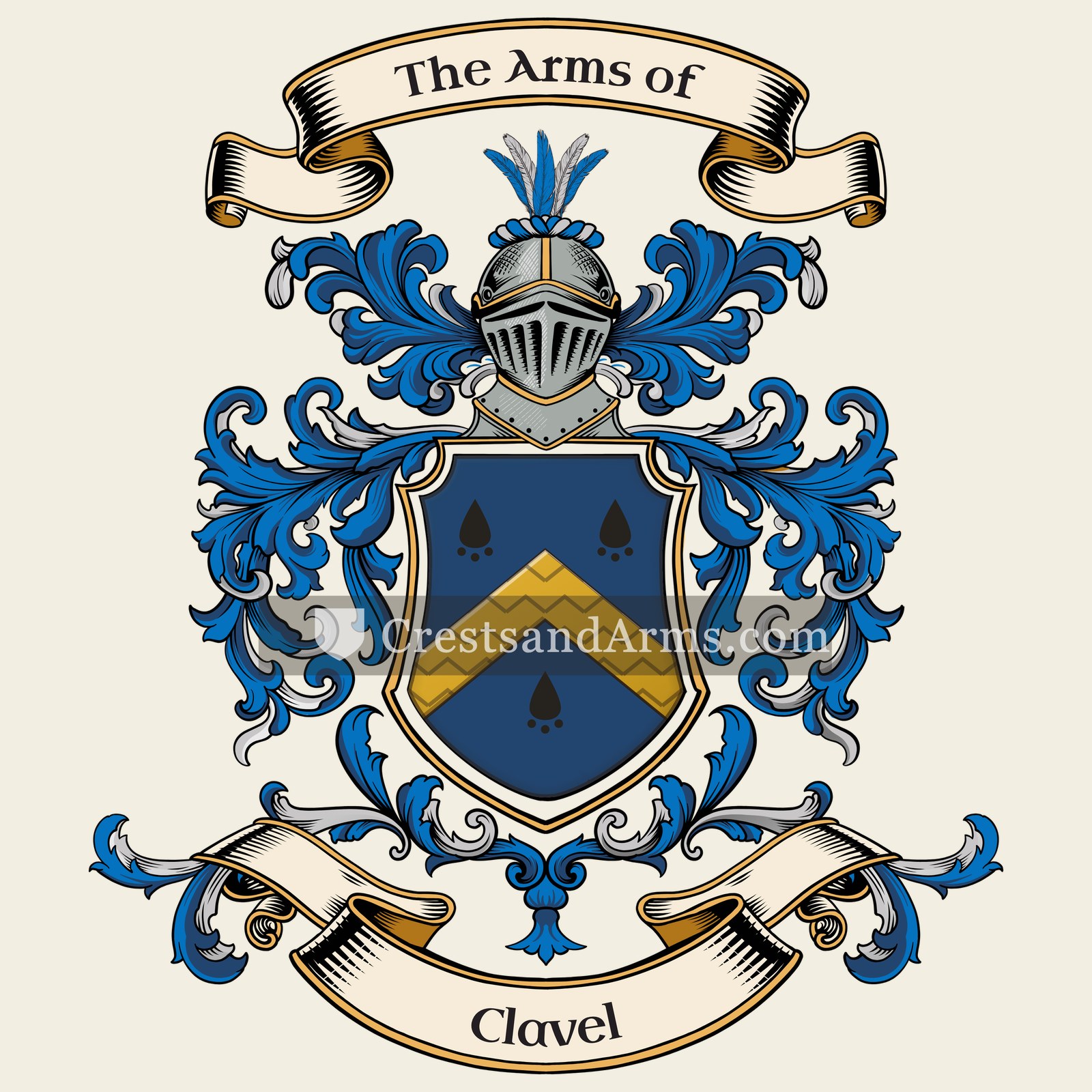


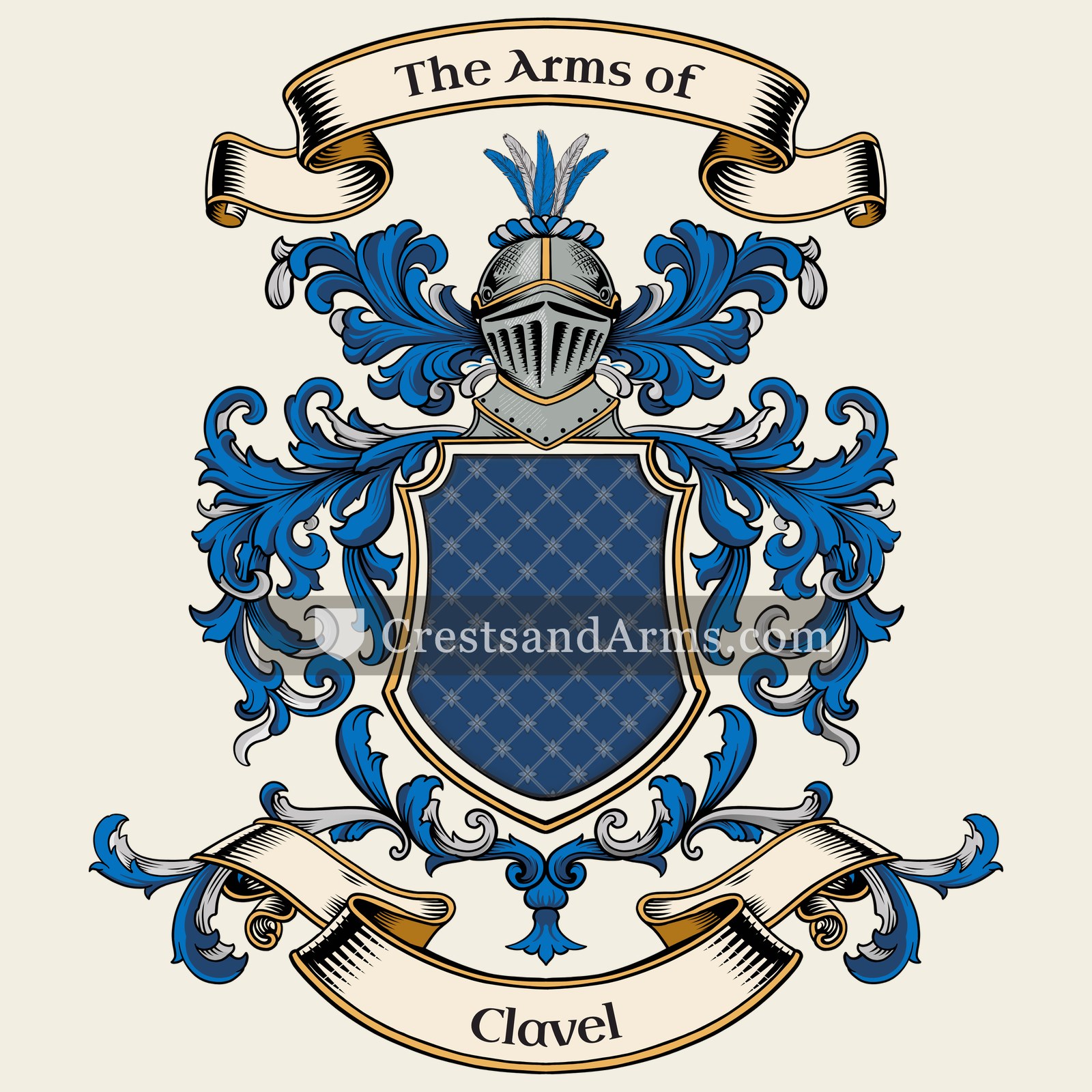


 hat or capDignity, and the honour of office