Map of Spain showing where the Claver arms are recorded
The Claver arms were recorded in Catalonia, c. 1722.
Catalonia lived by sea trade, and its merchant houses were as powerful as its landowners. Both sorts of family took arms, and Barcelona kept records of the houses entitled to bear them.
This is where the arms were entered in the register. Families often moved to other parts of the country, so the same name can turn up in more than one region.
The body that granted and recorded arms in Spain in this period.
Philip V of Spain
Sovereign of the period
Philip V of Spain
1714–1724
Reigning in Spain when the Claver arms are first recorded.
How Arms Worked in Spain
In Spain, a coat of arms was considered a form of property that belonged to the entire family line. These arms were passed down from a father to all his children equally. Younger branches of the family usually kept the original design without needing to add any special marks to distinguish their specific line.
Granting authority
The Cronista Rey de Armas was the official body that regulated and granted coats of arms throughout Spain.
How they got arms
Families often obtained their arms through royal grants or by proving their noble status to the official heraldic authority.
Where arms were recorded
Coats of arms were officially recorded in the registers of the Cronista Rey de Armas starting in 1496.
The family's standing
Recorded among the armigerous families of Catalonia.
Origin & History of the Claver Family in Spain
The family name Claver has deep roots in the northeastern region of Spain known as Catalonia. Historical records confirm that members of the family were well-established in this area by the early 18th century, specifically by the year 1722. The name itself is linked to the Catalan word for a key, which suggests that early ancestors may have held positions of responsibility or served as guardians of important locations. During this period, the Claver family was part of the local social fabric in Catalan towns, where they participated in the agricultural and administrative life of their communities. As the family grew, they became integrated into the regional history of Catalonia, reflecting the broader cultural and linguistic shifts of the Spanish Mediterranean coast during the Enlightenment era.
Coat of Arms & Family Crest Details
Symbols on this shield
chevronProtection, and faithful service completed
chiefAuthority, wisdom and dominion
fessThe military belt, and readiness to serve
trefoilPerpetuity, and the Trinity
starThe celestial goddess, and nobility
swordJustice, and military honour
Colours
Blue (Azure)Means: Loyalty and truth
Gold (Or)Means: Generosity
Silver (Argent)Means: Peace and sincerity
Historical info
Source
J. B. Rietstap, Armorial Général, Gouda: G. B. van Goor Zonen, 1884–87
Blazon (the actual original written record)
“D'azur au chev. d'or, acc. en chef de deux étoiles du même et en p. d'une épée d'arg., garnie du sec.; au chef d'arg., soutnue d'une fasce ondée de sin. et ch. de deux trèfles du même, les tiges passées en saut., mouv. de ladite fasce ondée.”
Netherlandsc. 1815
Digital archive packCoat of arms PNG, gold border print PDF, vector SVG and the certificate of authenticity. Sent to your email in minutes.
Map of Netherlands showing where the Claver arms are recorded
The Claver arms were recorded in Netherlands, c. 1815.
Arms such as these were typically recorded in Friesland.
Friesland was low, wet country on the northern coast of the Netherlands, farmed by families who had held the same land for centuries. Free landholders were unusually common there, and a free landholder could carry arms.
This is where the arms were entered in the register. Families often moved to other parts of the country, so the same name can turn up in more than one region.
Region
Friesland
First recorded
1815
Granting Authority for the Claver Arms
Hoge Raad van Adel
Photograph made by me · CC BY-SA 3.0
The body that granted and recorded arms in Netherlands in this period.
William I of the Netherlands
Sovereign of the period
William I of the Netherlands
1815–1840
Reigning in Spain when the Claver arms are first recorded.
How Arms Worked in Netherlands
In the Netherlands, coats of arms were often used by noble families and those who held specific public offices. These arms were passed down through the generations to legitimate descendants. Younger branches of a family usually kept the original design without needing to add special marks. This system ensured that the family identity remained clear and consistent over many years.
Granting authority
The Hoge Raad van Adel is the official body that regulates and manages noble titles and coats of arms in the Netherlands.
How they got arms
Families typically obtained their coats of arms through official royal grants or by proving their long-standing historical use of the symbols.
Where arms were recorded
Coats of arms are officially recorded in the registers held by the Hoge Raad van Adel, which began its work in 1814.
The family's standing
Recorded among the armigerous families of Netherlands.
Origin & History of the Claver Family in Netherlands
The family name Claver has deep roots in the northern provinces of the Netherlands, particularly within the region of Friesland. By the early 19th century, records confirm that members of the family were well-established in this area, living as part of the local Frisian community. The name itself is thought to be linked to the Middle Dutch word for clover, which was a common term used to describe people who lived near specific fields or worked in agriculture. During the Napoleonic era, the Dutch government required all citizens to register formal surnames, which helped solidify the spelling and usage of the name for future generations. These early family members were likely involved in the traditional trades and farming practices that defined Frisian life at the time. Their presence in the region during the transition into the modern Dutch state reflects the broader history of families who helped shape the local culture and economy of the northern Netherlands.
Coat of Arms & Family Crest Details
Symbols on this shield
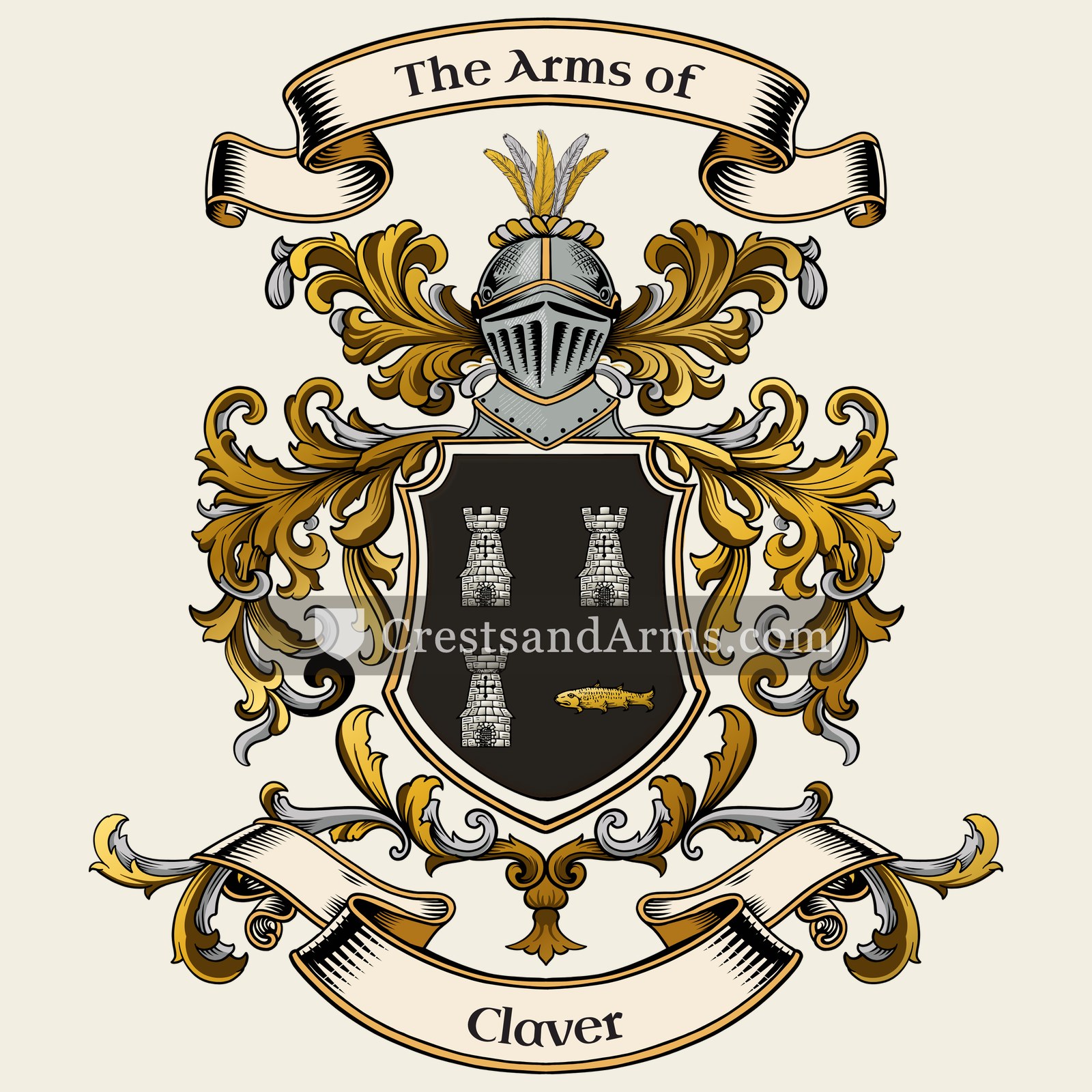
towerGrandeur and solidity, and a stronghold defended
fishA true and generous mind, and Christian faith
Colours
Black (Sable)Means: Constancy
Silver (Argent)Means: Peace and sincerity
Gold (Or)Means: Generosity
Historical info
Source
Sir Bernard Burke, The General Armory of England, Scotland, Ireland and Wales, London: Harrison & Sons, 1884
Blazon (the actual original written record)
“Sa. a bar gemel or, betw. three towers triple-towered ar”
BuckinghamshireBuckinghamshire, c. 1620
Digital archive packCoat of arms PNG, gold border print PDF, vector SVG and the certificate of authenticity. Sent to your email in minutes.
Map of England showing where the Claver arms are recorded
The Claver arms were recorded in Buckinghamshire, c. 1620.
This is where the arms were entered in the register. Families often moved to other parts of the country, so the same name can turn up in more than one region.
The body that granted and recorded arms in England in this period.
James VI and I
Sovereign of the period
James VI and I
1603–1625
Reigning in Spain when the Claver arms are first recorded.
How Arms Worked in England
English heraldry allowed arms to be shared by all legitimate descendants of the original owner. These symbols were treated as personal property that moved through the generations to all children. While the eldest son kept the original design, other family members could use the same shield without needing to change it or register their own unique versions.
Granting authority
The College of Arms in London has regulated the use of coats of arms throughout England and Wales since 1484.
How they got arms
Families typically obtained their coats of arms through a formal grant from the Crown or by proving their ancient right to them.
Where arms were recorded
All official coats of arms are recorded in the registers kept at the College of Arms, which date back to the fifteenth century.
The family's standing
Recorded among the armigerous families of Buckinghamshire.
Origin & History of the Claver Family in England
The surname Claver is rooted in the landscape of medieval England, where it likely originated as an occupational name for a person who worked with keys or locks. By the early seventeenth century, the family had established a notable presence in Buckinghamshire, a county known for its rich agricultural history and proximity to London. Records from 1620 confirm that members of the Claver family were settled in this region, living as part of the local community during a time of significant social and economic change. These early ancestors were likely involved in the traditional trades or farming practices that defined the English countryside before the Industrial Revolution. Their presence in Buckinghamshire suggests that the family had integrated into the local parish systems, which served as the primary way of organizing life and keeping track of residents during the reign of King James I.
Claver Meaning & Related Branches
Root word
Clavis
Latin term meaning a key or a locking mechanism.
This name
ClaverRefers to a person who served as a key-bearer or a gatekeeper.
also spelled
Clavier
Clavar
Clavor
Documented Sources
J. B. Rietstap, Armorial Général, Gouda: G. B. van Goor Zonen, 1884–87
Arxiu de la Corona d'Aragó, Protocolos Notariales de Barcelona
Arxiu Històric de la Ciutat de Barcelona, Fons de l'Ajuntament de Barcelona
Bofarull i Sans, Francisco de, Los gremios de Barcelona, 1910
Pujol i Hamelink, Marcel, La vida quotidiana a la Catalunya del segle XVIII, 2004
Digital archive packCoat of arms PNG, gold border print PDF, vector SVG and the certificate of authenticity. Sent to your email in minutes.


 keyGuardianship, and the office of a steward
 keyGuardianship, and the office of a steward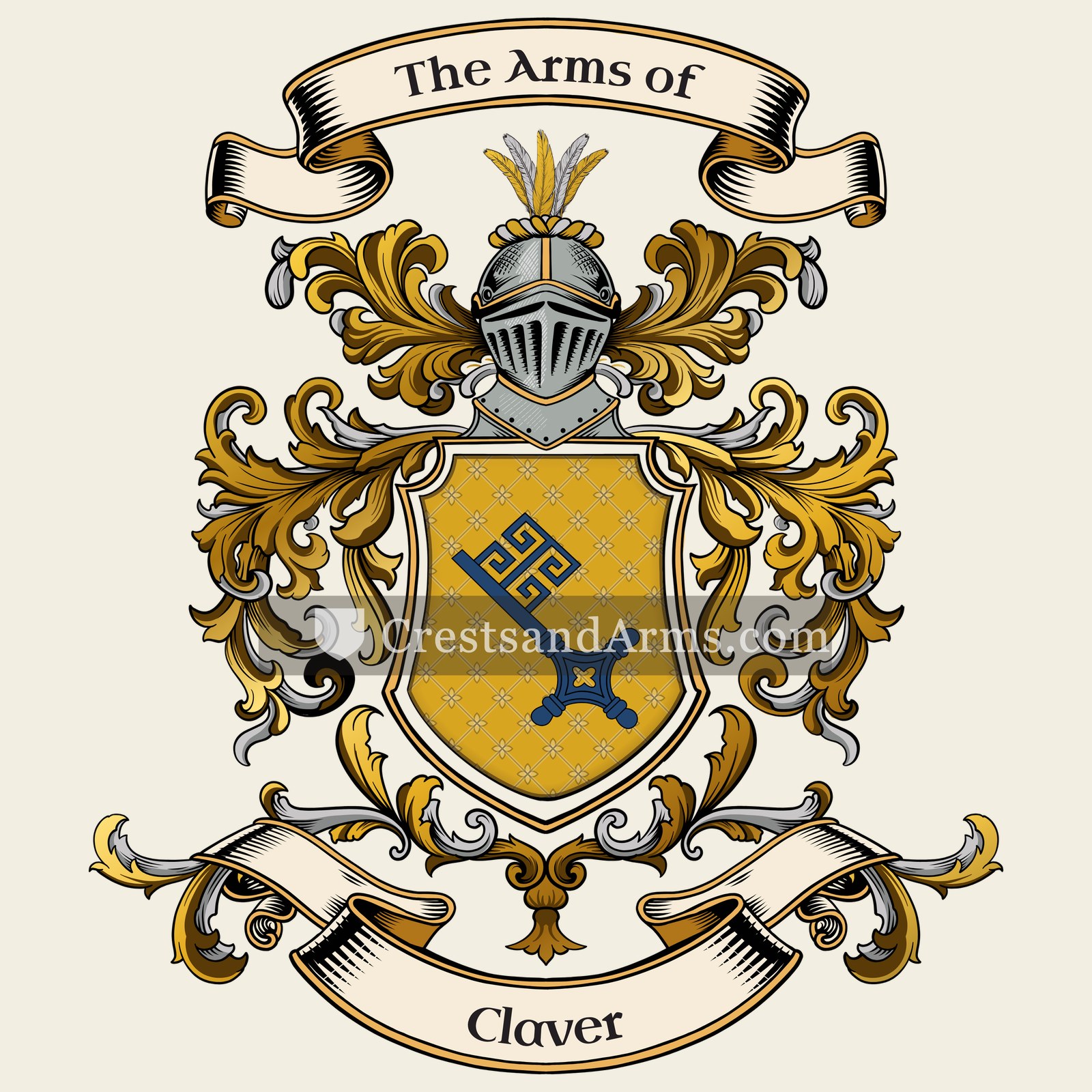


 chevronProtection, and faithful service completed
 chiefAuthority, wisdom and dominion
 fessThe military belt, and readiness to serve
 trefoilPerpetuity, and the Trinity
 starThe celestial goddess, and nobility
 swordJustice, and military honour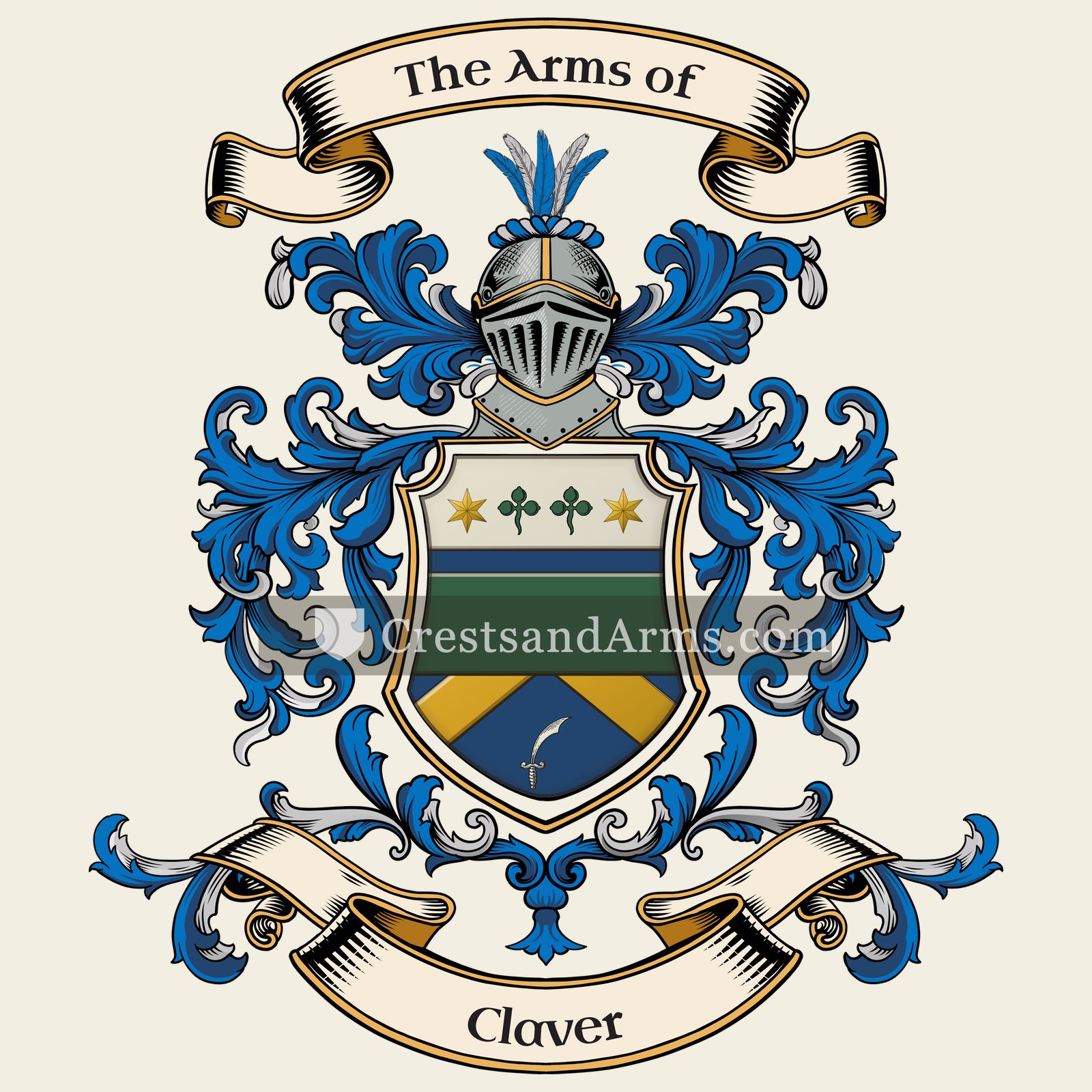


 towerGrandeur and solidity, and a stronghold defended
 fishA true and generous mind, and Christian faith