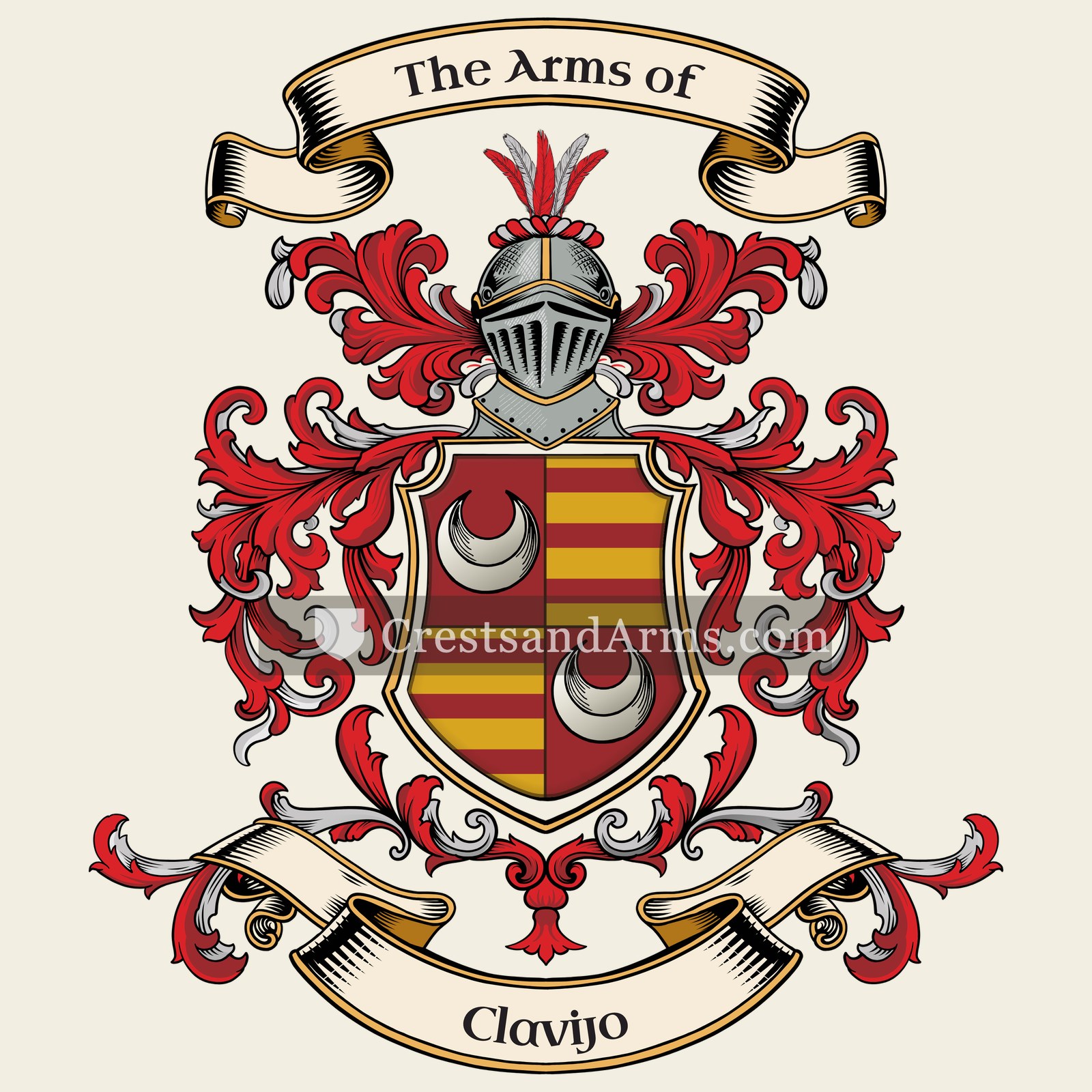
A record of documented arms, meaning and origin, researched for the Clavijo family of Spain.
Reg. 9363 · Spanish, A–C
Coat of Arms & Family Crest Details
Symbols on this shield
crescentHonour by the sovereign, and the second son
Colours
Red (Gules)Means: Military strength
Gold (Or)Means: Generosity
Silver (Argent)Means: Peace and sincerity
Historical info
Source
J. B. Rietstap, Armorial Général, Gouda: G. B. van Goor Zonen, 1884–87
Blazon (the actual original written record)
“Ec.: aux 1 et 4 de gu. au croiss. tourné d'arg.; aux 2 et 3 d'or à trois barres de gu.”
SpainCordoue, c. 1725
Where the Clavijo Arms Were Recorded
Cordoue
Map of Spain showing where the Clavijo arms are recorded
The Clavijo arms were recorded in Cordoue, c. 1725.
This is where the arms were entered in the register. Families often moved to other parts of the country, so the same name can turn up in more than one region.
The body that granted and recorded arms in Spain in this period.
Philip V of Spain
Sovereign of the period
Philip V of Spain
1724–1746
Reigning in Spain when the Clavijo arms are first recorded.
How Arms Worked in Spain
In Spain, a coat of arms was considered a form of property that belonged to the entire family line. These arms were passed down from a father to all his children equally. Younger branches of the family usually kept the original design without needing to add any special marks to distinguish their specific line.
Granting authority
The Cronista Rey de Armas was the official body that regulated and granted coats of arms throughout Spain.
How they got arms
Families often obtained their arms through royal grants or by proving their noble status to the official heraldic authority.
Where arms were recorded
Coats of arms were officially recorded in the registers of the Cronista Rey de Armas starting in 1496.
The family's standing
Recorded among the armigerous families of Spain.
Origin & History of the Clavijo Family in Spain
The surname Clavijo originates from the rugged landscapes of the Iberian Peninsula, where it is tied to the history of the Spanish Reconquista. The name is locative in nature, meaning it was likely taken from the town of Clavijo in the La Rioja region, a site famous for a legendary battle in the ninth century. Over the following centuries, families bearing this name migrated across the peninsula as the borders of kingdoms shifted and new territories were settled. By the early eighteenth century, the Clavijo family had established a notable presence in the historic city of Córdoba. Records from 1725 confirm that members of the family were integrated into the social and administrative fabric of this city, which served as a major cultural and economic hub during the Spanish Enlightenment. This transition from the northern regions to the southern heartland of Andalusia reflects the broader movement of families seeking new opportunities in the administrative centers of the Spanish Empire.
Related Branches & Arms
Root word
Clavis
Latin term meaning a key or a bolt used for locking.
This name
ClavijoRefers to a person who lived near a mountain pass or a key location.
also spelled
Clavicho
Claviyo
Claviho
Related arms
Angulorecorded with Clavijo, same area
Baenarecorded with Clavijo, same area
Cabezasrecorded with Clavijo, same area
Cardenasrecorded with Clavijo, same area
Documented Sources
J. B. Rietstap, Armorial Général, Gouda: G. B. van Goor Zonen, 1884–87
Moll, Francesc de B., Els llinatges catalans: Catalunya, País Valencià, Illes Balears, 1959
Faure, Roberto, Diccionario de apellidos españoles, 2001
Archivo Histórico Provincial de Córdoba, Protocolos Notariales
Digital archive packCoat of arms PNG, gold border print PDF, vector SVG and the certificate of authenticity. Sent to your email in minutes.


 crescentHonour by the sovereign, and the second son
 crescentHonour by the sovereign, and the second son