Map of England showing where the Clay arms are recorded
The Clay arms were recorded in London, c. 1620.
This is where the arms were entered in the register. Families often moved to other parts of the country, so the same name can turn up in more than one region.
The body that granted and recorded arms in England in this period.
James VI and I
Sovereign of the period
James VI and I
1603–1625
Reigning in England when the Clay arms are first recorded.
How Arms Worked in England
English heraldry allowed arms to be shared by all legitimate descendants of the original owner. These symbols were treated as personal property that moved through the generations to all children. While the eldest son kept the original design, other family members could use the same shield without needing to change it or register their own unique versions.
Granting authority
The College of Arms in London has regulated the use of coats of arms throughout England and Wales since 1484.
How they got arms
Families typically obtained their coats of arms through a formal grant from the Crown or by proving their ancient right to them.
Where arms were recorded
All official coats of arms are recorded in the registers kept at the College of Arms, which date back to the fifteenth century.
The family's standing
Recorded among the armigerous families of England.
Origin & History of the Clay Family in England
The surname Clay originated in England as a topographic name, which means it was given to people who lived near a specific natural feature. In this case, the name described individuals who resided on or near clay soil or a clay pit. During the Middle Ages, surnames were often adopted based on a person’s surroundings or their trade to help distinguish them from others in a growing population. By the time the family appeared in London records in 1620, the name had already been established in various English counties for several generations. The move to a bustling urban center like London suggests that members of the family were likely participating in the expanding trade and merchant networks of the seventeenth century. As the family settled into city life, they helped carry the name from its rural, land-based origins into the heart of England’s developing commercial society.
Coat of Arms & Family Crest Details
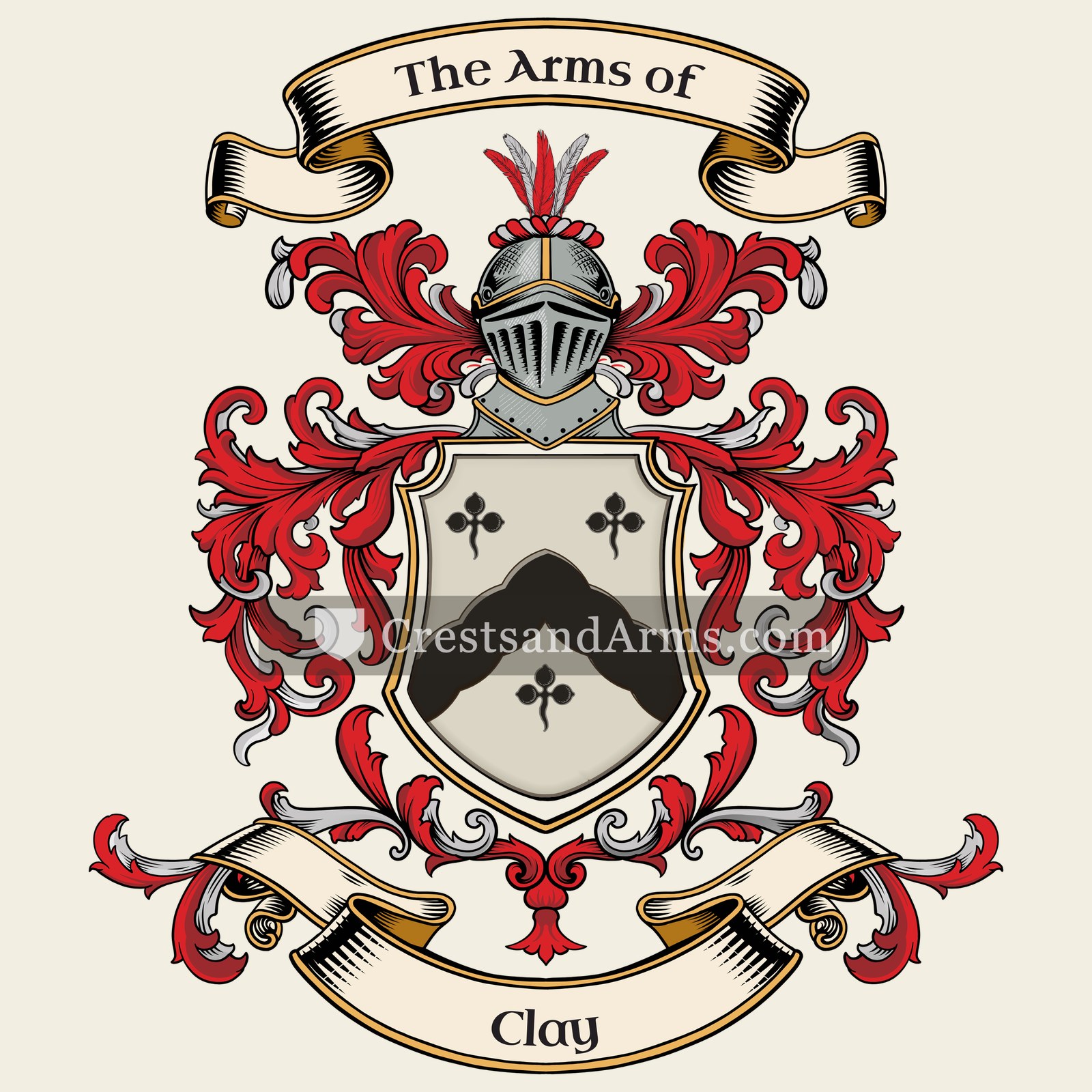
Symbols on this shield
chevronProtection, and faithful service completed
trefoilPerpetuity, and the Trinity
Colours
Silver (Argent)Means: Peace and sincerity
Black (Sable)Means: Constancy
Historical info
Source
Sir Bernard Burke, The General Armory of England, Scotland, Ireland and Wales, London: Harrison & Sons, 1884
Blazon (the actual original written record)
“Ar. a chev. engr. sa. betw. three trefoils of the second”
MonmouthPiercefield · Monmouth, c. 1647
Digital archive packCoat of arms PNG, gold border print PDF, vector SVG and the certificate of authenticity. Sent to your email in minutes.
Map of Wales showing where the Clay arms are recorded
The Clay arms were recorded in Monmouth, c. 1647.
Monmouthshire lay on the Welsh border, where land was held in return for military service. Families were expected to arm and to fight, and fighting households carried shields of their own.
This is where the arms were entered in the register. Families often moved to other parts of the country, so the same name can turn up in more than one region.
The body that granted and recorded arms in Wales in this period.
Charles I of England
Sovereign of the period
Charles I of England
1625–1649
Reigning in England when the Clay arms are first recorded.
How Arms Worked in Wales
English heraldry allowed arms to be shared by all legitimate descendants of the original owner. These symbols were treated as personal property that moved through the generations to all children. While the eldest son kept the original design, other family members could use the same shield without needing to change it or register their own unique versions.
Granting authority
The College of Arms in London has regulated the use of coats of arms throughout England and Wales since 1484.
How they got arms
Families typically obtained their coats of arms through a formal grant from the Crown or by proving their ancient right to them.
Where arms were recorded
All official coats of arms are recorded in the registers kept at the College of Arms, which date back to the fifteenth century.
The family's standing
Recorded among the armigerous families of Monmouth.
Origin & History of the Clay Family in Wales
The surname Clay is primarily of English origin, typically functioning as a topographic name for someone who lived near clay-rich soil or as an occupational name for a potter. While the name is not native to the Welsh language, its presence in Monmouth by 1647 highlights the movement of families across the border during a period of significant political and social upheaval. Monmouth served as a strategic location during the English Civil War, and the arrival of families like the Clays in this border region suggests they were part of the shifting demographics of the seventeenth century. As these families settled into Welsh towns, they often integrated into the local economy and social structures of the Wye Valley. Their presence in official records from this time indicates that they were established residents who participated in the legal and administrative life of the area shortly after the conclusion of major regional conflicts.
Clay Meaning & Related Branches
Root word
claeg
Old English word for sticky earth or mud.
This name
ClayAn occupational name for a worker who lived near or worked with clay soil.
also spelled
Cley
Related arms
Rousrecorded with Clay, same area
Walterrecorded with Clay, same area
Wellsrecorded with Clay, same area
Documented Sources
Sir Bernard Burke, The General Armory of England, Scotland, Ireland and Wales, London: Harrison & Sons, 1884
Bardsley, Charles Wareing, A Dictionary of English and Welsh Surnames, 1901
Reaney, P.H., A Dictionary of British Surnames, 1958
The National Archives, State Papers Domestic, James I, 1620
Digital archive packCoat of arms PNG, gold border print PDF, vector SVG and the certificate of authenticity. Sent to your email in minutes.


 lionCourage, strength and royalty
 escallopThe pilgrim's shell, and a long journey made
 lionCourage, strength and royalty
 escallopThe pilgrim's shell, and a long journey made
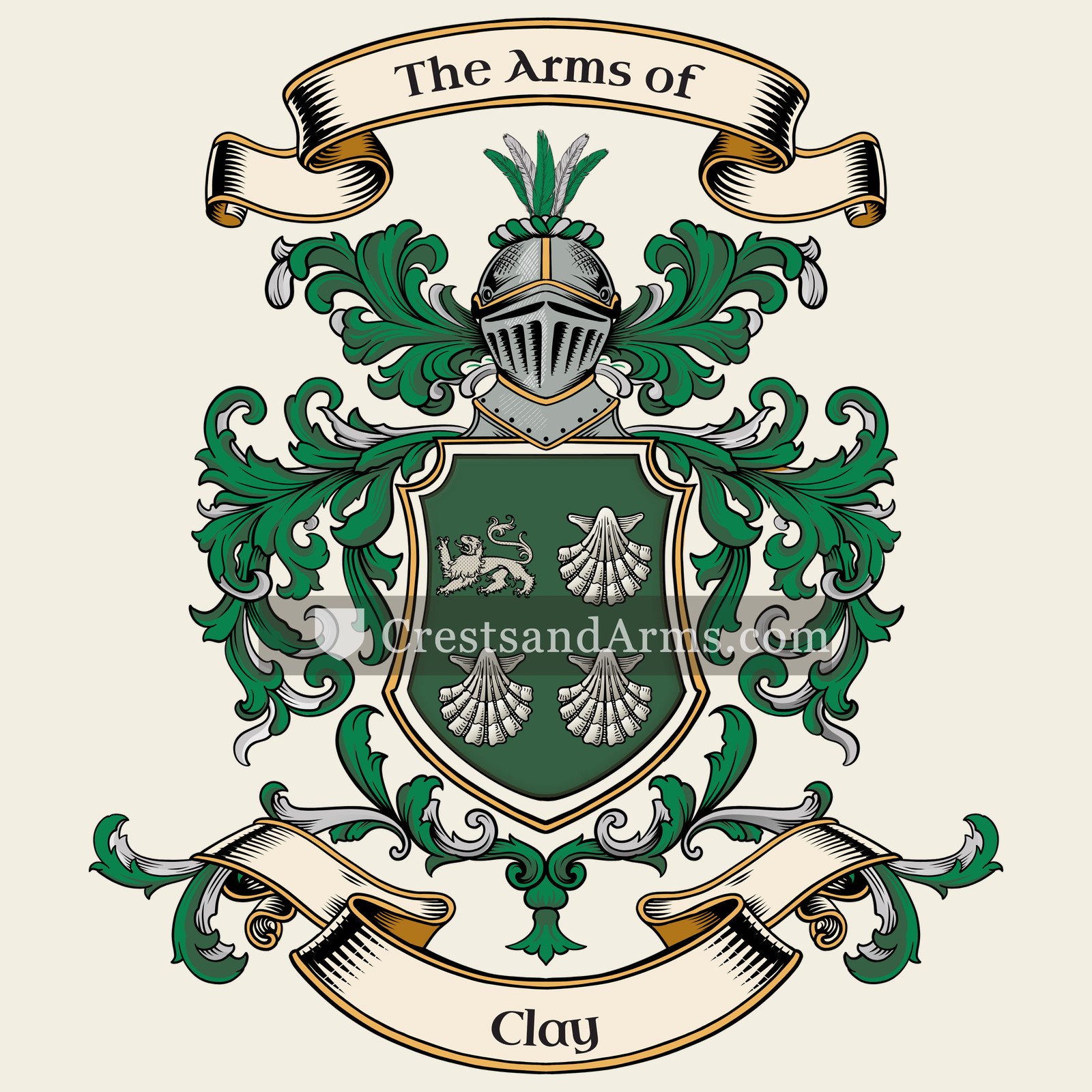


 chevronProtection, and faithful service completed
 trefoilPerpetuity, and the Trinity