A record of documented arms, meaning and origin, researched for the Clerk family lines. Documented in 3 countries.
Reg. 7152 · French, A–C
Coat of Arms & Family Crest Details
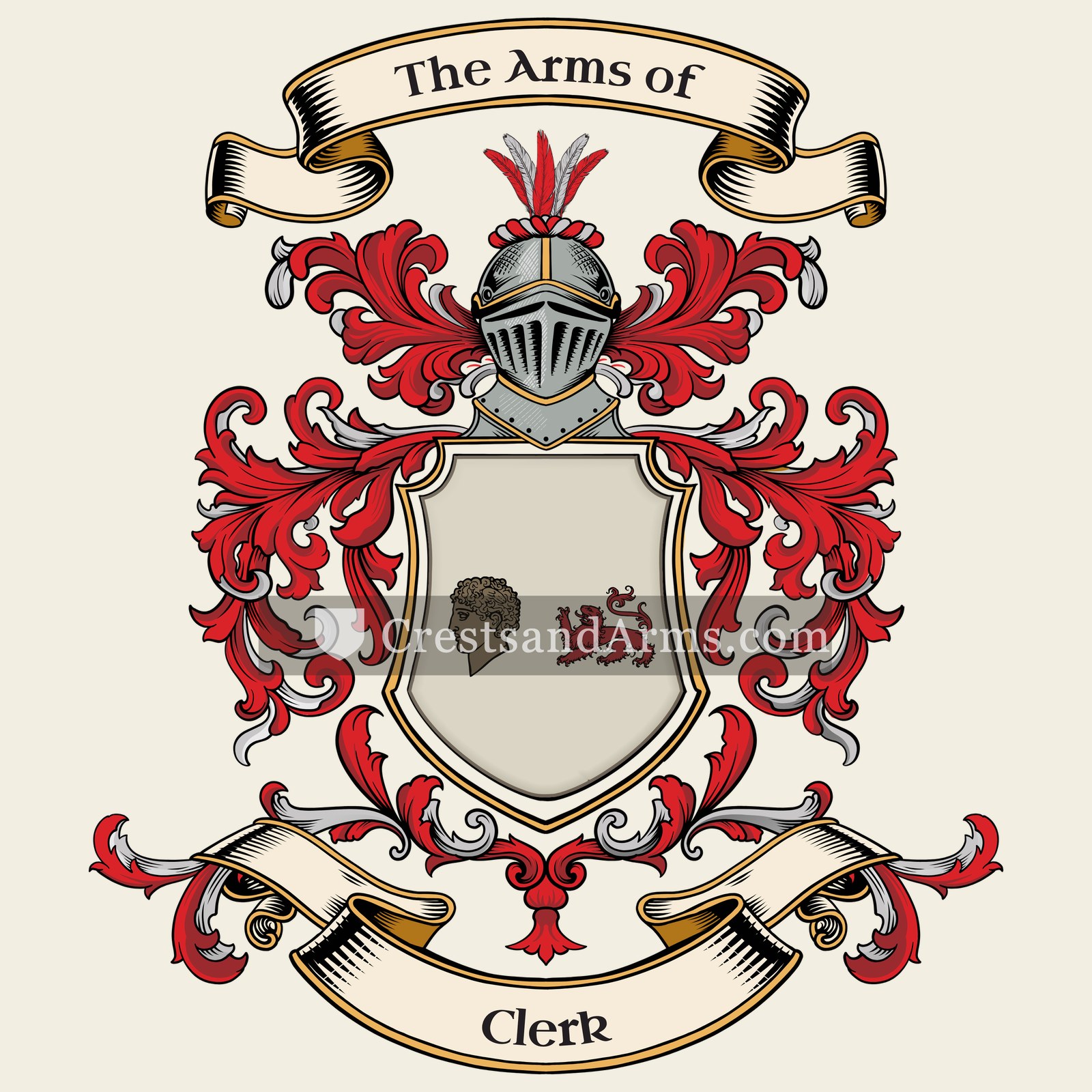
Symbols on this shield
savages head affrontyAn enemy overcome
lionCourage, strength and royalty
Colours
Silver (Argent)Means: Peace and sincerity
Red (Gules)Means: Military strength
Historical info
Source
J. B. Rietstap, Armorial Général, Gouda: G. B. van Goor Zonen, 1884–87
Blazon (the actual original written record)
“d'arg., acc. à dextre d'une tête de More, tort. d'arg., à sen. d'une bourse de gu. et en p. d'un lion du même”
Francec. 1725
Where the Clerk Arms Were Recorded
Bretagne
Map of France showing where the Clerk arms are recorded
The Clerk arms were recorded in France, c. 1725.
Arms such as these were typically recorded in Bretagne.
More families held coats of arms in Bretagne than anywhere else in France. The land was divided into many small estates rather than a few large ones, so far more households counted as gentry, and each needed a shield of its own to be told apart.
This is where the arms were entered in the register. Families often moved to other parts of the country, so the same name can turn up in more than one region.
The body that granted and recorded arms in France in this period.
Louis XV of France
Sovereign of the period
Louis XV of France
1715–1774
Reigning in France when the Clerk arms are first recorded.
How Arms Worked in France
In France, a coat of arms was a mark of honor that passed down through the male line to all legitimate descendants. Families often used the same shield without changes to show their shared heritage. If a branch wanted to stand out, they could add a small mark to their shield to show their specific place in the family tree.
Granting authority
The Juge d'armes de France acted as the official authority that regulated and verified coats of arms across the country.
How they got arms
Families typically inherited their arms from ancestors, though they could also receive them through royal grants or by proving their noble status.
Where arms were recorded
Coats of arms were officially recorded in the Armorial Général de France, which began its main collection in the year 1696.
The family's standing
Recorded among the armigerous families of France.
Origin & History of the Clerk Family in France
The surname Clerk, which translates to "clerk" or "scholar," originated as a professional title for individuals who served in administrative or religious roles during the Middle Ages. In the context of France, the name reflects a time when literacy was rare and those who could read and write held significant social influence. By the early eighteenth century, records confirm that families bearing this name were well-established in the region of Bretagne. During this period, the people of Bretagne maintained a distinct cultural identity, and those identified as Clerks often served as local officials, legal scribes, or members of the educated clergy. Their presence in the region suggests a family history deeply connected to the bureaucratic and intellectual life of the French provinces, where they helped manage the records and legal affairs of their local communities.
Coat of Arms & Family Crest Details
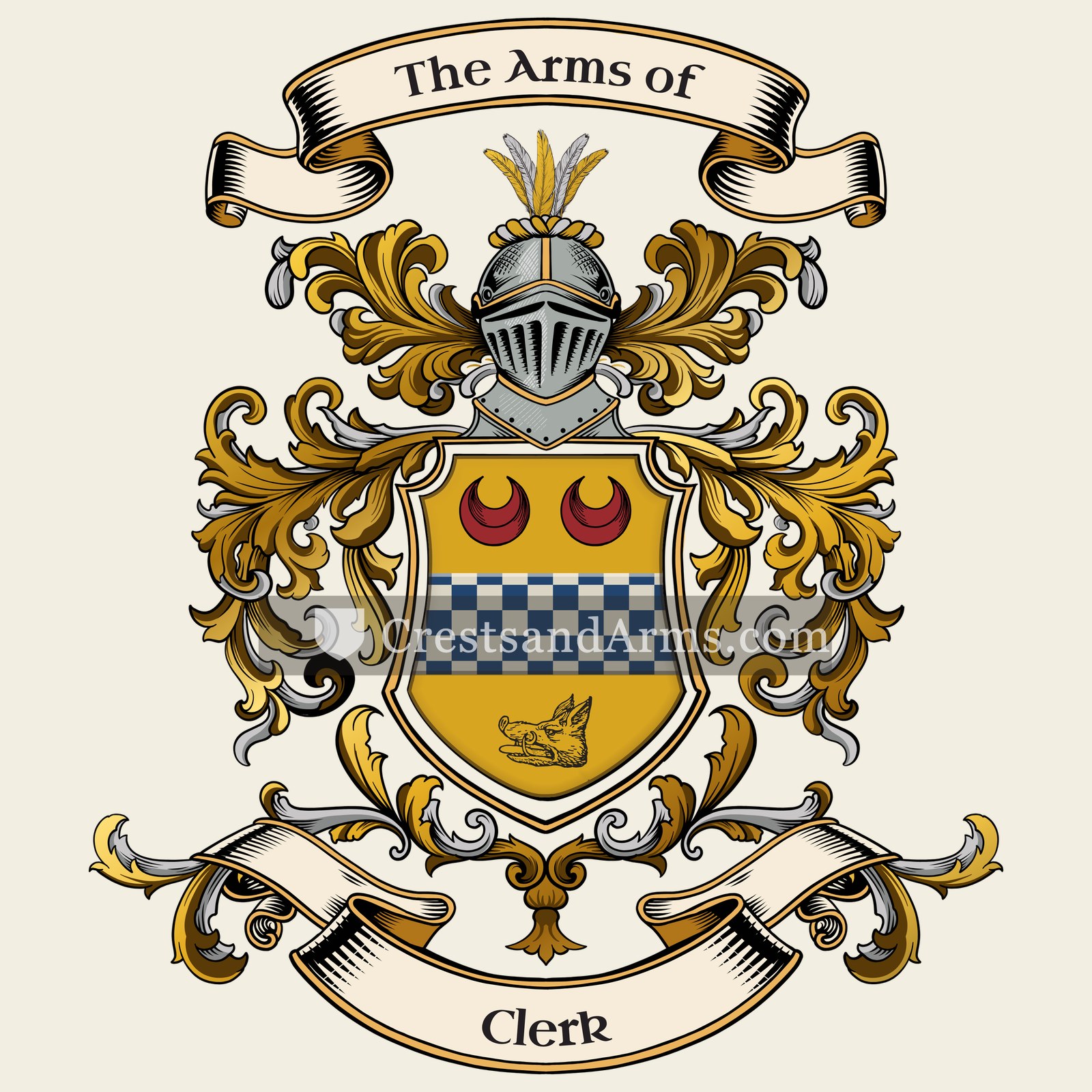
Symbols on this shield
fessThe military belt, and readiness to serve
chequyConstancy, and the counting-board
crescentHonour by the sovereign, and the second son
boars headA fierce fighter who battles to the end
Colours
Gold (Or)Means: Generosity
Silver (Argent)Means: Peace and sincerity
Red (Gules)Means: Military strength
Black (Sable)Means: Constancy
Historical info
Source
Sir Bernard Burke, The General Armory of England, Scotland, Ireland and Wales, London: Harrison & Sons, 1884
Blazon (the actual original written record)
“Or, a fesse chequy az. and ar. betw. two crescents in chief gu. and a boar's head couped in base sa”
EdinburghPennycuick · Edinburgh, c. 1679
Where the Clerk Arms Were Recorded
Edinburgh
Map of Scotland showing where the Clerk arms are recorded
The Clerk arms were recorded in Edinburgh, c. 1679.
Edinburgh was the seat of Scotland's government, its courts and its heralds. Families with business there settled nearby, and being close to where arms were recorded is exactly why so many of them appear.
This is where the arms were entered in the register. Families often moved to other parts of the country, so the same name can turn up in more than one region.
The body that granted and recorded arms in Scotland in this period.
Charles II of England
Sovereign of the period
Charles II of England
1660–1685
Reigning in France when the Clerk arms are first recorded.
How Arms Worked in Scotland
Scottish heraldry is unique because it treats a coat of arms as a piece of personal property protected by law. Only one person can own a specific design at any given time. When a family grows, the head keeps the original shield while other relatives must apply for their own distinct version with slight changes to prove their specific identity.
Granting authority
The Court of the Lord Lyon acts as the official body that regulates and controls all heraldic matters throughout Scotland.
How they got arms
Individuals obtain a legal right to their arms through a formal petition process that confirms their identity and family connection.
Where arms were recorded
All valid coats of arms are officially entered into the Public Register of All Arms and Bearings starting from 1672.
The family's standing
Recorded among the armigerous families of Edinburgh.
Origin & History of the Clerk Family in Scotland
The surname Clerk is a classic occupational name that originated from the medieval Latin word *clericus*, which referred to a person who could read and write. In early Scottish society, these individuals were often the only ones capable of managing legal documents, keeping financial accounts, or serving as secretaries to the nobility. By the time the family was firmly established in Edinburgh in 1679, they had transitioned from their clerical roots into influential roles within the city’s merchant and professional classes. During this period, Edinburgh was a bustling center of trade and intellectual growth, and the Clerks were well-positioned to participate in the city's expanding civic life. Their presence in the capital suggests they were part of a rising social group that valued education and administrative skill, which helped them secure their status in Scotland during the late seventeenth century.
Coat of Arms & Family Crest Details
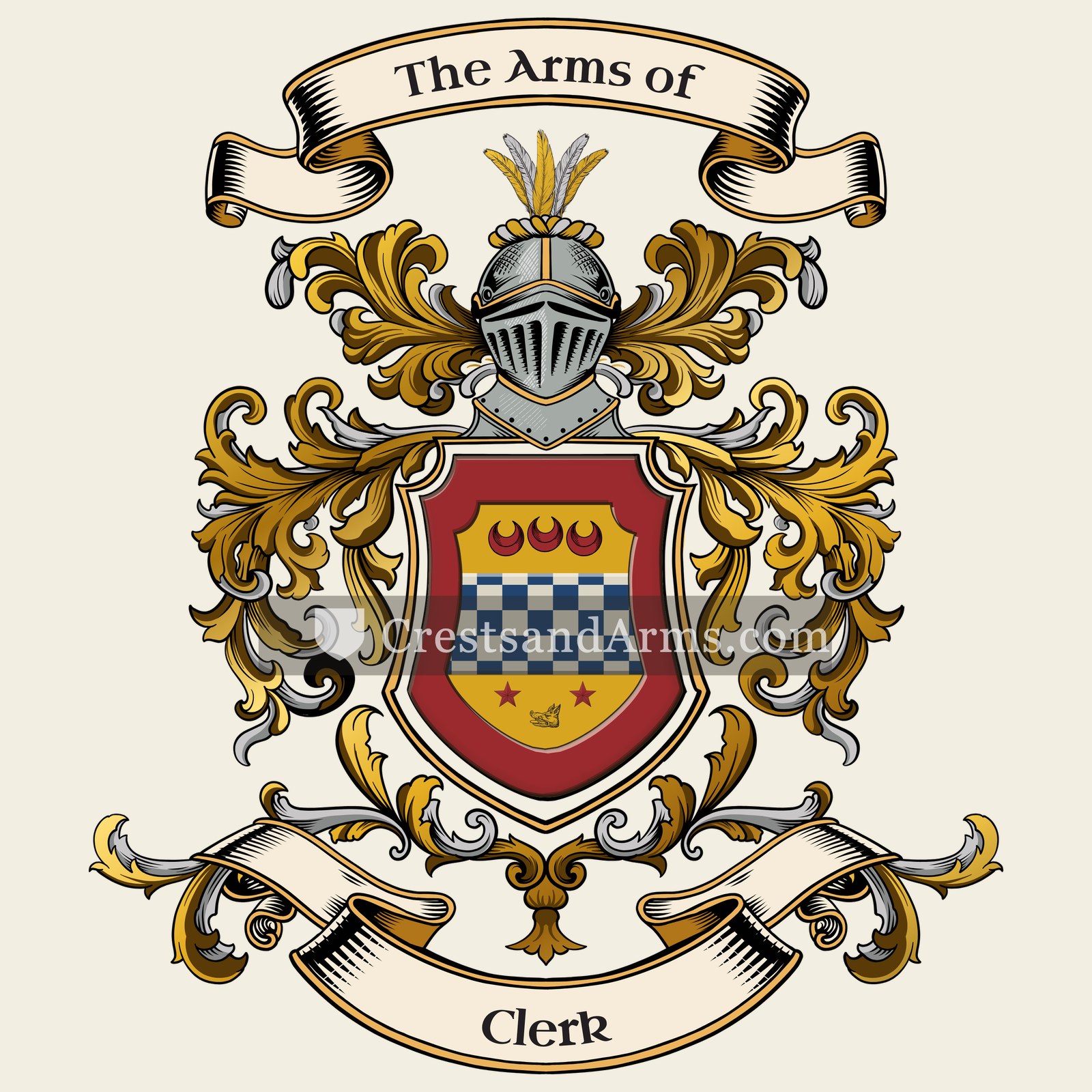
Symbols on this shield
fessThe military belt, and readiness to serve
chequyConstancy, and the counting-board
bordureA difference between branches of one family
boars headA fierce fighter who battles to the end
crescentHonour by the sovereign, and the second son
mulletThe third son, and a divine quality from above
Colours
Gold (Or)Means: Generosity
Silver (Argent)Means: Peace and sincerity
Red (Gules)Means: Military strength
Black (Sable)Means: Constancy
Historical info
Source
Sir Bernard Burke, The General Armory of England, Scotland, Ireland and Wales, London: Harrison & Sons, 1884
Blazon (the actual original written record)
“Or, a fesse chequy az. and ar. betw. three crescents in chief gu. and a boar's head couped sa. betw. two mullets of the fourth in base, all within a bordure engr. of the fifth”
EnglandNorwich, c. 1620
Where the Clerk Arms Were Recorded
York
Map of England showing where the Clerk arms are recorded
The Clerk arms were recorded in Norwich, c. 1620.
Arms such as these were typically recorded in York.
Yorkshire is the largest of the English counties, and it held more gentry families than any other. Land there was split among a great many households rather than a few, so a great many of them carried arms.
This is where the arms were entered in the register. Families often moved to other parts of the country, so the same name can turn up in more than one region.
The body that granted and recorded arms in England in this period.
James VI and I
Sovereign of the period
James VI and I
1603–1625
Reigning in France when the Clerk arms are first recorded.
How Arms Worked in England
English heraldry allowed arms to be shared by all legitimate descendants of the original owner. These symbols were treated as personal property that moved through the generations to all children. While the eldest son kept the original design, other family members could use the same shield without needing to change it or register their own unique versions.
Granting authority
The College of Arms in London has regulated the use of coats of arms throughout England and Wales since 1484.
How they got arms
Families typically obtained their coats of arms through a formal grant from the Crown or by proving their ancient right to them.
Where arms were recorded
All official coats of arms are recorded in the registers kept at the College of Arms, which date back to the fifteenth century.
The family's standing
Recorded among the armigerous families of England.
Origin & History of the Clerk Family in England
The surname Clerk originated as an occupational name during the Middle Ages, serving as a title for individuals who were literate and performed administrative or religious duties. Because education was rare at the time, a clerk often held a position of significant trust within a community, acting as a scribe, a record keeper, or an assistant to local officials. By the time members of the family were documented in York in 1620, the name had transitioned from a job description to a hereditary surname passed down through generations. Living in a major northern hub like York suggests that these early ancestors were likely involved in the city’s vibrant trade or ecclesiastical life. As the family established their roots in the region, they became part of the growing class of citizens who helped manage the legal and commercial affairs of the city. Their presence in the historical records of the early seventeenth century reflects the broader shift toward stable family lineages in English society.
Related Branches & Arms
Root word
Clericus
A member of the clergy or a learned person in holy orders.
This name
ClerkAn occupational surname for a scribe, scholar, or church official.
also spelled
Clerc
Klerk
Clarke
Clark
Related arms
Clercvariant spelling
Clerck de Bouveskerckevariant spelling
Clerck (de) d'Hurtebizevariant spelling
Clerck (de) dit de Hadevetterevariant spelling
Documented Sources
J. B. Rietstap, Armorial Général, Gouda: G. B. van Goor Zonen, 1884–87
Dauzat, Albert, Dictionnaire étymologique des noms et prénoms de France, 1951
Morlet, Marie-Thérèse, Dictionnaire étymologique des noms de famille, 1991
Archives départementales d'Ille-et-Vilaine, Registres paroissiaux et d'état civil de Bretagne
Digital archive packCoat of arms PNG, gold border print PDF, vector SVG and the certificate of authenticity. Sent to your email in minutes.


 savages head affrontyAn enemy overcome
 lionCourage, strength and royalty
 savages head affrontyAn enemy overcome
 lionCourage, strength and royalty

 fessThe military belt, and readiness to serve
 chequyConstancy, and the counting-board
 crescentHonour by the sovereign, and the second son
 boars headA fierce fighter who battles to the end

 bordureA difference between branches of one family
 mulletThe third son, and a divine quality from above