Map of England showing where the Cliffe arms are recorded
The Cliffe arms were recorded in Devon, c. 1620.
Devon was a county of small manors and seafaring families. Its gentry were spread thickly across the countryside, and money made at sea often bought an estate, which in turn brought a coat of arms.
This is where the arms were entered in the register. Families often moved to other parts of the country, so the same name can turn up in more than one region.
The body that granted and recorded arms in England in this period.
James VI and I
Sovereign of the period
James VI and I
1603–1625
Reigning in England when the Cliffe arms are first recorded.
How Arms Worked in England
English heraldry allowed arms to be shared by all legitimate descendants of the original owner. These symbols were treated as personal property that moved through the generations to all children. While the eldest son kept the original design, other family members could use the same shield without needing to change it or register their own unique versions.
Granting authority
The College of Arms in London has regulated the use of coats of arms throughout England and Wales since 1484.
How they got arms
Families typically obtained their coats of arms through a formal grant from the Crown or by proving their ancient right to them.
Where arms were recorded
All official coats of arms are recorded in the registers kept at the College of Arms, which date back to the fifteenth century.
The family's standing
Recorded among the armigerous families of Devon.
Origin & History of the Cliffe Family in England
The surname Cliffe is a topographical name, which means it was originally used to describe people who lived near a prominent cliff or a steep riverbank. In the early 17th century, the name was already well-established in the county of Devon, where families often took their identity from the specific landscape features of their local parish. By 1620, individuals bearing this name were deeply integrated into the rural life of the English West Country, working as farmers, craftsmen, or laborers. Because surnames were still evolving in their spelling during this period, the name appeared in various forms such as Clyff or Cliff in local tax records and church registers. These early families were part of the backbone of the English countryside, living in small, tight-knit communities where their name served as a simple way to identify their home and their place in the local geography.
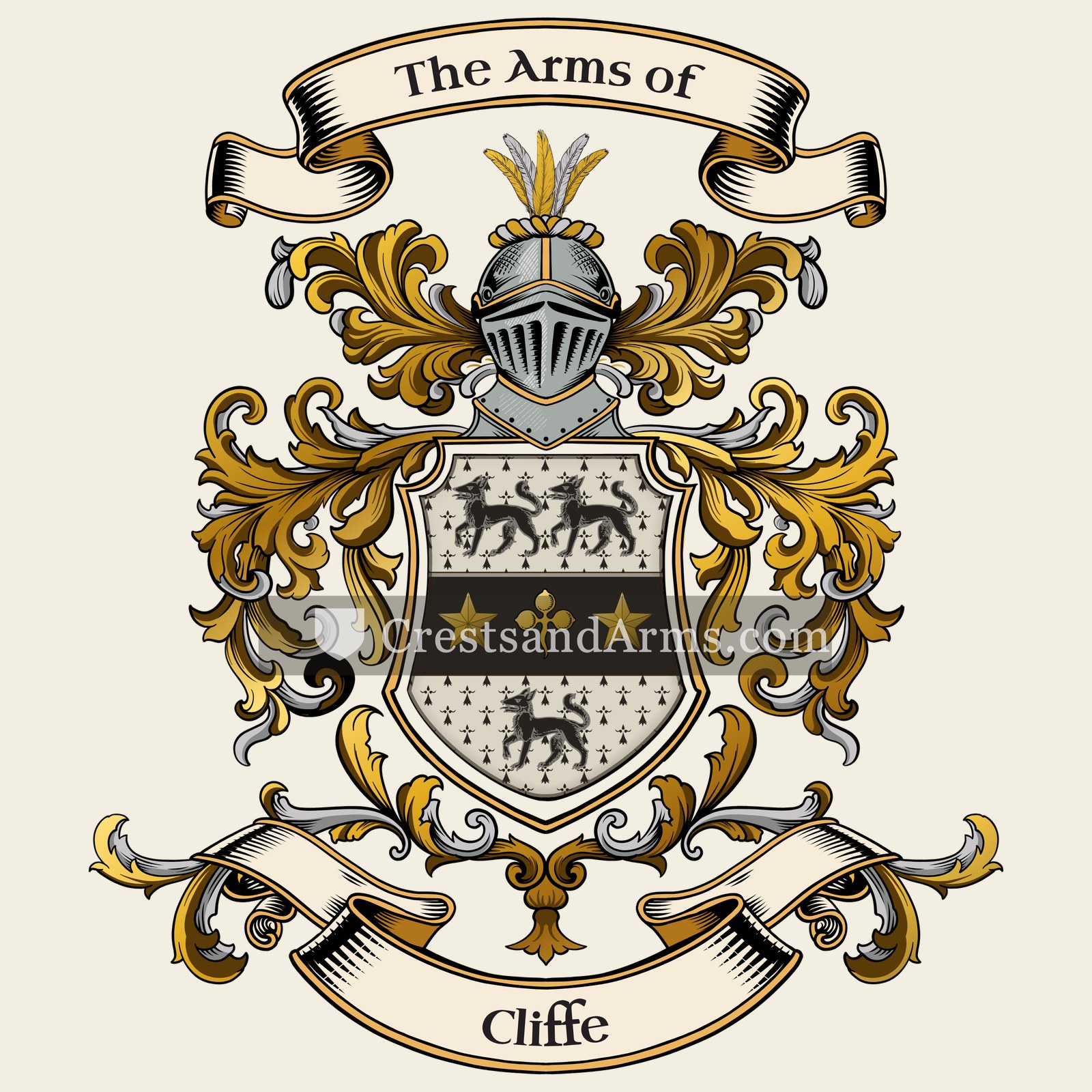
Coat of Arms & Family Crest Details
Symbols on this shield
fessThe military belt, and readiness to serve
trefoilPerpetuity, and the Trinity
wolfReward from long service and hard work
mulletThe third son, and a divine quality from above
Colours
ErmineMeans: Dignity
Black (Sable)Means: Constancy
Gold (Or)Means: Generosity
Historical info
Source
Sir Bernard Burke, The General Armory of England, Scotland, Ireland and Wales, London: Harrison & Sons, 1884
Blazon (the actual original written record)
“Erm. on a fess betw. three wolves' heads erased sa. a trefoil betw. two mullets or”
WexfordWexford, c. 1649
Digital archive packCoat of arms PNG, gold border print PDF, vector SVG and the certificate of authenticity. Sent to your email in minutes.
Map of Ireland showing where the Cliffe arms are recorded
The Cliffe arms were recorded in Wexford, c. 1649.
Wexford was the corner of Ireland closest to Wales, settled early by Norman families. They held their land under arms and kept it for generations, which is why so many Wexford names carry recorded shields.
This is where the arms were entered in the register. Families often moved to other parts of the country, so the same name can turn up in more than one region.
The body that granted and recorded arms in Ireland in this period.
Charles I of England
Sovereign of the period
Charles I of England
1625–1649
Reigning in England when the Cliffe arms are first recorded.
How Arms Worked in Ireland
The Ulster King of Arms granted coats of arms to individuals who proved their social standing and good character. These symbols were typically inherited by all legitimate descendants of the original holder. If a family branch wanted a unique look, they could apply for a specific change to their design through the office to ensure their identity remained distinct.
Granting authority
The Ulster King of Arms acted as the official body that regulated and issued all coats of arms throughout Ireland.
How they got arms
Families obtained their arms through formal grants issued by the office after proving their eligibility and paying the required fees.
Where arms were recorded
All official grants were recorded in the registers held by the Ulster King of Arms starting from the year 1552.
The family's standing
Recorded among the armigerous families of Wexford.
Origin & History of the Cliffe Family in Ireland
The Cliffe family established a significant presence in Ireland during the mid-seventeenth century, primarily settling in County Wexford around 1649. This arrival coincided with the Cromwellian conquest of Ireland, a period that saw many English families granted land in exchange for their service or support during the military campaigns. John Cliffe, a notable figure from this era, served as a judge and became a prominent landowner in the region. By securing estates such as New Ross and later Dunbrody Park, the family integrated themselves into the local administrative and social hierarchy. Over the following generations, they transitioned from military and legal roles to becoming influential members of the landed gentry. Their history in Wexford reflects the broader patterns of English settlement in Ireland during the seventeenth century, where new arrivals often sought to solidify their status through the acquisition of property and participation in local government.
Cliffe Meaning & Related Branches
Root word
clif
Old English word for a steep rock face or precipice.
This name
CliffeA topographic name for someone who lived near a steep cliff or riverbank.
also spelled
Clif
Clyff
Related arms
Clyffvariant spelling
Russellrecorded with Cliffe, same area
Documented Sources
Sir Bernard Burke, The General Armory of England, Scotland, Ireland and Wales, London: Harrison & Sons, 1884
Reaney, P.H., A Dictionary of English Surnames, 1958
Bardsley, Charles Wareing, A Dictionary of English and Welsh Surnames, 1901
The National Archives, Exchequer: King's Remembrancer: Lay Subsidy Rolls, E 179
Digital archive packCoat of arms PNG, gold border print PDF, vector SVG and the certificate of authenticity. Sent to your email in minutes.


 parrotEloquence, and travel in distant lands
 parrotEloquence, and travel in distant lands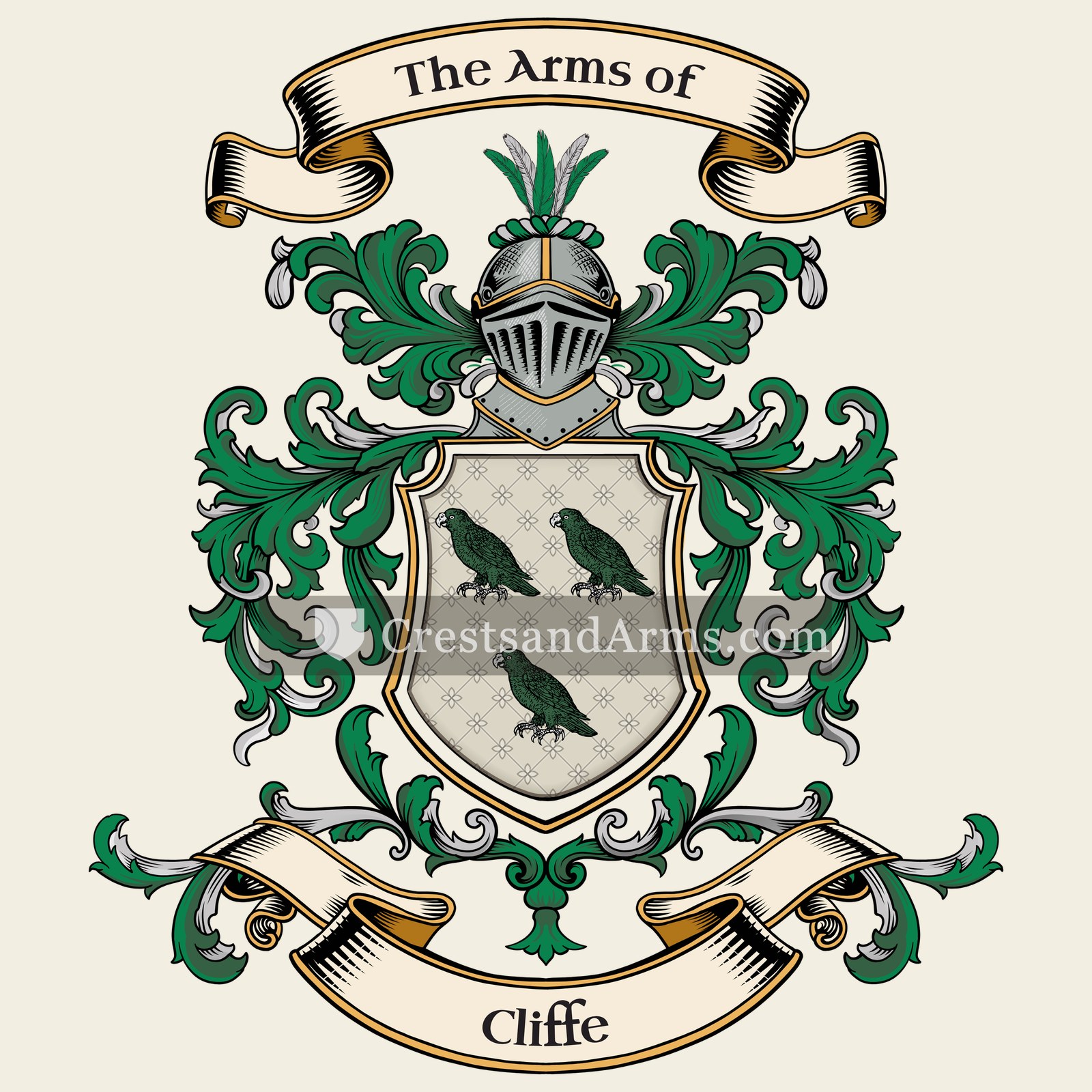


 fessThe military belt, and readiness to serve
 trefoilPerpetuity, and the Trinity
 wolfReward from long service and hard work
 mulletThe third son, and a divine quality from above