Map of England showing where the Clopton arms are recorded
The Clopton arms were recorded in Suffolk, c. 1586.
Suffolk was wool country, and its cloth towns were among the wealthiest in England. Clothier families bought manors with their profits, and holding a manor was the ordinary route to a coat of arms.
This is where the arms were entered in the register. Families often moved to other parts of the country, so the same name can turn up in more than one region.
The body that granted and recorded arms in England in this period.
Elizabeth I of England
Sovereign of the period
Elizabeth I of England
1558–1603
Reigning in England when the Clopton arms are first recorded.
How Arms Worked in England
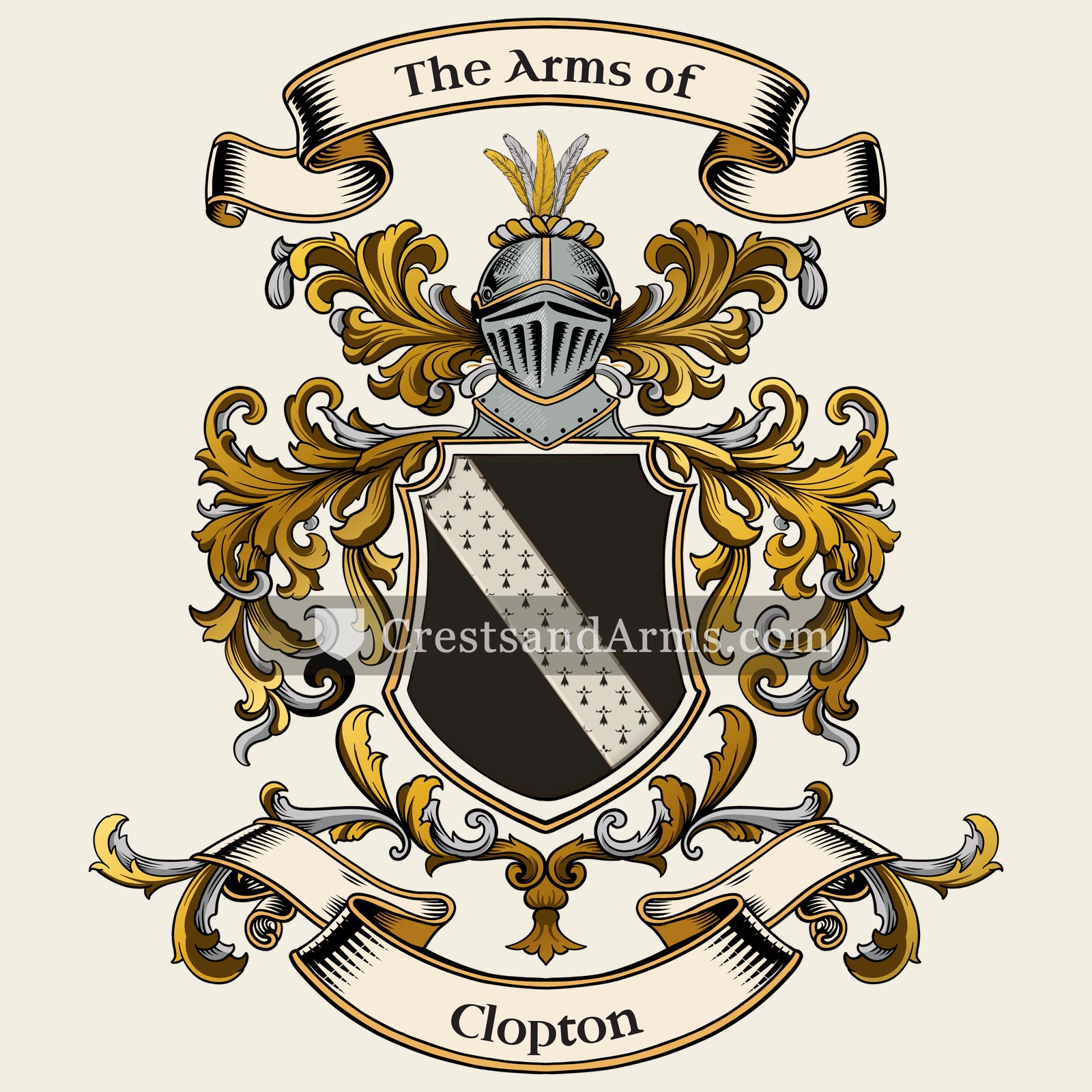
English heraldry allowed arms to be shared by all legitimate descendants of the original owner. These symbols were treated as personal property that moved through the generations to all children. While the eldest son kept the original design, other family members could use the same shield without needing to change it or register their own unique versions.
Granting authority
The College of Arms in London has regulated the use of coats of arms throughout England and Wales since 1484.
How they got arms
Families typically obtained their coats of arms through a formal grant from the Crown or by proving their ancient right to them.
Where arms were recorded
All official coats of arms are recorded in the registers kept at the College of Arms, which date back to the fifteenth century.
The family's standing
Recorded among the armigerous families of Suffolk.
Origin & History of the Clopton Family in England
The name Clopton is a locative surname, which means it originated from a specific place rather than a trade or a personal characteristic. The family took their name from the village of Clopton in the county of Suffolk, where they established deep roots during the medieval period. By the time historical records confirm their presence in the region in 1586, the family had already been influential landowners in East Anglia for several centuries. They were closely tied to the development of local agriculture and the management of rural estates, often serving as prominent figures in their parish communities. Over time, the family expanded their reach, but their identity remained firmly connected to the landscape of Suffolk where they first emerged as a recognized household.
Clopton Meaning & Related Branches
Root word
Clop-tun
Old English for a farmstead or enclosure located on a hill.
This name
CloptonRefers to a person who originated from a settlement situated on a hill or elevated ground.
also spelled
Cloptoun
Clopten
Documented Sources
Sir Bernard Burke, The General Armory of England, Scotland, Ireland and Wales, London: Harrison & Sons, 1884
Copinger, Walter Arthur, The Manors of Suffolk: Notes on their History and Devolution, 1905
Page, William, The Victoria History of the County of Suffolk, 1911
The National Archives, Records of the Prerogative Court of Canterbury, PROB 11
Suffolk Archives, Ipswich Branch, Parish Registers for Clopton, FC 113
Digital archive packCoat of arms PNG, gold border print PDF, vector SVG and the certificate of authenticity. Sent to your email in minutes.


 bendDefence, and the scarf of a commander
 bendDefence, and the scarf of a commander