Map of England showing where the Clough arms are recorded
The Clough arms were recorded in York, c. 1612.
Yorkshire is the largest of the English counties, and it held more gentry families than any other. Land there was split among a great many households rather than a few, so a great many of them carried arms.
This is where the arms were entered in the register. Families often moved to other parts of the country, so the same name can turn up in more than one region.
The body that granted and recorded arms in England in this period.
James VI and I
Sovereign of the period
James VI and I
1603–1625
Reigning in England when the Clough arms are first recorded.
How Arms Worked in England
English heraldry allowed arms to be shared by all legitimate descendants of the original owner. These symbols were treated as personal property that moved through the generations to all children. While the eldest son kept the original design, other family members could use the same shield without needing to change it or register their own unique versions.
Granting authority
The College of Arms in London has regulated the use of coats of arms throughout England and Wales since 1484.
How they got arms
Families typically obtained their coats of arms through a formal grant from the Crown or by proving their ancient right to them.
Where arms were recorded
All official coats of arms are recorded in the registers kept at the College of Arms, which date back to the fifteenth century.
The family's standing
Recorded among the armigerous families of York.
Origin & History of the Clough Family in England
The surname Clough is a topographical name that originated in Northern England, specifically derived from the Old English word "cloh," which refers to a deep ravine, a steep valley, or a narrow gorge. Families who took this name typically lived near such geographical features, which were common in the rugged landscapes of Yorkshire and Lancashire. By the early 17th century, the name was well-established in the region, as evidenced by records of the family residing in York by 1612. During this period, the Clough family was part of the local social fabric, often working as tradespeople or farmers who relied on the unique terrain of the north to define their livelihoods. As the family grew and moved throughout the English countryside, the name remained a clear link to the specific natural landmarks that had originally identified their ancestors.
Coat of Arms & Family Crest Details
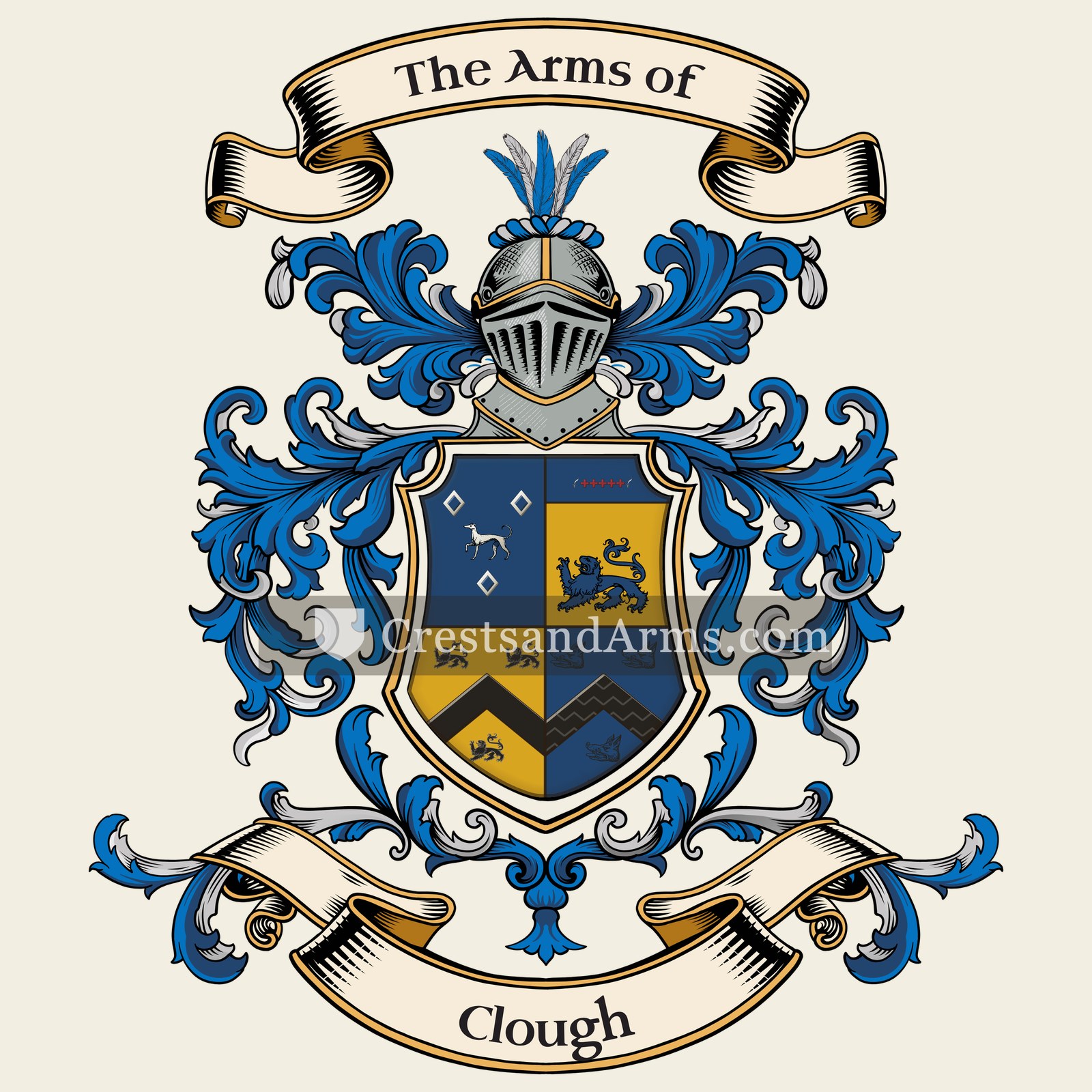
Symbols on this shield
chiefAuthority, wisdom and dominion
cross symbolChristian faith and service
chevronProtection, and faithful service completed
greyhoundCourage, vigilance and loyalty
masclePersuasion and the mail of a knight's coat
lionCourage, strength and royalty
swordJustice, and military honour
boars headA fierce fighter who battles to the end
Colours
Blue (Azure)Means: Loyalty and truth
Gold (Or)Means: Generosity
Black (Sable)Means: Constancy
Silver (Argent)Means: Peace and sincerity
Red (Gules)Means: Military strength
Historical info
Source
Sir Bernard Burke, The General Armory of England, Scotland, Ireland and Wales, London: Harrison & Sons, 1884
Blazon (the actual original written record)
“Quarterly of six, 1st, az. a greyhound's head couped betw. three mascles ar., for CLOUGH; 2nd, or, a lion pass. crowned az. on a chief ar. the Jerusalem cross betw. four crosses crosslet gu. and on each side a sword ppr. handled gold, the augmentation coat given to Sir RICHARD CLOUGH, Knt., on his return from a pilgrimage to the Holy Land; 3rd, per chev. or and sa. three panthers' heads erased, counterchanged, for SMITH; 4th, ar. a chev. betw. three boars' heads sa., for POWELL; 5th, per pale or and az. on a chief gu. three leopards' heads erased of the first, for CALDECOT; 6th, az. three covered cups or, for BUTLER”
DenbighPlas Clough · Denbigh, c. 1570
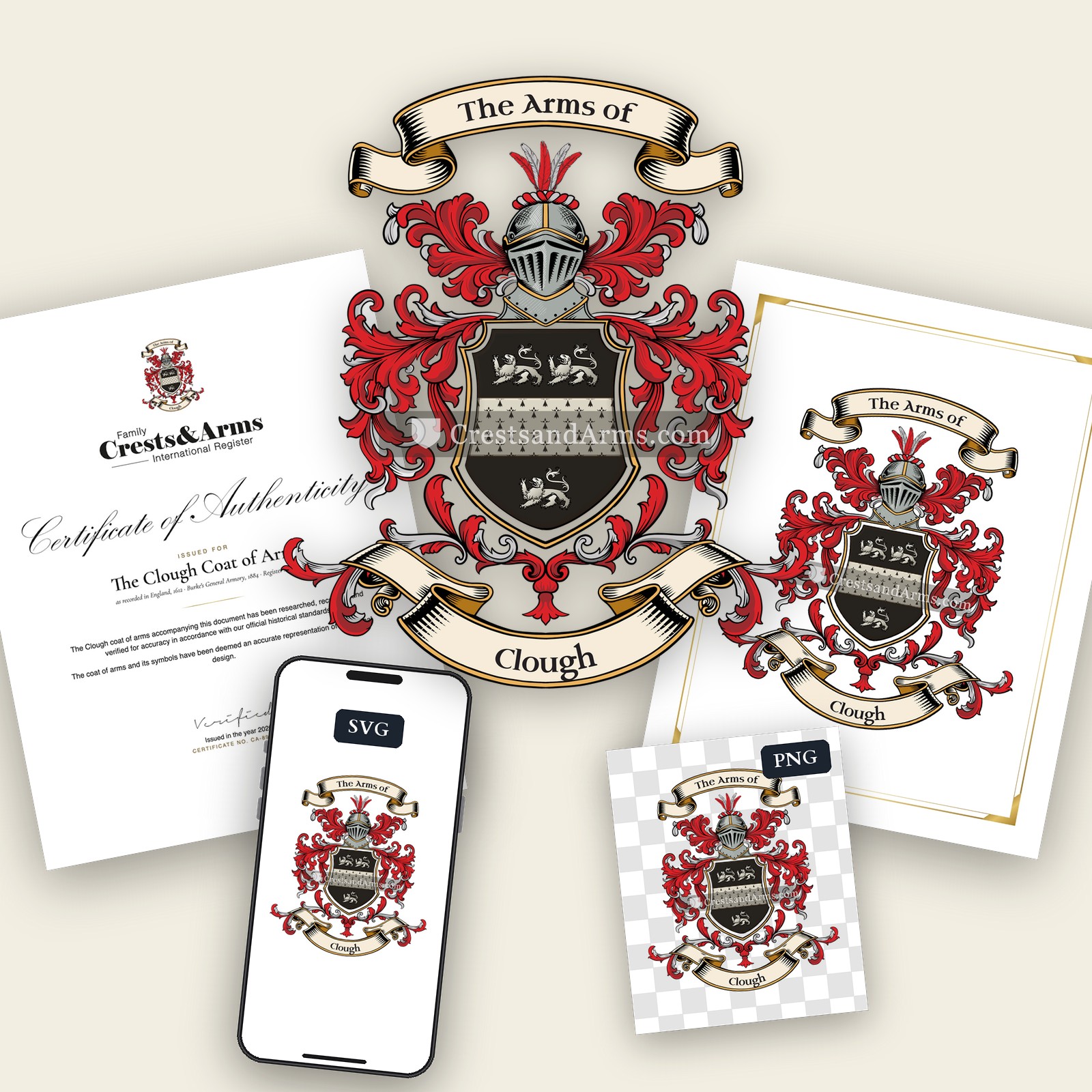
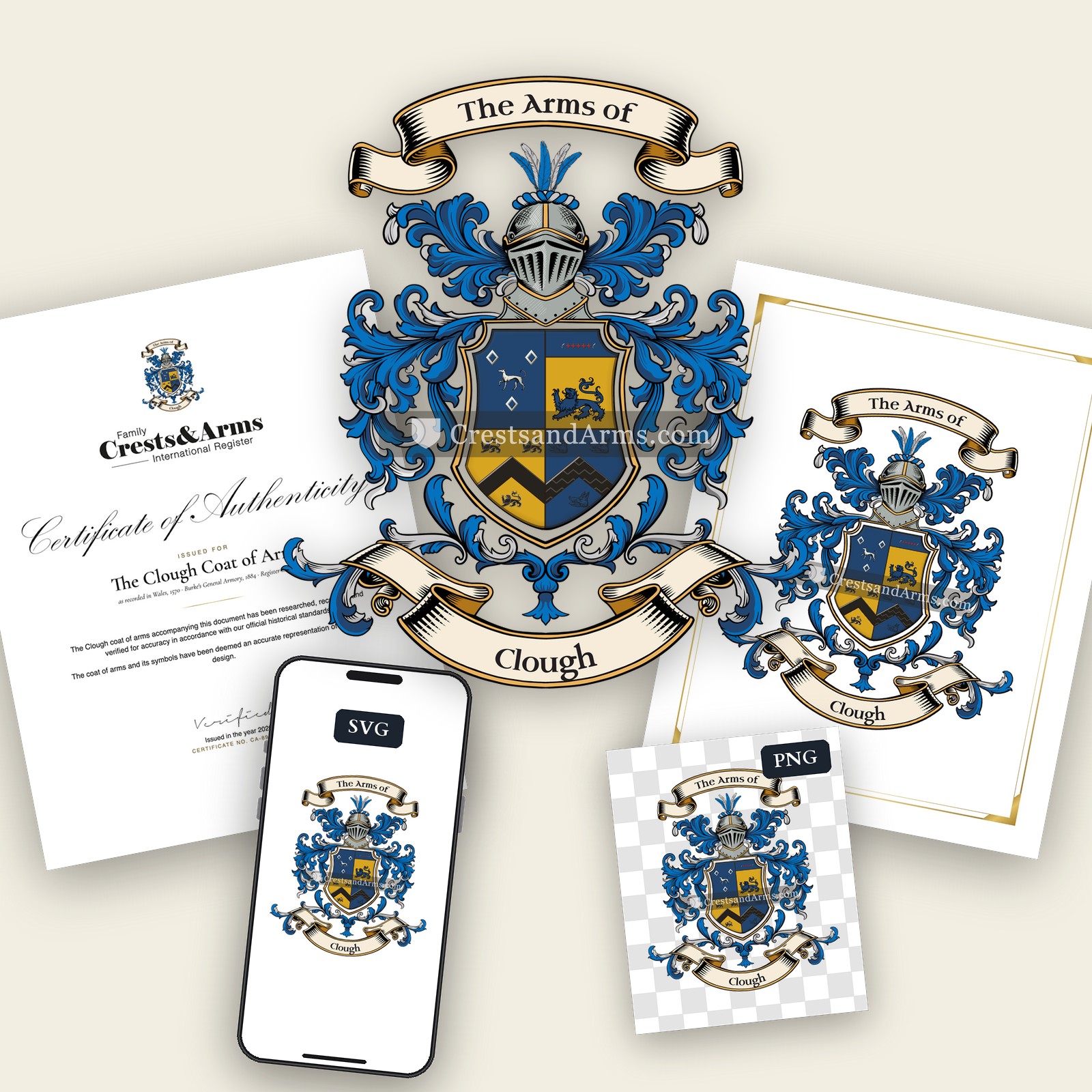
Digital archive packCoat of arms PNG, gold border print PDF, vector SVG and the certificate of authenticity. Sent to your email in minutes.
Map of Wales showing where the Clough arms are recorded
The Clough arms were recorded in Denbigh, c. 1570.
Denbighshire was north Welsh country of hills and small estates. Land was held by a great many families rather than a few, and each holding brought its own claim to a coat of arms.
This is where the arms were entered in the register. Families often moved to other parts of the country, so the same name can turn up in more than one region.
The body that granted and recorded arms in Wales in this period.
Elizabeth I of England
Sovereign of the period
Elizabeth I of England
1558–1603
Reigning in England when the Clough arms are first recorded.
How Arms Worked in Wales
English heraldry allowed arms to be shared by all legitimate descendants of the original owner. These symbols were treated as personal property that moved through the generations to all children. While the eldest son kept the original design, other family members could use the same shield without needing to change it or register their own unique versions.
Granting authority
The College of Arms in London has regulated the use of coats of arms throughout England and Wales since 1484.
How they got arms
Families typically obtained their coats of arms through a formal grant from the Crown or by proving their ancient right to them.
Where arms were recorded
All official coats of arms are recorded in the registers kept at the College of Arms, which date back to the fifteenth century.
The family's standing
Recorded among the armigerous families of Denbigh.
Origin & History of the Clough Family in Wales
The surname Clough originates from a Middle English word meaning a steep valley or a ravine. While the name is often associated with Northern England, the family established a significant presence in Wales by the sixteenth century. By 1570, records confirm that members of the Clough family were settled in the town of Denbigh. During this period, the family became deeply integrated into the local Welsh gentry and administrative life. They were known for their involvement in trade and land ownership, which helped them secure a stable social standing in the region. Over time, the name became firmly rooted in the local history of North Wales, marking a transition from their earlier origins to becoming a recognized part of the Denbighshire community.
Clough Meaning & Related Branches
Root word
cloh
A Middle English term referring to a ravine or deep valley.
This name
CloughA topographic name for someone who lived near a steep-sided valley or gorge.
also spelled
Clowgh
Cluff
Related arms
Clowvariant spelling
Documented Sources
Sir Bernard Burke, The General Armory of England, Scotland, Ireland and Wales, London: Harrison & Sons, 1884
Bardsley, Charles Wareing, A Dictionary of English and Welsh Surnames, 1901
Reaney, Percy Hide, A Dictionary of British Surnames, 1958
York City Archives, York City Chamberlains' Accounts, 1612
Digital archive packCoat of arms PNG, gold border print PDF, vector SVG and the certificate of authenticity. Sent to your email in minutes.


 fessThe military belt, and readiness to serve
 lionCourage, strength and royalty
 fessThe military belt, and readiness to serve
 lionCourage, strength and royalty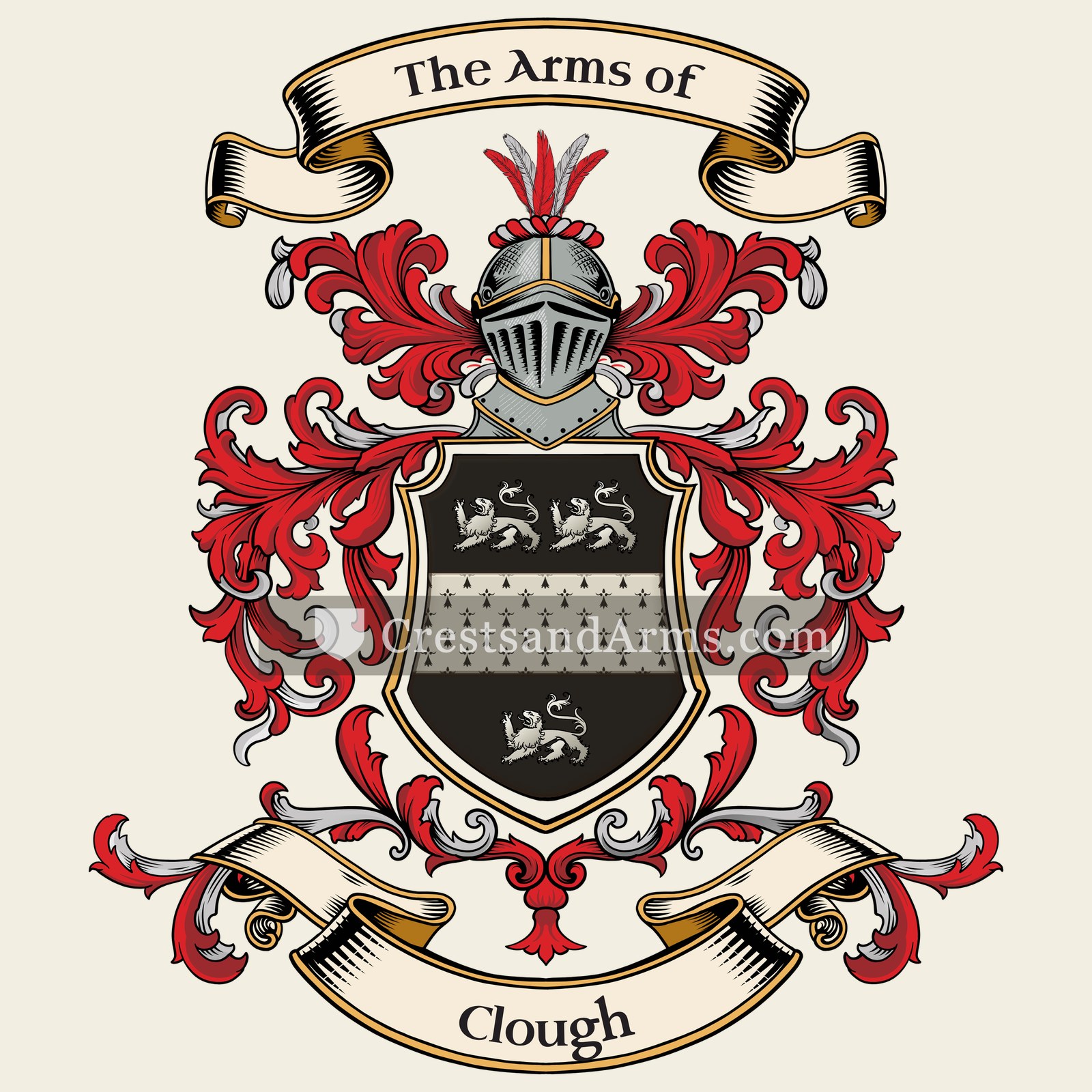


 chiefAuthority, wisdom and dominion
 cross symbolChristian faith and service
 chevronProtection, and faithful service completed
 greyhoundCourage, vigilance and loyalty
 masclePersuasion and the mail of a knight's coat
 swordJustice, and military honour
 boars headA fierce fighter who battles to the end