Map of Germany showing where the Cobb arms are recorded
The Cobb arms were recorded in Silesia, c. 1653.
Silesia was farming country in the east of the German lands, held in large estates by families who stayed put for generations. Owning land was what entitled a family to arms, so the region fills a good deal of the register.
This is where the arms were entered in the register. Families often moved to other parts of the country, so the same name can turn up in more than one region.
The body that granted and recorded arms in Germany in this period.
Ferdinand III, Holy Roman Emperor
Sovereign of the period
Ferdinand III, Holy Roman Emperor
1637–1657
Reigning in Germany when the Cobb arms are first recorded.
How Arms Worked in Germany
In the Holy Roman Empire, coats of arms were often granted to individuals by the Emperor or his representatives. These arms were then passed down through the generations to all legitimate descendants of the original holder. Younger branches of a family usually kept the same shield design without needing to change it, as the arms belonged to the entire lineage.
Granting authority
The Holy Roman Emperor held the sole power to grant new coats of arms throughout his vast imperial territories.
How they got arms
Families typically obtained their coats of arms through a formal imperial grant or by proving their noble status to the authorities.
Where arms were recorded
These grants were officially recorded in the Imperial Chancery registers, which began keeping formal records of such honors during the Middle Ages.
The family's standing
Recorded among the armigerous families of Silesia.
Origin & History of the Cobb Family in Germany
The family name Cobb has deep roots in the historical region of Silesia, where records confirm members of the family were living as early as 1653. During this period, Silesia was a crossroads of culture and trade, often shifting between the influence of the Holy Roman Empire and neighboring kingdoms. Families with this name were likely part of the local agricultural or merchant classes who helped shape the rural landscape of the region. Because surnames were still evolving during the seventeenth century, the name often reflected a person’s occupation, a specific physical trait, or the place where they resided. Living in Silesia meant that these early ancestors navigated a complex social environment shaped by the aftermath of the Thirty Years' War, which forced many families to move or adapt to new economic realities. By remaining in the region during the mid-1600s, the Cobb family became part of the long-standing demographic history of Central Europe.
Coat of Arms & Family Crest Details
Symbols on this shield
chevronProtection, and faithful service completed
chiefAuthority, wisdom and dominion
fishA true and generous mind, and Christian faith
Colours
Black (Sable)Means: Constancy
Silver (Argent)Means: Peace and sincerity
Gold (Or)Means: Generosity
Historical info
Source
Sir Bernard Burke, The General Armory of England, Scotland, Ireland and Wales, London: Harrison & Sons, 1884
Blazon (the actual original written record)
“Sa. a chev. betw. three fishes naiant ar. a chief or”
OxfordAdderbury · Oxford, c. 1393
Digital archive packCoat of arms PNG, gold border print PDF, vector SVG and the certificate of authenticity. Sent to your email in minutes.
Map of England showing where the Cobb arms are recorded
The Cobb arms were recorded in Oxford, c. 1393.
Oxfordshire was farming country with the university at its centre, and both produced families of standing. Scholars and lawyers who did well bought manors nearby, and holding a manor was the ordinary route to a coat of arms.
This is where the arms were entered in the register. Families often moved to other parts of the country, so the same name can turn up in more than one region.
The body that granted and recorded arms in England in this period.
Richard II of England
Sovereign of the period
Richard II of England
1377–1399
Reigning in Germany when the Cobb arms are first recorded.
How Arms Worked in England
English heraldry allowed arms to be shared by all legitimate descendants of the original owner. These symbols were treated as personal property that moved through the generations to all children. While the eldest son kept the original design, other family members could use the same shield without needing to change it or register their own unique versions.
Granting authority
The College of Arms in London has regulated the use of coats of arms throughout England and Wales since 1484.
How they got arms
Families typically obtained their coats of arms through a formal grant from the Crown or by proving their ancient right to them.
Where arms were recorded
All official coats of arms are recorded in the registers kept at the College of Arms, which date back to the fifteenth century.
The family's standing
Recorded among the armigerous families of Oxford.
Origin & History of the Cobb Family in England
The surname Cobb has deep roots in medieval England, emerging as a name tied to the social and professional landscape of the fourteenth century. Historical records confirm that members of the family were established in the city of Oxford by 1393, where they likely participated in the growing academic and mercantile life of the region. The name itself is thought to be a nickname derived from the Old English word cob, which could refer to a person of significant stature or a leader within a community. As the family grew, they integrated into the local English economy, often appearing in legal documents and tax rolls that tracked the movement of citizens across the countryside. Over time, the name spread from its early base in Oxford to other parts of the country, reflecting the typical patterns of migration and family expansion seen throughout the late Middle Ages.
Cobb Meaning & Related Branches
Root word
Jakob
Derived from the Hebrew name Yaakov meaning supplanter or holder of heel.
This name
CobbA patronymic surname originating as a medieval pet form of the name Jacob.
also spelled
Kob
Cobbe
Cobe
Related arms
Kobvariant spelling
Avelingrecorded with Cobb, same area
Buckrecorded with Cobb, same area
Coryrecorded with Cobb, same area
Documented Sources
J. B. Rietstap, Armorial Général, Gouda: G. B. van Goor Zonen, 1884–87
Bahlow, Hans, Deutsches Namenlexikon: Familien- und Vornamen nach Ursprung und Sinn erklärt, 1967
Heintze, Albert, Die deutschen Familien-Namen: geschichtlich, geographisch, sprachlich, 1903
State Archive in Wrocław (Archiwum Państwowe we Wrocławiu), Księgi metrykalne i akta stanu cywilnego, 1653
Digital archive packCoat of arms PNG, gold border print PDF, vector SVG and the certificate of authenticity. Sent to your email in minutes.


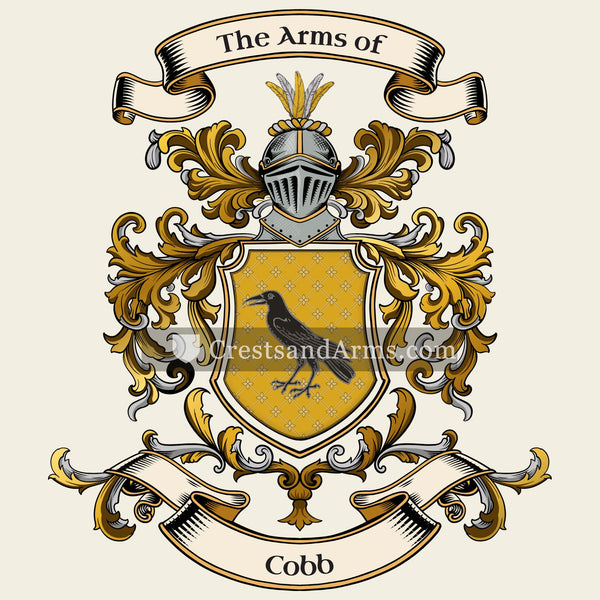
 ravenConstancy and divine providence
 ravenConstancy and divine providence


 chevronProtection, and faithful service completed
 chiefAuthority, wisdom and dominion
 fishA true and generous mind, and Christian faith