Map of England showing where the Codd arms are recorded
The Codd arms were recorded in Kent, c. 1620.
Kent sits between London and the short crossing to Europe, and the trade passing through made it wealthy. Merchant families bought land with that money, and it was landowners who took coats of arms.
This is where the arms were entered in the register. Families often moved to other parts of the country, so the same name can turn up in more than one region.
The body that granted and recorded arms in England in this period.
James VI and I
Sovereign of the period
James VI and I
1603–1625
Reigning in England when the Codd arms are first recorded.
How Arms Worked in England
English heraldry allowed arms to be shared by all legitimate descendants of the original owner. These symbols were treated as personal property that moved through the generations to all children. While the eldest son kept the original design, other family members could use the same shield without needing to change it or register their own unique versions.
Granting authority
The College of Arms in London has regulated the use of coats of arms throughout England and Wales since 1484.
How they got arms
Families typically obtained their coats of arms through a formal grant from the Crown or by proving their ancient right to them.
Where arms were recorded
All official coats of arms are recorded in the registers kept at the College of Arms, which date back to the fifteenth century.
The family's standing
Recorded among the armigerous families of Kent.
Origin & History of the Codd Family in England
The surname Codd is rooted in the linguistic landscape of medieval England, likely originating as a descriptive nickname or a shortened form of a personal name. By the early seventeenth century, historical records confirm that members of the Codd family were well-established in the county of Kent. This region was a bustling hub of trade and agriculture, providing a stable environment for families to put down deep roots. As the family grew, they became integrated into the local social fabric, often appearing in parish registers and legal documents that tracked births, marriages, and land ownership. The presence of the Codd name in Kent by 1620 suggests that the family had already transitioned from transient laborers to settled members of the community, contributing to the local economy and the development of the English countryside during a time of significant social change.
Coat of Arms & Family Crest Details
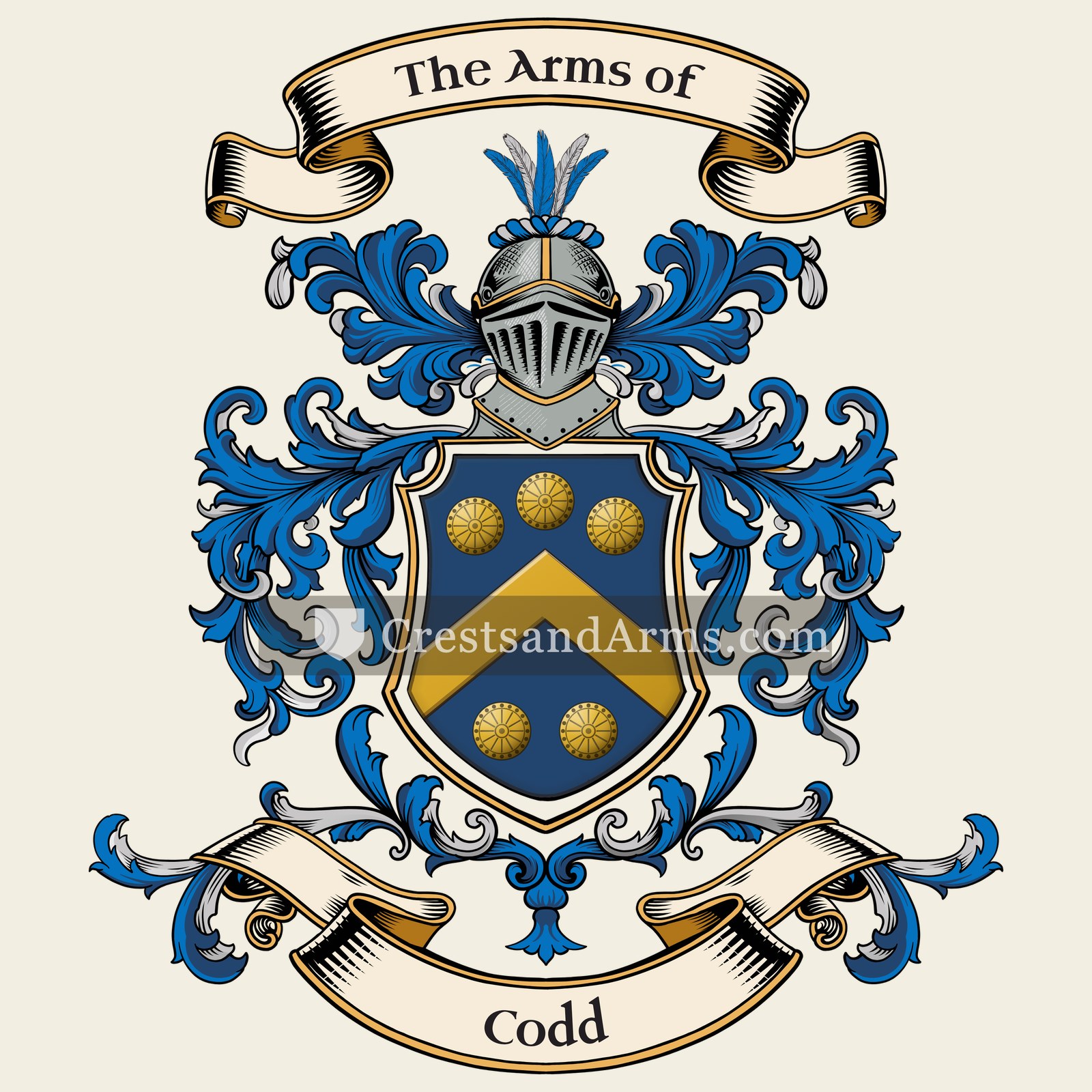
Symbols on this shield
chevronProtection, and faithful service completed
roundelA coin, and one who has been to the crusades
Colours
Blue (Azure)Means: Loyalty and truth
Gold (Or)Means: Generosity
Historical info
Source
Sir Bernard Burke, The General Armory of England, Scotland, Ireland and Wales, London: Harrison & Sons, 1884
Blazon (the actual original written record)
“Az. a chev. or, betw. five bezants, two in chief and three in base”
WexfordRathaspeck · Wexford, c. 1172
Digital archive packCoat of arms PNG, gold border print PDF, vector SVG and the certificate of authenticity. Sent to your email in minutes.
Map of Ireland showing where the Codd arms are recorded
The Codd arms were recorded in Wexford, c. 1172.
Wexford was the corner of Ireland closest to Wales, settled early by Norman families. They held their land under arms and kept it for generations, which is why so many Wexford names carry recorded shields.
This is where the arms were entered in the register. Families often moved to other parts of the country, so the same name can turn up in more than one region.
The body that granted and recorded arms in Ireland in this period.
Henry II of England
Sovereign of the period
Henry II of England
1154–1189
Reigning in England when the Codd arms are first recorded.
How Arms Worked in Ireland
The Ulster King of Arms granted coats of arms to individuals who proved their social standing and good character. These symbols were typically inherited by all legitimate descendants of the original holder. If a family branch wanted a unique look, they could apply for a specific change to their design through the office to ensure their identity remained distinct.
Granting authority
The Ulster King of Arms acted as the official body that regulated and issued all coats of arms throughout Ireland.
How they got arms
Families obtained their arms through formal grants issued by the office after proving their eligibility and paying the required fees.
Where arms were recorded
All official grants were recorded in the registers held by the Ulster King of Arms starting from the year 1552.
The family's standing
Recorded among the armigerous families of Wexford.
Origin & History of the Codd Family in Ireland
The Codd family name has deep roots in County Wexford, dating back to the arrival of Anglo-Norman forces in Ireland in 1172. The family established themselves as significant landowners in the baronies of Forth and Bargy, an area that became known as the English Pale of Wexford due to the high concentration of settlers from Britain. Over the following centuries, the Codds integrated into the local social structure while maintaining their identity as a distinct landed family. They were frequently involved in the administration of the region and held various positions of local authority. By the late medieval period, the family had become so well established in the southeast of Ireland that they were considered one of the prominent families of the county. Their history is closely tied to the development of Wexford as a hub for trade and cultural exchange between Ireland and the wider medieval world.
Codd Meaning & Related Branches
Root word
Cutha
An Old English personal name meaning known or famous.
This name
CoddA patronymic surname derived from a diminutive form of the Old English name Cutha.
also spelled
Code
Related arms
Code, or Coadevariant spelling
Battrecorded with Codd, same area
Colbyrecorded with Codd, same area
Curerecorded with Codd, same area
Documented Sources
Sir Bernard Burke, The General Armory of England, Scotland, Ireland and Wales, London: Harrison & Sons, 1884
Bardsley, Charles Wareing, A Dictionary of English and Welsh Surnames, 1901
Reaney, P.H., A Dictionary of British Surnames, 1958
Kent Archives, Archdeaconry of Canterbury Wills and Administrations, PRC 32
Digital archive packCoat of arms PNG, gold border print PDF, vector SVG and the certificate of authenticity. Sent to your email in minutes.


 fessThe military belt, and readiness to serve
 roundelA coin, and one who has been to the crusades
 fessThe military belt, and readiness to serve
 roundelA coin, and one who has been to the crusades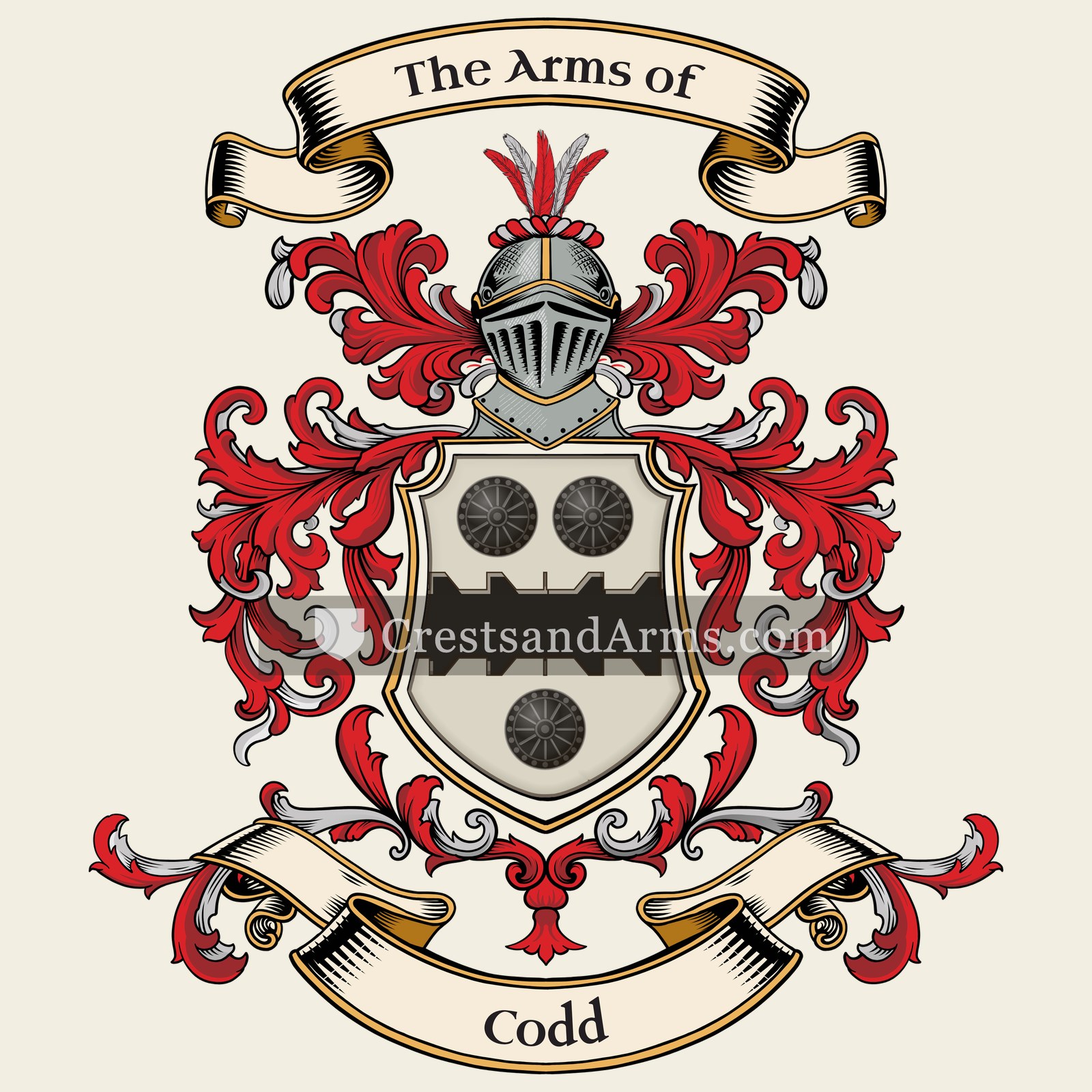


 chevronProtection, and faithful service completed