A record of documented arms, meaning and origin, researched for the Code family lines. Documented in 2 countries.
Reg. 7486 · Italian, A–C
Coat of Arms & Family Crest Details
Symbols on this shield
cross symbolChristian faith and service
cantonA mark of honour granted by the sovereign
maceAuthority, and the officer who bears it
arrowReadiness for battle, and affliction endured
mulletThe third son, and a divine quality from above
Colours
Blue (Azure)Means: Loyalty and truth
Red (Gules)Means: Military strength
Silver (Argent)Means: Peace and sincerity
Historical info
Source
J. B. Rietstap, Armorial Général, Gouda: G. B. van Goor Zonen, 1884–87
Blazon (the actual original written record)
“Coupé: au 1 d'azur à deux massues d'arg., passées en saut., le gros bout en haut, br. sur une flèche d'arg. en fasce; au 2 de gu. à la croix alésée d'arg., acc. de deux étoiles du même, 1 au canton dextre du chef et 1 au canton sen. de la p. [V. Codde.]”
ItalyMantoue, c. 1775
Digital archive packCoat of arms PNG, gold border print PDF, vector SVG and the certificate of authenticity. Sent to your email in minutes.
Map of Italy showing where the Code arms are recorded
The Code arms were recorded in Mantoue, c. 1775.
This is where the arms were entered in the register. Families often moved to other parts of the country, so the same name can turn up in more than one region.
The body that granted and recorded arms in Italy in this period.
Alvise Giovanni Mocenigo
Sovereign of the period
Alvise Giovanni Mocenigo
1763–1778
Reigning in Italy when the Code arms are first recorded.
How Arms Worked in Italy
In the Italian states, coats of arms were often used by noble families to show their status and history. These symbols were passed down through the generations to all legitimate male descendants. Younger branches of a family usually kept the original design but sometimes added small changes to distinguish their specific line from the main branch.
Granting authority
Various local rulers and city governments controlled the use of coats of arms across the different Italian states.
How they got arms
Families often assumed their own arms or received them as official grants from local lords, popes, or city councils.
Where arms were recorded
Arms were recorded in local city archives or private family books rather than in one single national register.
The family's standing
Recorded among the armigerous families of Italy.
Origin & History of the Code Family in Italy
The history of the Code family in Italy is deeply rooted in the cultural landscape of the Lombardy region, with documented evidence placing family members in the city of Mantua by 1775. During this period, Mantua served as a significant center for trade and administration under the influence of the Habsburg monarchy. Families living in this area often held roles connected to local governance or the management of agricultural estates in the fertile Po Valley. As the name appears in regional records during the late eighteenth century, it suggests that the family was well-integrated into the urban life of the city. These early ancestors likely navigated the transition from traditional feudal structures to the more modern bureaucratic systems that defined northern Italy before the Napoleonic era. By maintaining a presence in such a historically significant city, the family participated in the unique social and economic evolution of the Italian peninsula during the Enlightenment.
Coat of Arms & Family Crest Details
Symbols on this shield
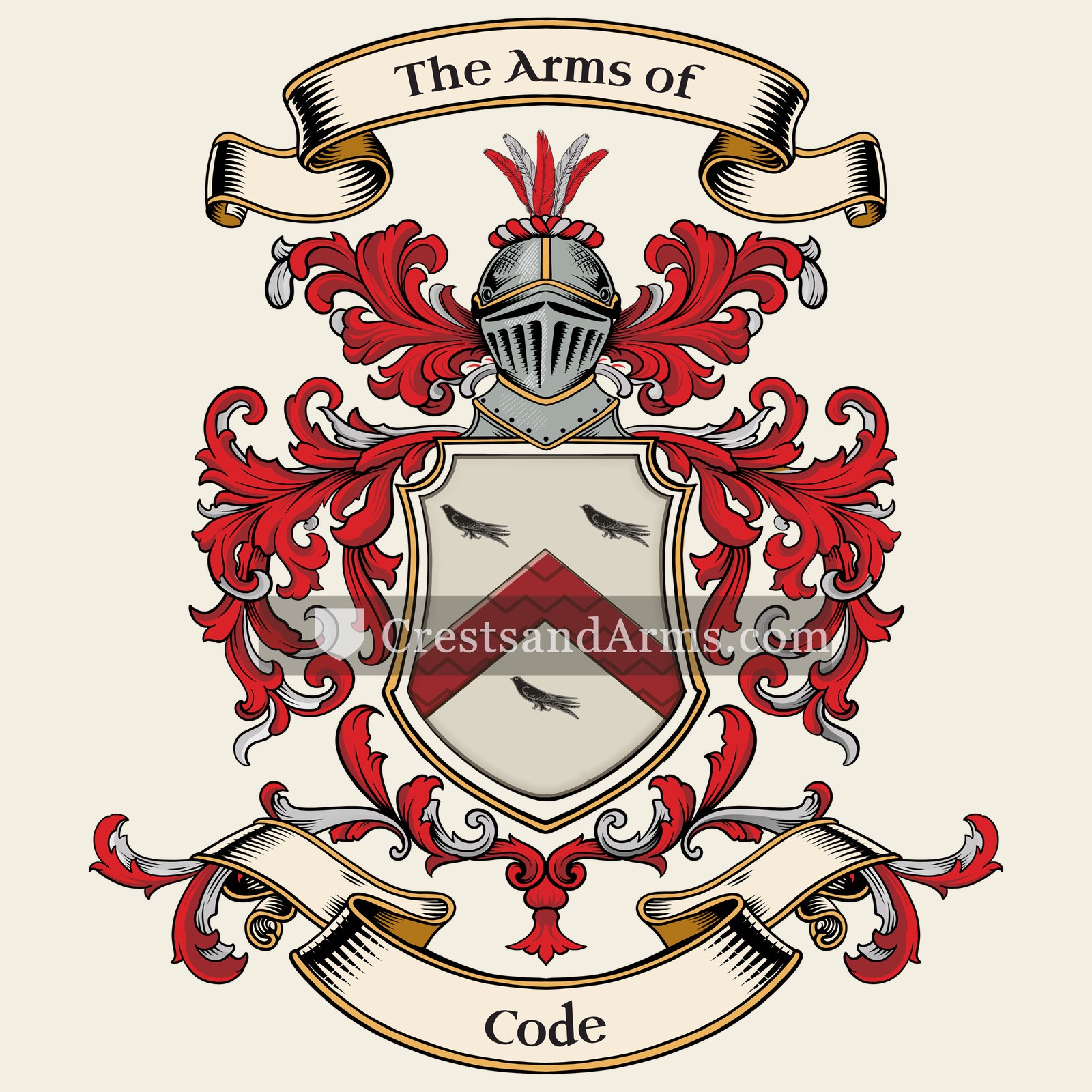
chevronProtection, and faithful service completed
martletA younger son, who must win his own land
Colours
Silver (Argent)Means: Peace and sincerity
Red (Gules)Means: Military strength
Black (Sable)Means: Constancy
Historical info
Source
Sir Bernard Burke, The General Armory of England, Scotland, Ireland and Wales, London: Harrison & Sons, 1884
Blazon (the actual original written record)
“Ar. a chev. gu. betw. three Cornish choughs”
DevonGidley Castle · Devon, c. 1620
Digital archive packCoat of arms PNG, gold border print PDF, vector SVG and the certificate of authenticity. Sent to your email in minutes.
Map of England showing where the Code arms are recorded
The Code arms were recorded in Devon, c. 1620.
Devon was a county of small manors and seafaring families. Its gentry were spread thickly across the countryside, and money made at sea often bought an estate, which in turn brought a coat of arms.
This is where the arms were entered in the register. Families often moved to other parts of the country, so the same name can turn up in more than one region.
The body that granted and recorded arms in England in this period.
James VI and I
Sovereign of the period
James VI and I
1603–1625
Reigning in Italy when the Code arms are first recorded.
How Arms Worked in England
English heraldry allowed arms to be shared by all legitimate descendants of the original owner. These symbols were treated as personal property that moved through the generations to all children. While the eldest son kept the original design, other family members could use the same shield without needing to change it or register their own unique versions.
Granting authority
The College of Arms in London has regulated the use of coats of arms throughout England and Wales since 1484.
How they got arms
Families typically obtained their coats of arms through a formal grant from the Crown or by proving their ancient right to them.
Where arms were recorded
All official coats of arms are recorded in the registers kept at the College of Arms, which date back to the fifteenth century.
The family's standing
Recorded among the armigerous families of Devon.
Origin & History of the Code Family in England
The surname Code has deep roots in the English county of Devon, where families bearing the name were well established by the early seventeenth century. Historians believe the name likely originated as a descriptive nickname or a shortened form of an older given name, reflecting the common medieval practice of identifying individuals by their personal traits or local ties. By 1620, members of the Code family were active participants in the rural life of Devon, often working as landowners or tradespeople within their local parishes. These early records suggest a family that was deeply integrated into the social and economic fabric of the West Country. As the seventeenth century progressed, the name remained concentrated in this region, serving as a marker of the family’s long-standing connection to the landscape and the community traditions of southwestern England.
Code Meaning & Related Branches
Root word
Coda
Derived from the Latin word cauda meaning tail.
This name
CodeA topographic or descriptive surname referring to someone living at the end of a settlement.
also spelled
Coode
Coad
Codd
Coade
Related arms
Coddesimilar arms
Coadevariant spelling
Coddvariant spelling
Documented Sources
J. B. Rietstap, Armorial Général, Gouda: G. B. van Goor Zonen, 1884–87
Archivio di Stato di Mantova, Anagrafe della popolazione di Mantova, 1775
D’Arco, Carlo, Studi intorno al municipio di Mantova, 1871
Digital archive packCoat of arms PNG, gold border print PDF, vector SVG and the certificate of authenticity. Sent to your email in minutes.


 cross symbolChristian faith and service
 cantonA mark of honour granted by the sovereign
 maceAuthority, and the officer who bears it
 arrowReadiness for battle, and affliction endured
 mulletThe third son, and a divine quality from above
 cross symbolChristian faith and service
 cantonA mark of honour granted by the sovereign
 maceAuthority, and the officer who bears it
 arrowReadiness for battle, and affliction endured
 mulletThe third son, and a divine quality from above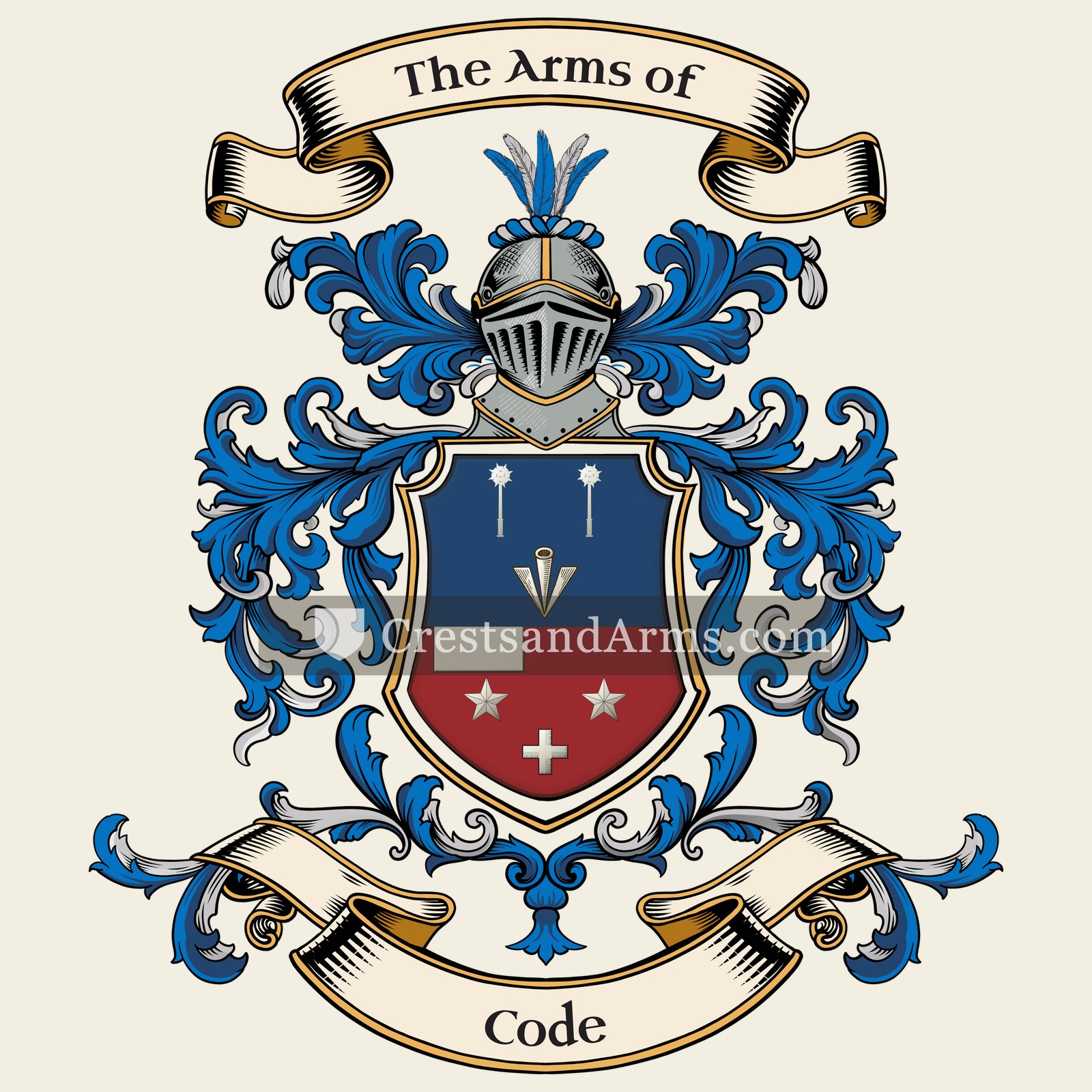


 chevronProtection, and faithful service completed
 martletA younger son, who must win his own land