Map of England showing where the Cohagan arms are recorded
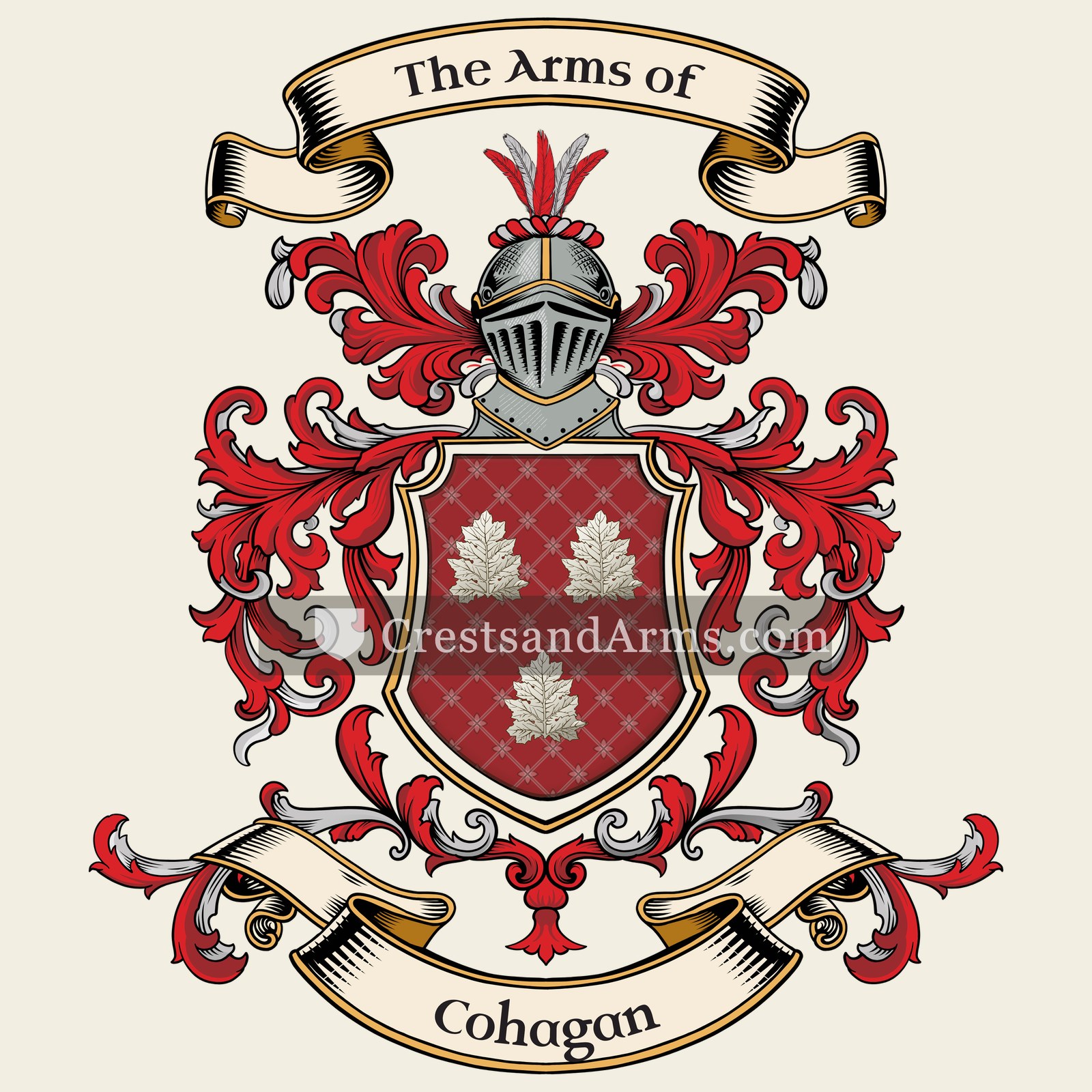
The Cohagan arms were recorded in Somerset, c. 1620.
Somerset was rich farming country with a thick scattering of manor houses. Its gentry were numerous and long-settled, and a settled landed family almost always ended up with arms.
This is where the arms were entered in the register. Families often moved to other parts of the country, so the same name can turn up in more than one region.
The body that granted and recorded arms in England in this period.
James VI and I
Sovereign of the period
James VI and I
1603–1625
Reigning in England when the Cohagan arms are first recorded.
How Arms Worked in England
English heraldry allowed arms to be shared by all legitimate descendants of the original owner. These symbols were treated as personal property that moved through the generations to all children. While the eldest son kept the original design, other family members could use the same shield without needing to change it or register their own unique versions.
Granting authority
The College of Arms in London has regulated the use of coats of arms throughout England and Wales since 1484.
How they got arms
Families typically obtained their coats of arms through a formal grant from the Crown or by proving their ancient right to them.
Where arms were recorded
All official coats of arms are recorded in the registers kept at the College of Arms, which date back to the fifteenth century.
The family's standing
Recorded among the armigerous families of Somerset.
Origin & History of the Cohagan Family in England
The family name Cohagan finds its early English roots in the county of Somerset, where records confirm members of the family were established by the year 1620. During this period, Somerset was a region defined by its vibrant agricultural landscape and its proximity to the bustling port of Bristol, which served as a gateway for trade and migration. Families living in this part of England often worked as skilled laborers or farmers, contributing to the local economy of the West Country. As the seventeenth century progressed, the name became woven into the fabric of local parish life, appearing in regional registers that documented births, marriages, and deaths. These early Cohagans lived through a time of significant social change in England, as the country transitioned toward a more global outlook and expanded its influence across the seas. By remaining in the rural communities of Somerset, the family helped maintain the traditions and daily rhythms that defined life in the English countryside during the early Stuart era.
Coat of Arms & Family Crest Details
Symbols on this shield
leafHappiness and abundance
Colours
Red (Gules)Means: Military strength
Silver (Argent)Means: Peace and sincerity
Historical info
Source
Sir Bernard Burke, The General Armory of England, Scotland, Ireland and Wales, London: Harrison & Sons, 1884
Blazon (the actual original written record)
“Gu. three oak leaves ar”
Irelandc. 1645
Digital archive packCoat of arms PNG, gold border print PDF, vector SVG and the certificate of authenticity. Sent to your email in minutes.
Map of Ireland showing where the Cohagan arms are recorded
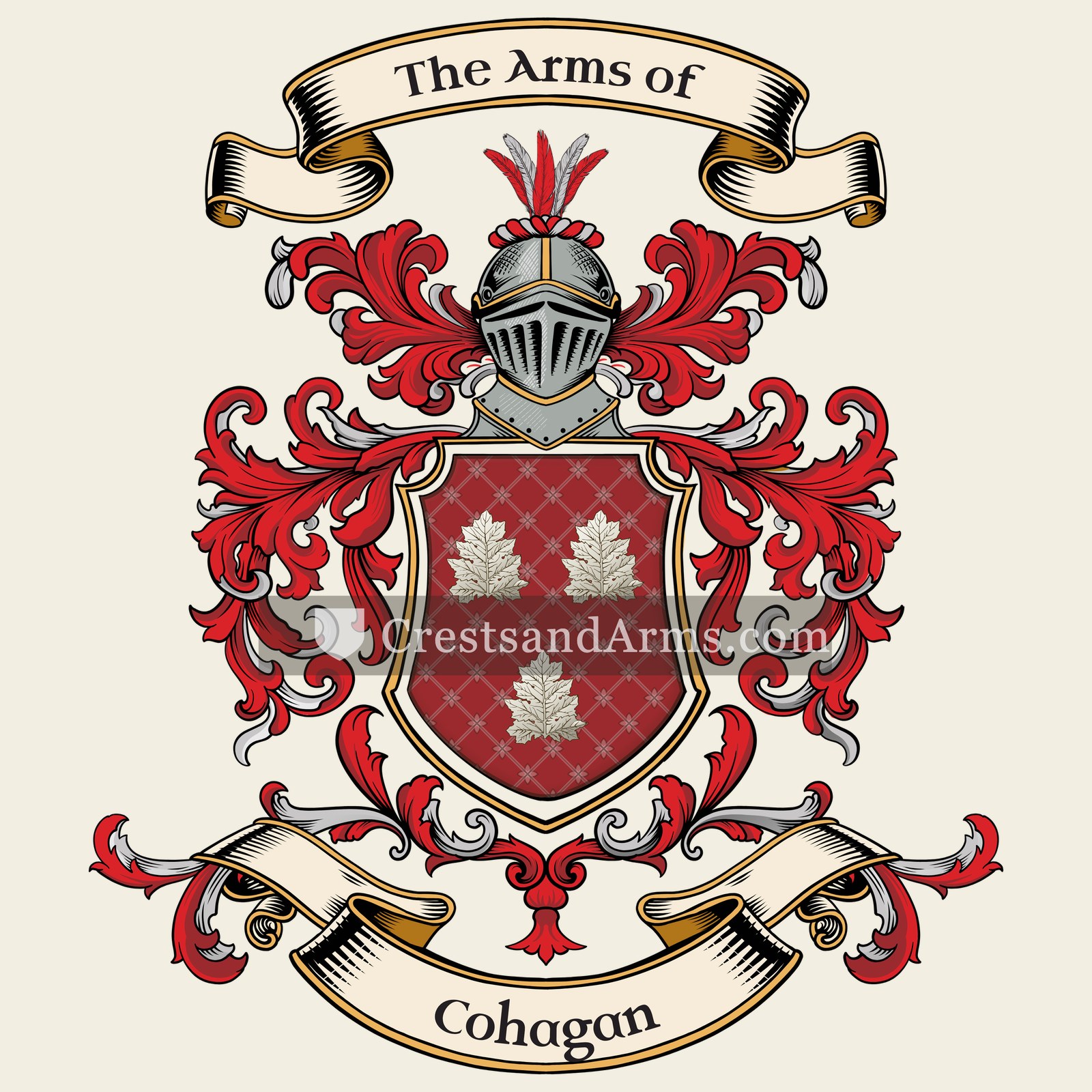
The Cohagan arms were recorded in Ireland, c. 1645.
Arms such as these were typically recorded in Dublin.
Dublin was the seat of government in Ireland and the place where grants were sought and recorded. Families with business at the castle or the courts settled nearby, and settling there put their arms on record.
This is where the arms were entered in the register. Families often moved to other parts of the country, so the same name can turn up in more than one region.
The body that granted and recorded arms in Ireland in this period.
Charles I of England
Sovereign of the period
Charles I of England
1625–1649
Reigning in England when the Cohagan arms are first recorded.
How Arms Worked in Ireland
The Ulster King of Arms granted coats of arms to individuals who proved their social standing and good character. These symbols were typically inherited by all legitimate descendants of the original holder. If a family branch wanted a unique look, they could apply for a specific change to their design through the office to ensure their identity remained distinct.
Granting authority
The Ulster King of Arms acted as the official body that regulated and issued all coats of arms throughout Ireland.
How they got arms
Families obtained their arms through formal grants issued by the office after proving their eligibility and paying the required fees.
Where arms were recorded
All official grants were recorded in the registers held by the Ulster King of Arms starting from the year 1552.
The family's standing
Recorded among the armigerous families of Ireland.
Origin & History of the Cohagan Family in Ireland
The family name Cohagan traces its roots to the Gaelic tradition, likely emerging as an anglicized variation of an older Irish surname. By the year 1645, records confirm that members of the family were established in Dublin. This period was a time of great upheaval in Ireland, as the city served as a central hub for political and military activity during the Irish Confederate Wars. Living in Dublin during the mid-seventeenth century suggests that the family was likely involved in the urban economy or the administrative life of the capital. As the name transitioned into its modern spelling, it remained tied to the shifting social landscape of Ireland. The presence of the family in Dublin at this early date highlights their integration into the city's growing population during a transformative era of Irish history.
Coat of Arms & Family Crest Details
Symbols on this shield
leafHappiness and abundance
Colours
Silver (Argent)Means: Peace and sincerity
Red (Gules)Means: Military strength
Historical info
Source
Sir Bernard Burke, The General Armory of England, Scotland, Ireland and Wales, London: Harrison & Sons, 1884
Blazon (the actual original written record)
“Ar. three aspin leaves gu. (another, slipped ar.)”
Walesc. 1647
Digital archive packCoat of arms PNG, gold border print PDF, vector SVG and the certificate of authenticity. Sent to your email in minutes.
Map of Wales showing where the Cohagan arms are recorded
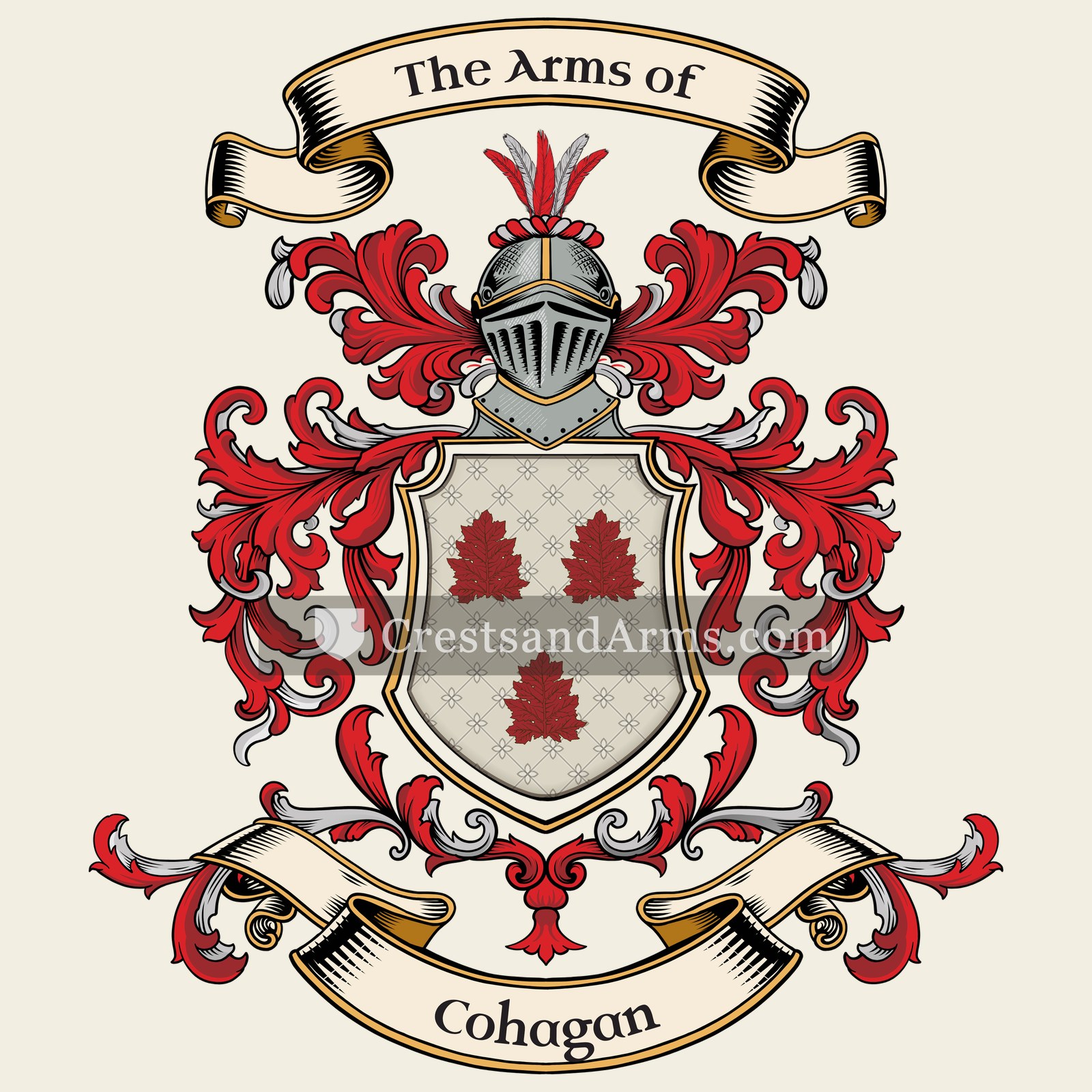
The Cohagan arms were recorded in Wales, c. 1647.
Arms such as these were typically recorded in Denbigh.
Denbighshire was north Welsh country of hills and small estates. Land was held by a great many families rather than a few, and each holding brought its own claim to a coat of arms.
This is where the arms were entered in the register. Families often moved to other parts of the country, so the same name can turn up in more than one region.
The body that granted and recorded arms in Wales in this period.
Charles I of England
Sovereign of the period
Charles I of England
1625–1649
Reigning in England when the Cohagan arms are first recorded.
How Arms Worked in Wales
English heraldry allowed arms to be shared by all legitimate descendants of the original owner. These symbols were treated as personal property that moved through the generations to all children. While the eldest son kept the original design, other family members could use the same shield without needing to change it or register their own unique versions.
Granting authority
The College of Arms in London has regulated the use of coats of arms throughout England and Wales since 1484.
How they got arms
Families typically obtained their coats of arms through a formal grant from the Crown or by proving their ancient right to them.
Where arms were recorded
All official coats of arms are recorded in the registers kept at the College of Arms, which date back to the fifteenth century.
The family's standing
Recorded among the armigerous families of Wales.
Origin & History of the Cohagan Family in Wales
The family name Cohagan finds its roots in the rugged landscape of Wales, where records confirm the family was well-established in the town of Denbigh by 1647. During this period, Denbigh was a significant market town that served as a central hub for the surrounding rural communities. Families like the Cohagans often lived in these areas to participate in the local wool trade or agricultural markets that defined the Welsh economy. As the seventeenth century progressed, the family became part of the social fabric of Denbighshire, navigating the complex political and religious shifts that defined life in Wales under the Stuart monarchy. By settling in this region, the early members of the family contributed to the local history of a town known for its historic castle and its role as a gateway between the Welsh highlands and the English borderlands.
Related Branches & Arms
Root word
O'Cadhain
Gaelic term derived from cadhan meaning wild goose.
This name
CohaganAn Anglicized form of an Irish surname denoting a descendant of the wild goose.
also spelled
Coggan
Kogan
Coggins
Documented Sources
Sir Bernard Burke, The General Armory of England, Scotland, Ireland and Wales, London: Harrison & Sons, 1884
Somerset Heritage Centre, Bishop's Transcripts of Baptisms, Marriages and Burials, 1620
Tite, Colin G. C., The Manuscript Library of Sir Robert Cotton, 1994
Dunning, Robert, A History of Somerset, 1983
Digital archive packCoat of arms PNG, gold border print PDF, vector SVG and the certificate of authenticity. Sent to your email in minutes.


 leafHappiness and abundance
 leafHappiness and abundance