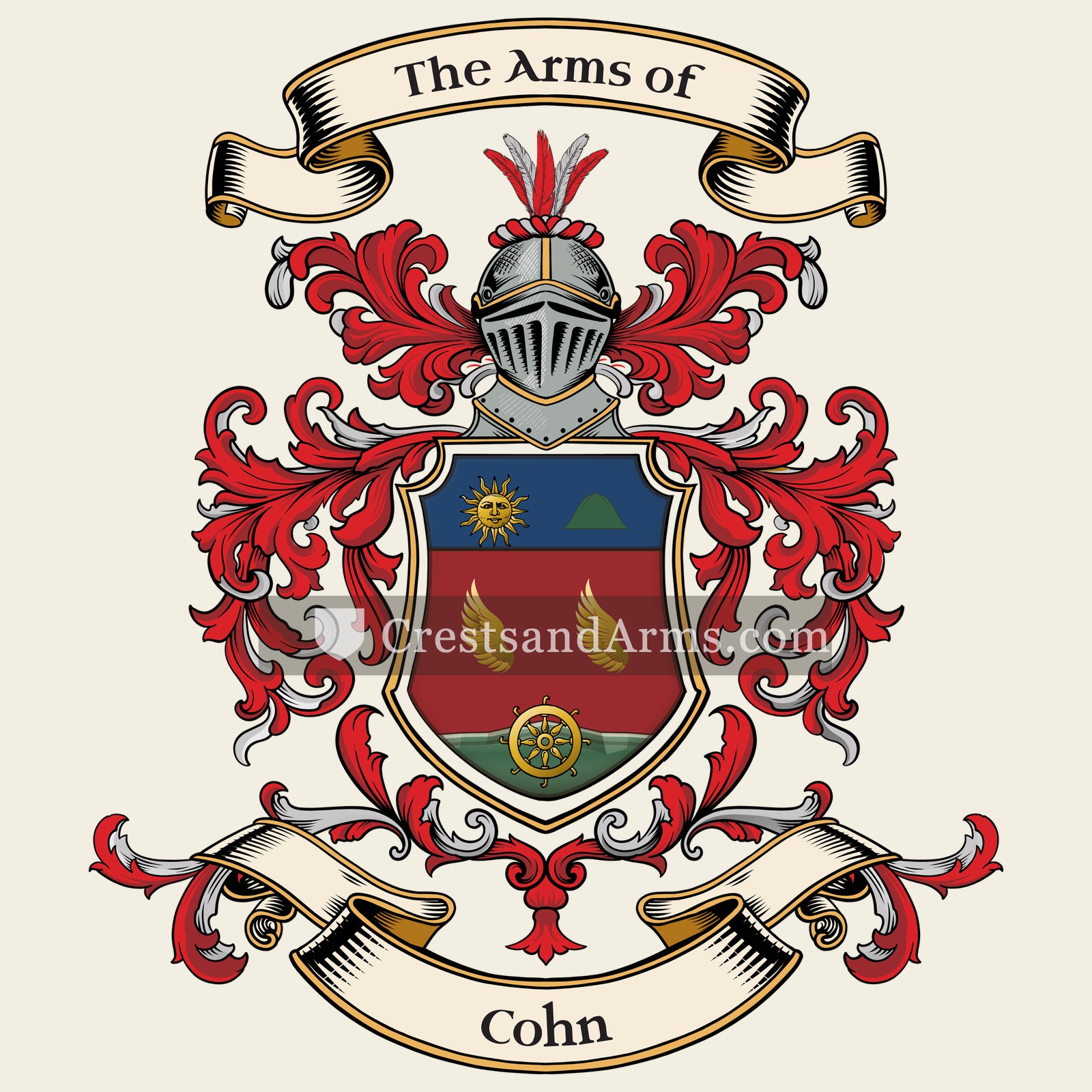
A record of documented arms, meaning and origin, researched for the Cohn family of Germany.
Reg. 5669 · German, A–C
Coat of Arms & Family Crest Details
Symbols on this shield
chiefAuthority, wisdom and dominion
mountThe ground held, and steadfastness upon it
wheelFortune's turning, and the carter's trade
wingSwiftness, and protection under a raised wing
sunGlory, splendour and the source of life
Colours
Red (Gules)Means: Military strength
Blue (Azure)Means: Loyalty and truth
Green (Vert)Means: Hope
Gold (Or)Means: Generosity
Historical info
Source
J. B. Rietstap, Armorial Général, Gouda: G. B. van Goor Zonen, 1884–87
Blazon (the actual original written record)
“De gu. à une roue d'or, ailée du même, sommée d'une grue avec sa vigilance d'arg.; au chef d'azur, ch. d'un soleil levant d'or, mouv. d'un tertre de sin. Cq. cour. C.: la roue ailée, sommée de la grue. L.: à dextre d'or et d'azur, à sen. d'or et de gu. T.: deux figures, représentant l'Industrie, hab. d'arg., revêtue d'un manteau brunâtre, accompagnée de ses attributs parmi lesquels une ruche, et la Fidélité, hab. d'azur, revêtue d'un manteau d'arg. à reflets jaunes, accostée d'un chien. D.: THÄTIG UND TREU.”
GermanyAnhalt, c. 1765
Digital archive packCoat of arms PNG, gold border print PDF, vector SVG and the certificate of authenticity. Sent to your email in minutes.
Map of Germany showing where the Cohn arms are recorded
The Cohn arms were recorded in Anhalt, c. 1765.
This is where the arms were entered in the register. Families often moved to other parts of the country, so the same name can turn up in more than one region.
The body that granted and recorded arms in Germany in this period.
Francis I, Holy Roman Emperor
Sovereign of the period
Francis I, Holy Roman Emperor
1745–1765
Reigning in Germany when the Cohn arms are first recorded.
How Arms Worked in Germany
In the Holy Roman Empire, coats of arms were often granted to individuals by the Emperor or his representatives. These arms were then passed down through the generations to all legitimate descendants of the original holder. Younger branches of a family usually kept the same shield design without needing to change it, as the arms belonged to the entire lineage.
Granting authority
The Holy Roman Emperor held the sole power to grant new coats of arms throughout his vast imperial territories.
How they got arms
Families typically obtained their coats of arms through a formal imperial grant or by proving their noble status to the authorities.
Where arms were recorded
These grants were officially recorded in the Imperial Chancery registers, which began keeping formal records of such honors during the Middle Ages.
The family's standing
Recorded among the armigerous families of Germany.
Origin & History of the Cohn Family in Germany
The family name Cohn is a variant of the Hebrew title Kohen, which historically identified individuals belonging to the priestly class within the Jewish community. Over many centuries, families carrying this name migrated across Europe, often adopting local spellings to fit into the languages of their new homes. By the mid-eighteenth century, records confirm that members of the family were well-established in the German region of Anhalt. During this period, the name served as a significant marker of ancestral heritage and religious tradition. Life in Anhalt during 1765 was shaped by the specific regulations placed on Jewish families by local rulers, which often influenced how names were recorded in official census documents and tax registers. These early ancestors were part of a resilient community that maintained its identity while navigating the complex social and political landscape of the Holy Roman Empire.
Cohn Meaning & Related Branches
Root word
Kohen
A Hebrew term referring to a priest or religious official.
This name
CohnA Germanized spelling indicating ancestral descent from the priestly class of ancient Israel.
also spelled
Con
Kohn
Cone
Documented Sources
J. B. Rietstap, Armorial Général, Gouda: G. B. van Goor Zonen, 1884–87
Kohn, David. Die Geschichte der jüdischen Namen. 1920
Löwenstein, Leopold. Geschichte der Juden in der Kurpfalz. 1895
Landesarchiv Sachsen-Anhalt, Judenakten des Fürstentums Anhalt
Digital archive packCoat of arms PNG, gold border print PDF, vector SVG and the certificate of authenticity. Sent to your email in minutes.


 chiefAuthority, wisdom and dominion
 mountThe ground held, and steadfastness upon it
 wheelFortune's turning, and the carter's trade
 wingSwiftness, and protection under a raised wing
 sunGlory, splendour and the source of life
 chiefAuthority, wisdom and dominion
 mountThe ground held, and steadfastness upon it
 wheelFortune's turning, and the carter's trade
 wingSwiftness, and protection under a raised wing
 sunGlory, splendour and the source of life