Map of Belgium showing where the Cole arms are recorded
The Cole arms were recorded in Bruxelles, c. 1737.
This is where the arms were entered in the register. Families often moved to other parts of the country, so the same name can turn up in more than one region.
The body that granted and recorded arms in Belgium in this period.
Charles VI, Holy Roman Emperor
Sovereign of the period
Charles VI, Holy Roman Emperor
1711–1740
Reigning in Belgium when the Cole arms are first recorded.
How Arms Worked in Belgium
In Belgium, a coat of arms is considered personal property that is passed down through the male line to legitimate descendants. Families often use the same shield design across generations to show their shared heritage. If a branch of the family wants to change the design, they must apply for an official update to their specific version of the arms.
Granting authority
The Conseil héraldique is the official body that regulates and approves all coats of arms in Belgium.
How they got arms
Families obtain their coats of arms through formal royal grants or by confirming their historical right to use existing designs.
Where arms were recorded
All approved coats of arms are officially recorded in the public registers of the Conseil héraldique since 1844.
The family's standing
Recorded among the armigerous families of Belgium.
Origin & History of the Cole Family in Belgium
The history of the Cole family in Belgium is deeply rooted in the urban landscape of Brussels during the eighteenth century. By 1737, records confirm that members of the family were already established residents within the city, participating in the daily life of a bustling European capital. The name itself likely evolved from older Germanic or Middle Dutch roots, often serving as a descriptive term for a person with a dark complexion or someone who worked with coal. As the family integrated into the social fabric of Brussels, they navigated the complex guild systems and local administrative structures that defined life in the Austrian Netherlands. Their presence in the city during this era suggests they were part of the growing middle class that helped shape the economic and cultural identity of Brussels before the major political upheavals of the nineteenth century.
Coat of Arms & Family Crest Details
Symbols on this shield
fleur de lisPurity, light, and the sixth son
Colours
Black (Sable)Means: Constancy
Silver (Argent)Means: Peace and sincerity
Historical info
Source
Sir Bernard Burke, The General Armory of England, Scotland, Ireland and Wales, London: Harrison & Sons, 1884
Blazon (the actual original written record)
“Sa. three fleurs-de-lis betw. two bendlets ar”
OxfordshireOxfordshire, c. 1412
Digital archive packCoat of arms PNG, gold border print PDF, vector SVG and the certificate of authenticity. Sent to your email in minutes.
Map of England showing where the Cole arms are recorded
The Cole arms were recorded in Oxfordshire, c. 1412.
This is where the arms were entered in the register. Families often moved to other parts of the country, so the same name can turn up in more than one region.
The body that granted and recorded arms in England in this period.
Henry IV of England
Sovereign of the period
Henry IV of England
1399–1413
Reigning in Belgium when the Cole arms are first recorded.
How Arms Worked in England
English heraldry allowed arms to be shared by all legitimate descendants of the original owner. These symbols were treated as personal property that moved through the generations to all children. While the eldest son kept the original design, other family members could use the same shield without needing to change it or register their own unique versions.
Granting authority
The College of Arms in London has regulated the use of coats of arms throughout England and Wales since 1484.
How they got arms
Families typically obtained their coats of arms through a formal grant from the Crown or by proving their ancient right to them.
Where arms were recorded
All official coats of arms are recorded in the registers kept at the College of Arms, which date back to the fifteenth century.
The family's standing
Recorded among the armigerous families of Oxfordshire.
Origin & History of the Cole Family in England
The surname Cole has deep roots in England, where it emerged as a common name during the Middle Ages. It is generally classified as a nickname, likely derived from the Old English word for coal, which suggests that early ancestors may have had dark hair or a particularly swarthy complexion. By the early fifteenth century, the family had established a clear presence in the English countryside, with records confirming their residence in Oxfordshire by 1412. During this period, the name was often associated with local farmers and tradespeople who lived in small rural communities. As the family grew, they spread across different regions of the country and adapted to the changing social landscape of late medieval England. Their history reflects the broader movement of common families who built their lives through agriculture and local commerce in the centuries before the industrial era.
Coat of Arms & Family Crest Details
Symbols on this shield
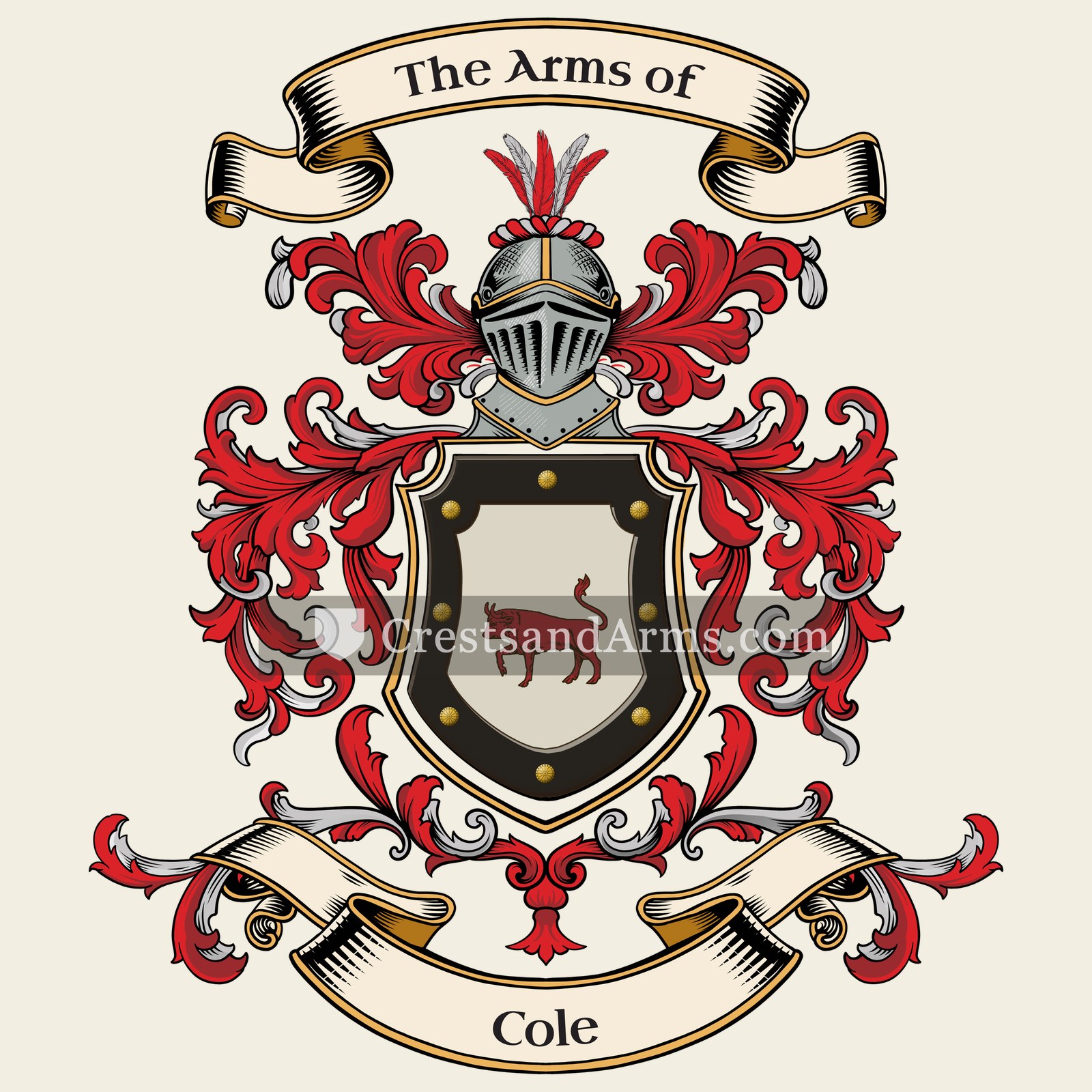
bordureA difference between branches of one family
bullValour and generosity
roundelA coin, and one who has been to the crusades
Colours
Silver (Argent)Means: Peace and sincerity
Black (Sable)Means: Constancy
Red (Gules)Means: Military strength
Gold (Or)Means: Generosity
Historical info
Source
Sir Bernard Burke, The General Armory of England, Scotland, Ireland and Wales, London: Harrison & Sons, 1884
Blazon (the actual original written record)
“Ar. a bull pass. gu. armed or, within a bordure sa. bezantée”
KildareLeixlip Castle · Kildare, c. 1645
Digital archive packCoat of arms PNG, gold border print PDF, vector SVG and the certificate of authenticity. Sent to your email in minutes.
Map of Ireland showing where the Cole arms are recorded
The Cole arms were recorded in Kildare, c. 1645.
Kildare was flat grazing country close to Dublin, taken early by Norman families. Being near the seat of government meant being near where arms were recorded, which is why so many Kildare names appear.
This is where the arms were entered in the register. Families often moved to other parts of the country, so the same name can turn up in more than one region.
The body that granted and recorded arms in Ireland in this period.
Charles I of England
Sovereign of the period
Charles I of England
1625–1649
Reigning in Belgium when the Cole arms are first recorded.
How Arms Worked in Ireland
The Ulster King of Arms granted coats of arms to individuals who proved their social standing and good character. These symbols were typically inherited by all legitimate descendants of the original holder. If a family branch wanted a unique look, they could apply for a specific change to their design through the office to ensure their identity remained distinct.
Granting authority
The Ulster King of Arms acted as the official body that regulated and issued all coats of arms throughout Ireland.
How they got arms
Families obtained their arms through formal grants issued by the office after proving their eligibility and paying the required fees.
Where arms were recorded
All official grants were recorded in the registers held by the Ulster King of Arms starting from the year 1552.
The family's standing
Recorded among the armigerous families of Kildare.
Origin & History of the Cole Family in Ireland
The history of the Cole family in Ireland is deeply connected to the political shifts of the seventeenth century. While the name has roots in various parts of the British Isles, members of the family were firmly established in County Kildare by 1645. During this period, Ireland was experiencing significant upheaval due to the Irish Confederate Wars, which forced many families to navigate complex land ownership laws and shifting loyalties. The presence of the Coles in Kildare suggests they were part of the broader movement of settlers who arrived to manage estates and participate in the local administration of the region. As they integrated into Irish society, they became involved in the agricultural and social life of the county, helping to shape the local community during a time of great national transition. Their early records in Kildare serve as a snapshot of how families established themselves in the Irish landscape during the mid-seventeenth century.
Cole Meaning & Related Branches
Root word
Nicolaus
Derived from Greek words meaning victory of the people.
This name
ColeA shortened form of Nicholas, historically used as a nickname for someone named Nicholas.
also spelled
Kole
Coole
Cool
Coless
Colles
Related arms
Coelvariant spelling
Coolevariant spelling
Collesvariant spelling
Collessvariant spelling
Documented Sources
J. B. Rietstap, Armorial Général, Gouda: G. B. van Goor Zonen, 1884–87
Archives de la Ville de Bruxelles, Registres paroissiaux et état civil
Archives de l'État à Bruxelles, Fonds de l'Ancien Régime
Debrabandere, Frans, Woordenboek van de familienamen in België en Noord-Frankrijk, 2003
Digital archive packCoat of arms PNG, gold border print PDF, vector SVG and the certificate of authenticity. Sent to your email in minutes.


 towerGrandeur and solidity, and a stronghold defended
 towerGrandeur and solidity, and a stronghold defended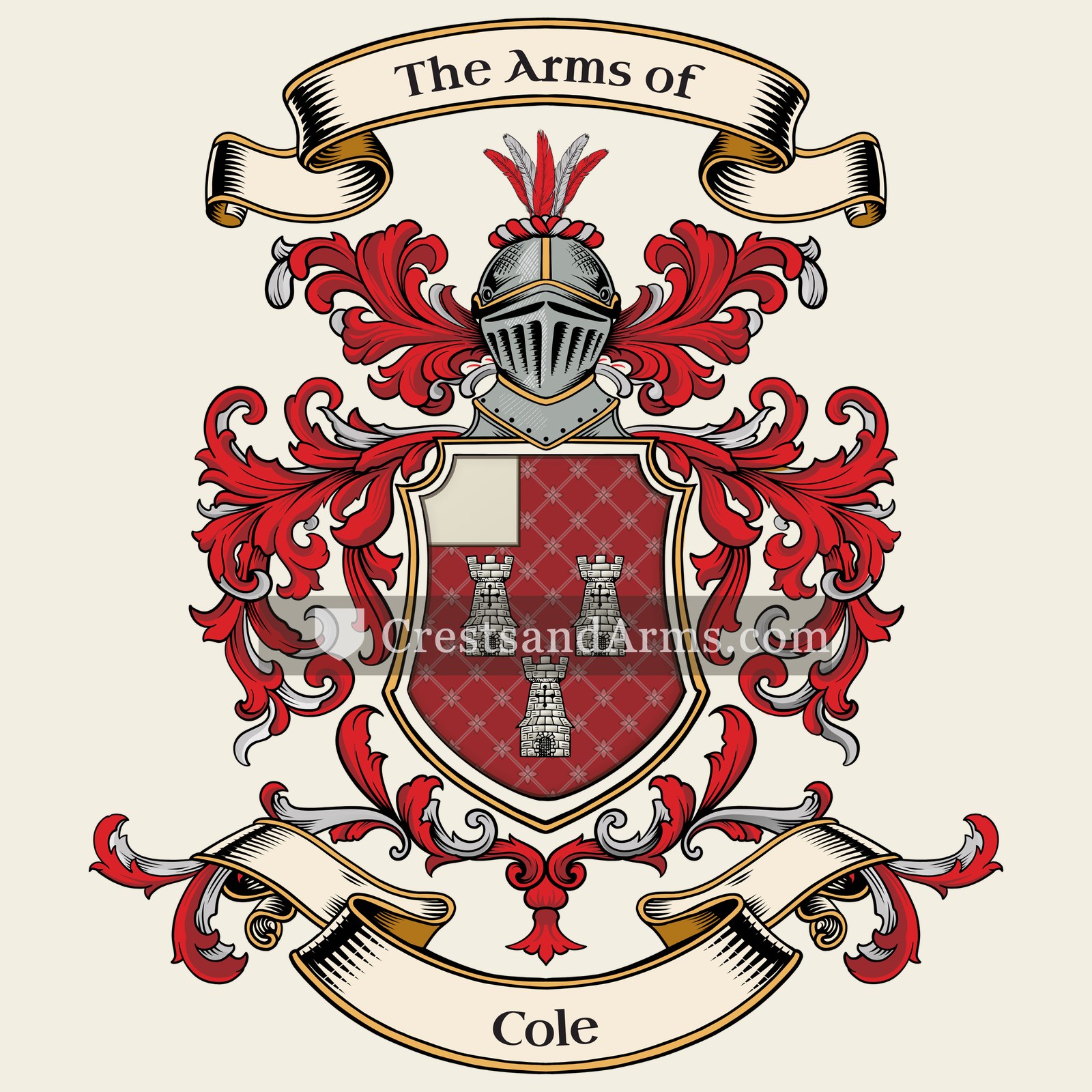


 fleur de lisPurity, light, and the sixth son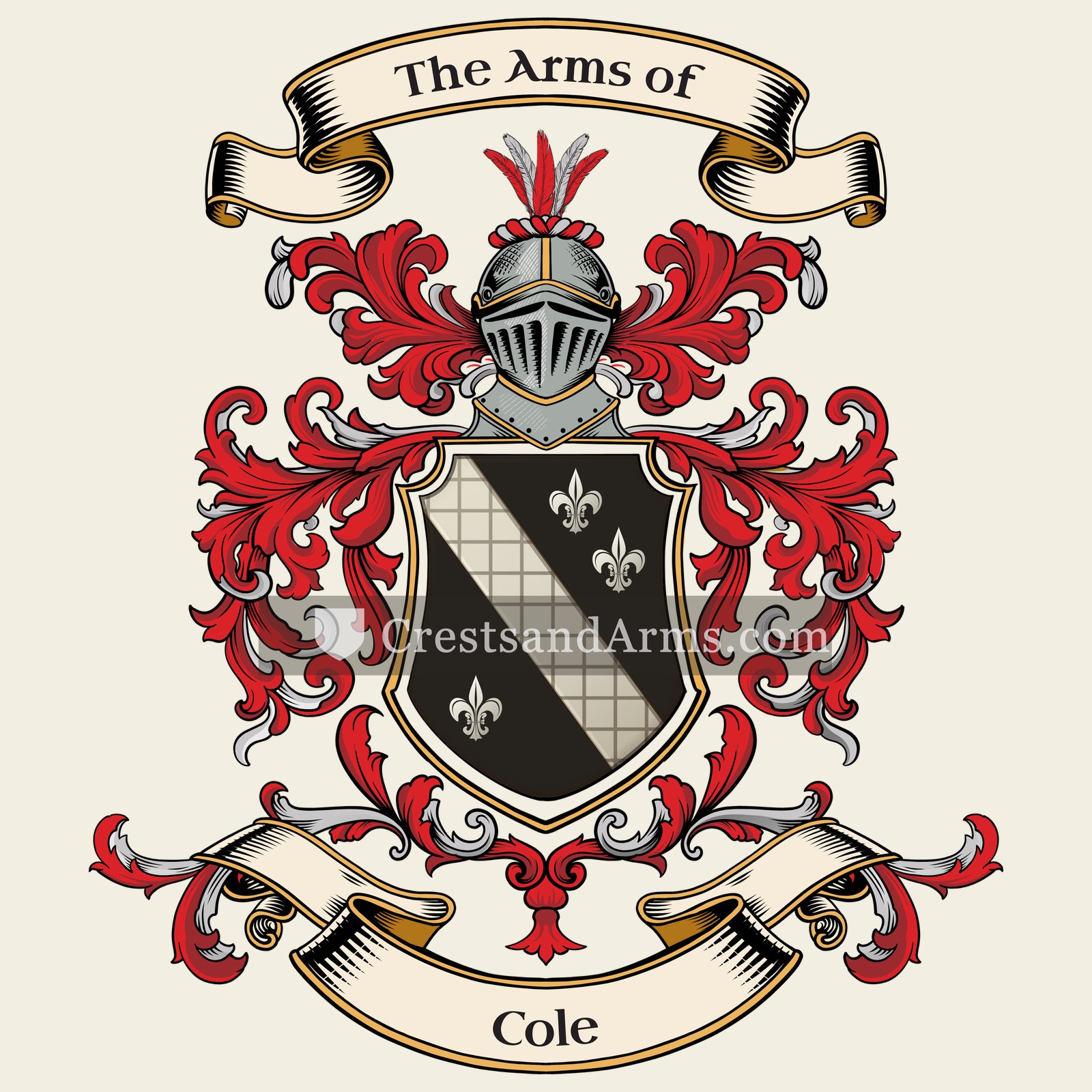


 bordureA difference between branches of one family
 bullValour and generosity
 roundelA coin, and one who has been to the crusades