A record of documented arms, meaning and origin, researched for the Colin family lines. Documented in 2 countries.
Reg. 4347 · French, A–C
Coat of Arms & Family Crest Details
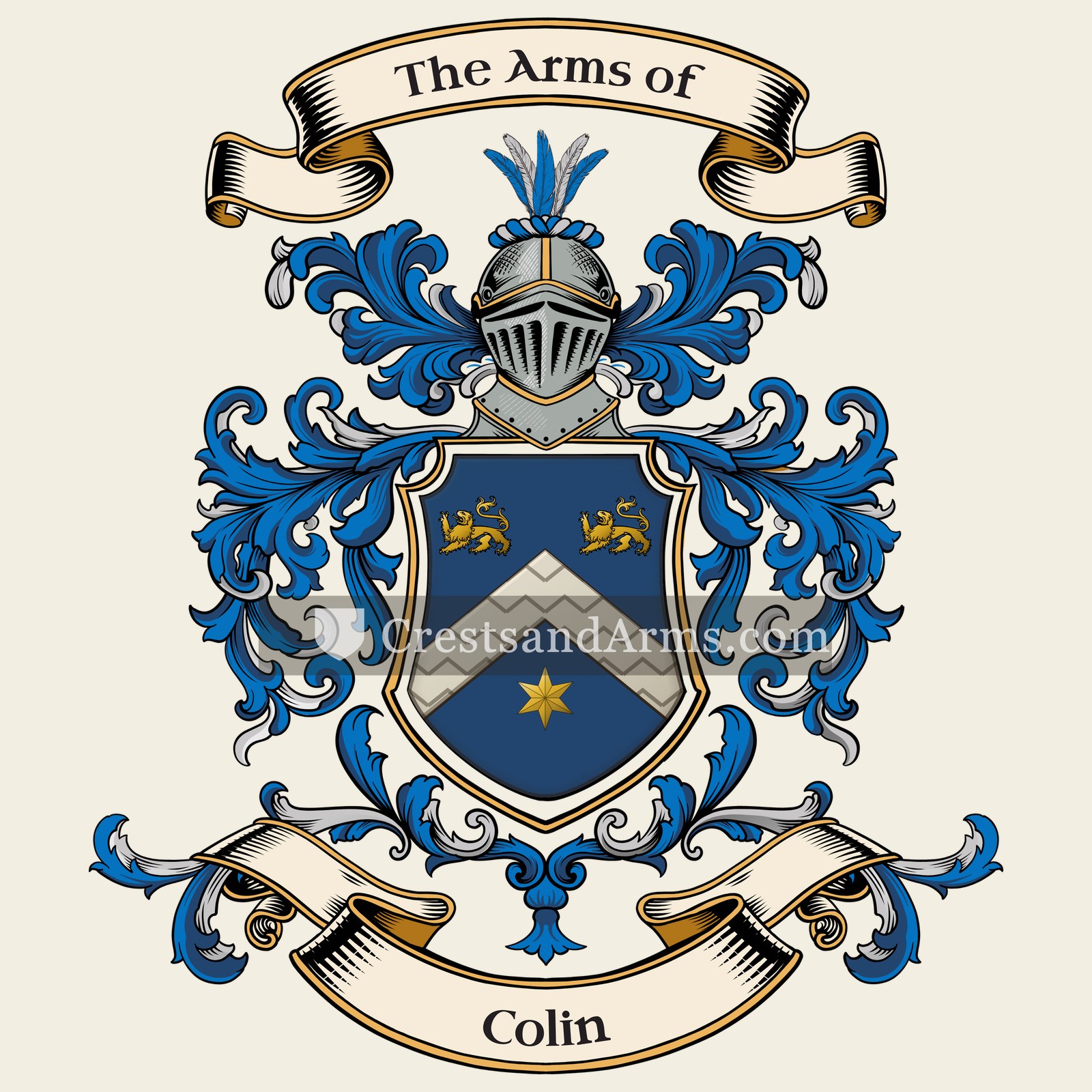
Symbols on this shield
chevronProtection, and faithful service completed
lionCourage, strength and royalty
starThe celestial goddess, and nobility
Colours
Blue (Azure)Means: Loyalty and truth
Silver (Argent)Means: Peace and sincerity
Gold (Or)Means: Generosity
Historical info
Source
J. B. Rietstap, Armorial Général, Gouda: G. B. van Goor Zonen, 1884–87
Blazon (the actual original written record)
“D'azur au chev. d'arg., acc. en chef de deux têtes de lion arr. d'or et en p. d'une étoile du même. C.: une tête et col de lion d'or, naiss. d'un armet morné.”
LorraineLorraine, c. 1589
Digital archive packCoat of arms PNG, gold border print PDF, vector SVG and the certificate of authenticity. Sent to your email in minutes.
Map of France showing where the Colin arms are recorded
The Colin arms were recorded in Lorraine, c. 1589.
Lorraine sat on the border between France and the German lands, and border country bred soldiers. Families here held small estates and served in arms, and a fighting man was exactly the sort who carried a shield of his own.
This is where the arms were entered in the register. Families often moved to other parts of the country, so the same name can turn up in more than one region.
The body that granted and recorded arms in France in this period.
Henry III of France
Sovereign of the period
Henry III of France
1574–1589
Reigning in France when the Colin arms are first recorded.
How Arms Worked in France
In France, a coat of arms was a mark of honor that passed down through the male line to all legitimate descendants. Families often used the same shield without changes to show their shared heritage. If a branch wanted to stand out, they could add a small mark to their shield to show their specific place in the family tree.
Granting authority
The Juge d'armes de France acted as the official authority that regulated and verified coats of arms across the country.
How they got arms
Families typically inherited their arms from ancestors, though they could also receive them through royal grants or by proving their noble status.
Where arms were recorded
Coats of arms were officially recorded in the Armorial Général de France, which began its main collection in the year 1696.
The family's standing
Recorded among the armigerous families of Lorraine.
Origin & History of the Colin Family in France
The surname Colin traces its roots back to medieval France as a common diminutive form of the name Nicholas. During the sixteenth century, the name became firmly established in the Lorraine region, a territory known for its complex history at the crossroads of French and Germanic cultures. By 1589, families bearing this name were active participants in the local social and economic life of the province. Because Lorraine was a major center for trade and religious activity, families like the Colins often held roles as skilled laborers or landholders who helped shape the rural landscape. The name spread steadily across the region as families moved between villages to find work or establish new homesteads. This period of history reflects the resilience of families who lived through the shifting political borders and regional conflicts that defined life in eastern France during the late Renaissance.
Coat of Arms & Family Crest Details
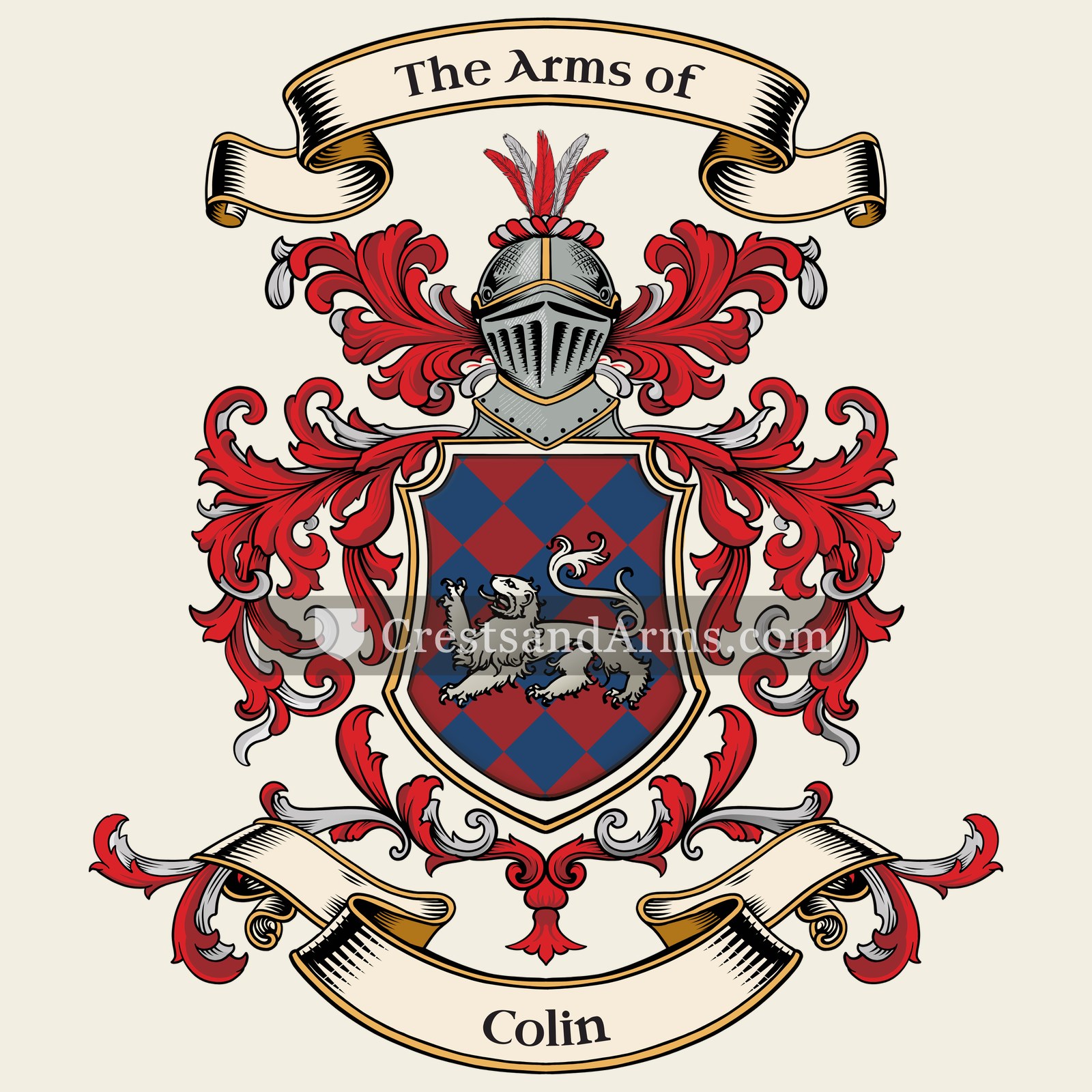
Symbols on this shield
lionCourage, strength and royalty
Colours
Red (Gules)Means: Military strength
Silver (Argent)Means: Peace and sincerity
Blue (Azure)Means: Loyalty and truth
Historical info
Source
J. B. Rietstap, Armorial Général, Gouda: G. B. van Goor Zonen, 1884–87
Blazon (the actual original written record)
“Coupé: au 1 de gu. au lion naiss. d'arg., mouv. du coupé; au 2 losangé d'arg. et d'azur. L. d'arg. et d'azur.”
GermanyNuremberg, c. 1765
Digital archive packCoat of arms PNG, gold border print PDF, vector SVG and the certificate of authenticity. Sent to your email in minutes.
Map of Germany showing where the Colin arms are recorded
The Colin arms were recorded in Nuremberg, c. 1765.
This is where the arms were entered in the register. Families often moved to other parts of the country, so the same name can turn up in more than one region.
The body that granted and recorded arms in Germany in this period.
Francis I, Holy Roman Emperor
Sovereign of the period
Francis I, Holy Roman Emperor
1745–1765
Reigning in France when the Colin arms are first recorded.
How Arms Worked in Germany
In the Holy Roman Empire, coats of arms were often granted to individuals by the Emperor or his representatives. These arms were then passed down through the generations to all legitimate descendants of the original holder. Younger branches of a family usually kept the same shield design without needing to change it, as the arms belonged to the entire lineage.
Granting authority
The Holy Roman Emperor held the sole power to grant new coats of arms throughout his vast imperial territories.
How they got arms
Families typically obtained their coats of arms through a formal imperial grant or by proving their noble status to the authorities.
Where arms were recorded
These grants were officially recorded in the Imperial Chancery registers, which began keeping formal records of such honors during the Middle Ages.
The family's standing
Recorded among the armigerous families of Germany.
Origin & History of the Colin Family in Germany
The family name Colin has deep roots in the German-speaking regions of Europe, where it functioned as a patronymic surname derived from the personal name Nicholas. In the German context, the name often evolved from the shortened form Colas or Colin, which served as a familiar way to address someone named Nikolaus. By the middle of the eighteenth century, the family established a notable presence in the imperial city of Nuremberg. During this era, Nuremberg served as a major hub for trade and craftsmanship, providing a stable environment for families to settle and grow. Records from 1765 confirm that members of the Colin family were integrated into the local community, likely participating in the city's vibrant guild system or merchant networks. This period of residency suggests that the family was well-established within the social and economic fabric of the city, contributing to the long history of urban life in Bavaria.
Colin Meaning & Related Branches
Root word
Nikolaos
Victory of the people derived from Greek words for victory and people.
This name
ColinA diminutive form of Nicholas often associated with the meaning people of victory.
also spelled
Colyn
Collin
Related arms
Collinvariant spelling
Colynvariant spelling
Documented Sources
J. B. Rietstap, Armorial Général, Gouda: G. B. van Goor Zonen, 1884–87
Albert Dauzat, Dictionnaire étymologique des noms et prénoms de France, 1951
Marie-Thérèse Morlet, Dictionnaire étymologique des noms de famille, 1991
Archives départementales de Meurthe-et-Moselle, Série B: Cours et juridictions
Digital archive packCoat of arms PNG, gold border print PDF, vector SVG and the certificate of authenticity. Sent to your email in minutes.


 chevronProtection, and faithful service completed
 lionCourage, strength and royalty
 starThe celestial goddess, and nobility
 chevronProtection, and faithful service completed
 lionCourage, strength and royalty
 starThe celestial goddess, and nobility