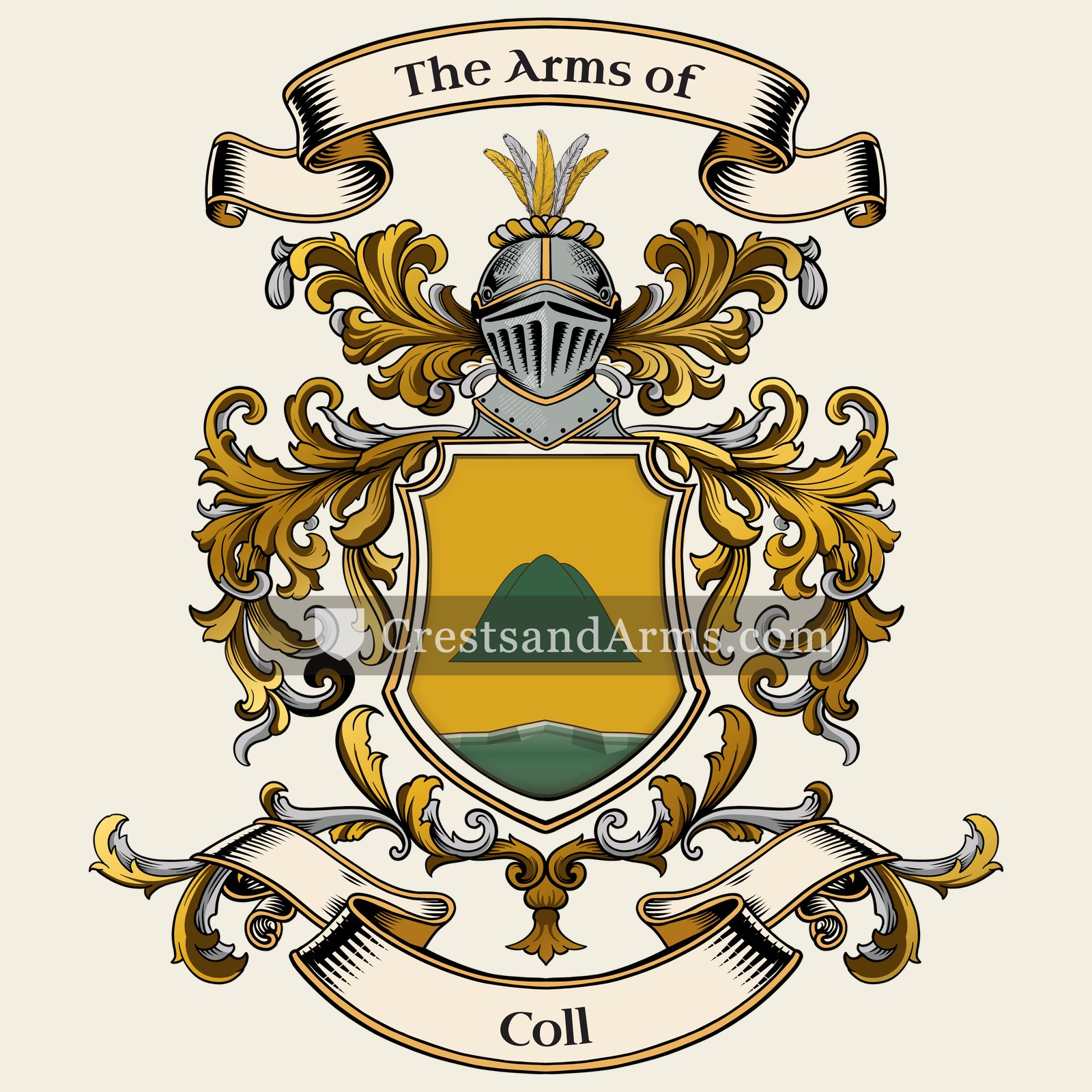
A record of documented arms, meaning and origin, researched for the Coll family lines. Documented in 2 countries.
Reg. 9968 · French, A–C
Coat of Arms & Family Crest Details
Symbols on this shield
chevronProtection, and faithful service completed
armA person of action, industrious and laborious
dovePeace, love and the Holy Spirit
Colours
Red (Gules)Means: Military strength
Silver (Argent)Means: Peace and sincerity
Blue (Azure)Means: Loyalty and truth
Historical info
Source
J. B. Rietstap, Armorial Général, Gouda: G. B. van Goor Zonen, 1884–87
Blazon (the actual original written record)
“Ec.: aux 1 et 4 de gu. à un bras d'arg., posé en pal, tenant une dague du même, la pointe vers le canton dextre du chef; aux 2 et 3 d'azur au chev. d'arg. Sur le tout d'arg. à trois colombes d'azur, bq. et m. de gu.”
ArtoisArtois, c. 1663
Digital archive packCoat of arms PNG, gold border print PDF, vector SVG and the certificate of authenticity. Sent to your email in minutes.
Map of France showing where the Coll arms are recorded
The Coll arms were recorded in Artois, c. 1663.
Artois lay on the disputed ground between France and the Low Countries and was fought over for centuries. Families there held their land under arms, and a shield was how a fighting household was known.
This is where the arms were entered in the register. Families often moved to other parts of the country, so the same name can turn up in more than one region.
The body that granted and recorded arms in France in this period.
Louis XIV of France
Sovereign of the period
Louis XIV of France
1643–1715
Reigning in France when the Coll arms are first recorded.
How Arms Worked in France
In France, a coat of arms was a mark of honor that passed down through the male line to all legitimate descendants. Families often used the same shield without changes to show their shared heritage. If a branch wanted to stand out, they could add a small mark to their shield to show their specific place in the family tree.
Granting authority
The Juge d'armes de France acted as the official authority that regulated and verified coats of arms across the country.
How they got arms
Families typically inherited their arms from ancestors, though they could also receive them through royal grants or by proving their noble status.
Where arms were recorded
Coats of arms were officially recorded in the Armorial Général de France, which began its main collection in the year 1696.
The family's standing
Recorded among the armigerous families of Artois.
Origin & History of the Coll Family in France
The family name Coll has deep roots in the northern French province of Artois, where records confirm members of the family were living as early as 1663. During the seventeenth century, Artois was a region defined by its strategic importance and frequent shifts in political control between the French Crown and the Spanish Netherlands. Families living in this area often navigated a complex landscape of agricultural traditions and local governance. The name itself likely emerged from the linguistic blend common in the borderlands, where regional dialects influenced how surnames were recorded in parish registers. As residents of Artois, the early members of the Coll family were part of a resilient population that maintained strong community ties despite the pressures of regional conflicts and the evolving administrative systems of the French monarchy.
Coat of Arms & Family Crest Details
Symbols on this shield
mountThe ground held, and steadfastness upon it
Colours
Gold (Or)Means: Generosity
Green (Vert)Means: Hope
Historical info
Source
J. B. Rietstap, Armorial Général, Gouda: G. B. van Goor Zonen, 1884–87
Blazon (the actual original written record)
“D'or à un mont de deux coupeaux de sin., celui à dextre sommé d'une croix recr. au pied fiché d'azur et celui à sen. d'un chêne du sec.”
Spainc. 1722
Digital archive packCoat of arms PNG, gold border print PDF, vector SVG and the certificate of authenticity. Sent to your email in minutes.
Map of Spain showing where the Coll arms are recorded
The Coll arms were recorded in Spain, c. 1722.
Arms such as these were typically recorded in Castile.
Castile was the heart of Spain and the source of most of its noble families. Land won in the long wars against the Moors was granted out to fighting men, and a man granted land was granted arms along with it.
This is where the arms were entered in the register. Families often moved to other parts of the country, so the same name can turn up in more than one region.
The body that granted and recorded arms in Spain in this period.
Philip V of Spain
Sovereign of the period
Philip V of Spain
1714–1724
Reigning in France when the Coll arms are first recorded.
How Arms Worked in Spain
In Spain, a coat of arms was considered a form of property that belonged to the entire family line. These arms were passed down from a father to all his children equally. Younger branches of the family usually kept the original design without needing to add any special marks to distinguish their specific line.
Granting authority
The Cronista Rey de Armas was the official body that regulated and granted coats of arms throughout Spain.
How they got arms
Families often obtained their arms through royal grants or by proving their noble status to the official heraldic authority.
Where arms were recorded
Coats of arms were officially recorded in the registers of the Cronista Rey de Armas starting in 1496.
The family's standing
Recorded among the armigerous families of Spain.
Origin & History of the Coll Family in Spain
The surname Coll has deep roots in the Iberian Peninsula, where it functioned as a topographic name for families living near a hill or a mountain pass. While the name is often associated with the eastern regions of Catalonia and the Balearic Islands, members of the family were firmly established in the central kingdom of Castile by the early eighteenth century. By 1722, records show individuals bearing the name participating in the social and administrative life of the Castilian heartland. During this era, families like the Coll were often involved in the local agricultural economy or served in municipal roles that helped maintain the structure of rural towns. Their presence in Castile suggests a period of migration and integration as families moved across regional borders to seek new opportunities in trade or land management. This movement helped the name transition from a localized identifier to a broader presence within the Spanish interior.
Coll Meaning & Related Branches
Root word
Collis
Latin term referring to a hill or elevated piece of land.
This name
CollA topographic surname for someone who resided on or near a hill.
also spelled
Col
Documented Sources
J. B. Rietstap, Armorial Général, Gouda: G. B. van Goor Zonen, 1884–87
Archives Départementales du Pas-de-Calais, Registres paroissiaux et d'état civil, 1663
Lefebvre, Georges, Les paysans du Nord pendant la Révolution française, 1924
Pérennès, Henri, Histoire de l'Artois, 1948
Digital archive packCoat of arms PNG, gold border print PDF, vector SVG and the certificate of authenticity. Sent to your email in minutes.


 chevronProtection, and faithful service completed
 armA person of action, industrious and laborious
 dovePeace, love and the Holy Spirit
 chevronProtection, and faithful service completed
 armA person of action, industrious and laborious
 dovePeace, love and the Holy Spirit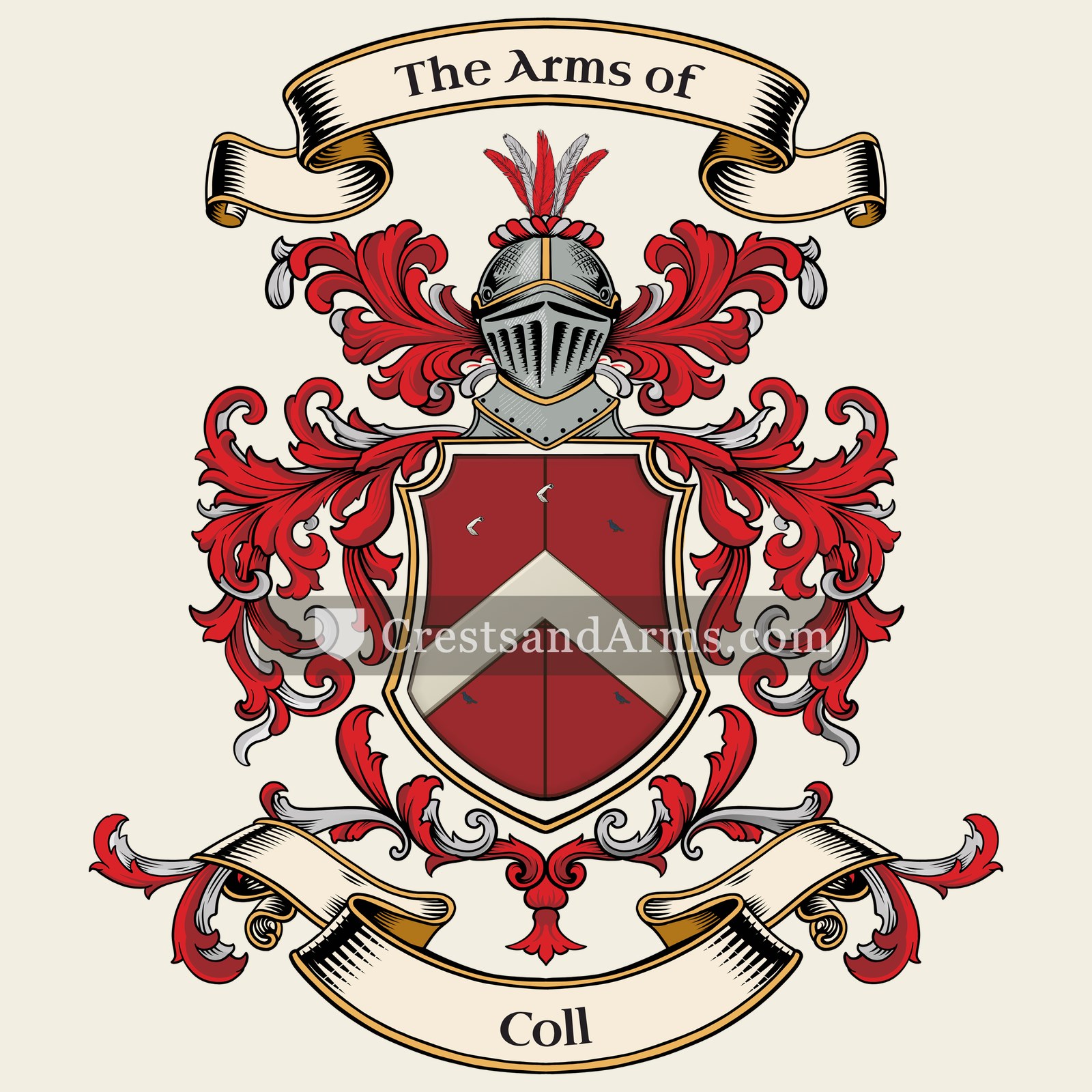


 mountThe ground held, and steadfastness upon it