A record of documented arms, meaning and origin, researched for the Colmar family lines. Documented in 2 countries.
Reg. 4999 · French, A–C
Coat of Arms & Family Crest Details
Symbols on this shield
skullMortality remembered, and courage in the face of death
billetThe sealed letter, and a message delivered
Colours
Black (Sable)Means: Constancy
Silver (Argent)Means: Peace and sincerity
Historical info
Source
J. B. Rietstap, Armorial Général, Gouda: G. B. van Goor Zonen, 1884–87
Blazon (the actual original written record)
“De sa. à un crâne de bouquetin avec ses deux cornes d'arg., la pointe des cornes dirigée vers sen., le tout acc. de six bill. d'arg., 2 en chef, 2 en flancs et 2 en p. Cq. cour. C.: les cornes.”
AlsaceAlsace, c. 1663
Digital archive packCoat of arms PNG, gold border print PDF, vector SVG and the certificate of authenticity. Sent to your email in minutes.
Map of France showing where the Colmar arms are recorded
The Colmar arms were recorded in Alsace, c. 1663.
Alsace lay between France and the German lands and belonged to both at different times. Its families held small estates and served whichever side ruled, and men who served in arms carried arms of their own.
This is where the arms were entered in the register. Families often moved to other parts of the country, so the same name can turn up in more than one region.
The body that granted and recorded arms in France in this period.
Louis XIV of France
Sovereign of the period
Louis XIV of France
1643–1715
Reigning in France when the Colmar arms are first recorded.
How Arms Worked in France
In France, a coat of arms was a mark of honor that passed down through the male line to all legitimate descendants. Families often used the same shield without changes to show their shared heritage. If a branch wanted to stand out, they could add a small mark to their shield to show their specific place in the family tree.
Granting authority
The Juge d'armes de France acted as the official authority that regulated and verified coats of arms across the country.
How they got arms
Families typically inherited their arms from ancestors, though they could also receive them through royal grants or by proving their noble status.
Where arms were recorded
Coats of arms were officially recorded in the Armorial Général de France, which began its main collection in the year 1696.
The family's standing
Recorded among the armigerous families of Alsace.
Origin & History of the Colmar Family in France
The family name Colmar is deeply rooted in the historical landscape of Alsace, a region in eastern France that has long served as a crossroads for European culture. By 1663, records confirm that members of the family were already established in this area, living through a period of significant transition as Alsace became increasingly integrated into the French kingdom. The name itself likely originates from the city of Colmar, which was a vital center for trade and administration during the seventeenth century. Families living in this region often adopted the name of their home city to identify their origins as they moved or conducted business across the province. During this era, the Colmar family would have navigated the complex social and linguistic shifts occurring in Alsace, where German and French influences blended together. Their presence in the region during the mid-1600s places them at the heart of a transformative time in French history, as the local population adapted to new administrative structures and regional loyalties.
Coat of Arms & Family Crest Details
Symbols on this shield
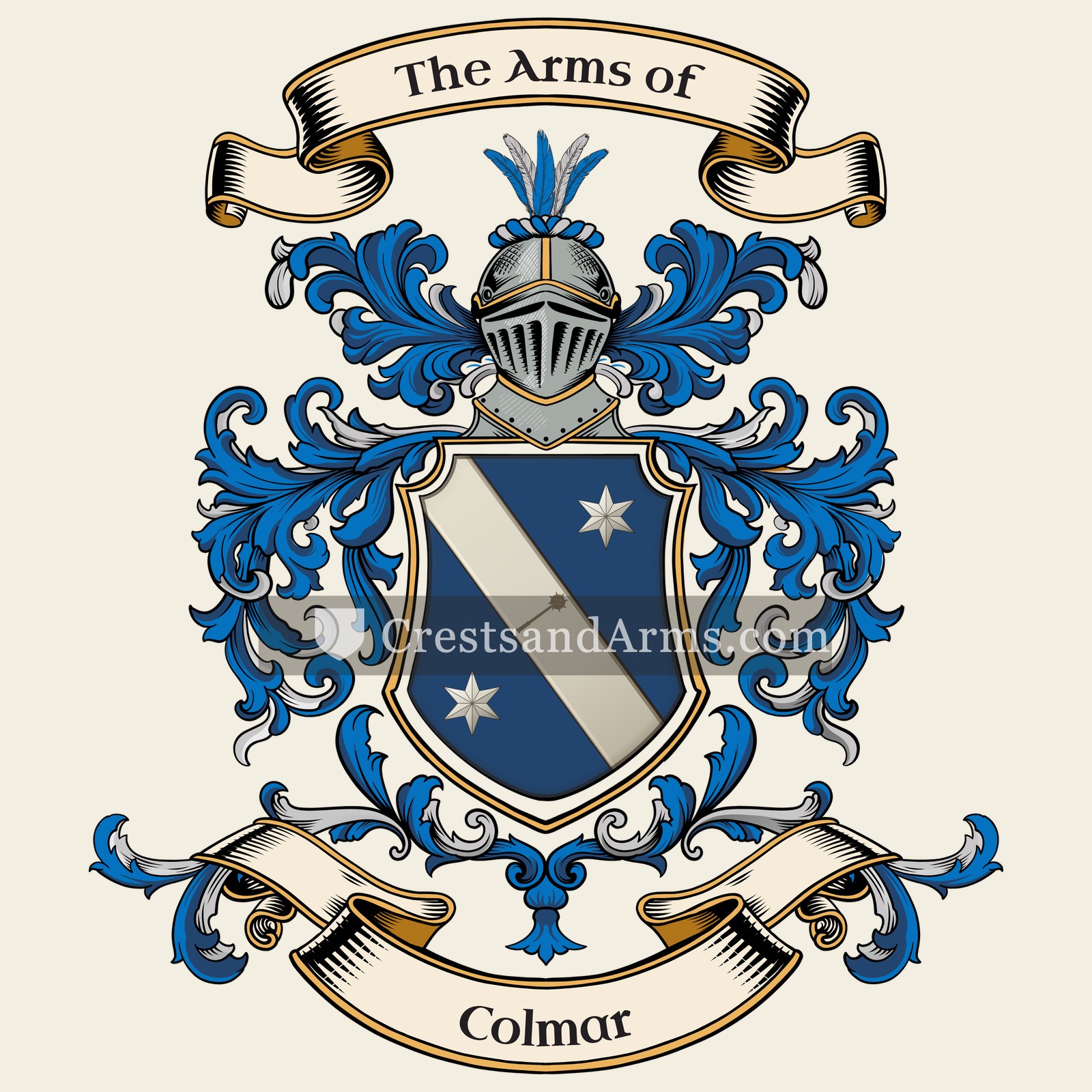
bendDefence, and the scarf of a commander
maceAuthority, and the officer who bears it
starThe celestial goddess, and nobility
Colours
Blue (Azure)Means: Loyalty and truth
Silver (Argent)Means: Peace and sincerity
Historical info
Source
J. B. Rietstap, Armorial Général, Gouda: G. B. van Goor Zonen, 1884–87
Blazon (the actual original written record)
“D'azur à la bande d'arg., ch. d'une masse à picotons au nat. et acc. de deux étoiles du sec. C.: un homme iss., hab. d'azur, ceint et rebr. d'arg., au rabat du même, coiffé d'un bonnet pointu d'azur et tenant la masse à picotons, posée sur son épaule.”
GermanyNuremberg, c. 1765
Digital archive packCoat of arms PNG, gold border print PDF, vector SVG and the certificate of authenticity. Sent to your email in minutes.
Map of Germany showing where the Colmar arms are recorded
The Colmar arms were recorded in Nuremberg, c. 1765.
This is where the arms were entered in the register. Families often moved to other parts of the country, so the same name can turn up in more than one region.
The body that granted and recorded arms in Germany in this period.
Francis I, Holy Roman Emperor
Sovereign of the period
Francis I, Holy Roman Emperor
1745–1765
Reigning in France when the Colmar arms are first recorded.
How Arms Worked in Germany
In the Holy Roman Empire, coats of arms were often granted to individuals by the Emperor or his representatives. These arms were then passed down through the generations to all legitimate descendants of the original holder. Younger branches of a family usually kept the same shield design without needing to change it, as the arms belonged to the entire lineage.
Granting authority
The Holy Roman Emperor held the sole power to grant new coats of arms throughout his vast imperial territories.
How they got arms
Families typically obtained their coats of arms through a formal imperial grant or by proving their noble status to the authorities.
Where arms were recorded
These grants were officially recorded in the Imperial Chancery registers, which began keeping formal records of such honors during the Middle Ages.
The family's standing
Recorded among the armigerous families of Germany.
Origin & History of the Colmar Family in Germany
The family name Colmar is deeply rooted in the historical landscape of Germany, with significant ties to the city of Nuremberg by the mid-eighteenth century. During this era, Nuremberg served as a major hub for trade and craftsmanship, attracting families who were often involved in the city’s thriving guild systems and merchant networks. The name itself likely originated as a locative surname, meaning it was used to identify individuals who migrated from the town of Colmar in the Alsace region to other parts of the German-speaking world. By 1765, records confirm that members of the Colmar family were established residents within the city walls of Nuremberg, participating in the urban life and social structures of the Holy Roman Empire. This transition from regional origins to city dwellers reflects the broader patterns of movement and professional growth that defined many German families during the Enlightenment period.
Colmar Meaning & Related Branches
Root word
Columbarium
A place for doves or a dovecote structure.
This name
ColmarDerived from a place name in Alsace referring to a dovecote or pigeon house.
also spelled
Colmare
Colmarr
Documented Sources
J. B. Rietstap, Armorial Général, Gouda: G. B. van Goor Zonen, 1884–87
Archives Départementales du Haut-Rhin, Registres paroissiaux de l'état civil, 1663
Grasser, Jean-Paul, Histoire de Colmar, 1983
Livet, Georges, L'Intendance d'Alsace sous Louis XIV, 1956
Digital archive packCoat of arms PNG, gold border print PDF, vector SVG and the certificate of authenticity. Sent to your email in minutes.


 skullMortality remembered, and courage in the face of death
 billetThe sealed letter, and a message delivered
 skullMortality remembered, and courage in the face of death
 billetThe sealed letter, and a message delivered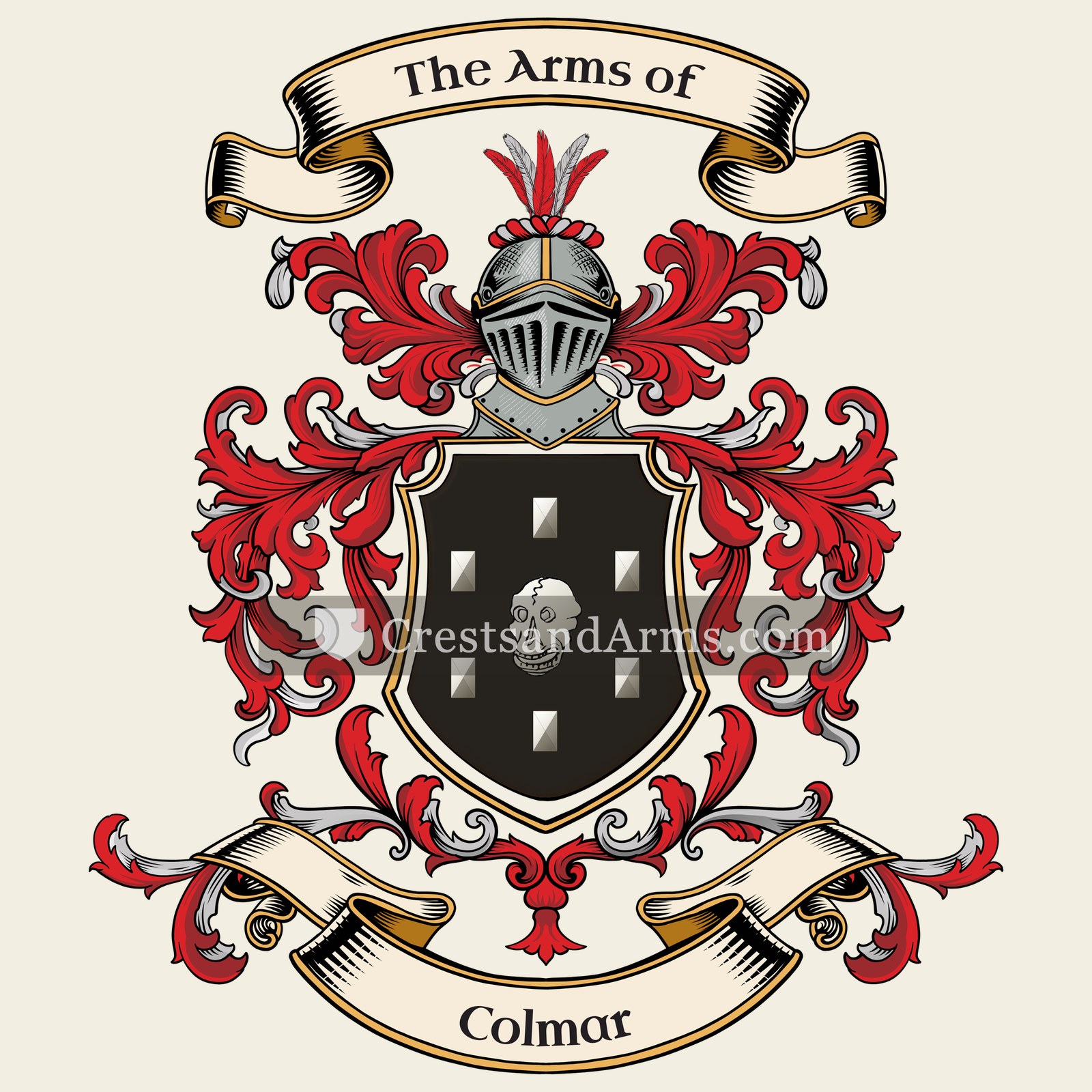


 bendDefence, and the scarf of a commander
 maceAuthority, and the officer who bears it
 starThe celestial goddess, and nobility