Map of France showing where the Colomb arms are recorded
The Colomb arms were recorded in Quercy, c. 1663.
Quercy was limestone country in southern France, dry and thinly farmed. Its gentry held small estates for centuries, and long unbroken holding is what fills a register of arms.
This is where the arms were entered in the register. Families often moved to other parts of the country, so the same name can turn up in more than one region.
The body that granted and recorded arms in France in this period.
Louis XIV of France
Sovereign of the period
Louis XIV of France
1643–1715
Reigning in France when the Colomb arms are first recorded.
How Arms Worked in France
In France, a coat of arms was a mark of honor that passed down through the male line to all legitimate descendants. Families often used the same shield without changes to show their shared heritage. If a branch wanted to stand out, they could add a small mark to their shield to show their specific place in the family tree.
Granting authority
The Juge d'armes de France acted as the official authority that regulated and verified coats of arms across the country.
How they got arms
Families typically inherited their arms from ancestors, though they could also receive them through royal grants or by proving their noble status.
Where arms were recorded
Coats of arms were officially recorded in the Armorial Général de France, which began its main collection in the year 1696.
The family's standing
Recorded among the armigerous families of Quercy.
Origin & History of the Colomb Family in France
The family name Colomb has deep roots in the historical province of Quercy, located in southwestern France. By the year 1663, records confirm that members of the family were well-established in this region, which was known for its rugged limestone plateaus and river valleys. The name itself is derived from the Latin word columba, meaning dove, and it was often used as a nickname for people who were considered gentle or peaceful. During the seventeenth century, families in Quercy were typically tied to the land and local trade, living in small rural communities that had remained largely unchanged for generations. As the family grew, they became part of the social fabric of the French countryside, navigating the challenges of agricultural life and the shifting political landscape of the era. Their presence in Quercy serves as a window into the lives of provincial families who helped shape the identity of the French heartland long before the modern age.
Coat of Arms & Family Crest Details
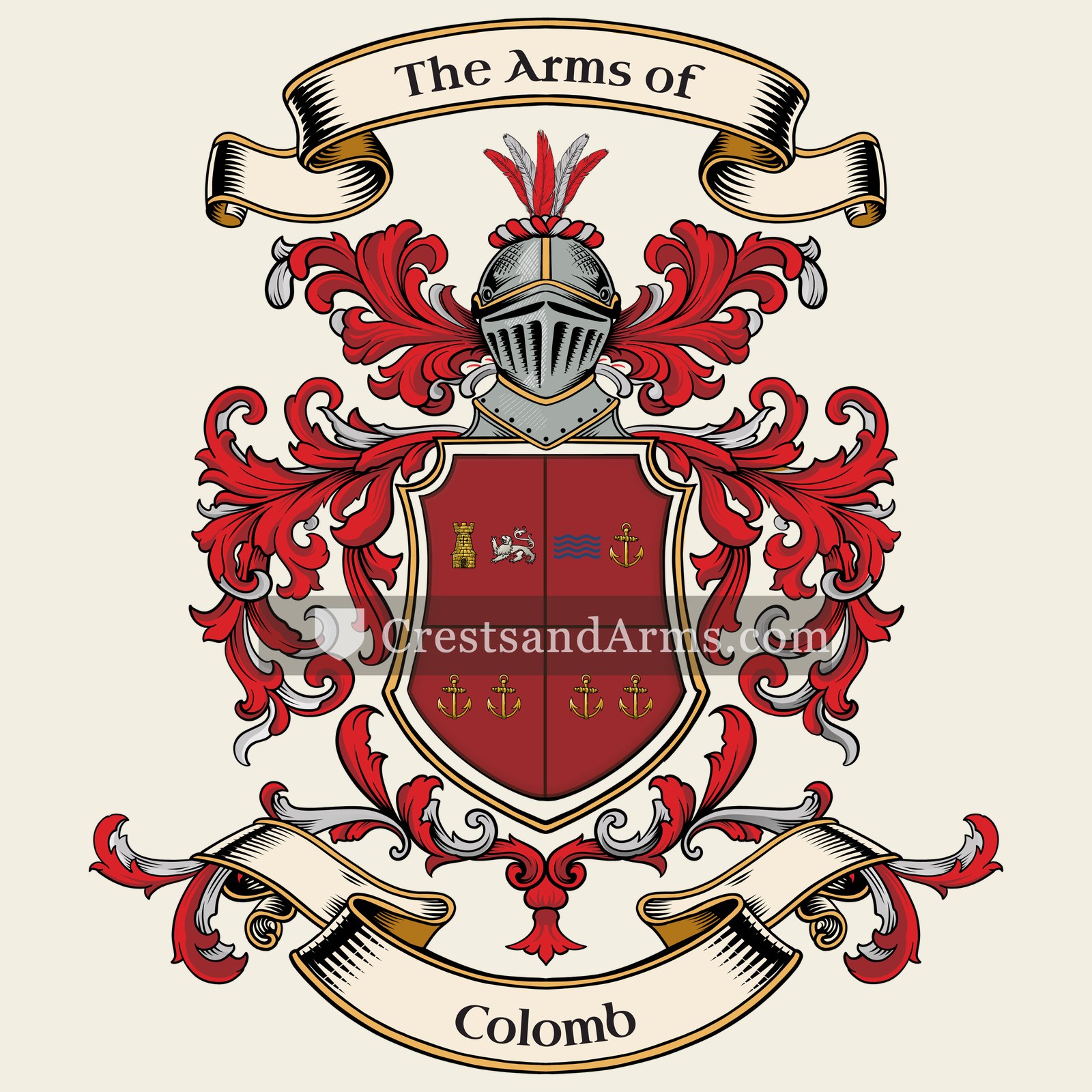
Symbols on this shield
dovePeace, love and the Holy Spirit
savages head affrontyAn enemy overcome
trefoilPerpetuity, and the Trinity
Colours
Gold (Or)Means: Generosity
Silver (Argent)Means: Peace and sincerity
Historical info
Source
J. B. Rietstap, Armorial Général, Gouda: G. B. van Goor Zonen, 1884–87
Blazon (the actual original written record)
“D'or à une colombe, tenant en son bec un rameau d'olivier et posée sur une proue de vaisseau, le tout au nat.; le champ chapé-ployé d'azur, ch. à dextre de trois têtes de More, tort. d'arg., 2 et 1, et à sen. de trois trèfles d'arg., 2 et 1. Cq. cour. C.: un vol de sa. L.: d'or et d'azur. S.: deux aigles de Prusse, reg.”
Germanyc. 1786
Digital archive packCoat of arms PNG, gold border print PDF, vector SVG and the certificate of authenticity. Sent to your email in minutes.
Map of Germany showing where the Colomb arms are recorded
The Colomb arms were recorded in Germany, c. 1786.
Arms such as these were typically recorded in Bavaria.
Bavaria was a country of old landed families and walled market towns. Estates passed down the same line for centuries, and both the landowners and the leading townsmen kept arms, which is why so many Bavarian names sit in the registers.
This is where the arms were entered in the register. Families often moved to other parts of the country, so the same name can turn up in more than one region.
The body that granted and recorded arms in Germany in this period.
Joseph II, Holy Roman Emperor
Sovereign of the period
Joseph II, Holy Roman Emperor
1765–1790
Reigning in France when the Colomb arms are first recorded.
How Arms Worked in Germany
In the Holy Roman Empire, coats of arms were often granted to individuals by the Emperor or his representatives. These arms were then passed down through the generations to all legitimate descendants of the original holder. Younger branches of a family usually kept the same shield design without needing to change it, as the arms belonged to the entire lineage.
Granting authority
The Holy Roman Emperor held the sole power to grant new coats of arms throughout his vast imperial territories.
How they got arms
Families typically obtained their coats of arms through a formal imperial grant or by proving their noble status to the authorities.
Where arms were recorded
These grants were officially recorded in the Imperial Chancery registers, which began keeping formal records of such honors during the Middle Ages.
The family's standing
Recorded among the armigerous families of Germany.
Origin & History of the Colomb Family in Germany
The family name Colomb has deep roots in European history, with a notable presence in the German-speaking regions by the late eighteenth century. Records confirm that members of the family were established in Bavaria by 1786, a time when the region was undergoing significant social and political changes under the influence of the Holy Roman Empire. The name itself is often linked to the Latin word for dove, which was a common way to identify people based on their personality or local nicknames during the Middle Ages. As the family settled in southern Germany, they integrated into the local culture and administrative systems of the era. Over time, the name became associated with families who moved across borders, reflecting the broader movement of people throughout Central Europe during the eighteenth and nineteenth centuries. By maintaining their presence in Bavaria, the early members of the Colomb family contributed to the regional history of the area as it transitioned into the modern age.
Coat of Arms & Family Crest Details
Symbols on this shield
towerGrandeur and solidity, and a stronghold defended
lionCourage, strength and royalty
riverThe bounds of a land, and life carried through it
anchorHope, and steadfastness in trouble
Colours
Red (Gules)Means: Military strength
Gold (Or)Means: Generosity
Blue (Azure)Means: Loyalty and truth
Historical info
Source
J. B. Rietstap, Armorial Général, Gouda: G. B. van Goor Zonen, 1884–87
Blazon (the actual original written record)
“Ec.: au 1 de gu. à une tour sommée de trois tourelles d'or (royaume de Castille); au 2 d'arg. au lion de gu., cour. d'or (royaume de Léon); au 3 une mer d'azur, semée d'îles d'arg., la moitié de la circonférence environnée de la terre ferme, des grains d'or répandus partout, les terres et les îles couvertes d'arbres de sin.; au 4 d'azur à cinq ancres d'or, 2, 1 et 2. Enté en p. d'un fascé-ondé d'arg. et d'azur [Armes de Christophe Colomb et de ses descendants, les ducs de Veraguas.]”
Spainc. 1722
Digital archive packCoat of arms PNG, gold border print PDF, vector SVG and the certificate of authenticity. Sent to your email in minutes.
Map of Spain showing where the Colomb arms are recorded
The Colomb arms were recorded in Spain, c. 1722.
Arms such as these were typically recorded in Castile.
Castile was the heart of Spain and the source of most of its noble families. Land won in the long wars against the Moors was granted out to fighting men, and a man granted land was granted arms along with it.
This is where the arms were entered in the register. Families often moved to other parts of the country, so the same name can turn up in more than one region.
The body that granted and recorded arms in Spain in this period.
Philip V of Spain
Sovereign of the period
Philip V of Spain
1714–1724
Reigning in France when the Colomb arms are first recorded.
How Arms Worked in Spain
In Spain, a coat of arms was considered a form of property that belonged to the entire family line. These arms were passed down from a father to all his children equally. Younger branches of the family usually kept the original design without needing to add any special marks to distinguish their specific line.
Granting authority
The Cronista Rey de Armas was the official body that regulated and granted coats of arms throughout Spain.
How they got arms
Families often obtained their arms through royal grants or by proving their noble status to the official heraldic authority.
Where arms were recorded
Coats of arms were officially recorded in the registers of the Cronista Rey de Armas starting in 1496.
The family's standing
Recorded among the armigerous families of Spain.
Origin & History of the Colomb Family in Spain
The family name Colomb carries a deep history that connects to the movement of people across European borders during the eighteenth century. While the name is often associated with broader Mediterranean roots, records confirm that members of the family were firmly established in the region of Castile by 1722. During this era, Castile served as a central hub for administration and social growth, making it a common destination for families seeking to build new lives or expand their professional influence. The presence of the Colomb name in these early Castilian documents suggests that the family integrated into the local economy and social structure of the Spanish heartland. By settling in this region, they became part of the complex tapestry of families that helped shape the local communities of the time. This history highlights how a family name can travel across regions and take root in new territories, leaving a lasting mark on the historical record of the area.
Colomb Meaning & Related Branches
Root word
Columba
Latin word for a dove or pigeon.
This name
ColombA habitational or occupational name for someone who kept doves or lived near a dove cote.
also spelled
Colom
Related arms
Bellonsimilar arms
Clarysimilar arms
Havartsimilar arms
Documented Sources
J. B. Rietstap, Armorial Général, Gouda: G. B. van Goor Zonen, 1884–87
Dauzat, Albert. Dictionnaire étymologique des noms de famille et prénoms de France. 1951
Lartigaut, Jean. Quercy et Rouergue aux temps féodaux. 1995
Archives départementales du Lot, Série E (Familles et notaires)
Digital archive packCoat of arms PNG, gold border print PDF, vector SVG and the certificate of authenticity. Sent to your email in minutes.


 chevronProtection, and faithful service completed
 crescentHonour by the sovereign, and the second son
 starThe celestial goddess, and nobility
 dovePeace, love and the Holy Spirit
 chevronProtection, and faithful service completed
 crescentHonour by the sovereign, and the second son
 starThe celestial goddess, and nobility
 dovePeace, love and the Holy Spirit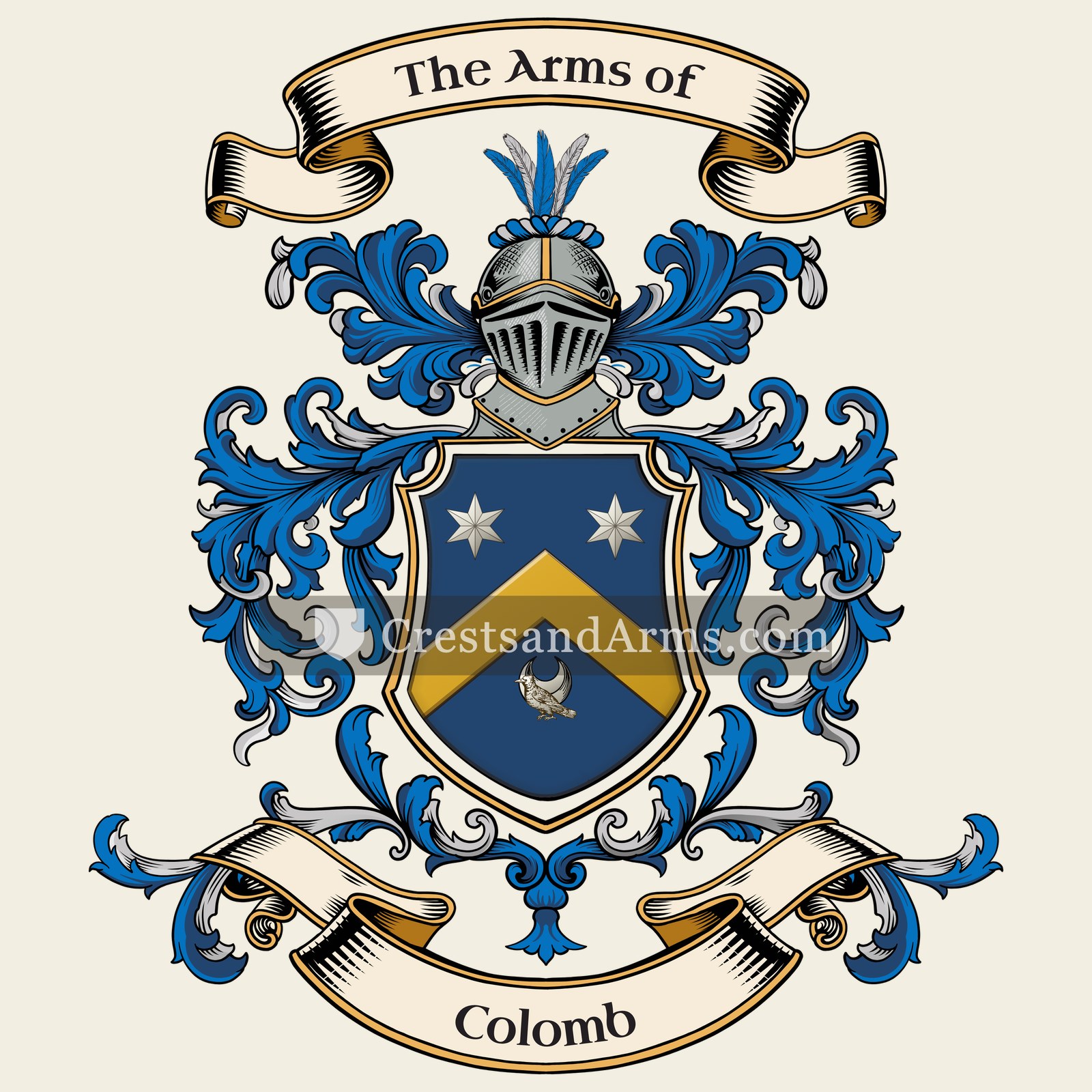


 savages head affrontyAn enemy overcome
 trefoilPerpetuity, and the Trinity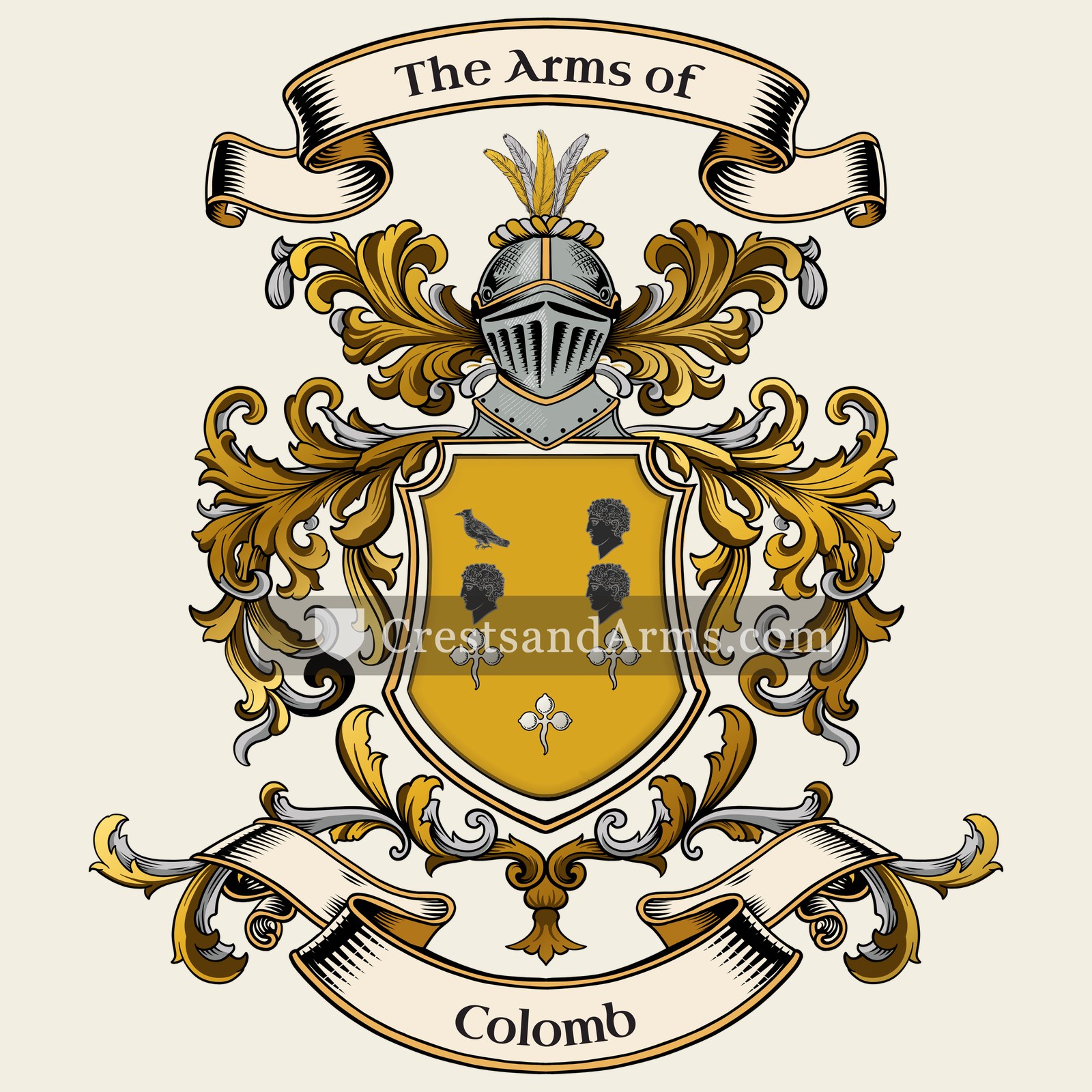


 towerGrandeur and solidity, and a stronghold defended
 lionCourage, strength and royalty
 riverThe bounds of a land, and life carried through it
 anchorHope, and steadfastness in trouble