Map of Germany showing where the Colquhoun arms are recorded
The Colquhoun arms were recorded in Oldenbourg, c. 1765.
This is where the arms were entered in the register. Families often moved to other parts of the country, so the same name can turn up in more than one region.
The body that granted and recorded arms in Germany in this period.
Francis I, Holy Roman Emperor
Sovereign of the period
Francis I, Holy Roman Emperor
1745–1765
Reigning in Germany when the Colquhoun arms are first recorded.
How Arms Worked in Germany
In the Holy Roman Empire, coats of arms were often granted to individuals by the Emperor or his representatives. These arms were then passed down through the generations to all legitimate descendants of the original holder. Younger branches of a family usually kept the same shield design without needing to change it, as the arms belonged to the entire lineage.
Granting authority
The Holy Roman Emperor held the sole power to grant new coats of arms throughout his vast imperial territories.
How they got arms
Families typically obtained their coats of arms through a formal imperial grant or by proving their noble status to the authorities.
Where arms were recorded
These grants were officially recorded in the Imperial Chancery registers, which began keeping formal records of such honors during the Middle Ages.
The family's standing
Recorded among the armigerous families of Germany.
Origin & History of the Colquhoun Family in Germany
The history of the Colquhoun name in Germany begins with the migration of individuals who settled in the region of Oldenburg during the mid-eighteenth century. By 1765, records confirm that members of the family were firmly established in this area, likely drawn by the opportunities for trade or professional service within the local administration. While the name itself is of Scottish origin, its presence in Northern Germany reflects the broader movement of people across Europe during the Enlightenment era. These early settlers integrated into the local community, adapting to the social and economic structures of the Oldenburg state. Their presence in the region highlights a fascinating chapter of international movement where families carried their heritage into new lands, eventually becoming a part of the local historical fabric.
Coat of Arms & Family Crest Details
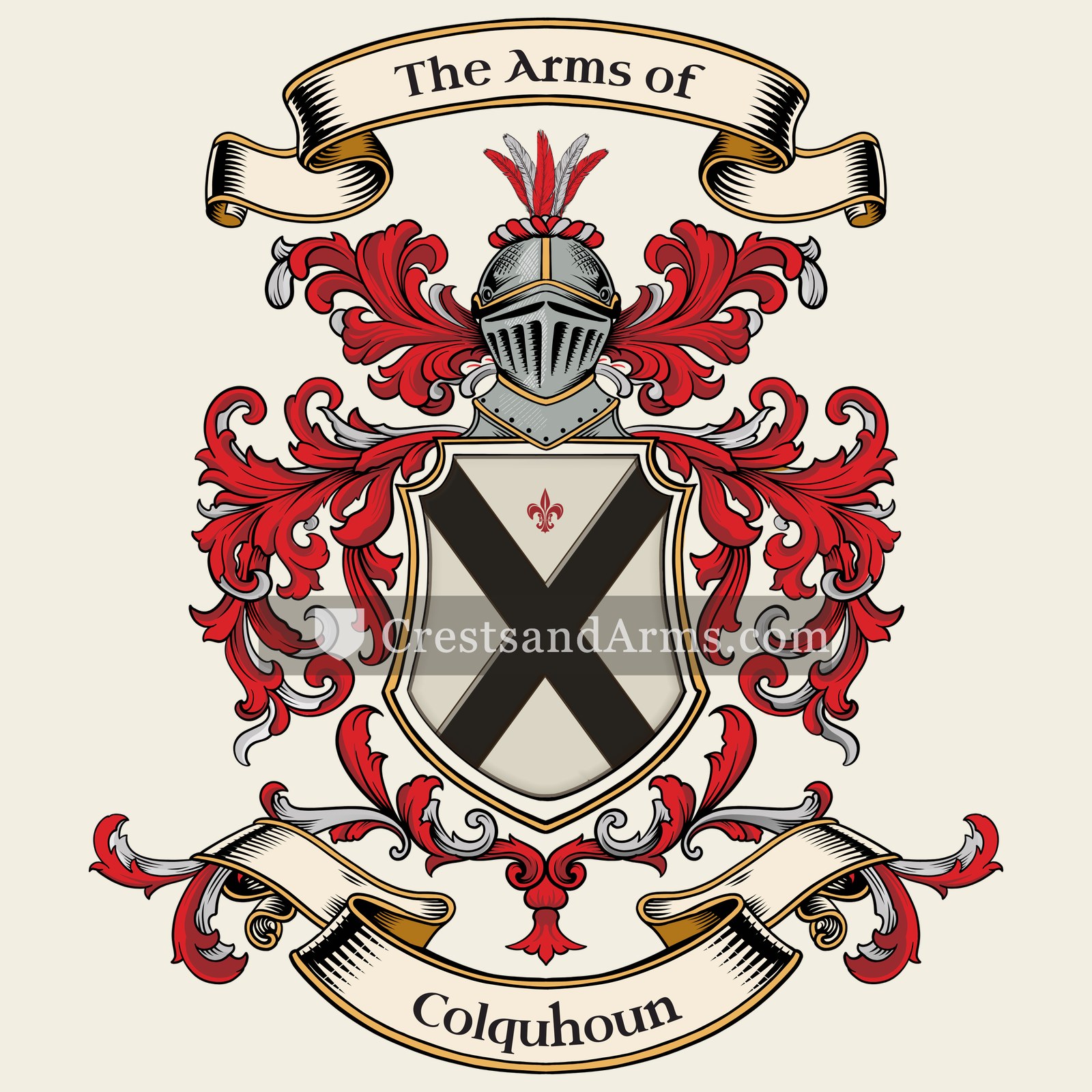
Symbols on this shield
saltireResolution, and St Andrew's cross
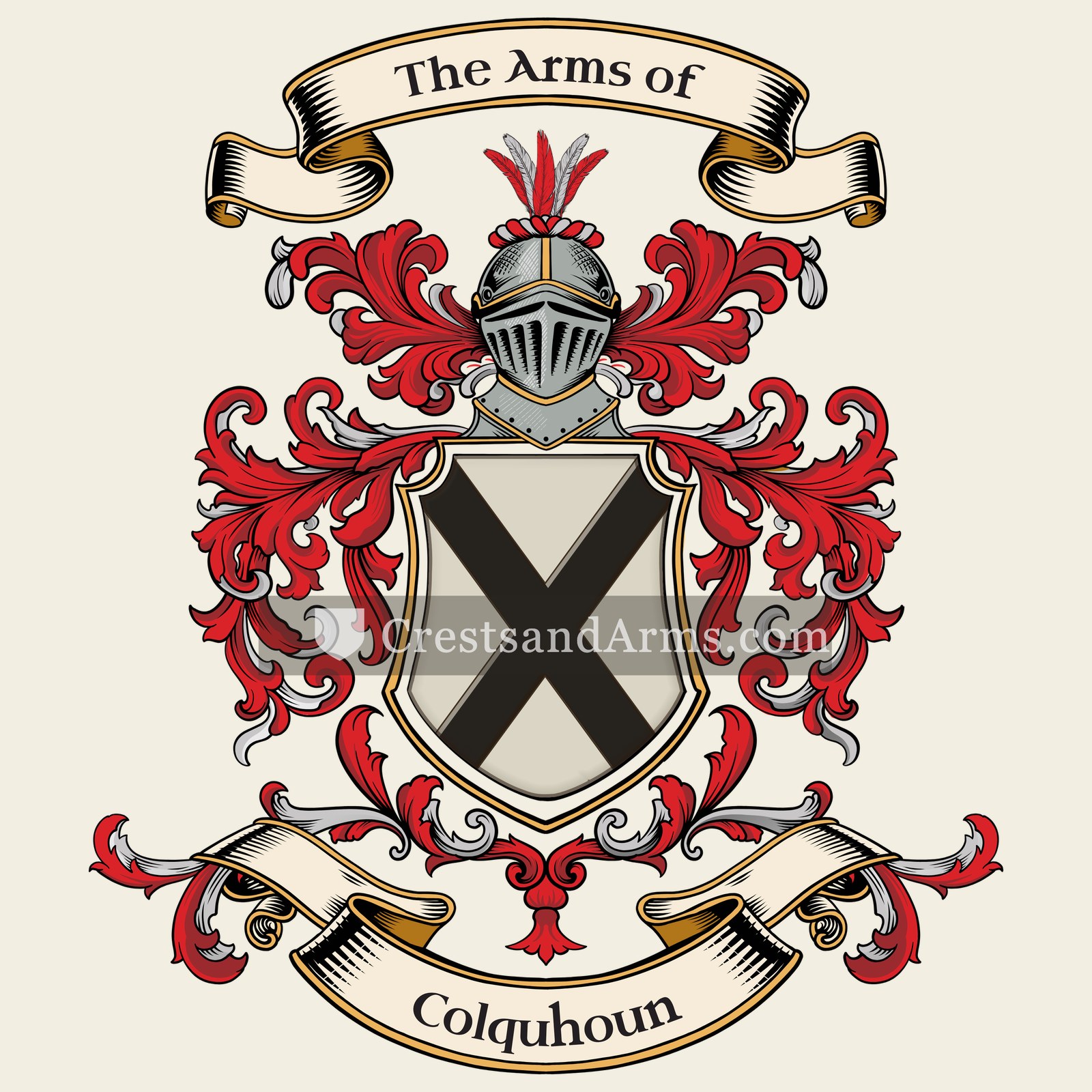
bordureA difference between branches of one family
Colours
Silver (Argent)Means: Peace and sincerity
Black (Sable)Means: Constancy
Red (Gules)Means: Military strength
Historical info
Source
Sir Bernard Burke, The General Armory of England, Scotland, Ireland and Wales, London: Harrison & Sons, 1884
Blazon (the actual original written record)
“Ar. a saltire engr. sa. within a bordure gu”
BedfordElstow Lodge · Bedford, c. 1620
Digital archive packCoat of arms PNG, gold border print PDF, vector SVG and the certificate of authenticity. Sent to your email in minutes.
Map of England showing where the Colquhoun arms are recorded
The Colquhoun arms were recorded in Bedford, c. 1620.
Bedfordshire was small, flat farming country close to London. Its manors were held by middling families rather than great ones, but a manor was a manor, and holding one brought arms.
This is where the arms were entered in the register. Families often moved to other parts of the country, so the same name can turn up in more than one region.
The body that granted and recorded arms in England in this period.
James VI and I
Sovereign of the period
James VI and I
1603–1625
Reigning in Germany when the Colquhoun arms are first recorded.
How Arms Worked in England
English heraldry allowed arms to be shared by all legitimate descendants of the original owner. These symbols were treated as personal property that moved through the generations to all children. While the eldest son kept the original design, other family members could use the same shield without needing to change it or register their own unique versions.
Granting authority
The College of Arms in London has regulated the use of coats of arms throughout England and Wales since 1484.
How they got arms
Families typically obtained their coats of arms through a formal grant from the Crown or by proving their ancient right to them.
Where arms were recorded
All official coats of arms are recorded in the registers kept at the College of Arms, which date back to the fifteenth century.
The family's standing
Recorded among the armigerous families of Bedford.
Origin & History of the Colquhoun Family in England
The family name Colquhoun traces its roots to the ancient lands of Dunbartonshire in Scotland, but the family’s reach extended into England by the early seventeenth century. By 1620, records confirm that members of the Colquhoun family were established in Bedford, marking a significant shift from their northern ancestral home to the English Midlands. During this period, families often moved across the border to pursue new opportunities in trade, law, or administration as the union of the Scottish and English crowns brought the two nations closer together. These early settlers in Bedford likely integrated into the local gentry or merchant classes, adapting to the social structures of their new home while maintaining the distinct identity associated with their Scottish surname. This migration highlights how families of the era navigated the changing political landscape of Great Britain by establishing roots in new regions far from their traditional territories.
Coat of Arms & Family Crest Details
Symbols on this shield
saltireResolution, and St Andrew's cross
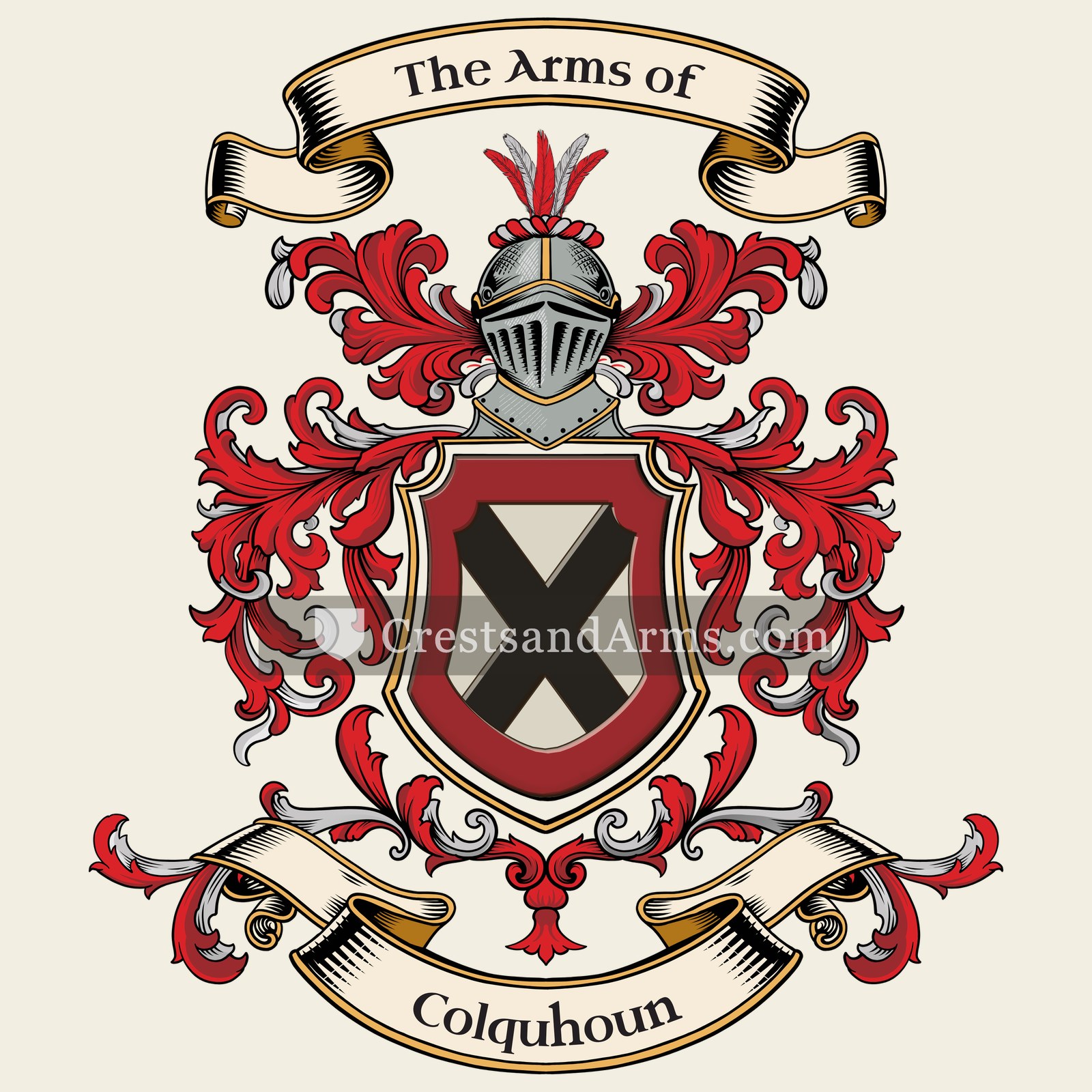
fleur de lisPurity, light, and the sixth son
Colours
Silver (Argent)Means: Peace and sincerity
Black (Sable)Means: Constancy
Red (Gules)Means: Military strength
Historical info
Source
Sir Bernard Burke, The General Armory of England, Scotland, Ireland and Wales, London: Harrison & Sons, 1884
Blazon (the actual original written record)
“Ar. a saltire engr. sa. a fleur-de-lis gu. in chief”
DumbartonKilmardinny · Dumbarton, c. 1748
Digital archive packCoat of arms PNG, gold border print PDF, vector SVG and the certificate of authenticity. Sent to your email in minutes.
Map of Scotland showing where the Colquhoun arms are recorded
The Colquhoun arms were recorded in Dumbarton, c. 1748.
Dumbartonshire sat where the Clyde meets the Highlands, guarded by a royal castle. Families held land in return for service, and service in arms brought a shield with it.
This is where the arms were entered in the register. Families often moved to other parts of the country, so the same name can turn up in more than one region.
The body that granted and recorded arms in Scotland in this period.
George II of Great Britain
Sovereign of the period
George II of Great Britain
1727–1760
Reigning in Germany when the Colquhoun arms are first recorded.
How Arms Worked in Scotland
Scottish heraldry is unique because it treats a coat of arms as a piece of personal property protected by law. Only one person can own a specific design at any given time. When a family grows, the head keeps the original shield while other relatives must apply for their own distinct version with slight changes to prove their specific identity.
Granting authority
The Court of the Lord Lyon acts as the official body that regulates and controls all heraldic matters throughout Scotland.
How they got arms
Individuals obtain a legal right to their arms through a formal petition process that confirms their identity and family connection.
Where arms were recorded
All valid coats of arms are officially entered into the Public Register of All Arms and Bearings starting from 1672.
The family's standing
Recorded among the armigerous families of Dumbarton.
Origin & History of the Colquhoun Family in Scotland
The history of the Colquhoun family is deeply rooted in the rugged landscape of Dumbartonshire, where they established themselves as a prominent force in the medieval Scottish Lowlands. The name itself is of territorial origin, derived from the lands of Colquhoun located near the shores of Loch Lomond. By the thirteenth century, the family had secured a firm foothold in the region, eventually becoming the powerful Lairds of Luss. Their influence grew through strategic marriages and royal charters, which allowed them to manage vast estates and play a significant role in local governance. While their presence in Dumbarton remained a constant throughout the centuries, the family was frequently involved in the complex political struggles and territorial feuds that defined life in the west of Scotland. By the time of the mid-eighteenth century, the Colquhouns were well-established figures in the area, maintaining their status as landowners and key participants in the social and economic development of the region.
Colquhoun Meaning & Related Branches
Root word
Coill a' Chòmhnaird
Gaelic phrase meaning narrow wood or corner of the high ground.
This name
ColquhounRefers to a territorial designation in Dunbartonshire, Scotland, signifying a location near a narrow wood.
also spelled
Colhoun
Colquhon
Kuhhoon
Calhoun
Colquhone
Related arms
Bissetrecorded with Colquhoun, same area
Ochterlonyrecorded with Colquhoun, same area
Documented Sources
J. B. Rietstap, Armorial Général, Gouda: G. B. van Goor Zonen, 1884–87
Niedersächsisches Landesarchiv, Oldenburg, Best. 261-2.1 (Kirchenbücher der Garnisongemeinde Oldenburg)
Friedrich-Wilhelm Schaer, Die Geschichte des Oldenburger Landes, 1972
Digital archive packCoat of arms PNG, gold border print PDF, vector SVG and the certificate of authenticity. Sent to your email in minutes.


 saltireResolution, and St Andrew's cross
 saltireResolution, and St Andrew's cross


 bordureA difference between branches of one family


 fleur de lisPurity, light, and the sixth son