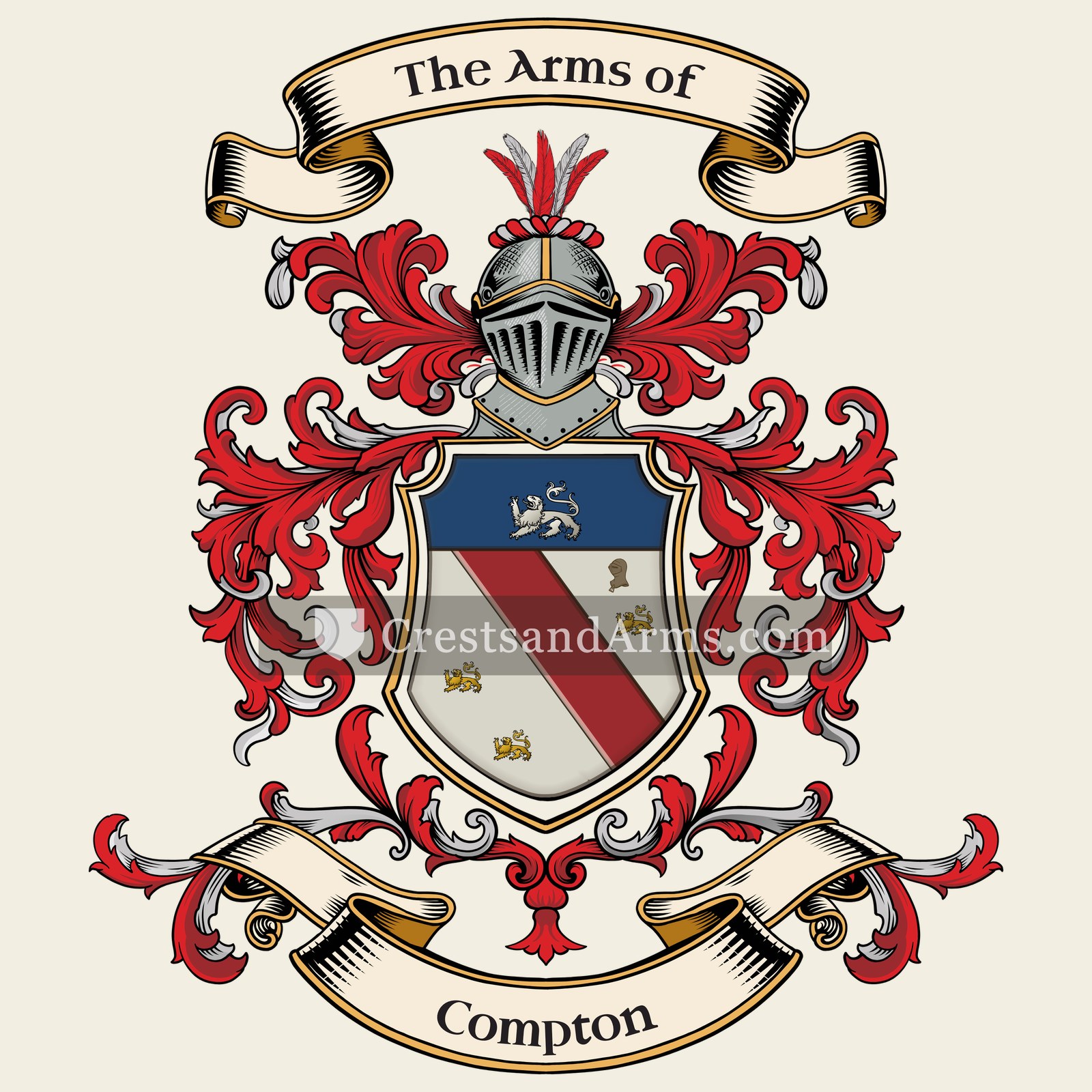
A record of documented arms, meaning and origin, researched for the Compton family lines. Documented in 3 countries.
Reg. 8980 · French, A–C
Coat of Arms & Family Crest Details
Symbols on this shield
lionCourage, strength and royalty
Colours
Black (Sable)Means: Constancy
Gold (Or)Means: Generosity
Historical info
Source
J. B. Rietstap, Armorial Général, Gouda: G. B. van Goor Zonen, 1884–87
Blazon (the actual original written record)
“De sa. au léopard d'or, acc. de trois casques fermés d'arg., tarés de profil. C.: un phare d'or, allumé de gu., avec la D.: NISI DOMINUS. S.: deux dragons ailés d'herm., coll. chacun d'une couronne d'or, enchaînée du même. D.: JE NE CHERCHE QUE UNG.”
Francec. 1572
Digital archive packCoat of arms PNG, gold border print PDF, vector SVG and the certificate of authenticity. Sent to your email in minutes.
Map of France showing where the Compton arms are recorded
The Compton arms were recorded in France, c. 1572.
Arms such as these were typically recorded in Bretagne.
More families held coats of arms in Bretagne than anywhere else in France. The land was divided into many small estates rather than a few large ones, so far more households counted as gentry, and each needed a shield of its own to be told apart.
This is where the arms were entered in the register. Families often moved to other parts of the country, so the same name can turn up in more than one region.
The body that granted and recorded arms in France in this period.
Charles IX of France
Sovereign of the period
Charles IX of France
1560–1574
Reigning in France when the Compton arms are first recorded.
How Arms Worked in France
In France, a coat of arms was a mark of honor that passed down through the male line to all legitimate descendants. Families often used the same shield without changes to show their shared heritage. If a branch wanted to stand out, they could add a small mark to their shield to show their specific place in the family tree.
Granting authority
The Juge d'armes de France acted as the official authority that regulated and verified coats of arms across the country.
How they got arms
Families typically inherited their arms from ancestors, though they could also receive them through royal grants or by proving their noble status.
Where arms were recorded
Coats of arms were officially recorded in the Armorial Général de France, which began its main collection in the year 1696.
The family's standing
Recorded among the armigerous families of France.
Origin & History of the Compton Family in France
The history of the Compton name in France is deeply rooted in the complex social landscape of the sixteenth century. By 1572, members of the family were established in the region of Bretagne, a time marked by significant religious and political tension across the country. During this era, families with similar names often lived in rural areas where they worked as landowners or local administrators. The name itself likely evolved from geographic descriptions of the landscape, as families were often identified by the specific valleys or settlements where they resided. Living in Bretagne allowed these early ancestors to participate in the unique cultural traditions of the province while navigating the shifting loyalties of the French crown. Their presence in this coastal region suggests that they were well-integrated into the local community, maintaining their status through land management and regional ties during a period of great national change.
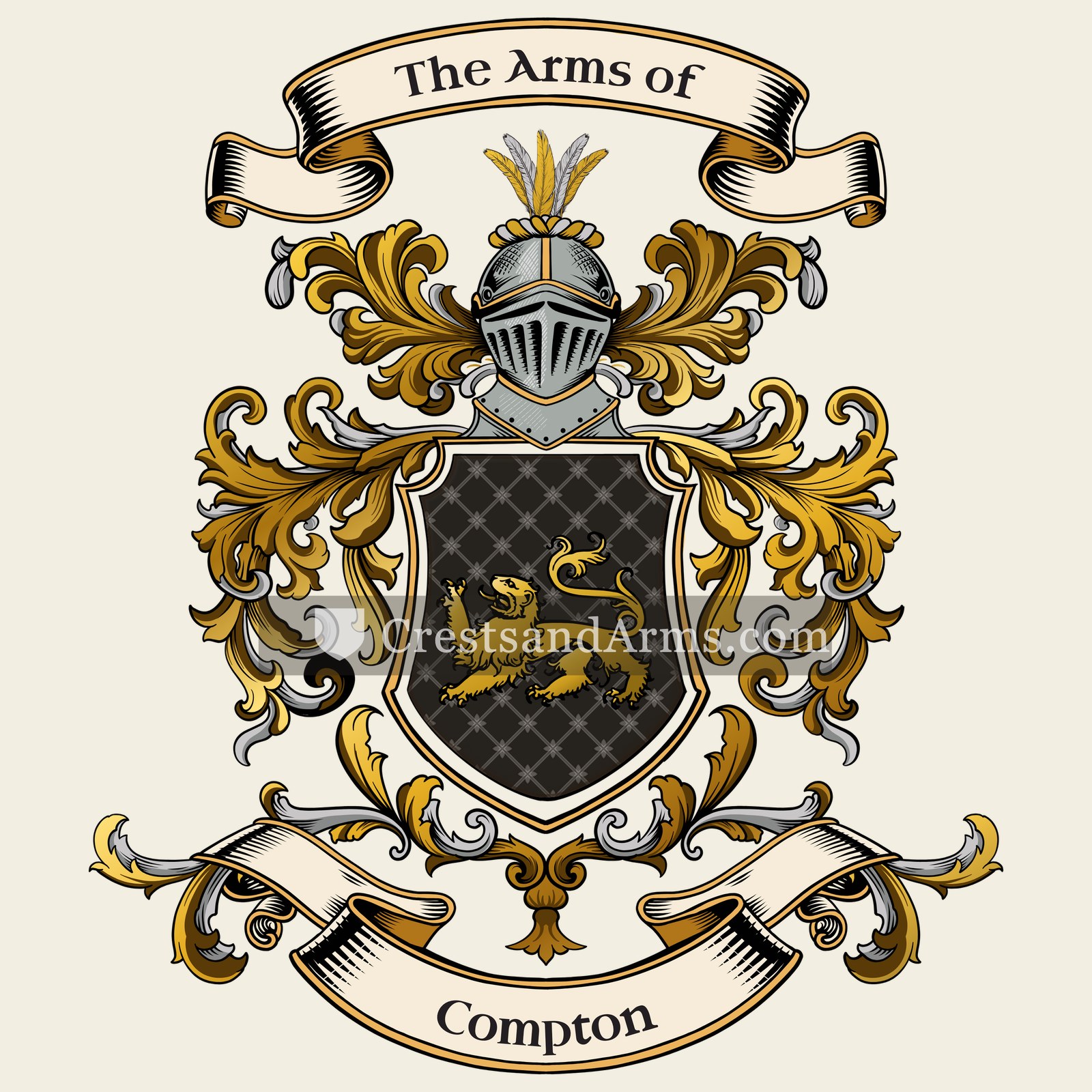
Coat of Arms & Family Crest Details
Symbols on this shield
lionCourage, strength and royalty
helmetWisdom and security in defence
Colours
Black (Sable)Means: Constancy
Gold (Or)Means: Generosity
Blue (Azure)Means: Loyalty and truth
Historical info
Source
Sir Bernard Burke, The General Armory of England, Scotland, Ireland and Wales, London: Harrison & Sons, 1884
Blazon (the actual original written record)
“Sa. a lion pass. guard. or, betw. three helmets az”
NorthumberlandCarham Hall · Northumberland, c. 1620
Digital archive packCoat of arms PNG, gold border print PDF, vector SVG and the certificate of authenticity. Sent to your email in minutes.
Map of England showing where the Compton arms are recorded
The Compton arms were recorded in Northumberland, c. 1620.
Northumberland was border country facing Scotland, raided and fought over for three hundred years. Families held their land in return for defending it, and a defending household carried a shield.
This is where the arms were entered in the register. Families often moved to other parts of the country, so the same name can turn up in more than one region.
The body that granted and recorded arms in England in this period.
James VI and I
Sovereign of the period
James VI and I
1603–1625
Reigning in France when the Compton arms are first recorded.
How Arms Worked in England
English heraldry allowed arms to be shared by all legitimate descendants of the original owner. These symbols were treated as personal property that moved through the generations to all children. While the eldest son kept the original design, other family members could use the same shield without needing to change it or register their own unique versions.
Granting authority
The College of Arms in London has regulated the use of coats of arms throughout England and Wales since 1484.
How they got arms
Families typically obtained their coats of arms through a formal grant from the Crown or by proving their ancient right to them.
Where arms were recorded
All official coats of arms are recorded in the registers kept at the College of Arms, which date back to the fifteenth century.
The family's standing
Recorded among the armigerous families of Northumberland.
Origin & History of the Compton Family in England
The surname Compton is a locational name that originated from various places across England, particularly those named Compton, which translates to a settlement located in a valley. While the name appears in historical records throughout southern England as early as the eleventh century, branches of the family eventually moved northward. By 1620, members of the Compton family were well-established in the rugged landscape of Northumberland. During this period, families in the north often lived in close-knit communities to navigate the challenges of border life and regional politics. These early settlers helped shape the local identity of the area, transitioning from their southern roots to become part of the distinct history of the English borderlands.
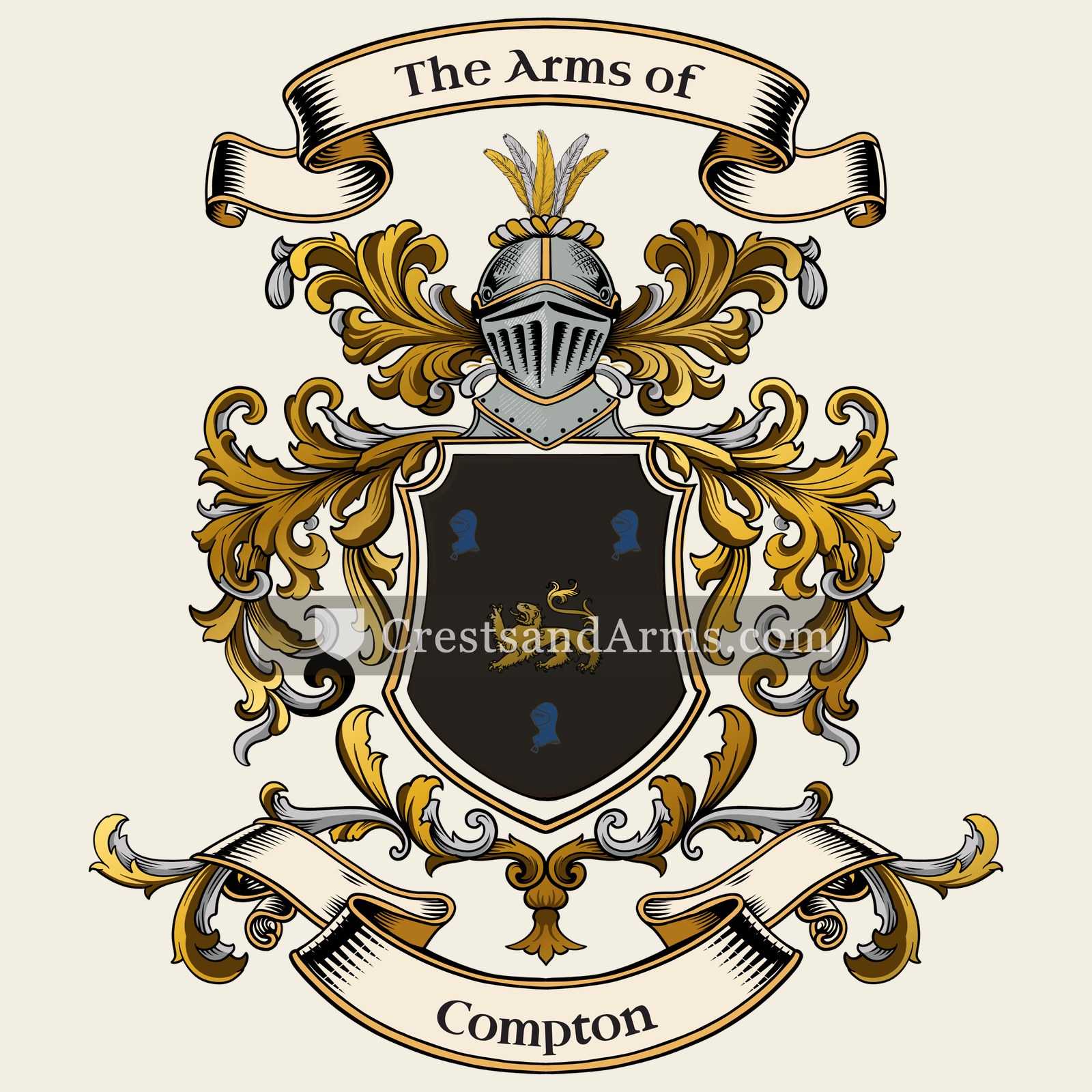
Coat of Arms & Family Crest Details
Symbols on this shield
chiefAuthority, wisdom and dominion
helmetWisdom and security in defence
lionCourage, strength and royalty
Colours
Red (Gules)Means: Military strength
Blue (Azure)Means: Loyalty and truth
Gold (Or)Means: Generosity
Silver (Argent)Means: Peace and sincerity
Historical info
Source
Sir Bernard Burke, The General Armory of England, Scotland, Ireland and Wales, London: Harrison & Sons, 1884
Blazon (the actual original written record)
“Quarterly, 1st and 4th, COMPTON, sa. an esquire's helmet ppr. betw. three lions pass. guard., two and one or; 2nd and 3rd, WIDENHAM, ar. two bendlets gu. on a chief az. a lion pass. of the first crowned or”
LimerickLimerick, c. 1645
Digital archive packCoat of arms PNG, gold border print PDF, vector SVG and the certificate of authenticity. Sent to your email in minutes.
Map of Ireland showing where the Compton arms are recorded
The Compton arms were recorded in Limerick, c. 1645.
Limerick was river country in western Ireland with a walled city at its centre. Merchant families ran the city and bought land around it, and both the trade and the land brought arms.
This is where the arms were entered in the register. Families often moved to other parts of the country, so the same name can turn up in more than one region.
The body that granted and recorded arms in Ireland in this period.
Charles I of England
Sovereign of the period
Charles I of England
1625–1649
Reigning in France when the Compton arms are first recorded.
How Arms Worked in Ireland
The Ulster King of Arms granted coats of arms to individuals who proved their social standing and good character. These symbols were typically inherited by all legitimate descendants of the original holder. If a family branch wanted a unique look, they could apply for a specific change to their design through the office to ensure their identity remained distinct.
Granting authority
The Ulster King of Arms acted as the official body that regulated and issued all coats of arms throughout Ireland.
How they got arms
Families obtained their arms through formal grants issued by the office after proving their eligibility and paying the required fees.
Where arms were recorded
All official grants were recorded in the registers held by the Ulster King of Arms starting from the year 1552.
The family's standing
Recorded among the armigerous families of Limerick.
Origin & History of the Compton Family in Ireland
The Compton family name in Ireland is deeply connected to the turbulent events of the seventeenth century. While the name has roots in England, records confirm that members of the family were established in County Limerick by 1645. During this period, Ireland was caught in the middle of the Irish Confederate Wars, a time when land ownership and political loyalties shifted rapidly. Families like the Comptons often arrived in the region as part of the broader movement of settlers and soldiers during the Cromwellian era. By settling in Limerick, they became part of a changing social landscape where new families integrated into the local economy and administration. Over time, these early settlers helped shape the history of the region as they transitioned from military or administrative roles into established members of the local community.
Compton Meaning & Related Branches
Root word
Combe
A valley or hollow in the landscape.
This name
ComptonDerived from a settlement located in a valley or near a small enclosed town.
also spelled
Comptone
Comptun
Compten
Kompton
Comptoun
Related arms
Edmundsrecorded with Compton, same area
Madockrecorded with Compton, same area
Documented Sources
J. B. Rietstap, Armorial Général, Gouda: G. B. van Goor Zonen, 1884–87
Archives départementales d'Ille-et-Vilaine, Série B: Cours et juridictions
Le Moyne de La Borderie, Arthur, Histoire de Bretagne, 1896
Pocquet du Haut-Jussé, Barthélemy, La vie quotidienne en Bretagne au XVIe siècle, 1965
Digital archive packCoat of arms PNG, gold border print PDF, vector SVG and the certificate of authenticity. Sent to your email in minutes.


 lionCourage, strength and royalty
 lionCourage, strength and royalty


 helmetWisdom and security in defence


 chiefAuthority, wisdom and dominion