Map of France showing where the Conahan arms are recorded
The Conahan arms were recorded in Guyenne, c. 1663.
Guyenne was the great wine country of south-western France, shipping claret to England for centuries. The trade made merchant families rich, they bought vineyards and estates with the money, and land of that kind brought arms with it.
This is where the arms were entered in the register. Families often moved to other parts of the country, so the same name can turn up in more than one region.
The body that granted and recorded arms in France in this period.
Louis XIV of France
Sovereign of the period
Louis XIV of France
1643–1715
Reigning in France when the Conahan arms are first recorded.
How Arms Worked in France
In France, a coat of arms was a mark of honor that passed down through the male line to all legitimate descendants. Families often used the same shield without changes to show their shared heritage. If a branch wanted to stand out, they could add a small mark to their shield to show their specific place in the family tree.
Granting authority
The Juge d'armes de France acted as the official authority that regulated and verified coats of arms across the country.
How they got arms
Families typically inherited their arms from ancestors, though they could also receive them through royal grants or by proving their noble status.
Where arms were recorded
Coats of arms were officially recorded in the Armorial Général de France, which began its main collection in the year 1696.
The family's standing
Recorded among the armigerous families of Guyenne.
Origin & History of the Conahan Family in France
The history of the Conahan family in France is rooted in the southwestern region of Guyenne, where records confirm their presence as early as 1663. During this period, Guyenne was a landscape defined by its agricultural wealth and its strategic importance as a former province of the English crown, which left a unique cultural imprint on the local population. Families living in this area often navigated the complex social shifts following the French Wars of Religion, which had ended only a few decades prior to the family’s documented arrival. As residents of a region known for its vineyards and trade routes toward the Atlantic, the Conahans likely participated in the rural economy that sustained the provincial towns. Their presence in the mid-17th century suggests they were part of the stable, land-holding or merchant classes that helped rebuild the social fabric of the region during the reign of King Louis XIV.
Meaning of the Conahan family crest colors & symbols
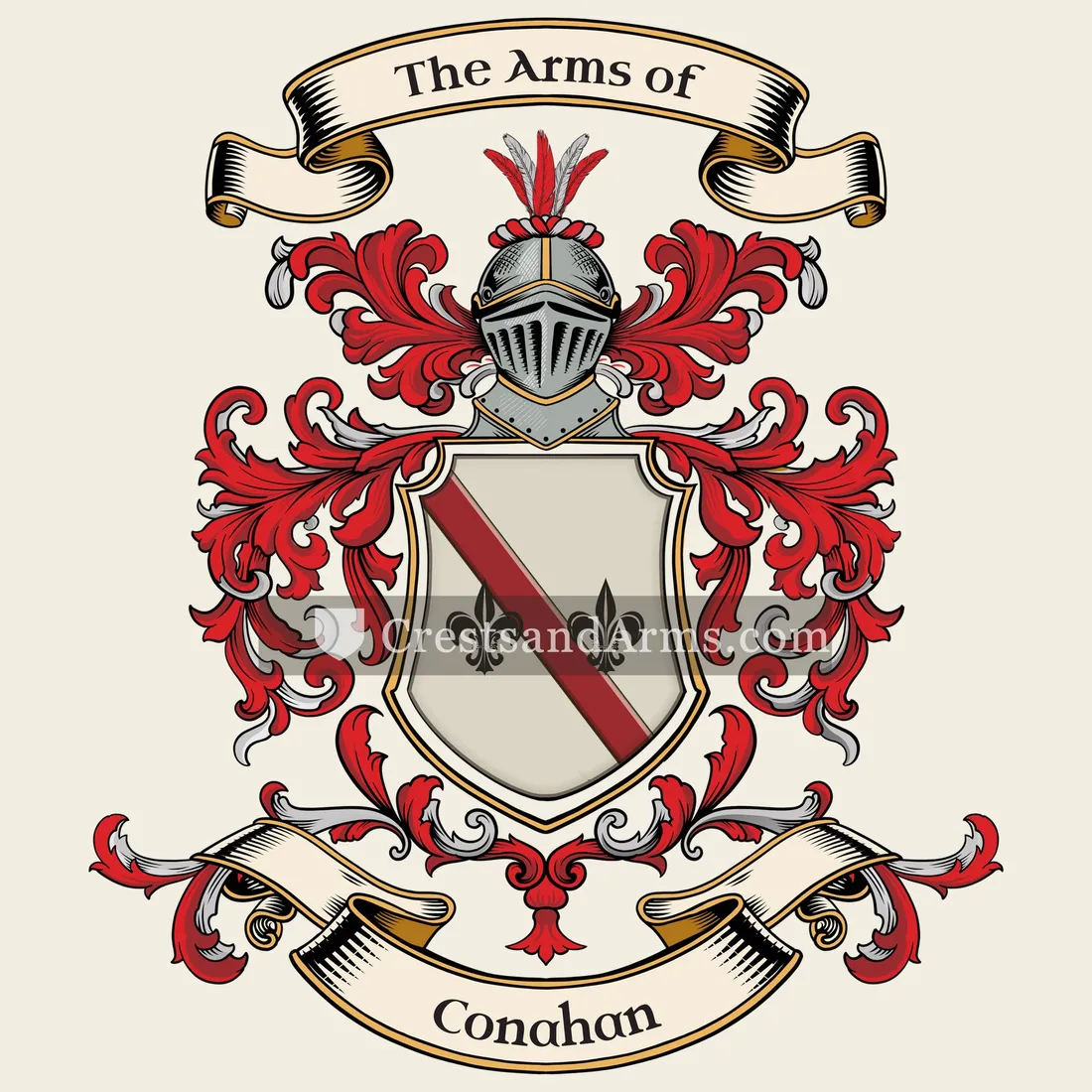
Symbols on this shield
fleur de lisPurity, light, and the sixth son
Colours
Silver (Argent)Means: Peace and sincerity
Red (Gules)Means: Military strength
Black (Sable)Means: Constancy
Historical info
Source
Sir Bernard Burke, The General Armory of England, Scotland, Ireland and Wales, London: Harrison & Sons, 1884
Blazon (the actual original written record)
“Ar. a fesse sa. cottised gu. betw. two fleurs-de-lis of the second”
DublinDublin, c. 1602
Digital archive packCoat of arms PNG, gold border print PDF, vector SVG and the certificate of authenticity. Sent to your email in minutes.
Map of Ireland showing where the Conahan arms are recorded
The Conahan arms were recorded in Dublin, c. 1602.
Dublin was the seat of government in Ireland and the place where grants were sought and recorded. Families with business at the castle or the courts settled nearby, and settling there put their arms on record.
This is where the arms were entered in the register. Families often moved to other parts of the country, so the same name can turn up in more than one region.
The body that granted and recorded arms in Ireland in this period.
Elizabeth I of England
Sovereign of the period
Elizabeth I of England
1558–1603
Reigning in France when the Conahan arms are first recorded.
How Arms Worked in Ireland
The Ulster King of Arms granted coats of arms to individuals who proved their social standing and good character. These symbols were typically inherited by all legitimate descendants of the original holder. If a family branch wanted a unique look, they could apply for a specific change to their design through the office to ensure their identity remained distinct.
Granting authority
The Ulster King of Arms acted as the official body that regulated and issued all coats of arms throughout Ireland.
How they got arms
Families obtained their arms through formal grants issued by the office after proving their eligibility and paying the required fees.
Where arms were recorded
All official grants were recorded in the registers held by the Ulster King of Arms starting from the year 1552.
The family's standing
Recorded among the armigerous families of Dublin.
Origin & History of the Conahan Family in Ireland
The family name Conahan has deep roots in the history of Ireland, with early records confirming their presence in Dublin as far back as 1602. During this period, the name was often associated with the Gaelic tradition of patronymic naming, which evolved as families settled into urban centers like Dublin. By the turn of the 17th century, the city was a bustling hub of trade and political change, and families like the Conahans were often involved in the professional and mercantile life of the capital. As the English administration expanded its influence over Ireland, the spelling and documentation of native surnames began to shift to match the phonetic styles of the time. The Conahan family remained a part of this shifting social landscape, adapting to the changing legal and economic structures of the city while maintaining their distinct ancestral identity.
Conahan Meaning & Related Branches
Root word
O'Cuinneagain
Descendant of the leader or the intelligent one.
This name
ConahanAn anglicized form of an Irish Gaelic surname denoting a descendant of a wise or cunning person.
also spelled
Conane
Conann
Conon
Documented Sources
J. B. Rietstap, Armorial Général, Gouda: G. B. van Goor Zonen, 1884–87
Archives départementales de la Gironde, Registres paroissiaux et d'état civil, Series E
Boutruche, Robert, Une société provinciale en lutte contre le régime féodal: L'alleu en Bordelais et en Bazadais du XIe au XVIIIe siècle, 1963
Papy, Michel, Histoire de la Guyenne, 1998
Digital archive packCoat of arms PNG, gold border print PDF, vector SVG and the certificate of authenticity. Sent to your email in minutes.


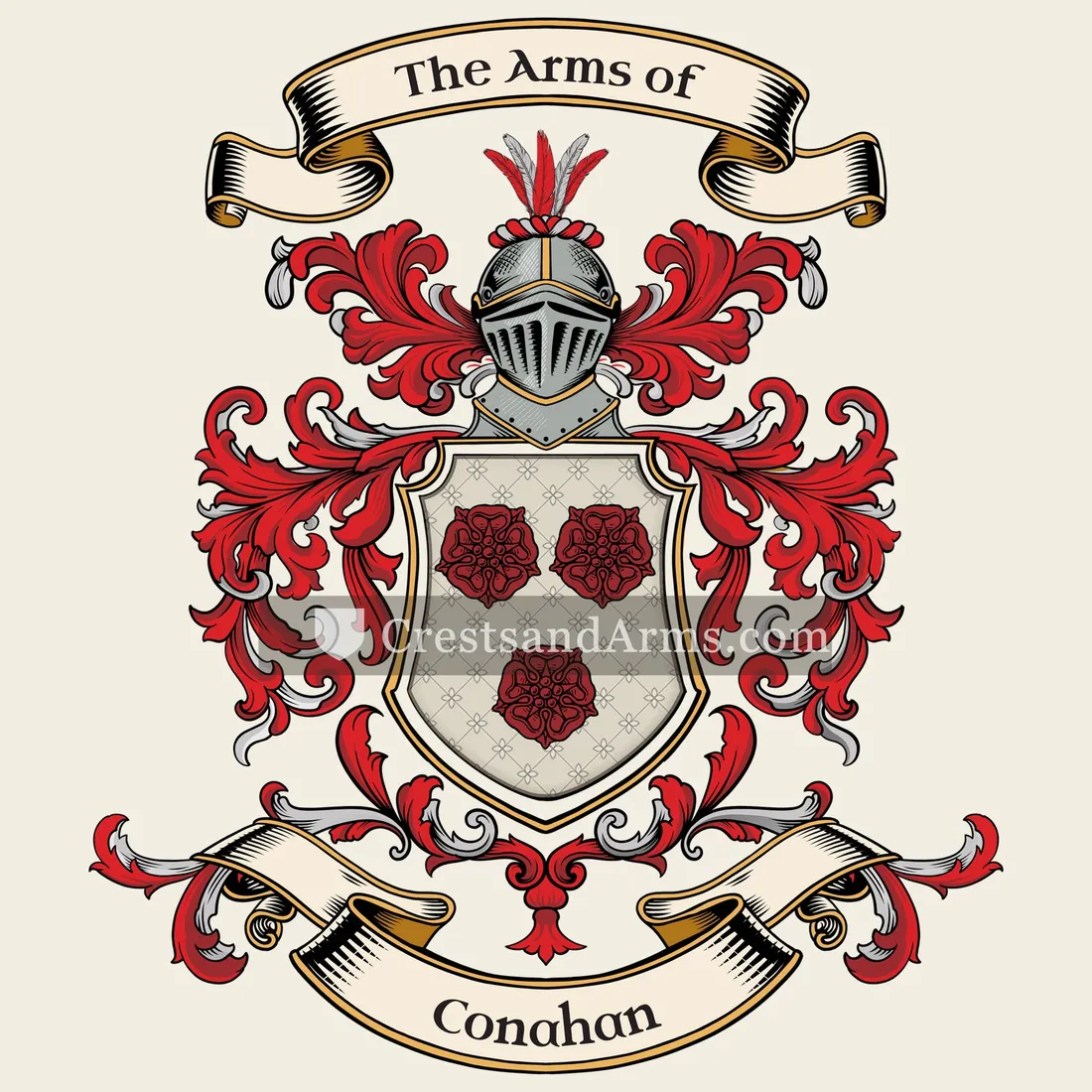
 roseThe seventh son, and beauty with grace
 roseThe seventh son, and beauty with grace


 fleur de lisPurity, light, and the sixth son