Map of France showing where the Conain arms are recorded
The Conain arms were recorded in Guyenne, c. 1663.
Guyenne was the great wine country of south-western France, shipping claret to England for centuries. The trade made merchant families rich, they bought vineyards and estates with the money, and land of that kind brought arms with it.
This is where the arms were entered in the register. Families often moved to other parts of the country, so the same name can turn up in more than one region.
The body that granted and recorded arms in France in this period.
Louis XIV of France
Sovereign of the period
Louis XIV of France
1643–1715
Reigning in France when the Conain arms are first recorded.
How Arms Worked in France
In France, a coat of arms was a mark of honor that passed down through the male line to all legitimate descendants. Families often used the same shield without changes to show their shared heritage. If a branch wanted to stand out, they could add a small mark to their shield to show their specific place in the family tree.
Granting authority
The Juge d'armes de France acted as the official authority that regulated and verified coats of arms across the country.
How they got arms
Families typically inherited their arms from ancestors, though they could also receive them through royal grants or by proving their noble status.
Where arms were recorded
Coats of arms were officially recorded in the Armorial Général de France, which began its main collection in the year 1696.
The family's standing
Recorded among the armigerous families of Guyenne.
Origin & History of the Conain Family in France
The family name Conain has deep roots in the southwestern region of France known as Guyenne. By the year 1663, records confirm that members of the family were already established in this area, which was historically significant for its wine production and its complex relationship with the French monarchy. During the seventeenth century, families in Guyenne often lived through periods of great social change as the central government in Paris sought to increase its control over the provinces. The Conain family likely participated in the local agricultural or merchant life that defined this region, which was then a crossroads for trade and cultural exchange. Living in Guyenne during this era meant navigating a society shaped by both local traditions and the growing influence of the state. While the exact origins of the name remain part of the broader history of French surnames, the presence of the Conain family in 1663 places them firmly within the vibrant and evolving landscape of early modern France.
Meaning of the Conain family crest colors & symbols
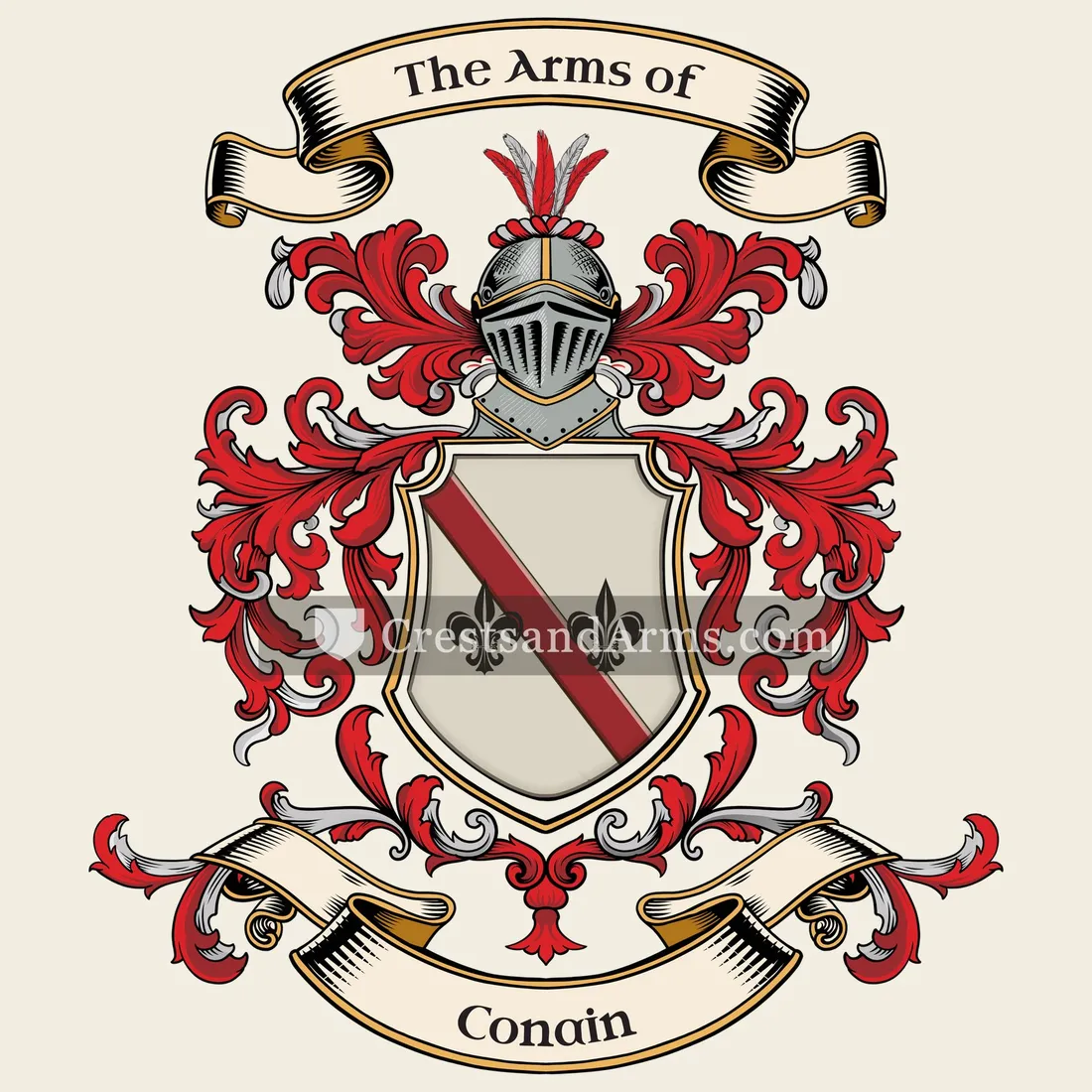
Symbols on this shield
fleur de lisPurity, light, and the sixth son
Colours
Silver (Argent)Means: Peace and sincerity
Red (Gules)Means: Military strength
Black (Sable)Means: Constancy
Historical info
Source
Sir Bernard Burke, The General Armory of England, Scotland, Ireland and Wales, London: Harrison & Sons, 1884
Blazon (the actual original written record)
“Ar. a fesse sa. cottised gu. betw. two fleurs-de-lis of the second”
DublinDublin, c. 1602
Digital archive packCoat of arms PNG, gold border print PDF, vector SVG and the certificate of authenticity. Sent to your email in minutes.
Map of Ireland showing where the Conain arms are recorded
The Conain arms were recorded in Dublin, c. 1602.
Dublin was the seat of government in Ireland and the place where grants were sought and recorded. Families with business at the castle or the courts settled nearby, and settling there put their arms on record.
This is where the arms were entered in the register. Families often moved to other parts of the country, so the same name can turn up in more than one region.
The body that granted and recorded arms in Ireland in this period.
Elizabeth I of England
Sovereign of the period
Elizabeth I of England
1558–1603
Reigning in France when the Conain arms are first recorded.
How Arms Worked in Ireland
The Ulster King of Arms granted coats of arms to individuals who proved their social standing and good character. These symbols were typically inherited by all legitimate descendants of the original holder. If a family branch wanted a unique look, they could apply for a specific change to their design through the office to ensure their identity remained distinct.
Granting authority
The Ulster King of Arms acted as the official body that regulated and issued all coats of arms throughout Ireland.
How they got arms
Families obtained their arms through formal grants issued by the office after proving their eligibility and paying the required fees.
Where arms were recorded
All official grants were recorded in the registers held by the Ulster King of Arms starting from the year 1552.
The family's standing
Recorded among the armigerous families of Dublin.
Origin & History of the Conain Family in Ireland
The surname Conain has deep roots in the Irish landscape, with historical evidence placing members of the family in Dublin as early as 1602. During this period, Dublin was a city undergoing significant transition as English influence expanded across the island. Families like the Conains often lived through a time of shifting land ownership and changing political loyalties. Because the name is linked to the Gaelic tradition, it likely originated from an ancient personal name, reflecting a lineage that existed long before the seventeenth century. By the time they appear in the Dublin records, these individuals were part of a growing urban population navigating the complexities of colonial administration and trade. Their presence in the capital city suggests that they were active participants in the economic and social life of Ireland during a very turbulent era.
Conain Meaning & Related Branches
Root word
Conan
Derived from the Celtic word for hound or wolf.
This name
ConainA French surname originating from a diminutive form of the name meaning little hound or little warrior.
also spelled
Conane
Conann
Conon
Documented Sources
J. B. Rietstap, Armorial Général, Gouda: G. B. van Goor Zonen, 1884–87
Archives départementales de la Gironde, Registres paroissiaux et d'état civil
Boutruche, Robert, Une société provinciale en lutte contre le régime féodal: L'espace rural bordelais, 1942
Papy, Michel, Histoire de la Guyenne, 1998
Digital archive packCoat of arms PNG, gold border print PDF, vector SVG and the certificate of authenticity. Sent to your email in minutes.


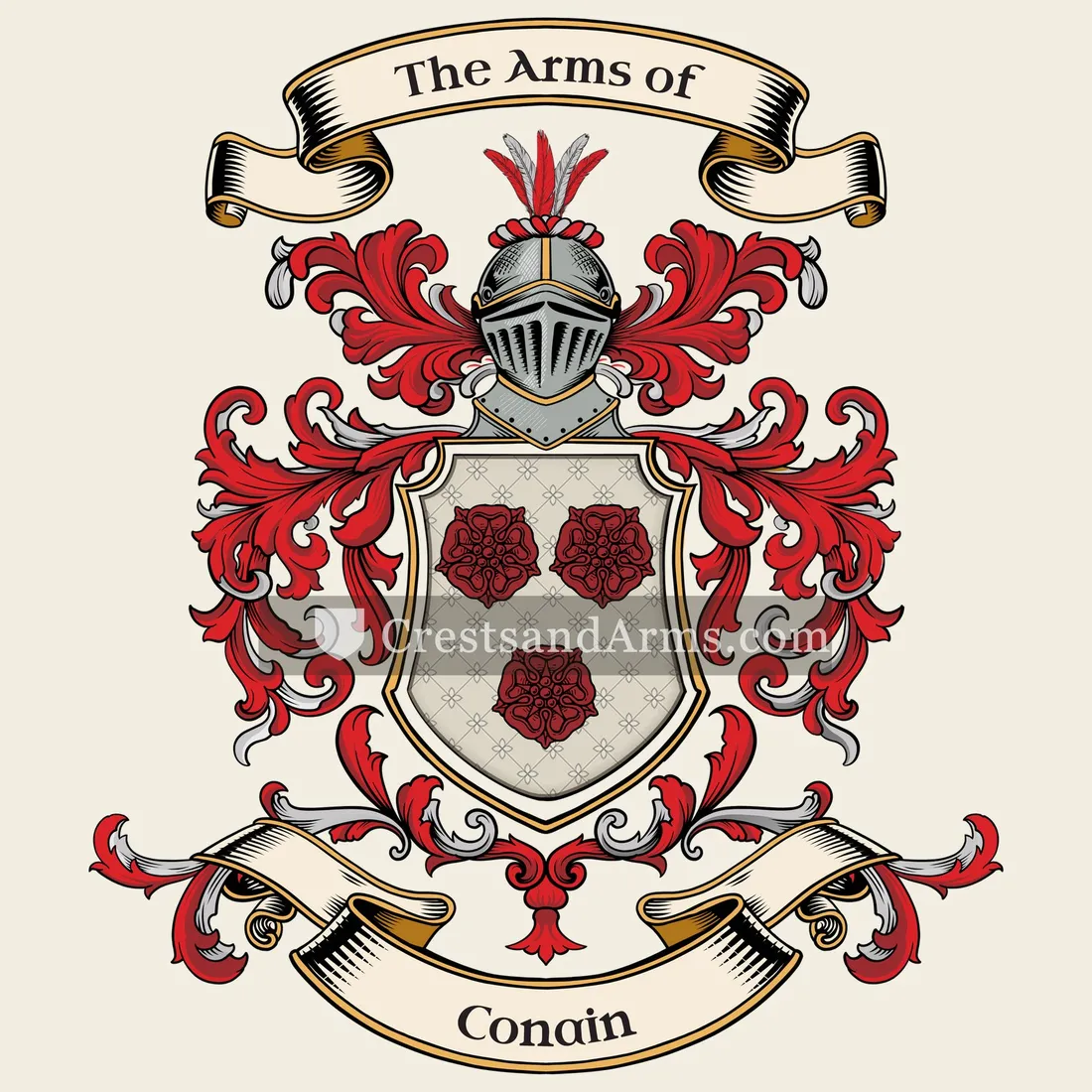
 roseThe seventh son, and beauty with grace
 roseThe seventh son, and beauty with grace


 fleur de lisPurity, light, and the sixth son