A record of documented arms, meaning and origin, researched for the Conradi family lines. Documented in 2 countries.
Reg. 1383 · Finnish, A–C
Coat of Arms & Family Crest Details
Symbols on this shield
chiefAuthority, wisdom and dominion
starThe celestial goddess, and nobility
Colours
Blue (Azure)Means: Loyalty and truth
Gold (Or)Means: Generosity
Historical info
Source
J. B. Rietstap, Armorial Général, Gouda: G. B. van Goor Zonen, 1884–87
Blazon (the actual original written record)
“D'azur à deux pointes d'or, mouv. de la base de l'écu, posées en chev.; au chef d'azur, ch. d'un étoile (5) du champ. C.: une tête et col de cygne d'arg., tenant en son bec une couronne de laurier du même; entre deux pl. d'aut., d'or et d'azur.”
Finlandc. 1769
Digital archive packCoat of arms PNG, gold border print PDF, vector SVG and the certificate of authenticity. Sent to your email in minutes.
Map of Finland showing where the Conradi arms are recorded
The Conradi arms were recorded in Finland, c. 1769.
Arms such as these were typically recorded in Uusimaa.
Uusimaa was the Finnish coast facing Sweden, and the part of the country most closely tied to Stockholm. Its landowners and officers served the Swedish crown, and that service is what put their arms on record.
This is where the arms were entered in the register. Families often moved to other parts of the country, so the same name can turn up in more than one region.
The body that granted and recorded arms in Finland in this period.
How Arms Worked in Finland
Nobility in Finland held the exclusive right to register their coats of arms with the House of Nobility. These symbols were tied to the family name and were inherited by all members of the noble house. If a family branch moved or changed status, they kept their original design to maintain their identity within the official records.
Granting authority
The Finnish House of Nobility served as the official body that managed and protected all noble coats of arms.
How they got arms
Families received their arms through formal letters of nobility or by having their existing ancestral symbols confirmed by the House.
Where arms were recorded
All approved coats of arms were officially recorded in the Finnish House of Nobility Armorial starting in 1818.
The family's standing
Recorded among the armigerous families of Finland.
Origin & History of the Conradi Family in Finland
The Conradi family name first appeared in the historical records of Finland during the eighteenth century, marking the arrival of individuals who integrated into the local society of the Uusimaa region. By 1769, members of the family were established in this southern coastal area, which was then part of the Swedish realm. The name itself is of Germanic origin and likely arrived in the Nordic countries through trade connections or the movement of skilled professionals across the Baltic Sea. As these early family members settled in Uusimaa, they became part of the administrative and social fabric of the region, often appearing in church registers and legal documents that tracked the lives of local residents. This transition from their ancestral roots to the Finnish landscape reflects the broader patterns of migration and social mobility that defined the eighteenth century. Over time, the family name became a permanent fixture in the local history of the area, representing a lineage that contributed to the development of their community through their work and daily lives.
Coat of Arms & Family Crest Details
Symbols on this shield
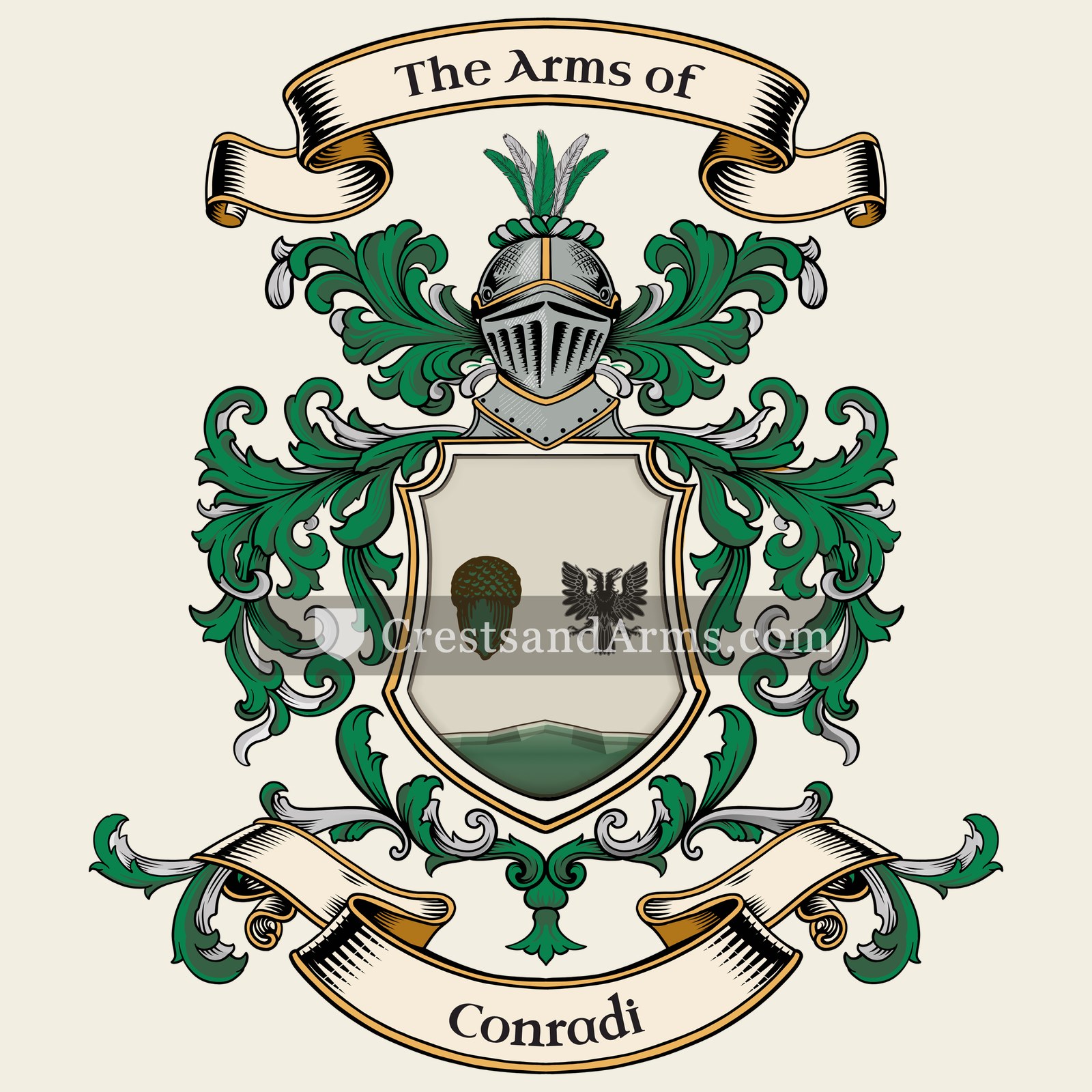
oakGreat age, strength and steadfastness
eagleNobility, strength and a keen mind
Colours
Silver (Argent)Means: Peace and sincerity
Green (Vert)Means: Hope
Black (Sable)Means: Constancy
Historical info
Source
J. B. Rietstap, Armorial Général, Gouda: G. B. van Goor Zonen, 1884–87
Blazon (the actual original written record)
“Parti: au 1 d'arg. à une branche de chène de sin., terrassée du même, poussant en bas à dextre et à sen. une feuille du même et portant trois glands, l'un au sommet, le deuxième en haut à sen., le troisième au milieu à dextre; au 2 d'arg. à une aigle de Prusse, tenant un sceptre et une épée. Cq. cour. C.: un bras arm., tenant une épée en barre, le tout au nat.”
Germanyc. 1749
Digital archive packCoat of arms PNG, gold border print PDF, vector SVG and the certificate of authenticity. Sent to your email in minutes.
Map of Germany showing where the Conradi arms are recorded
The Conradi arms were recorded in Germany, c. 1749.
Arms such as these were typically recorded in Bavaria.
Bavaria was a country of old landed families and walled market towns. Estates passed down the same line for centuries, and both the landowners and the leading townsmen kept arms, which is why so many Bavarian names sit in the registers.
This is where the arms were entered in the register. Families often moved to other parts of the country, so the same name can turn up in more than one region.
The body that granted and recorded arms in Germany in this period.
Francis I, Holy Roman Emperor
Sovereign of the period
Francis I, Holy Roman Emperor
1745–1765
Reigning in Finland when the Conradi arms are first recorded.
How Arms Worked in Germany
In the Holy Roman Empire, coats of arms were often granted to individuals by the Emperor or his representatives. These arms were then passed down through the generations to all legitimate descendants of the original holder. Younger branches of a family usually kept the same shield design without needing to change it, as the arms belonged to the entire lineage.
Granting authority
The Holy Roman Emperor held the sole power to grant new coats of arms throughout his vast imperial territories.
How they got arms
Families typically obtained their coats of arms through a formal imperial grant or by proving their noble status to the authorities.
Where arms were recorded
These grants were officially recorded in the Imperial Chancery registers, which began keeping formal records of such honors during the Middle Ages.
The family's standing
Recorded among the armigerous families of Germany.
Origin & History of the Conradi Family in Germany
The surname Conradi is a Latinized variation of the Germanic name Konrad, which translates to "bold advisor" or "brave counsel." During the 18th century, it was common for families in German-speaking regions to adopt these formal, Latin-style endings to signify a connection to education, the church, or the professional class. By 1749, records confirm that members of the Conradi family were well-established in the region of Bavaria. At this time, Bavaria was a collection of territories deeply influenced by the Holy Roman Empire, and families like the Conradis often lived in agricultural or small-town settings where they served as local craftsmen, merchants, or civil administrators. Because the name was rooted in a popular personal name, it spread across various German states as families moved to find new work or land. These early ancestors lived through a period of significant social change in southern Germany, where their name became a permanent marker of their family identity within the local community.
Conradi Meaning & Related Branches
Root word
Konrad
Derived from Germanic elements meaning brave or bold counsel.
This name
ConradiA patronymic surname signifying descendant of the wise and courageous advisor.
also spelled
Conrad
Konradi
Conrady
Related arms
Conradvariant spelling
Conradyvariant spelling
Documented Sources
J. B. Rietstap, Armorial Général, Gouda: G. B. van Goor Zonen, 1884–87
National Archives of Finland (Kansallisarkisto), Uudenmaan läänin henkikirjat (Tax registers of the Uusimaa province)
National Archives of Finland (Kansallisarkisto), Evankelis-luterilaisen kirkon arkistot (Archives of the Evangelical Lutheran Church of Finland)
Kerkkonen, Gunvor, Borgå stads historia (1942)
Wirilander, Kaarlo, Suomen upseeristo 1700-luvulla (1950)
Digital archive packCoat of arms PNG, gold border print PDF, vector SVG and the certificate of authenticity. Sent to your email in minutes.


 chiefAuthority, wisdom and dominion
 starThe celestial goddess, and nobility
 chiefAuthority, wisdom and dominion
 starThe celestial goddess, and nobility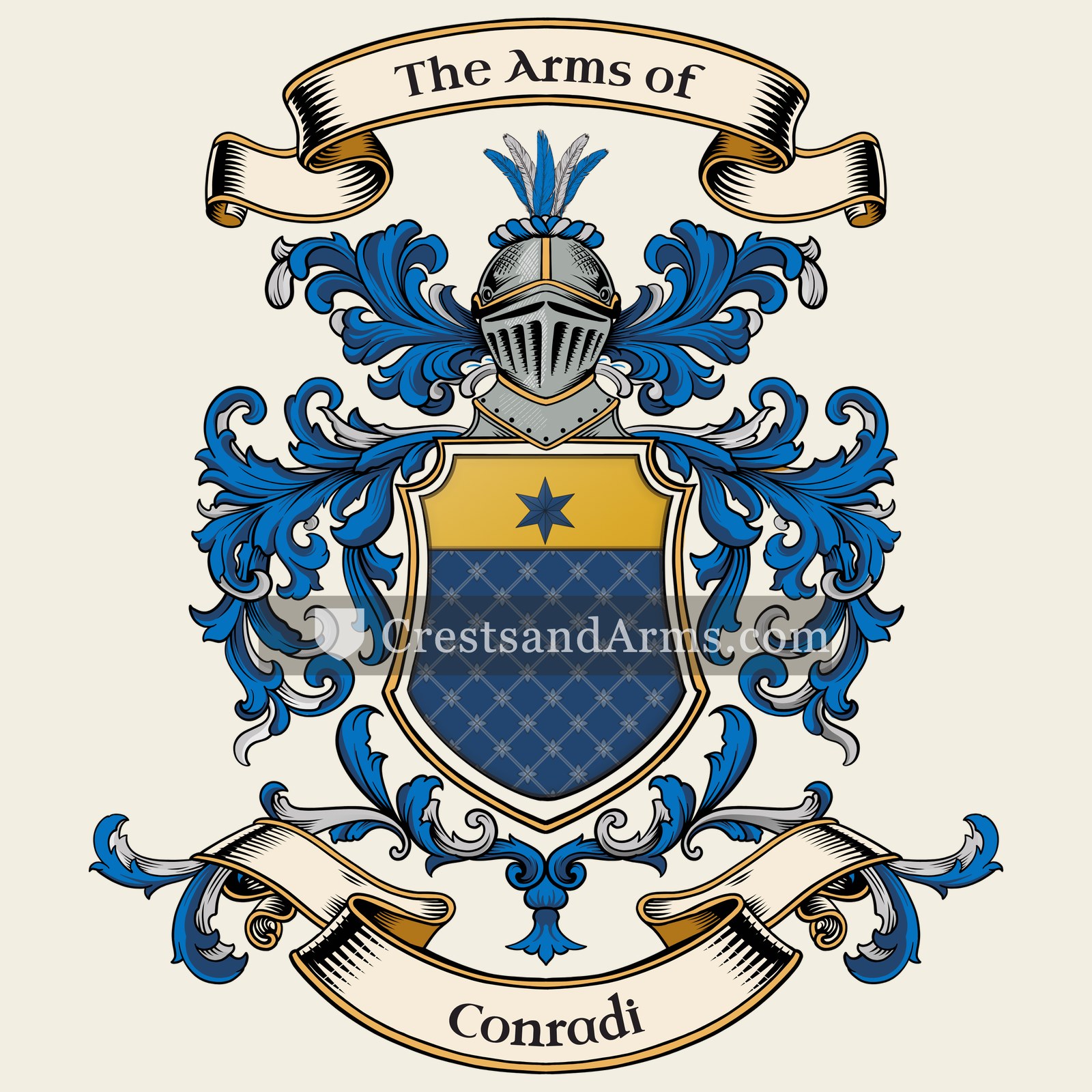

 oakGreat age, strength and steadfastness
 eagleNobility, strength and a keen mind