Map of France showing where the Conteh arms are recorded
The Conteh arms were recorded in Champagne, c. 1663.
Champagne made its money at its great trade fairs, where merchants from across Europe met. Wealth of that kind bought land, and land brought arms, so the region carries a lot of names.
This is where the arms were entered in the register. Families often moved to other parts of the country, so the same name can turn up in more than one region.
The body that granted and recorded arms in France in this period.
Louis XIV of France
Sovereign of the period
Louis XIV of France
1643–1715
Reigning in France when the Conteh arms are first recorded.
How Arms Worked in France
In France, a coat of arms was a mark of honor that passed down through the male line to all legitimate descendants. Families often used the same shield without changes to show their shared heritage. If a branch wanted to stand out, they could add a small mark to their shield to show their specific place in the family tree.
Granting authority
The Juge d'armes de France acted as the official authority that regulated and verified coats of arms across the country.
How they got arms
Families typically inherited their arms from ancestors, though they could also receive them through royal grants or by proving their noble status.
Where arms were recorded
Coats of arms were officially recorded in the Armorial Général de France, which began its main collection in the year 1696.
The family's standing
Recorded among the armigerous families of Champagne.
Origin & History of the Conteh Family in France
The history of the Conteh name in France begins in the historic province of Champagne, where records confirm the family was established by 1663. During the seventeenth century, Champagne was a region defined by its agricultural importance and its role as a crossroads for trade between northern and central Europe. Families living in this area often took names that reflected their social standing or their specific roles within the local community. The name Conteh likely evolved from regional linguistic roots tied to the administrative structures of the time. Living in Champagne meant the family was part of a society that was deeply influenced by the French monarchy and the local nobility. By settling in this region, the early members of the family became part of a long tradition of rural life and local governance that shaped the development of northern France.
Coat of Arms & Family Crest Details
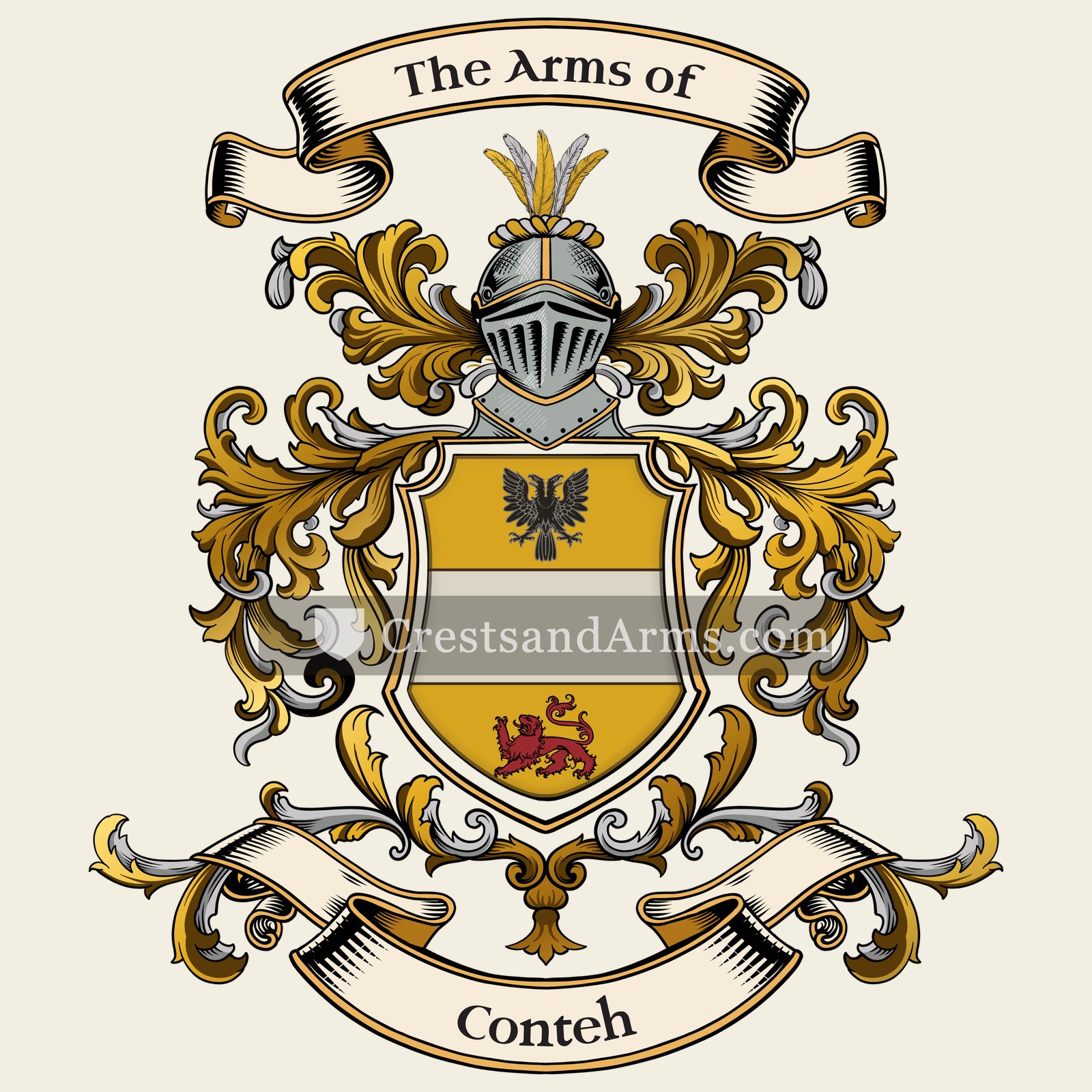
Symbols on this shield
eagleNobility, strength and a keen mind
lionCourage, strength and royalty
Colours
Gold (Or)Means: Generosity
Silver (Argent)Means: Peace and sincerity
Black (Sable)Means: Constancy
Red (Gules)Means: Military strength
Historical info
Source
J. B. Rietstap, Armorial Général, Gouda: G. B. van Goor Zonen, 1884–87
Blazon (the actual original written record)
“Tiercé en fasce: au 1 d'or à l'aigle de sa.; au 2 d'arg. au lion léopardé de gu.; au 3 de gu. à quatre pieux d'or, chacun entaillé aux deux extrémités, deux posés en pals et deux brochant en fasces, cloués de sa. C.: l'aigle, iss.”
ItalyMilan, c. 1775
Digital archive packCoat of arms PNG, gold border print PDF, vector SVG and the certificate of authenticity. Sent to your email in minutes.
Map of Italy showing where the Conteh arms are recorded
The Conteh arms were recorded in Milan, c. 1775.
This is where the arms were entered in the register. Families often moved to other parts of the country, so the same name can turn up in more than one region.
The body that granted and recorded arms in Italy in this period.
Alvise Giovanni Mocenigo
Sovereign of the period
Alvise Giovanni Mocenigo
1763–1778
Reigning in France when the Conteh arms are first recorded.
How Arms Worked in Italy
In the Italian states, coats of arms were often used by noble families to show their status and history. These symbols were passed down through the generations to all legitimate male descendants. Younger branches of a family usually kept the original design but sometimes added small changes to distinguish their specific line from the main branch.
Granting authority
Various local rulers and city governments controlled the use of coats of arms across the different Italian states.
How they got arms
Families often assumed their own arms or received them as official grants from local lords, popes, or city councils.
Where arms were recorded
Arms were recorded in local city archives or private family books rather than in one single national register.
The family's standing
Recorded among the armigerous families of Italy.
Origin & History of the Conteh Family in Italy
The family name Conteh traces its roots in Italy to the vibrant urban landscape of Milan, where records confirm members of the family were established by 1775. During this period, Milan was a center of significant social and political transition under the influence of the Habsburg monarchy. Families like the Contehs often integrated into the city’s growing middle class, participating in the local economy and the intellectual shifts of the late eighteenth century. As residents of a major European hub, the family would have experienced the modernization of trade and the changing administrative structures that defined Milanese life before the Napoleonic era. Their presence in the city suggests a history tied to the urban development of Lombardy, reflecting the broader movement of families who settled in growing metropolitan centers to pursue new professional and social opportunities.
Related Branches & Arms
Root word
Comes
Latin term for a companion or attendant to a high official.
This name
ContehA status-based surname denoting a person who served a count or held noble rank.
also spelled
Conti
Cont
Count
Documented Sources
J. B. Rietstap, Armorial Général, Gouda: G. B. van Goor Zonen, 1884–87
Archives départementales de la Marne, Registres paroissiaux et d'état civil, 1663
Boutier, Jean, Les noms de famille en France: Histoire et société, 2002
Digital archive packCoat of arms PNG, gold border print PDF, vector SVG and the certificate of authenticity. Sent to your email in minutes.


 millrind / fer de molineThe mill's iron, and the grinding of grain
 millrind / fer de molineThe mill's iron, and the grinding of grain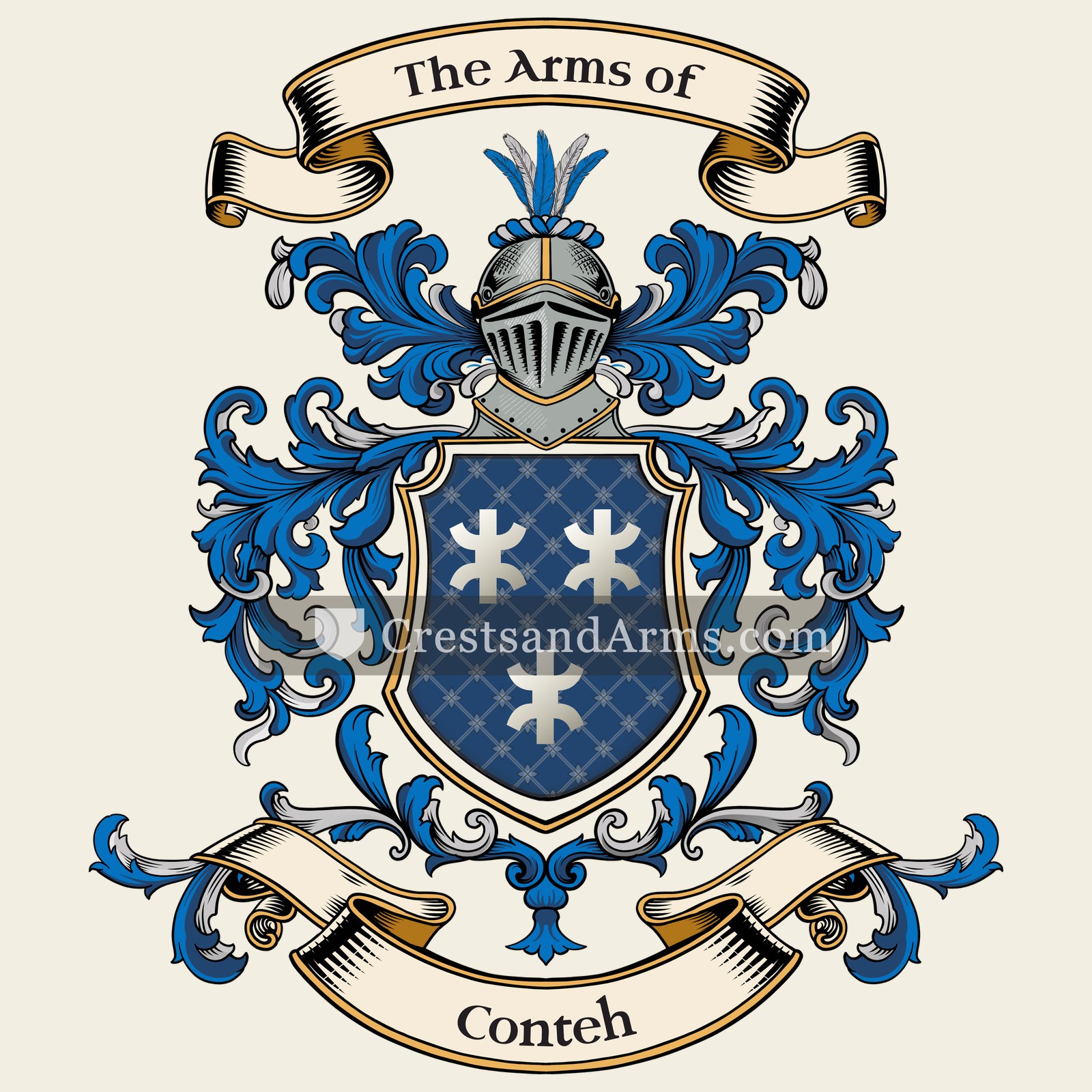


 eagleNobility, strength and a keen mind
 lionCourage, strength and royalty