Map of Italy showing where the Contri arms are recorded
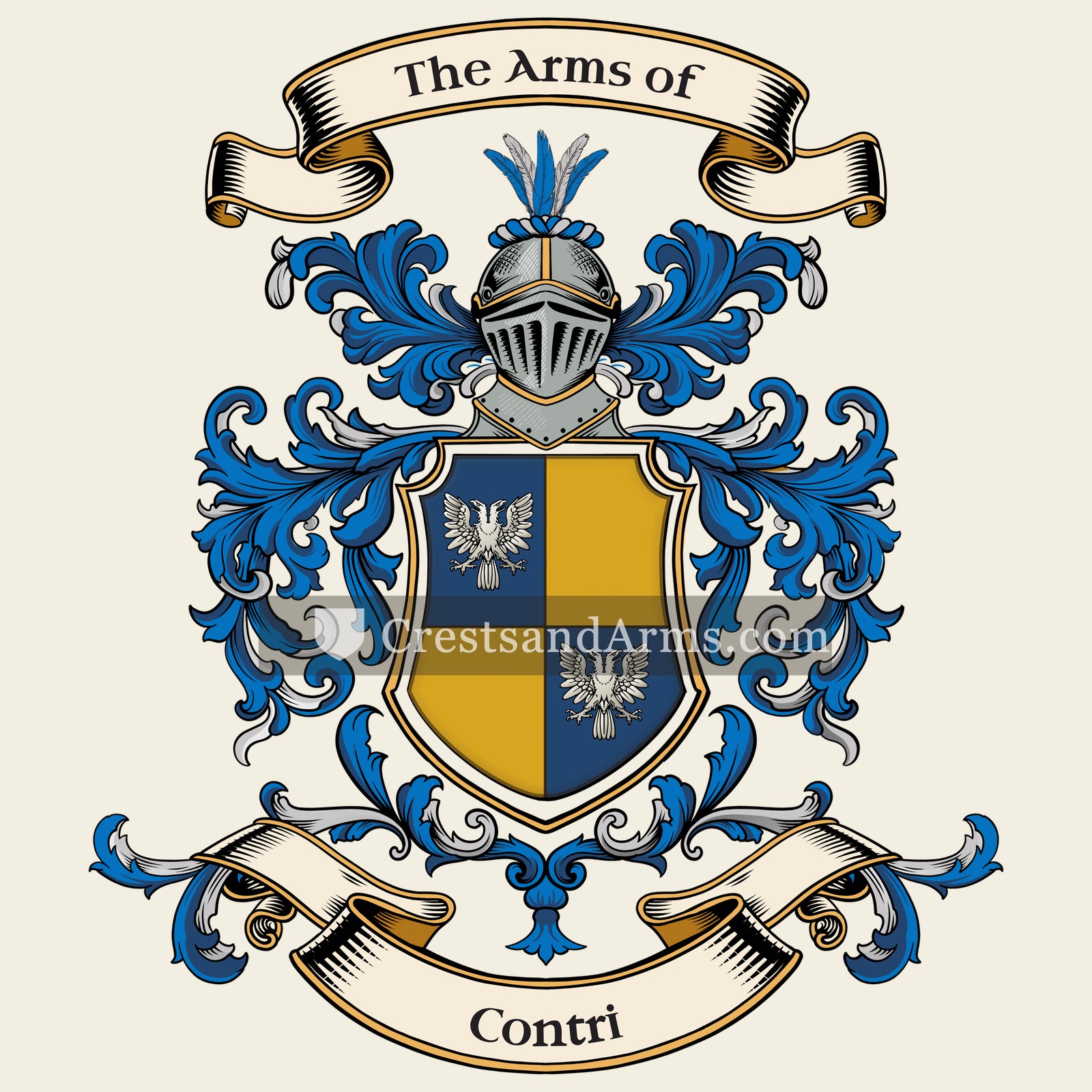
The Contri arms were recorded in Ferrare, c. 1775.
This is where the arms were entered in the register. Families often moved to other parts of the country, so the same name can turn up in more than one region.
The body that granted and recorded arms in Italy in this period.
Alvise Giovanni Mocenigo
Sovereign of the period
Alvise Giovanni Mocenigo
1763–1778
Reigning in Italy when the Contri arms are first recorded.
How Arms Worked in Italy
In the Italian states, coats of arms were often used by noble families to show their status and history. These symbols were passed down through the generations to all legitimate male descendants. Younger branches of a family usually kept the original design but sometimes added small changes to distinguish their specific line from the main branch.
Granting authority
Various local rulers and city governments controlled the use of coats of arms across the different Italian states.
How they got arms
Families often assumed their own arms or received them as official grants from local lords, popes, or city councils.
Where arms were recorded
Arms were recorded in local city archives or private family books rather than in one single national register.
The family's standing
Recorded among the armigerous families of Italy.
Origin & History of the Contri Family in Italy
The family name Contri has deep roots in the northern Italian region of Emilia-Romagna, with historical documentation confirming their presence in the city of Ferrara by 1775. During this period, Ferrara was a significant cultural and administrative center under the influence of the Papal States, and families like the Contris often integrated into the local urban fabric through trade, craftsmanship, or civic service. The name itself is thought to be a variation of the medieval Italian term "contro," which sometimes functioned as a descriptive nickname for individuals who lived opposite a specific landmark or held a position of opposition in local disputes. As the family established themselves in the city, they became part of the long-standing social history of Ferrara, contributing to the local economy and community life that defined the region during the late eighteenth century.
Related Branches & Arms
Root word
Contus
Latin term meaning a pole, pike, or long staff.
This name
ContriDerived from a nickname for a tall, thin person or a soldier carrying a pike.
Documented Sources
J. B. Rietstap, Armorial Général, Gouda: G. B. van Goor Zonen, 1884–87
Archivio di Stato di Ferrara, Stato delle anime della parrocchia di San Gregorio
Frizzi, Antonio, Memorie per la storia di Ferrara, 1791
Gamberini, Andrea, The Italian City-State: From Commune to Signoria, 2012
Digital archive packCoat of arms PNG, gold border print PDF, vector SVG and the certificate of authenticity. Sent to your email in minutes.


 eagleNobility, strength and a keen mind
 eagleNobility, strength and a keen mind